Want more images or videos?
Request additional images or videos from the seller
1 of 5

Unknown
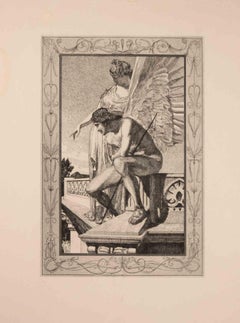
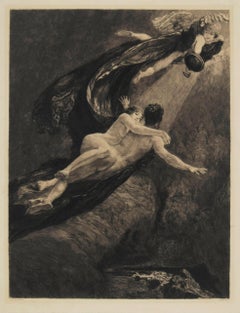
Der Zeichner - Etching by Unknown Artist of circle of Max Klinger

1900 ca.

$800.10
£592.43
€680VAT Included
CA$1,114.42
A$1,133.78
CHF 649.77
MX$13,651.38
NOK 7,594.58
SEK 7,627.91
DKK 5,185.28

About the Item

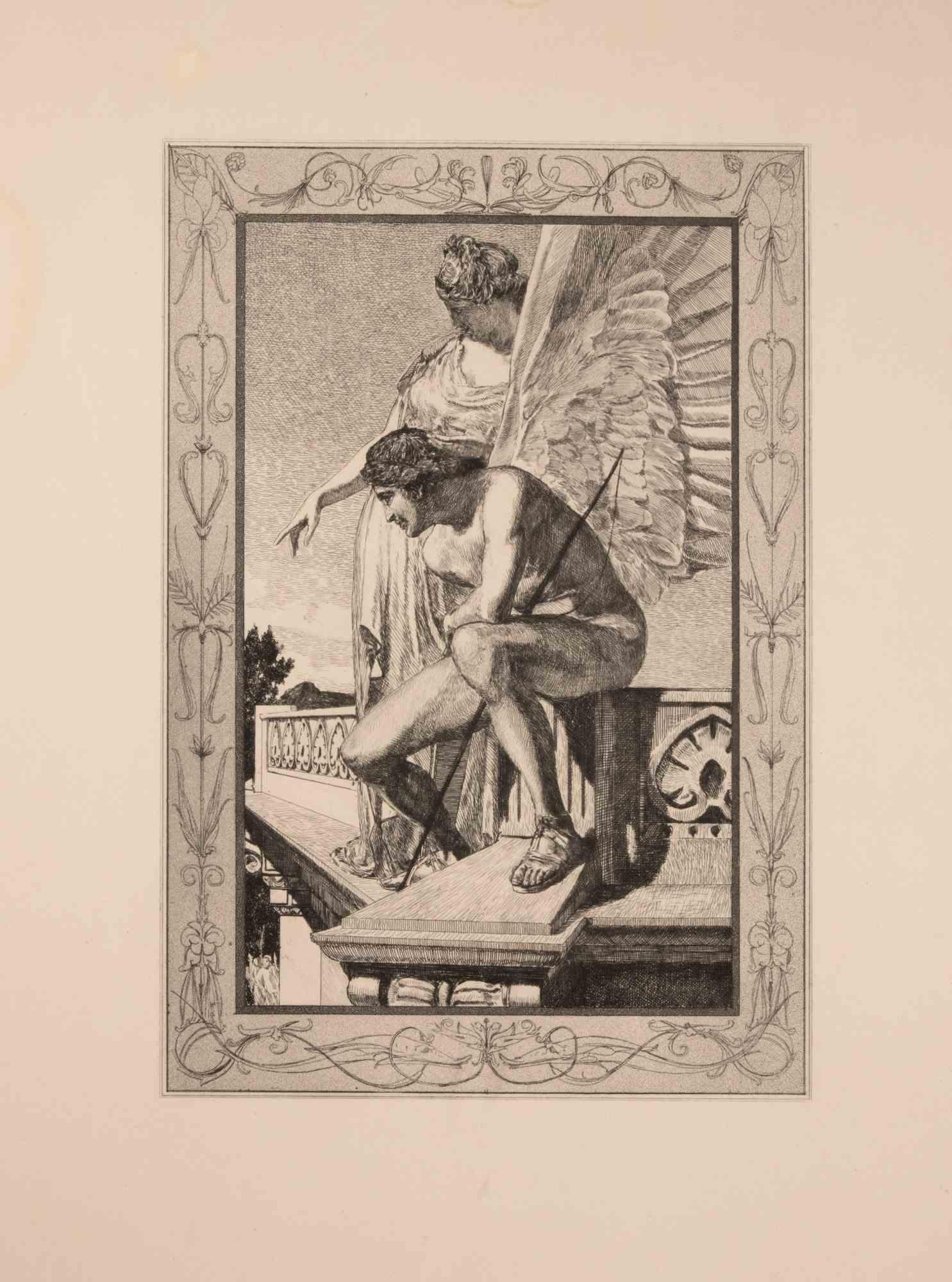
Der Zeichner is a superb etching made around 1900 by a still unknown author, but surely from the circle of Max Klinger (Leipzig, 1857 - Grossjena, 1920). Title on plate in the lower margin in the center. Posthumous impression of a matrix by an unknown author. The style refers to the Griffelkunst and the prescriptions of the Max Klinger "school of stylus"and of the artists who were close to him. In particular, for the subject in question, in the circle of Max Klinger, Saschia Schneider stands out, who placed male nudity at the center of his production and his formal research. The title, Der Zeichner, recalls that of the Klinger's treaty "Malerei und Zeichnung" and the meanings attached to it, that is, it combines in the figuration and in the poetics the liberating dictates and instances of the so-called reform of life and the neo-Greek cult of the body, also the homoerotic sense, carried out by Saschia Schneider himself and by German magazines such as "Die Schonheit" and "Der Eigene". Very interesting work, made with an infinite variety of strokes and a wide range of tones from black to white, in excellent condition and in good general preservation, except for minimal marginal tears and some marginal folds. Sascha Schneider, stage name of Rudolph Karl Alexander Schneider (St. Petersburg, 1870 - Swinemünde, 1927). The German painter and sculptor enters the world of art when, in 1903 he meets the famous writer Karl May and soon became the illustrator of the covers of his books Winnetou, Old Surehand, Am Rio de la Plata. A year later, in 1904, Schneider was appointed professor at the Großherzoglich-Sächsische Kunstschule Weimar in Weimar. During this period he lived a not happy cohabitation with the painter Hellmuth Jahn, who woul make public the Schneider's homosexuality (at the time punishable under article 175 of the penal code). So he decided to move to Italy, where homosexuality was not considered a crime. Here Schneider met the painter Robert Spies with whom he began a journey in the mountains of the Caucasus chain. He eventually returned to Germany where he stayed for about six months in Leipzig before returning to Italy, settling in Florence. After 1918 he founded the Kraft-Kunst institute for body building, an environment that provided him with many models for his works.
  • Creation Year:
    1900 ca.
  • Dimensions:
    Height: 30.32 in (77 cm)Width: 21.26 in (54 cm)Depth: 0.04 in (1 mm)
  • Medium:
  • Movement & Style:
  • Period:
  • Condition:
    Insurance may be requested by customers as additional service, contact us for more information.
  • Gallery Location:
    Roma, IT
  • Reference Number:
    Seller: M-1016401stDibs: LU65034469852

More From This Seller

View All
Menzel Fest-Blatt - Original Etching by Max Klinger - 1884

Menzel Fest-Blatt - Original Etching by Max Klinger - 1884

By Max Klinger

Located in Roma, IT

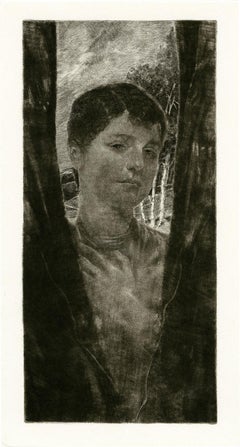
Menzel Fest-Blatt is a fine black and white etching on Japon paper, realized in 1884 by the artist Max Klinger (Leipzig, 1857- Grossjena 1920), and published in the "Max Klinger-Album" in 1925. Signed on plate on lower left corner. In excellent conditions: as good as new Reference: Singer, n. 268 Max Klinger Album Composed of 30 etchings realized by the German master and selected by Johannes Hartmann and Felix Becker, this wonderful portfolio was edited by Siegfried Wagner for the Museumsverein Naumburg . Exactly five years after Max Klinger's death, in 1925, Johannes Hartmann and Felix Becker put together an album containing the artist's 30 most beautiful etchings. Both Hartmann, who managed Klinger's vineyard where the artist was buried, and the art historian that wrote the text accompanying the graphic...

Category

1890s Symbolist Figurative Prints

Materials

Paper, Engraving

Opus IV, Simplicius in der Waldeinode - Etching by Max Klinger - 1881

Opus IV, Simplicius in der Waldeinode - Etching by Max Klinger - 1881

By Max Klinger

Located in Roma, IT

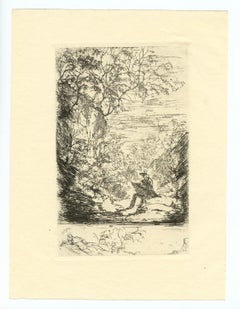
Opus IV, Simplicius in der Waldeinode (Simplicius in the Wilderness) belongs to a series of prints called Intermezzi realized by Max Klinger, published by Nurnberg: Stroefer, 1881. ...

Category

1880s Symbolist Figurative Prints

Materials

Etching

Kämpfende Kentauren - Etching by Max Klinger - 1881

Kämpfende Kentauren - Etching by Max Klinger - 1881

By Max Klinger

Located in Roma, IT

Kämpfende Kentauren (Fighting Centaurs), is an etching and aquatint realized by  Max Klinger in 1881. Plate V from “Intermezzi” Opus IV, 2nd state on 2,  first edition. Here the art...

Category

1880s Symbolist Figurative Prints

Materials

Etching

Opus IV, Simplicius in der Waldeinode - Etching by Max Klinger - 1881

Opus IV, Simplicius in der Waldeinode - Etching by Max Klinger - 1881

By Max Klinger

Located in Roma, IT

Opus IV, Simplicius in der Waldeinode (Simplicius in the Wilderness) belongs to a series of prints called Intermezzi realized by Max Klinger, published by Nurnberg: Stroefer, 1881. ...

Category

1880s Symbolist Figurative Prints

Materials

Etching

Venus zeigt Amor Psyche - Etching by Max Klinger - 1880

Venus zeigt Amor Psyche - Etching by Max Klinger - 1880

By Max Klinger

Located in Roma, IT

Etching and aquatint realized in 1880, belonging to the Series "Amor und Psyche", Opus V. Ref. Singer 67, IV. Excellent condition.

Category

1880s Symbolist Figurative Prints

Materials

Etching

Opus IV Unter den Soldaten Rad - Etching by Max Klinger - 1881

Opus IV Unter den Soldaten Rad - Etching by Max Klinger - 1881

By Max Klinger

Located in Roma, IT

Opus IV Unter den Soldaten Rad belongs to a series of prints called Intermezzi realized by Max Klinger, published by Nurnberg: Stroefer, 1881. Etching on paper. Signed in the plate...

Category

1880s Symbolist Figurative Prints

Materials

Etching

You May Also Like

Neue Träume von Glück (New Dreams of Happiness)

Neue Träume von Glück (New Dreams of Happiness)

By Max Klinger

Located in Fairlawn, OH

Neue Träume von Glück (New Dreams of Happiness) Etching on heavy laid paper without watermark, 1887 Unsigned, as usual From: Eine Liebe (Opus X) [A Love (Opus X)], Plate No. 7 fourth...

Category

1880s Expressionist Nude Prints

Materials

Etching

'Erinnerung (Remembrance)' — Turn-of-the Century Romanticism

'Erinnerung (Remembrance)' — Turn-of-the Century Romanticism

By Max Klinger

Located in Myrtle Beach, SC

Max Klinger, 'Erinnerung' (Remembrance), original etching with aquatint, 1896. A fine, richly inked impression on off-white, wove paper, with full margins (1 3/4 to 3 1/8 inches), in...

Category

1890s Post-Impressionist Figurative Prints

Materials

Etching, Aquatint

"Der Maler in der Landschaft" original etching

"Der Maler in der Landschaft" original etching

Located in Henderson, NV

Medium: original etching. Printed in 1919 and published in Berlin by Paul Cassirer. Plate size: 6 1/2 x 4 1/4 inches (168 x 113 mm). Sheet size: 9 x 6 3/4 inches (230 x 173 mm). Not ...

Category

1910s Realist Prints and Multiples

Materials

Etching

Max Klinger etching, Nature, Female, Artemis of Ephesus, German Romantic

Max Klinger etching, Nature, Female, Artemis of Ephesus, German Romantic

By Max Klinger

Located in Fairlawn, OH

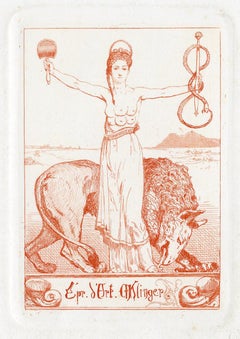
Nature with the Griffin (Edition Device “Épr. d’Art M. Klinger”) Etching, printed in reddish-orange ink, 1879-1880 Signed in the plate in the tablet inscription at bottom (see photo)...

Category

1870s Romantic Nude Prints

Materials

Etching

The Witness, Charcoal Lithograph Drawing by Adolf Uzarski, Tutinama Series, 1919

The Witness, Charcoal Lithograph Drawing by Adolf Uzarski, Tutinama Series, 1919

By Adolf Uzarski 1

Located in Atlanta, GA

A striking and atmospheric charcoal lithograph on paper by Adolf Uzarski (1885–1970), this work belongs to the artist's rare series of six illustrations inspired by the Tutinama—the ...

Category

1910s Art Deco Figurative Drawings and Watercolors

Materials

Charcoal