Want more images or videos?
Request additional images or videos from the seller
1 of 4

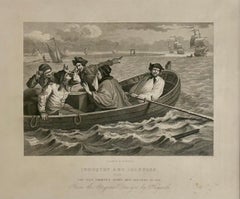
Industry and Idleness Plate 1: The Fellow 'Prentices at their Looms

1830

$187.99
$234.5920% Off
£136
£17020% Off
€162.29
€202.7820% Off
CA$260.66
CA$325.5320% Off
A$264.75
A$331.3920% Off
CHF 152.57
CHF 190.8420% Off
MX$3,196.48
MX$3,993.5920% Off
NOK 1,772.23
NOK 2,215.1720% Off
SEK 1,787.02
SEK 2,234.9720% Off
DKK 1,213.20
DKK 1,515.6120% Off

About the Item

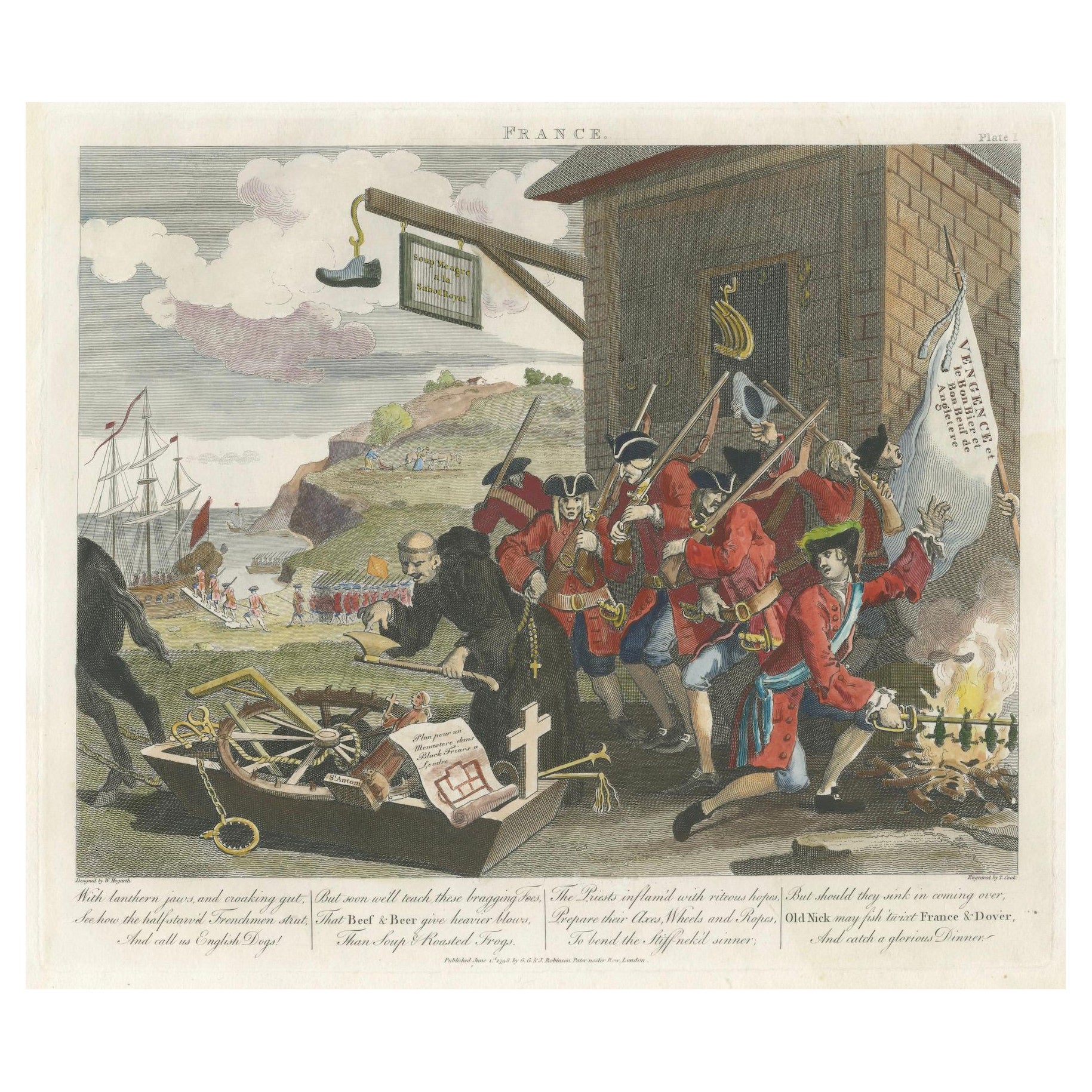
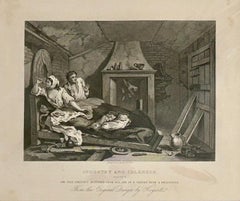
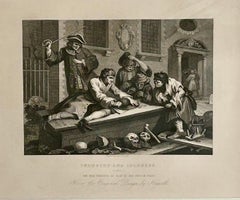
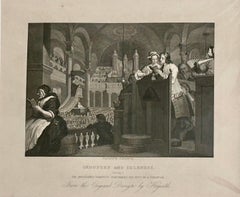
William Hogarth was an English painter and engraver, the outstanding British artist of his period. During his childhood, his father, a schoolteacher, was imprisoned for debt, and this early experience of the seamy side of life left a deep mark on Hogarth (much of his output is concerned with the contrast between success and failure, and he depicted prisons in several works). He trained as an engraver of silver plate and by 1720 had set up his own business in London, doing various kinds of commercial work. In his spare time he studied painting, first at the St Martin's Lane Academy and later under Sir James Thornhill, whose daughter he married in 1729. By the early 1730s he had achieved some success as a painter of conversation pieces and at about the same time he invented the idea of using a sequence of anecdotal pictures ‘similar to representations on the stage’ to point a moral and satirize social abuses. A set of 12 original engravings illustrating Industry and Idleness, after the drawings by William Hogarth, printed in 1833. The engravers are F Jordan, E Smith, C Armstrong, S Davenport, H Adlard, W H Worthington, H Fernell, A Duncan and F F Walker. The engravings, which are in excellent condition, would be mounted (matted) and ready to frame Edward Smith (fl. 1823-49) The landscape, figure, and portrait engraver Edward Smith may have been a native of Edinburgh but appears to have worked mostly in London. His earliest recorded plates are for Effigies Poeticae in 1823. He went on to contribute to Hogarth Moralized (1831), Hogarth's Works (1833) Read moreText source: The Oxford Dictionary of Art and Artists (Oxford University Press) Engraved from the original by Wm Hogarth Minor Foxing
  • Creation Year:
    1830
  • Dimensions:
    Height: 6.7 in (17 cm)Width: 8.08 in (20.5 cm)
  • Medium:
  • After:
    William Hogarth (1697 - 1764, British)
  • Period:
  • Condition:
  • Gallery Location:
    Bournemouth, GB
  • Reference Number:
    1stDibs: LU1589214969462

More From This Seller

View All
Industry and Idleness Plate 7: The Idle 'Prentice Returned From Sea

Industry and Idleness Plate 7: The Idle 'Prentice Returned From Sea

By William Hogarth

Located in Bournemouth, Dorset

William Hogarth was an English painter and engraver, the outstanding British artist of his period. During his childhood, his father, a schoolteacher, was imprisoned for debt, and th...

Category

1830s Figurative Prints

Materials

Engraving

Industry and Idleness Plate 3: The Idle 'Prentice at Play In The Church Yard

Industry and Idleness Plate 3: The Idle 'Prentice at Play In The Church Yard

By William Hogarth

Located in Bournemouth, Dorset

William Hogarth was an English painter and engraver, the outstanding British artist of his period. During his childhood, his father, a schoolteacher, was imprisoned for debt, and this early experience of the seamy side of life left a deep mark on Hogarth (much of his output is concerned with the contrast between success and failure, and he depicted prisons in several works). He trained as an engraver of silver plate and by 1720 had set up his own business in London, doing various kinds of commercial work. In his spare time he studied painting, first at the St Martin's Lane Academy and later under Sir James Thornhill, whose daughter he married in 1729. By the early 1730s he had achieved some success as a painter of conversation pieces and at about the same time he invented the idea of using a sequence of anecdotal pictures ‘similar to representations on the stage’ to point a moral and satirize social abuses. A set of 12 original engravings illustrating Industry and Idleness, after the drawings by William Hogarth, printed in 1833. The engravers are F Jordan, E Smith, C Armstrong, S Davenport, H Adlard, W H Worthington, H Fernell, A Duncan and F F Walker. The engravings, which are in excellent condition, would be mounted (matted) and ready to frame Edward Smith (fl. 1823-49) The landscape, figure, and portrait engraver Edward Smith may have been a native of Edinburgh but appears to have worked mostly in London. His earliest recorded plates...

Category

1830s Figurative Prints

Materials

Engraving

Industry and Idleness Plate 2: The Industrious 'Prentice Performing: Duty

Industry and Idleness Plate 2: The Industrious 'Prentice Performing: Duty

By William Hogarth

Located in Bournemouth, Dorset

William Hogarth was an English painter and engraver, the outstanding British artist of his period. During his childhood, his father, a schoolteacher, was imprisoned for debt, and this early experience of the seamy side of life left a deep mark on Hogarth (much of his output is concerned with the contrast between success and failure, and he depicted prisons in several works). He trained as an engraver of silver plate and by 1720 had set up his own business in London, doing various kinds of commercial work. In his spare time he studied painting, first at the St Martin's Lane Academy and later under Sir James Thornhill, whose daughter he married in 1729. By the early 1730s he had achieved some success as a painter of conversation pieces and at about the same time he invented the idea of using a sequence of anecdotal pictures ‘similar to representations on the stage’ to point a moral and satirize social abuses. A set of 12 original engravings illustrating Industry and Idleness, after the drawings by William Hogarth, printed in 1833. The engravers are F Jordan, E Smith, C Armstrong, S Davenport, H Adlard, W H Worthington, H Fernell, A Duncan and F F Walker. The engravings, which are in excellent condition, would be mounted (matted) and ready to frame Edward Smith (fl. 1823-49) The landscape, figure, and portrait engraver Edward Smith may have been a native of Edinburgh but appears to have worked mostly in London. His earliest recorded plates...

Category

1830s Figurative Prints
Materials

Engraving

Industry and Idleness Plate 5: The Idle 'Prentice Turn'd Away & Sent to Sea

Industry and Idleness Plate 5: The Idle 'Prentice Turn'd Away & Sent to Sea

By William Hogarth

Located in Bournemouth, Dorset

William Hogarth was an English painter and engraver, the outstanding British artist of his period. During his childhood, his father, a schoolteacher, was imprisoned for debt, and this early experience of the seamy side of life left a deep mark on Hogarth (much of his output is concerned with the contrast between success and failure, and he depicted prisons in several works). He trained as an engraver of silver plate and by 1720 had set up his own business in London, doing various kinds of commercial work. In his spare time he studied painting, first at the St Martin's Lane Academy and later under Sir James Thornhill, whose daughter he married in 1729. By the early 1730s he had achieved some success as a painter of conversation pieces and at about the same time he invented the idea of using a sequence of anecdotal pictures ‘similar to representations on the stage’ to point a moral and satirize social abuses. From a set of 12 original engravings illustrating Industry and Idleness, after the drawings by William Hogarth, printed in 1833. The engravers are F Jordan, E Smith, C Armstrong, S Davenport, H Adlard, W H Worthington, H Fernell, A Duncan and F F Walker. The engravings, which are in excellent condition, would be mounted and ready to frame Edward Smith (fl. 1823-49) The landscape, figure, and portrait engraver Edward Smith may have been a native of Edinburgh but appears to have worked mostly in London. His earliest recorded plates...

Category

1830s Figurative Prints
Materials

Engraving

Whoever Makes A Design Without the knowledge of Perspective

Whoever Makes A Design Without the knowledge of Perspective

By William Hogarth

Located in Bournemouth, Dorset

William Hogarth was an English painter and engraver, the outstanding British artist of his period. During his childhood, his father, a schoolteacher, was imprisoned for debt, and th...

Category

1830s Figurative Prints
Materials

Engraving

The Weighing House Engraving, Figurative Print, Circa 1830, Unframed

The Weighing House Engraving, Figurative Print, Circa 1830, Unframed

By William Hogarth

Located in Bournemouth, Dorset

William Hogarth was an English painter and engraver, the outstanding British artist of his period. During his childhood, his father, a schoolteacher, was imprisoned for debt, and th...

Category

1830s Figurative Prints
Materials

Engraving

You May Also Like

Antique Print of Men Grinding and Polishing Plate Glass by Hinton, 1748

Antique Print of Men Grinding and Polishing Plate Glass by Hinton, 1748

Located in Langweer, NL

Antique print titled 'The Art of Grinding and Polishing of Plate Glass'. View of a workshop with several men at work around large tables. This print originates from 'The Universal Ma...

Category

Antique Mid-18th Century Prints

Materials

Paper

Antique Print of Men Working at a Diamond-Cutting Machine in London, '1750'

Antique Print of Men Working at a Diamond-Cutting Machine in London, '1750'

Located in Langweer, NL

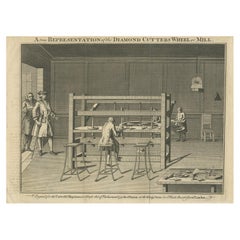
Antique print titled 'A true Representation of the Diamond Cutters Wheel or Mill'. View of a man working at a large diamond-cutting machine with two men working at wheels behind hi...

Category

Antique Mid-18th Century English Prints

Materials

Paper

Antique Print of Gold and Silver Refiners at Work by Hinton, 1747

Antique Print of Gold and Silver Refiners at Work by Hinton, 1747

Located in Langweer, NL

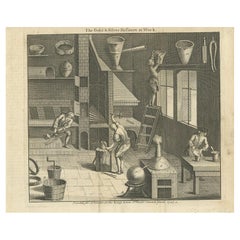
Antique print titled 'The Gold & Silver Refiners at Work'. View of a workshop with three men at work, the one to left pouring liquid into a mould, the one at centre hammering a metal tool, the one to right pouring a substance into pots. This print originates from 'The Universal Magazine' published by J...

Category

Antique Mid-18th Century Prints

Materials

Paper

BATHOS / Tail PIece

BATHOS / Tail PIece

By William Hogarth

Located in Santa Monica, CA

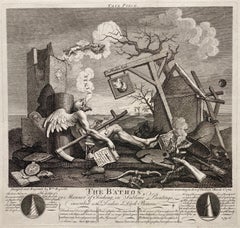
WILLIAM HOGRATH (1767- 1764) THE BATHOS / Tail Piece 1764 (Paulson 1989: 216 I/I Paulson 1965/70: 216 I/I) Engraving Plate 12 7/8 x 13 3/8, sheet 17 ¾ x 18 ¾ Designed & Engrav’d by Wm Hogarth at left and Published according to Act of Parliam’t March 3, 1764 at right. Good condition on thick laid paper Small bit of tape on the left & right sheet edges small stan lower sheet edge all on recto. This Hogarth’s last print is fascinating as it is prophacy about death. Various institutions have interesting commentaries - to wit: Chicago Art Institute: Hogarth created The Bathos toward the end of his life. It is considered one of the bleakest artworks of the 18th century because it depicts the Apocalypse without an afterlife. The Angel of Death even collapses in exhaustion after having destroyed the world. In his hand is an execution decree and around him lies a mass of broken objects. Princeton: Hogarth’s last print, The Bathos,….. is filled with all manner of images denoting the end of life as we know it. Entry no. 216 in Ronald Paulson’s catalogue raisonne Hogarth’s Graphic Works, 3rd revised edition says “This print is the culmination of such pessimistic images . . . . [taking] his general composition, the configuration of objects, and some of the particular items, from Dürer’s engraving, Melancholia; but he also recalls Salvator Rosa’s Democritus in Meditation (which derives from Dürer’s print) with a scroll at the bottom of the etching: ‘Democritus the mocker of all things, confounded by the ending of All Things’ (Antal, p.168).” Newfields (Indianapolis Museum of Art): Hogarth intended this engraving to serve as the tailpiece to bound volumes of his collected engravings and, appropriately, it proved to be his last engraving. Father Time has died and his last will and testament has been witnessed by the three Fates. He is surrounded by a landscape of death, decay, and ruin. Hogarth aimed this print at dealers in “dark” Old Masters paintings who promoted the idea that ruins evoked sublime feelings in viewers—a sentiment, Hogarth wrote, that was reducing the world to ruin. British Caricature...

Category

1760s Old Masters Figurative Prints

Materials

Woodcut

Hogarth's 1756 'France' Satirical Print: A Scathing Critique - Published in 1798

Hogarth's 1756 'France' Satirical Print: A Scathing Critique - Published in 1798

Located in Langweer, NL

Hogarth's 1756 "France" Satirical Print: A Scathing Critique Step into the world of 18th-century satire with this rare 1756 William Hogarth print, "France," from his "France and E...

Category

Antique 1790s Prints

Materials

Paper