Want more images or videos?
Request additional images or videos from the seller
1 of 16

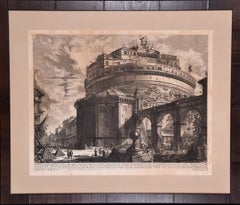
Giovanni Battista Piranesi
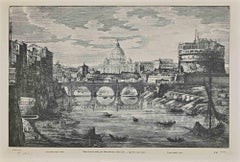
The Ponte and Castel S. Angelo (Veduta del Ponte e Castello Sant' Angelo)

1754

$5,000
£3,765.53
€4,399.74
CA$7,084.17
A$7,115.62
CHF 4,125.83
MX$86,817.94
NOK 47,747.71
SEK 48,991.64
DKK 32,889.87

About the Item

The Ponte and Castel S. Angelo Veduta del Ponte e Castello Sant' Angelo Etching, 1754 Signed in the plate lower right above the caption From: Vedute di Roma A proper Roman printing with the price in the lower right corner. Printed on a Double Circle Fleur de Lys watermark paper, c. 1760, with full margins. A brilliant impression . Note: A view of the Tiber River, Castello Sant' Angelo and St. Peter's Basilica in the distance. Watermark: Double Circle Fleur de Lys References: Robison c/g Hind 29 ii/VII Foclllon 793 Condition: A Roman printing before the numbers added in Paris. Printed on a Double Circle Fleur-de-Lys watermark paper. Right margin folded over 5/8 inches for framing. Usual centerfold as issued in the album. Slight aging to the sheet. Binding holes at the left margin edge Framed with plexi. Plate size: 14 7/8 x 22 7/8 inches Sheet size: 21 5/8 x 30 5/16 inches Frame size: 22 3/4 x 33 1/2 inches Sant’Angelo Bridge, Italian Ponte Sant’Angelo, ancient (Latin) Pons Aelius, ancient Roman bridge, probably the finest surviving in Rome itself, built over the Tiber by the emperor Hadrian (reigned 117–138 AD) to connect the Campus Martius with his mausoleum (later renamed Castel Sant’Angelo). The bridge was completed about AD 135. It consists of seven stone arches and five main spans of about 60 feet (18 m) each, supported on piers 24 feet (7 m) high. In the 13th century Pope Clement IV installed an iron balustrade and in the 16th century Pope Clement VII placed statues of Saints Peter and Paul at the end of the bridge. In 1688, 10 statues of angels, designed by Gian Lorenzo Bernini, were mounted on the parapets. Courtesy Encyclopedia Britannica
  • Creator:
    Giovanni Battista Piranesi (1720-1778, Italian)
  • Creation Year:
    1754
  • Dimensions:
    Height: 14.88 in (37.8 cm)Width: 22.88 in (58.12 cm)
  • Medium:
  • Movement & Style:
  • Period:
    1750-1759
  • Condition:
  • Gallery Location:
    Fairlawn, OH
  • Reference Number:
    Seller: FA96431stDibs: LU14015736942

More From This Seller

View All
View of the Ancient Structure built by Tarquinius Superbus called the Bel Lido

View of the Ancient Structure built by Tarquinius Superbus called the Bel Lido

By Giovanni Battista Piranesi

Located in Fairlawn, OH

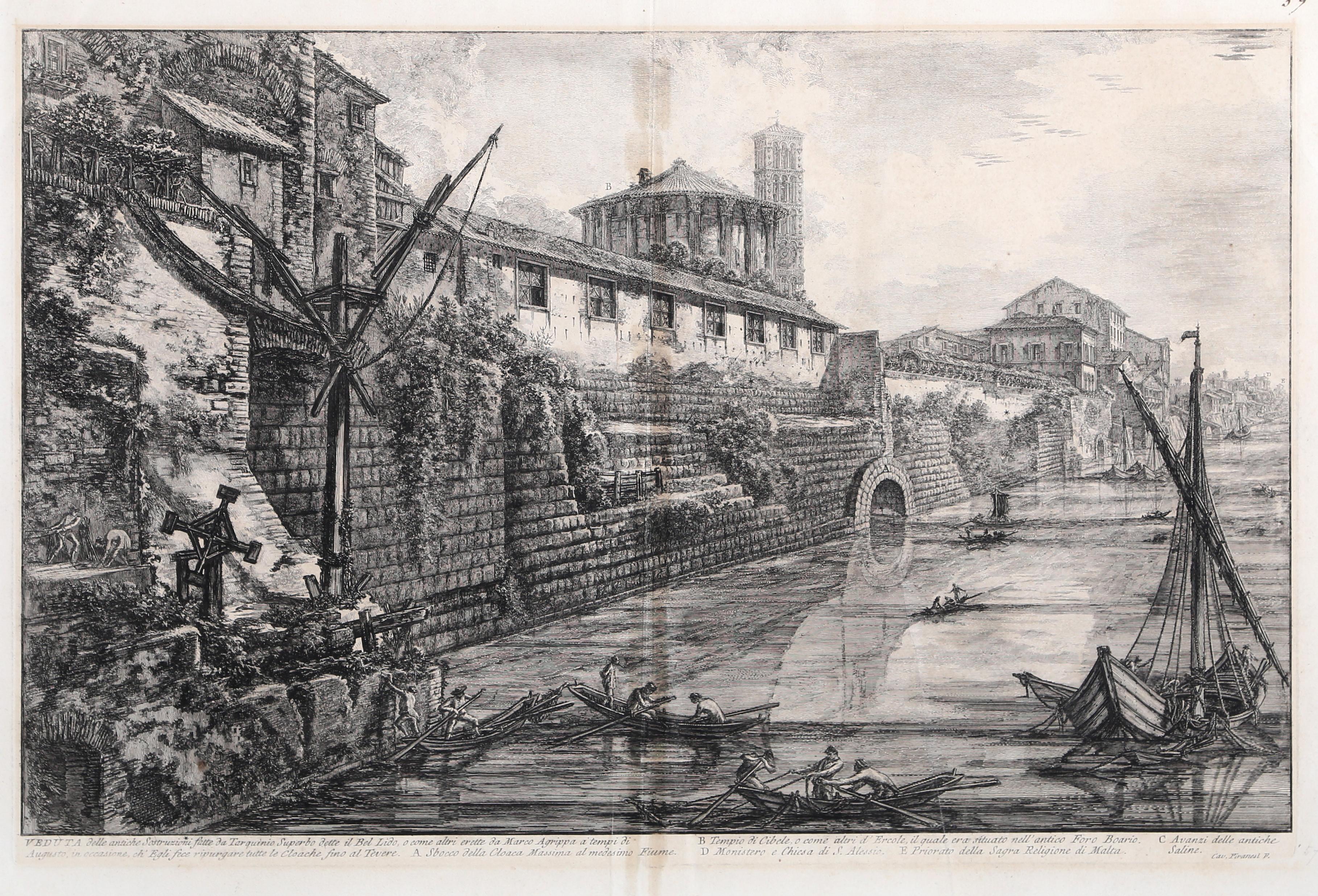
View of the Ancient Structure built by Tarquinius Superbus called the Bel Lido, and like others built by Marcus Agrippa in the time of Augustus when he cleaned all the sewers leading...

Category

1750s Old Masters Landscape Prints

Materials

Etching

Veduta dell'esterno della gran Basilica di S. Pietro in Vaticano

Veduta dell'esterno della gran Basilica di S. Pietro in Vaticano

By Giovanni Battista Piranesi

Located in Fairlawn, OH

Veduta dell'esterno della gran Basilica di S. Pietro in Vaticano (View of the Exterior of St. Peter's Basilica in the Vatican) Etching, 1748 From the first printing of the "Vedute di Roma" An early impression with strong contrasts Before the price and the addition of numbers in the later states. A view of Michelangelo's done from behind the Piazza, redesigned in 1547 Condition: Excellent Plate size: 15 3/4 x 24 3/4 inches Reference: Robison 5 a/g Hind 5 i/VII Focillon 54.789 Designed principally by Donato Bramante, Michelangelo, Carlo Maderno and Gian Lorenzo Bernini, St. Peter's is the most renowned work of Renaissance architecture and the largest church in the world. While it is neither the mother church of the Catholic Church nor the cathedral of the Diocese of Rome (these equivalent titles being held by the Archbasilica of Saint John Lateran in Rome), St. Peter's is regarded as one of the holiest Catholic shrines...

Category

1740s Old Masters Landscape Prints

Materials

Etching

Veduta del Romano Camipidpglio con scalinata che va alla chisea d’Araceli (The C

Veduta del Romano Camipidpglio con scalinata che va alla chisea d’Araceli (The C

By Giovanni Battista Piranesi

Located in Fairlawn, OH

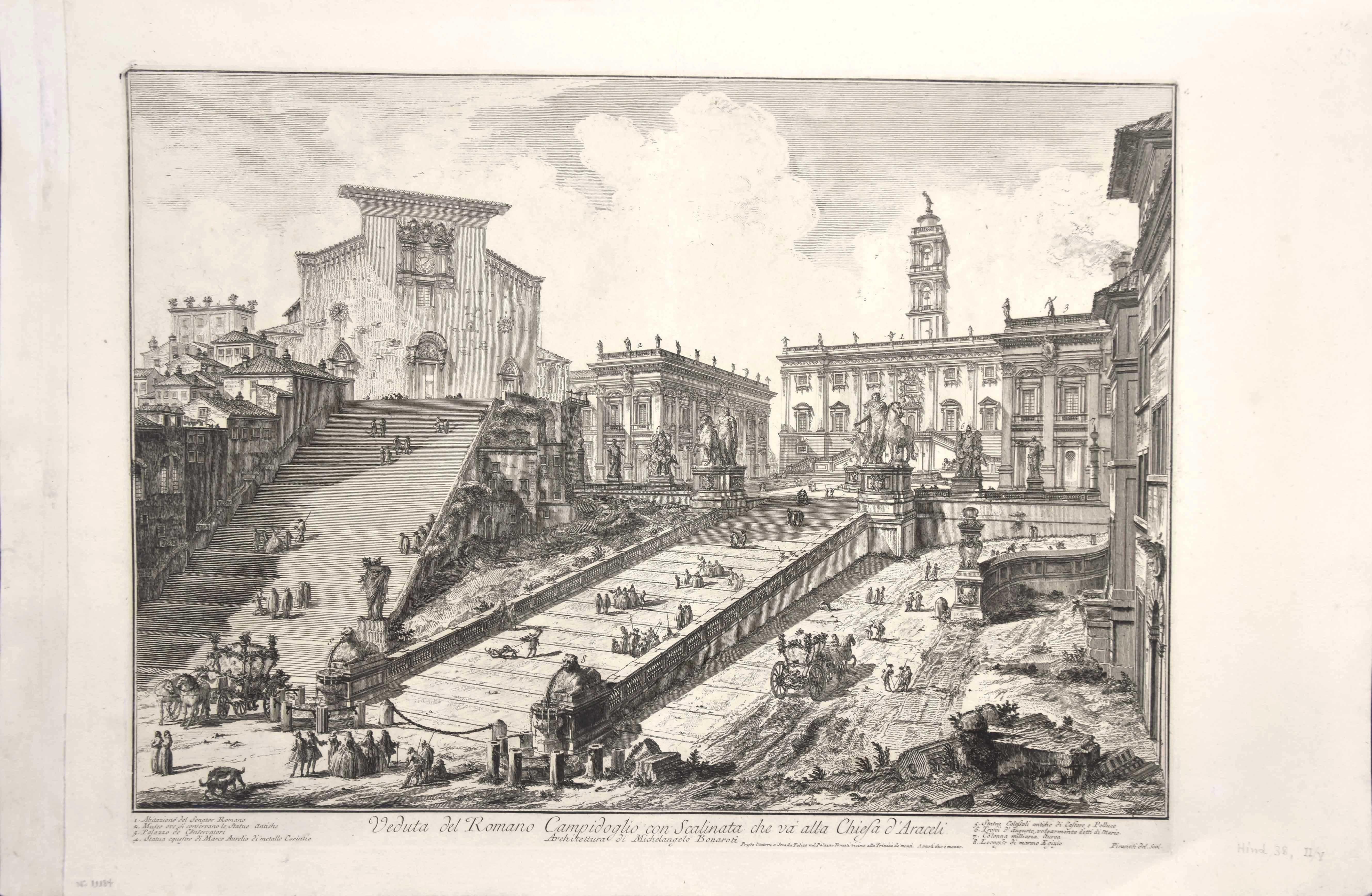
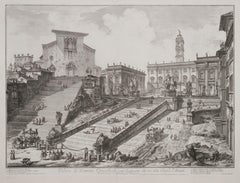
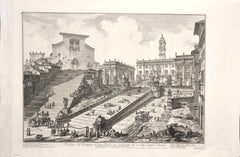
Veduta del Romano Camipidpglio con scalinata che va alla chisea d’Araceli (The Capitol and the Steps of S. Maria in Aracoeli) Etching, 1775 Watermark: Double Circle Fleur de Lys A lifetime impression with the price etching in the plate Printed in Rome, before the plates are moved to Paris and the numerous posthumous editions Reference: Hind 38 ii/IV Robison 38 ii/V with the price Wilton Ely 190 Condition: A fine Roman...

Category

1770s Baroque Landscape Prints

Materials

Etching

The Arch of Constantine and the Colosseum

The Arch of Constantine and the Colosseum

By Giovanni Battista Piranesi

Located in Fairlawn, OH

The Arch of Constantine and the Colosseum Vedute dell' Arco di Costantino, e dell' Anfiteatro Flavio il Colosseo From: "Vedute di Roma" (Roman Views), part II An early Paris edition,...

Category

1760s Old Masters Landscape Prints

Materials

Etching

S. Paolo Fuori Le Mura  (Vedute della Basilica di S. Paolo fuor della mura)

S. Paolo Fuori Le Mura (Vedute della Basilica di S. Paolo fuor della mura)

By Giovanni Battista Piranesi

Located in Fairlawn, OH

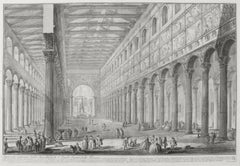
S. Paolo Fuori Le Mura (Vedute della Basilica di S. Paolo fuor della mura) Etching, 1748 From: Vedute di Roma, Plate 8 An early Roman printing, published by Bouchard e Gravier Watermark: Fleur de Lys in a double circle Signed in the plate Condition: Small margins as are common with Bouchard published impressions. Centerfold (as usual) Rich impression with good contrasts Plate/Image size: 15 7/8 x 24 1/8 inches Sheet size: 17 3/8 x 24 3/4 inches Reference: Focillon 723 Wilton-Ely 138 Hind 6 ii/VI, Bouchard e Gravier printing, before the price and numbers in later states This image is Piranesi’s second interior scene from the Vedute di Roma. The first interior is a less complex composition of the Interior of St. Peters which lacks the challenging perspective that the artist masters in this image. The Papal Basilica of St. Paul Outside the Walls...

Category

1740s Old Masters Interior Prints

Materials

Etching

Ruine di Sepolcro antico

Ruine di Sepolcro antico

By Giovanni Battista Piranesi

Located in Fairlawn, OH

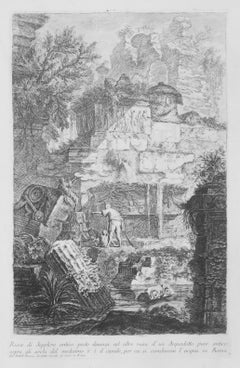
Ruine di Sepolcro antico Etching, 1743 Signed in the plate bottomleft in the caaption plate From: Prima Parte, 1743 Second edition: 1750-1778 Watermark: R 37-39 A lifetime impression printed during Piranesi’s life, before the plates are moved to Paris by his sons in the 1790’s Coniditon: Excellent/Very good Image size: 14 5/8 x 9 3/4 inches Reference: Robison 17 iii/V Piranesi In Rome: Prima Parte di Architetture e Prospettive "Although Piranesi studied architecture in Venice, he never was able to find work in the field other than a few jobs involving remodeling in Rome. While Piranesi was struggling to support his architectural endeavors upon his arrival in Rome in 1740, he spent a short period of time in the studio of master painter Giovanni Battista Tiepolo (1696-1770) in addition to his apprenticeship with Giuseppe Vasi. The first production of Piranesi’s early years in Rome and a culmination of his training under Vasi, Tiepolo, and his uncle, was the Prima Parte di Architetture e Prospettive (1743). The Prima Parte was a collection of twelve etchings of imaginary temples, palaces, ruins, and a prison. During this time, Piranesi was still developing the unique style of etching he is known for today, and as such the Prima Parte differs significantly in technique compared to later works. In the Frontispiece of the Prima Parte, Piranesi’s lines are definite and exact with very little flow to them, designed in the form of traditional etching. The detail is immaculate, and yet perspective of the piece is oddly simple and familiar to the viewer. Piranesi’s technique employs miniscule markings and lines, intricately woven together to create a stippling effect. The Prima Parte, described as “rigid” by art historian Jonathan Scott, came to be seen as a stark contrast to his later sketches, which were much lighter and freer. Influenced by the style of Tiepolo, which epitomized the lightness and brightness of the Rococo period, Piranesi adopted some of the more painterly techniques of the masters he apprenticed under. Piranesi made the medium of etching appear as though it was a sketch or a painting, hence a “freer” and more fluid design in his later works. For example, the frontispiece of the Prima Parte read as an etching to Piranesi’s audience, but in his later vedute, the style of etching almost appears to be made of brushstrokes. Moreover, at the same time Piranesi was working on the Prima Parte, he aided the artist Giambattista Nolli. There is a small section of Nolli’s map...

Category

1740s Old Masters Interior Prints
Materials

Etching

You May Also Like

Hadrian's Mausoleum, Castel S. Angelo: A Framed 18th Century Etching by Piranesi

Hadrian's Mausoleum, Castel S. Angelo: A Framed 18th Century Etching by Piranesi

By Giovanni Battista Piranesi

Located in Alamo, CA

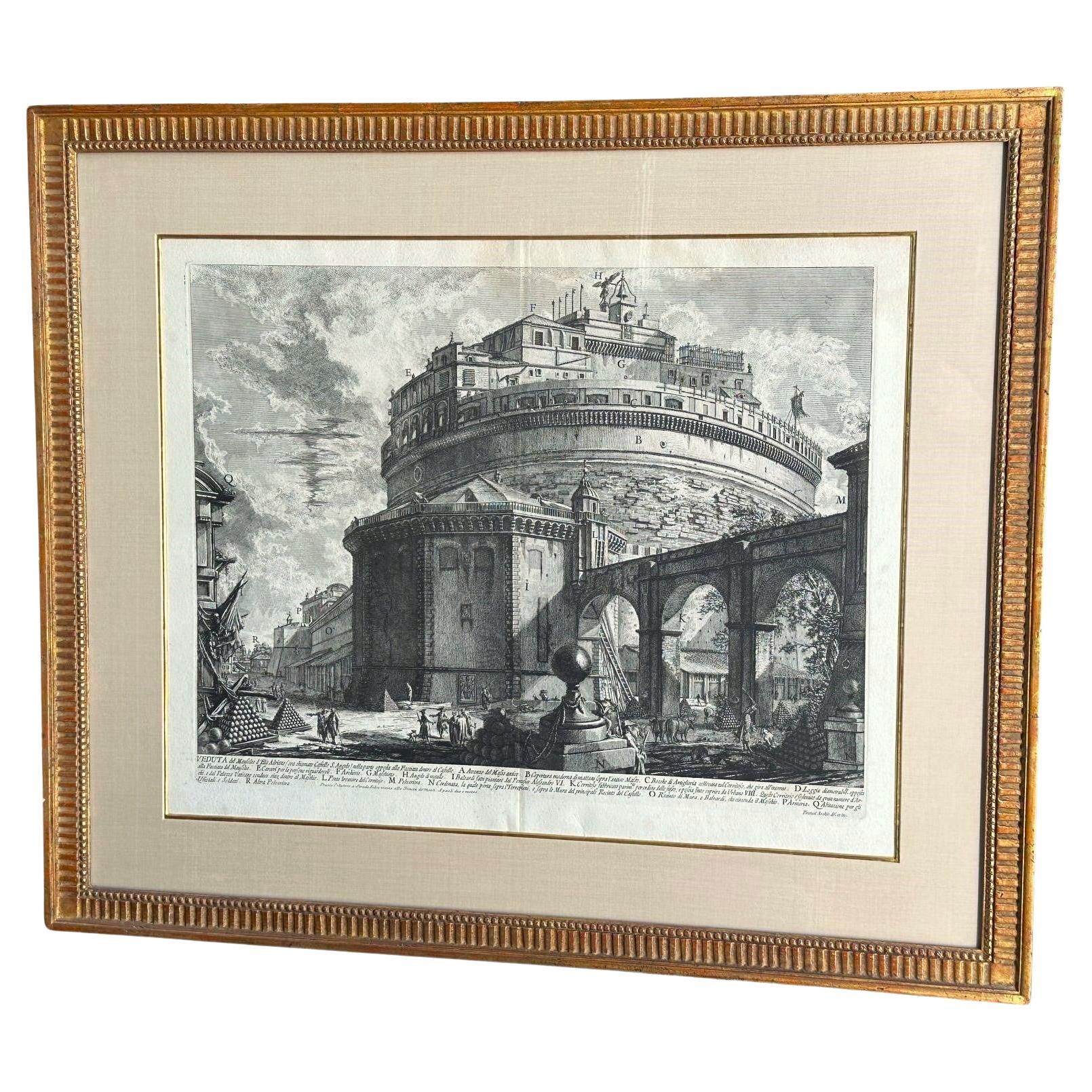
This large framed 18th century etching by Giovanni Battista Piranesi entitled "Veduta del Mausoleo d'Elio Adriana ora chiamato Castello S. Angelo nella parte opposta alla Facciata de...

Category

1750s Old Masters Landscape Prints

Materials

Etching