Want more images or videos?
Request additional images or videos from the seller
1 of 8

James Basire
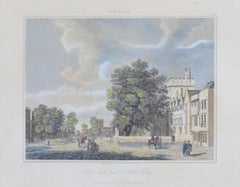
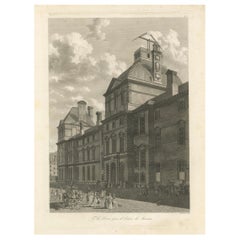
The Sheldonian and Clarendon, Broad Street, Oxford engraving by Basire

1800

$521.61
£375
€447.17
CA$722.92
A$726.27
CHF 418.92
MX$8,838.31
NOK 4,866.31
SEK 4,936.35
DKK 3,342.89

About the Item

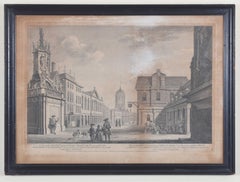
To see our other views of Oxford and Cambridge, scroll down to "More from this Seller" and below it click on "See all from this Seller" - or send us a message if you cannot find the view you want. James Basire II (1769 - 1822) after Edward Dayes (1763 - 1804) A View of the Theatre, Printing House, & c. (1800) Engraving 36 x 49 cm A view of Broad Street, showing the Clarendon Building, Sheldonian Theatre, and what is now the Museum of the History of Science. Edward Dayes' drawing was reproduced as a lithograph in 1800, to be published in the "Oxford Almanack". The Oxford Almanack was an annual almanac published by the Oxford University Press for the University of Oxford from 1674 through 2019 (when printing sadly ceased due to "dwindling interest"). The almanac traditionally included engravings or lithographs of the University and information about the upcoming year. Other almanac artists have included Michael Burghers, J. M. W. Turner, and John Piper. Basire and Dayes collaborated on several views of Oxford during the courses of their careers. Edward Dayes was a British painter and engraver. He exhibited topographical views at the Royal Academy from 1786 until his death, and is the author of an 'Excursion through Derbyshire and Yorkshire,' 'Essays on Painting; Instructions for Drawing and Colouring Landscapes', and 'Professional Sketches of Modem Artists'. James Basire II was a British engraver, son of James Basire I, also a celebrated engraver. In 1802 he became Engraver to the Society of Antiquaries.
  • Creator:
    James Basire (1730 - 1802, British)
  • Creation Year:
    1800
  • Dimensions:
    Height: 14.18 in (36 cm)Width: 19.3 in (49 cm)
  • Medium:
  • Movement & Style:
  • Period:
  • Condition:
    Some browning, as visible in photograph.
  • Gallery Location:
    London, GB
  • Reference Number:
    1stDibs: LU795311468662

More From This Seller

View All
The Sheldonian, Oxford University by Pieter van der Aa after David Loggan

The Sheldonian, Oxford University by Pieter van der Aa after David Loggan

By Pieter Van Der Aa

Located in London, GB

Pieter van der Aa (1659-1733), after David Loggan (1634–1692) The Sheldonian Theatre, University of Oxford Engraving 12 x 16 cm An eighteenth-century view of Oxford's marvellous She...

Category

Early 18th Century Realist Prints and Multiples

Materials

Engraving

Trinity College, Cambridge engraving by David Loggan

Trinity College, Cambridge engraving by David Loggan

By David Loggan

Located in London, GB

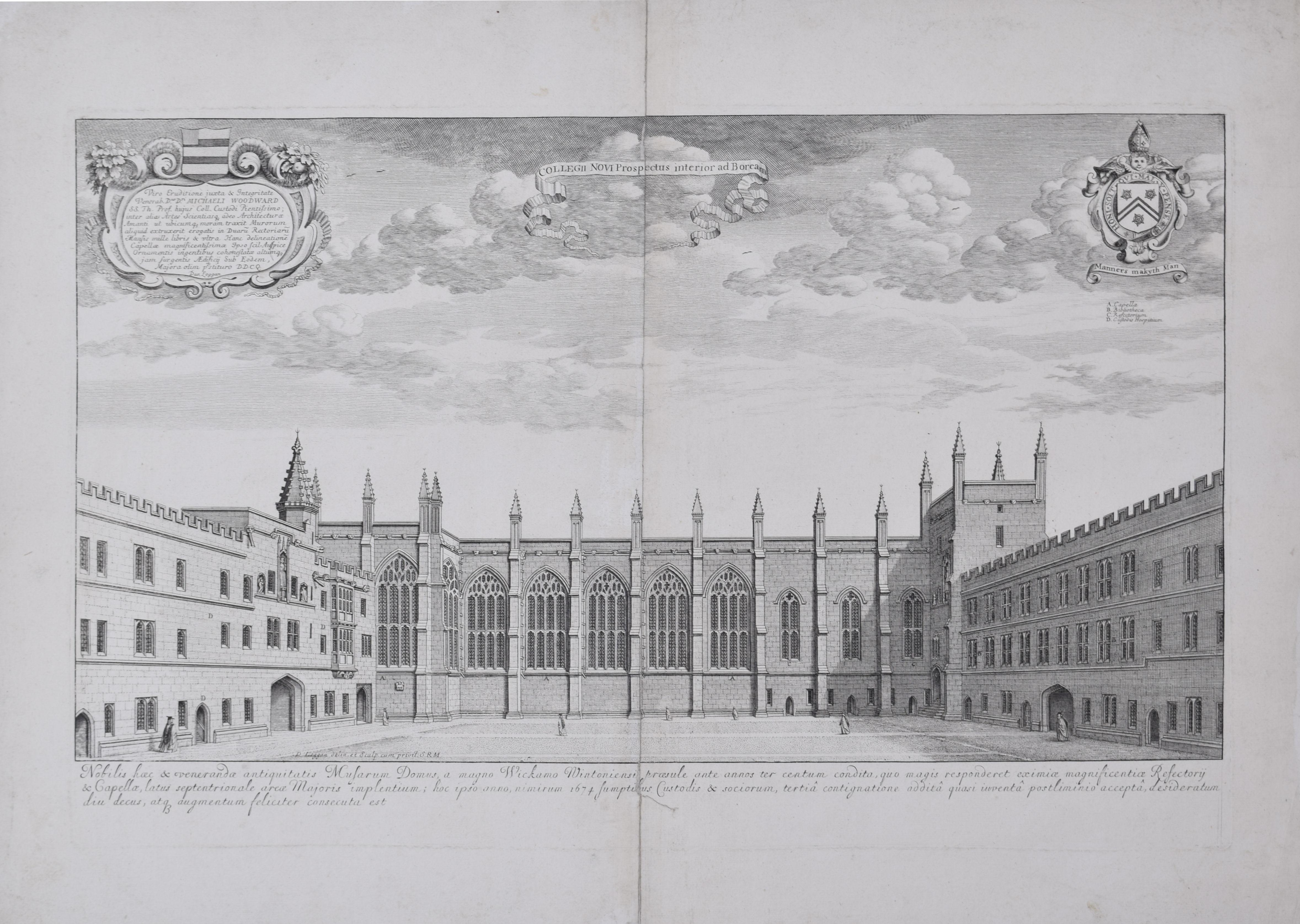
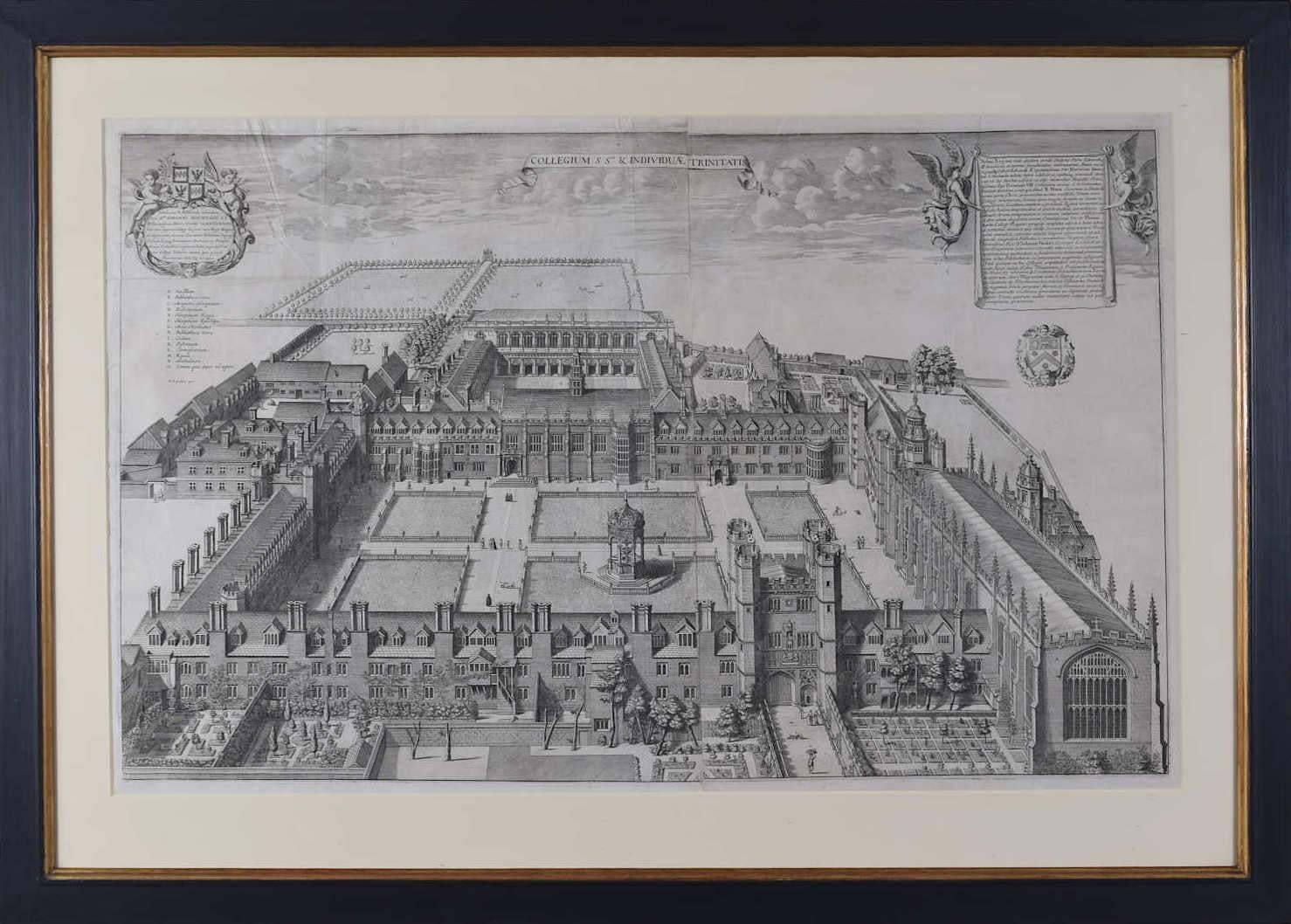
To see our other views of Oxford and Cambridge, scroll down to "More from this Seller" and below it click on "See all from this seller" - or send us a message if you cannot find the view you want. David Loggan (1634 - 1692) Trinity College, Cambridge (1690) Engraving 80 x 50 cm Loggan's marvellous and large view of Trinity from the 'Cantabrigia Illustrata'. Loggan was born to English and Scottish parents, and was baptised in Danzig in 1634. After studying engraving in Danzig with Willem Hondius (1598-1652 or 1658), he moved to London in the late 1650s, going on to produce the engraved title-page for the folio 1662 Book of Common Prayer. He married in 1663 and moved to Nuffield in Oxfordshire in 1665. Loggan was appointed Public Sculptor to the nearby University of Oxford in the late 1660s, having been commissioned to produce bird’s-eye views of all the Oxford colleges. He lived in Holywell Street as he did this. The 'Oxonia Illustrata' was published in 1675, with the help of Robert White (1645-1704). Following its completion, Loggan began work on his equivalent work for Cambridge; the 'Cantabrigia Illustrata' was finally published in 1690, when he was made engraver to Cambridge University. The 'Oxonia Illustrata' also includes an engraving of Winchester College (Winchester and New College share William of Wykeham as their founder) whilst the 'Cantabrigia Illustrata' includes one of Eton College (which shares its founder, Henry VIII, with King’s College). Bird’s-eye views from this era required a particular talent as an architectural perspectivist; it was not until 1783 that it became possible for artists to ascend via hot air balloons and view the scenes they were depicting from above. Loggan thus had to rely on his imagination in conceiving the views. Loggan’s views constitute the first accurate depictions of the two Universities, in many ways unchanged today. Whilst the Oxford engravings were produced in reasonable numbers and ran to a second edition by Henry Overton (on thicker paper and with a plate number in Roman numerals in the bottom right-hand corner), those of Cambridge were printed in much smaller numbers. The Dutchman Pieter van der Aa published some miniature versions of the engravings for James Beverell’s guidebook to the UK, 'Les Delices de la Grande Bretagne' (circa 1708). The contemporary artist Andrew Ingamells...

Category

1690s Realist Landscape Prints
Materials

Engraving

You May Also Like

Thomas Bowles (c.1712-1767) - 1753 Engraving, A View of Somerset House

Thomas Bowles (c.1712-1767) - 1753 Engraving, A View of Somerset House

Located in Corsham, GB

A View of Somerset House, with St. Mary's Church in the Strand, London,' a 1753 engraving with hand colouring by Thomas Bowles (c.1712-1767). Inscribed in English and French below th...

Category

Early 18th Century Landscape Prints

Materials

Engraving

Engraving of the Entrance Facade of the Royal Exchange, Cornhill, London, 1725

Engraving of the Entrance Facade of the Royal Exchange, Cornhill, London, 1725

Located in Langweer, NL

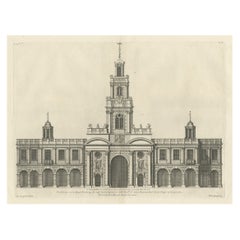
Antique print titled 'The Elevation of the Royal Exchange (..)'. Old engraving of the entrance facade of the Royal Exchange, Cornhill. This print originates from 'Vitruvius Brita...

Category

Antique 1720s Architectural Models

Materials

Paper

Antique Engraving of Kirby Hall Near Gretton, Northamptonshire, England c.1770

Antique Engraving of Kirby Hall Near Gretton, Northamptonshire, England c.1770

Located in Langweer, NL

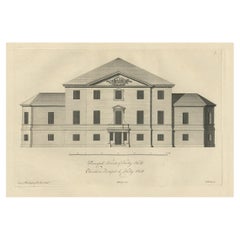
Antique print titled 'Principal Front of Kirby Hall'. Kirby Hall is an Elizabethan country house, located near Gretton, Northamptonshire, England. The nearest main town is Corby. One of the great Elizabethan houses of England, Kirby Hall was built for Sir Humphrey Stafford of Blatherwick, beginning in 1570. In 1575 the property was purchased by Sir Christopher Hatton of Holdenby,[1] Lord Chancellor to Queen Elizabeth I. It is a leading and early example of the Elizabethan prodigy house. Construction on the building began in 1570, based on the designs in French architectural pattern books and expanded in the Classical style over the course of the following decades. The house is now in a semi-ruined state with many parts roof-less although the Great Hall and state rooms remain intact. The gardens, with their elaborate "cutwork" design, complete with statues and urns, have been recently restored. Anne of Denmark stayed at Kirby on 9 August 1605 while King James stayed at Rockingham Castle. King James stayed for three days in August 1616. During a royal progress Esmé Stewart, 3rd Duke of Lennox died at Kirby of the "spotted ague" on 30 July 1624. The building and gardens are owned by the Earl of Winchilsea and are managed by English Heritage. Kirby Hall has been used as a filming location in many productions. These include the following; an episode (6. Protest and Communication) of Kenneth Clark...

Category

Antique 18th Century Prints

Materials

Paper

Antique Louvre Museum Entrance Engraving, Paris Architectural View, French, 1803

Antique Louvre Museum Entrance Engraving, Paris Architectural View, French, 1803

Located in Langweer, NL

Antique Louvre Museum Entrance Engraving, Paris Architectural View, French c.1803 A finely executed early 19th-century French architectural engraving depicting a detailed view of th...

Category

Antique Early 19th Century French Prints

Materials

Paper