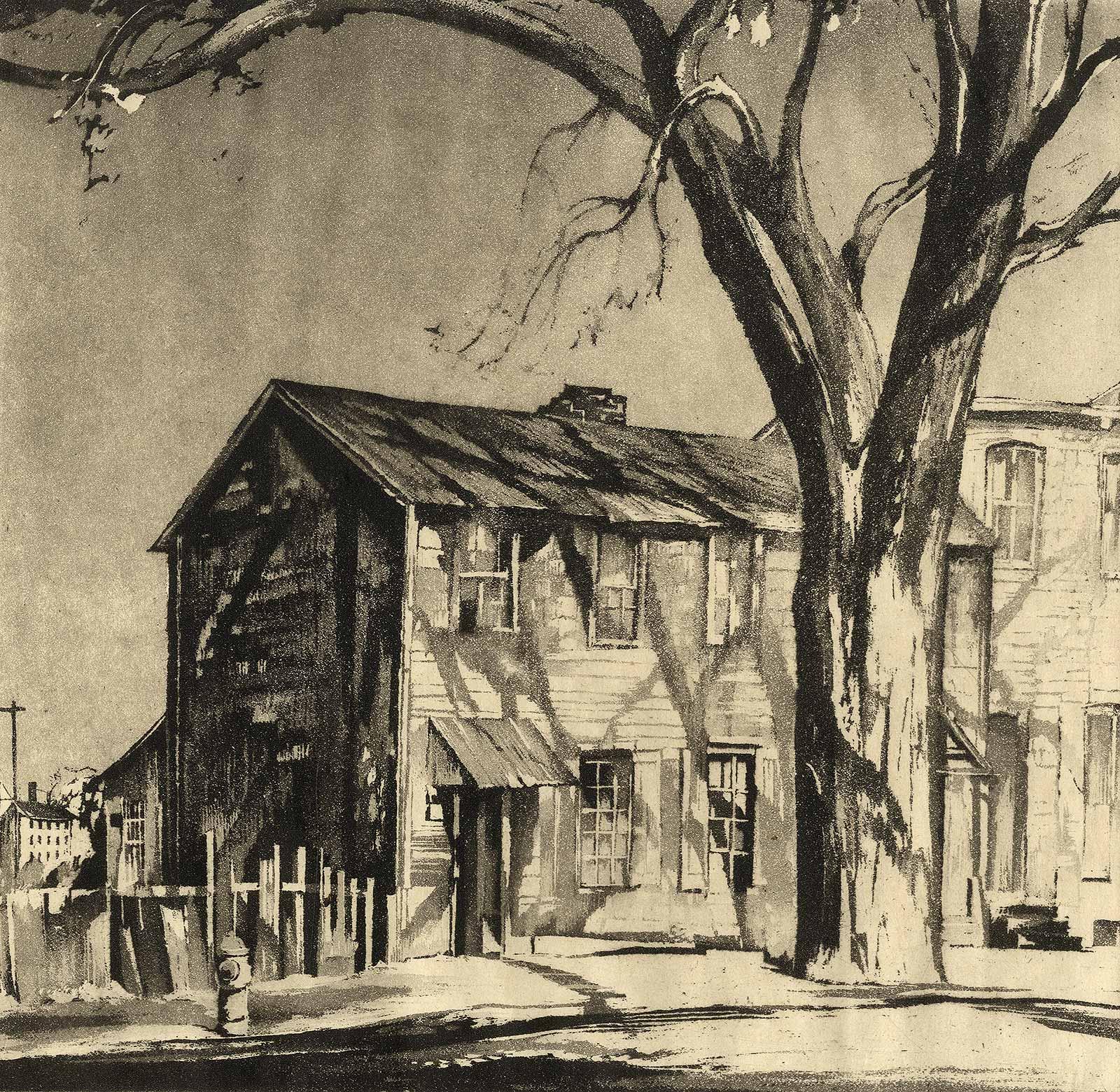
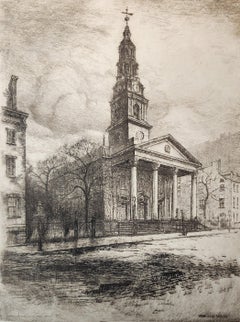
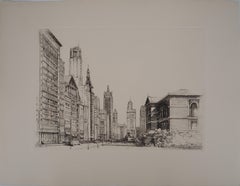
'St. Mark's Church on the Bowery', aquatint with etching, edition not stated but small, 1932. Signed in pencil. Signed in the plate lower left and titled in the plate lower right. A superb, atmospheric impression, on cream wove paper, with full margins (1 1/8 to 2 inches), in excellent condition. Matted to museum standards, unframed.
Image size 9 3/4 x 7 3/8 inches (248 x 187 mm); sheet size 13 1/8 x 10 inches (333 x 254 mm).
Impressions of this work are held in the collections of the Princeton University Art Museum and the Five College Museums.
ABOUT THE ARTIST
Born in Vienna, Leon Dolice left a secure position in the family business to pursue his artistic interests. He began his art education in his teens and early twenties when he traveled through Europe to study the works of the Old Masters. He immigrated to America in 1920 and made his home in Manhattan. As a printmaker, he chose as his subjects the architecture, back streets, dock scenes, and other aspects of New York City life that were being overtaken by the modern world.
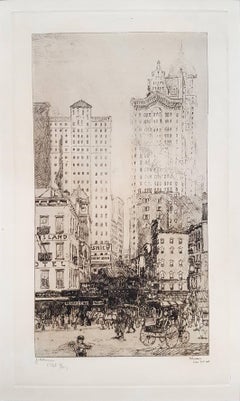
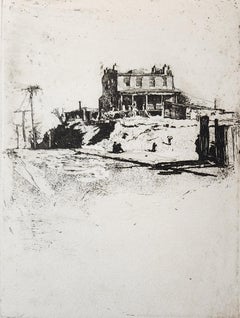
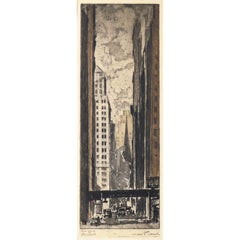
In 1950, learning of the coming demolition of the Third Avenue El, Dolice created a series of Third Avenue and other New York City landmarks that were threatened with extinction. His images from that period provide a record of a New York that has passed into history.
During his lifetime, Dolice exhibited throughout Europe and the United States. Retrospectives of his work include a one-man show of his graphic work at Tribeca Gallery, New York; the traveling exhibition ‘Vintage New York’ with the New Rochelle Council on the Arts; and the Hofstra Museum, Hempstead.
Dolice's works are in the permanent collections of the Museum of the City of New York, the National Gallery of Art, the New York Historical Society, Georgetown University, the Philadelphia Print Club, and the New York Public Library, as well as private and corporate collections.
ABOUT ST. MARKS CHURCH
St. Mark's Church in-the-Bowery is a parish of the Episcopal Church located at 131 East 10th Street, at the intersection of Stuyvesant Street and Second Avenue in the East Village neighborhood of Manhattan in New York City. The property has been the site of continuous Christian worship since the mid-17th century, making it New York City's oldest site of continuous religious practice. The structure is the second-oldest church building in Manhattan.
In 1651, Petrus Stuyvesant, Director General of New Netherland, purchased land for a bowery or farm from the Dutch West India Company and, by 1660, built a family chapel at the present-day site of St. Mark's Church. Stuyvesant died in 1672 and was interred in a vault under the chapel.
Stuyvesant's great-grandson, Petrus "Peter" Stuyvesant, sold the chapel property to the Episcopal Church for $1 in 1793, stipulating that a new chapel be erected to serve Bowery Village, the community which had coalesced around the Stuyvesant family chapel. In 1795, the cornerstone of the present-day St. Mark's Church was laid, and the fieldstone Georgian-style church, built by the architect and mason John McComb Jr., was completed and consecrated on May 9, 1799.[4] Alexander Hamilton provided legal aid in incorporating St. Mark's Church as the first Episcopal parish independent of Trinity Church in New York City. By 1807, the church had as many as two hundred worshipers at its summer services, with 70 during the winter.
While the 19th century saw St. Mark's Church grow through its many construction projects, the 20th century was marked by community service and cultural expansion. Today, the rectory houses the Neighborhood Preservation Center, the Greenwich Village Society for Historic Preservation, and the Historic Districts Council, as well as other preservation and community organizations such as the Poetry Project, the Millennium Film Workshop, and the Danspace Project.
St Mark's has supported an active artistic community since the 19th century. In 1919, poet Kahlil Gibran was appointed a member of the St. Mark's Arts Committee, and the next year, the two prominent Indian statues, "Aspiration" and "Inspiration" by sculptor Solon Borglum, which flank the church entry, were unveiled. Gibran also presented readings of his famous written works, some of which became annual affairs for a while, and an exhibition of his drawings. Isadora Duncan danced in the church in 1922, and Martha Graham in 1930. In 1926, poet William Carlos Williams lectured at the St. Mark's Sunday Symposium, which featured such artists as Amy Lowell, Edward Steichen, Houdini, Edna St. Vincent Millay, Ruth St. Denis, and Carl Sandburg.
Beginning in 1955, the Lower East Side artists held an annual summer exhibition at St. Mark's. It was an inclusive, non-juried group exhibition that featured hundreds of artists from the neighborhood and utilized the interior spaces and the yard.
Theatre Genesis was founded by director Ralph Cook in 1964, and in the same year, Sam Shepard had his first two plays, 'Cowboys' and 'Rock Garden,' produced at the church. In 1969, St. Mark's innovated a fusion of liturgy and experimental rock music, the Electric Liturgy given by the Mind Garage, which was the first work of its kind to be nationally televised.
In 1966, the Poetry Project and The Film Project, which later became the Millennium Film Workshop, were founded. A November 1971 Poetry Project reading by Patti Smith, accompanied by Lenny Kaye on guitar, launched their rock and roll careers and marked the founding of the Patti Smith Group. In 1975, the Danspace Project was founded by Larry Fagin; the Community Documentation Workshop under the direction of Arthur Tobier was established; and the Preservation Youth Project expanded to a full-time work training program, which undertook the mission of preserving St Mark's landmark exterior under the supervision of artisan teachers. Richard Foreman's avant-garde Ontological-Hysteric Theater was also housed at the church in its own space from 1992 until 2010.
On July 27, 1978, a fire nearly destroyed the church. The Citizens to Save St Mark's was founded to raise funds for its reconstruction, and the Preservation Youth Project undertook the reconstruction, supervised by architect Harold Edelman and craftspeople provided by preservation contractor I. Maas & Sons. The Landmark Fund emerged from the Citizens to Save St Mark's and continues to exist to help maintain and preserve St. Mark's Church for future generations. The restoration was completed in 1986, with new stained-glass windows designed by Edelman.