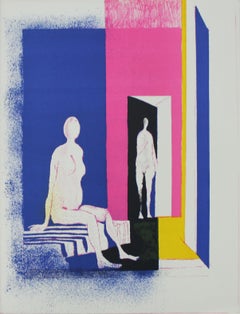
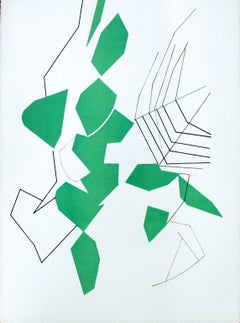
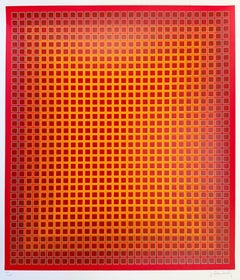
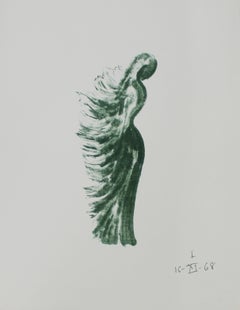
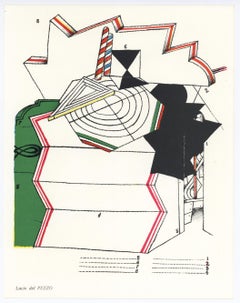
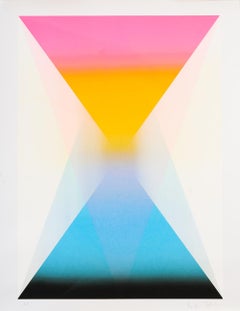
'Interieur' From Souvenirs de Portraits d'Artistes
By Paul Guiramand
Located in Philadelphia, PA
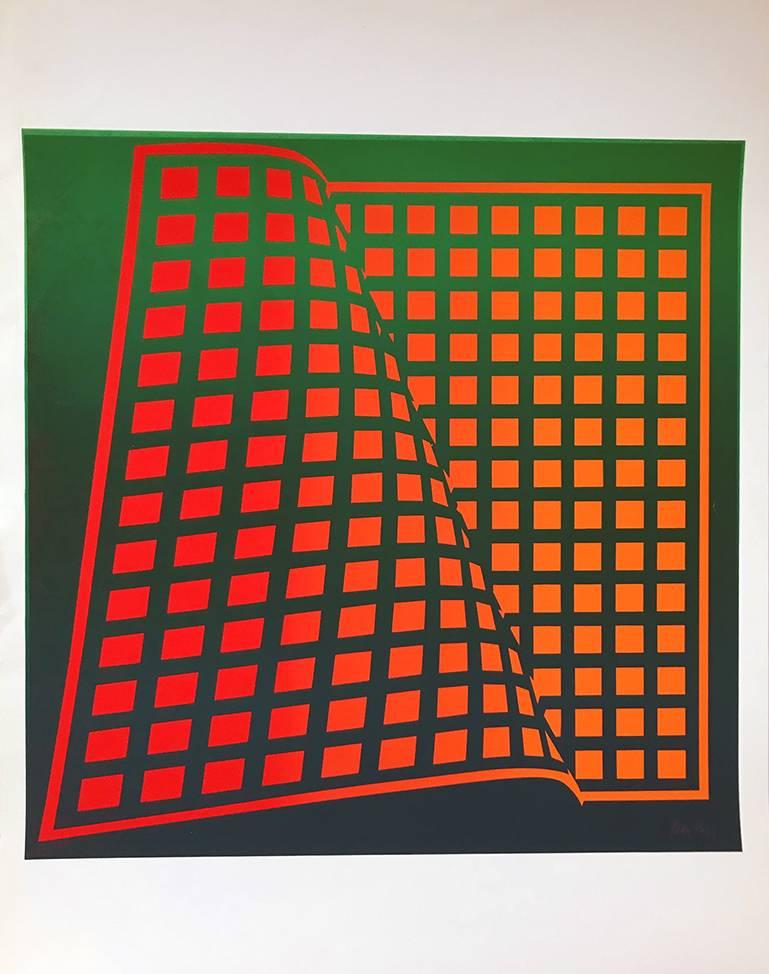
Paul Guiramand Interieur Original lithograph in colors on paper Mourlout Souvenirs de Portraits d'Artistes 1972
1970s Prints and Multiples
Lithograph
1975
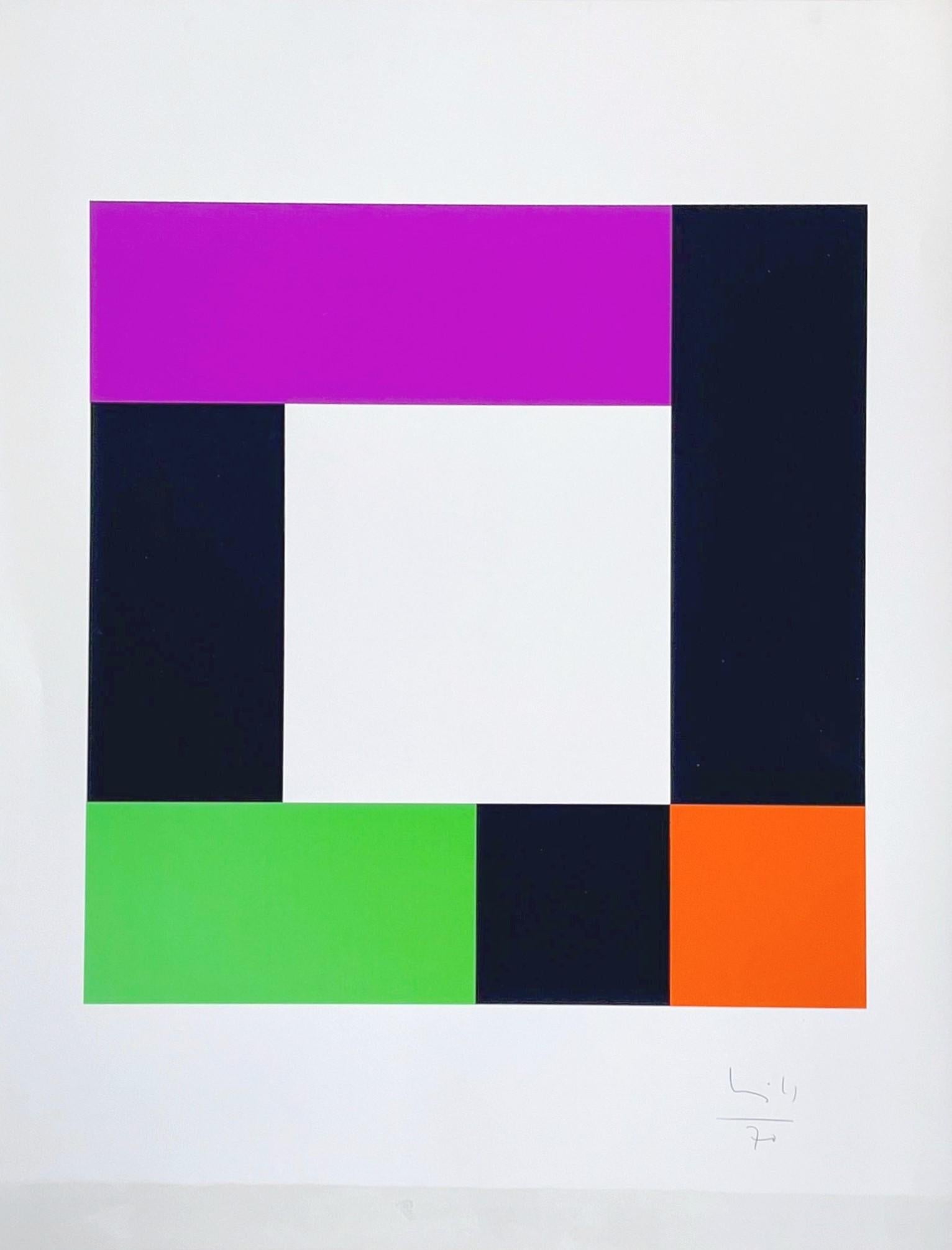
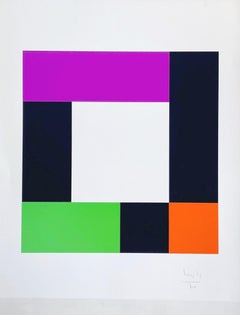
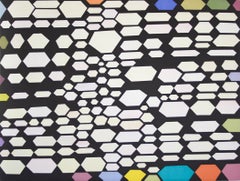
Max Bill was born in Winterthur, Switzerland. After an apprenticeship as a silversmith during 1924–27, he took up studies at the Bauhaus in Dessau under many teachers including Wassily Kandinsky, Paul Klee and Oskar Schlemmer from 1927 to 1929, after which he moved to Zurich.
After working on graphic designs for the few modern buildings being constructed, Bill built his first work, his own house and studio (1932–3) in Zurich-Höngg. From 1937 onward he was a prime mover behind the Allianz group of Swiss artists.
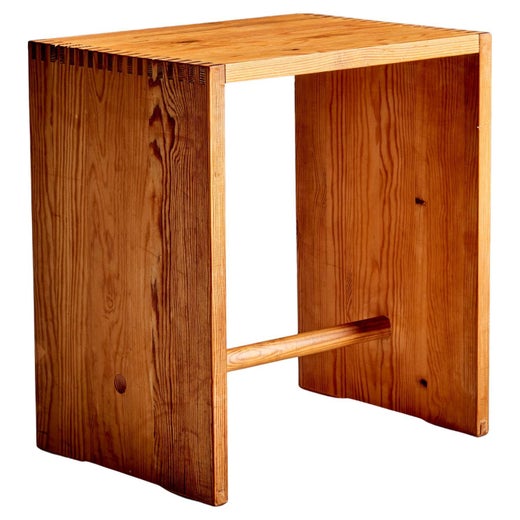
Bill is widely considered the single most decisive influence on Swiss graphic design beginning in the 1950s with his theoretical writing and progressive work. His connection to the days of modernism gave him special authority. As an industrial designer, his work is characterized by a clarity of design and precise proportions. Examples are the elegant clocks and watches designed for Junghans, a long-term client. Among Bill's most notable product designs is the Ulmer Hocker of 1954, a stool that can also be used as a shelf element, a speaker's desk, a tablet or a side table. Although the stool was a creation of both Bill's and Ulm School designer Hans Gugelot's, it is often called "Bill Hocker" because the first sketch of it on a cocktail napkin was Bill's work.
As a designer and artist, Bill sought to create forms which visually represent the New Physics of the early 20th century. He sought to create objects so that the new science of form could be understood by the senses: that is as a concrete art. Thus Bill is not a rationalist – as is typically thought – but rather a phenomenologist. He made spare geometric paintings, prints and spherical sculptures, some based on the Möbius strip, in stone, wood, metal and plaster. His architectural work included an office building in Germany, a radio studio in Zurich, and a bridge in eastern Switzerland.
Bill continued to produce architectural designs, such as those for a museum of contemporary art (1981) in Florence and for the Bauhaus Archive (1987) in Berlin. In 1982 he also entered a competition for an addition to the Neue Nationalgalerie in Berlin, built to a design by Ludwig Mies van der Rohe. Pavillon-Skulptur, a large granite sculpture, was installed adjacent to the Bahnhofstrasse, Zürich in 1983. As is often the case with modern art in public places, the installation generated some controversy. Endlose Treppe, a sculpture made of North American granite, was designed for the philosopher Ernst Bloch.
In 1982 he was awarded the Sir Misha Black award and was added to the College of Medallists.
Bill executed many public sculptures in Europe and exhibited extensively in galleries and museums, including a retrospective at the Kunsthaus Zürich in 1968–69. He was the subject of retrospectives at the Albright-Knox Art Gallery in Buffalo and the Los Angeles County Museum of Art in 1974, and the Solomon R. Guggenheim Museum in New York City in 1988.
Find vintage Max Bill stools, lighting, and other furniture on 1stDibs.
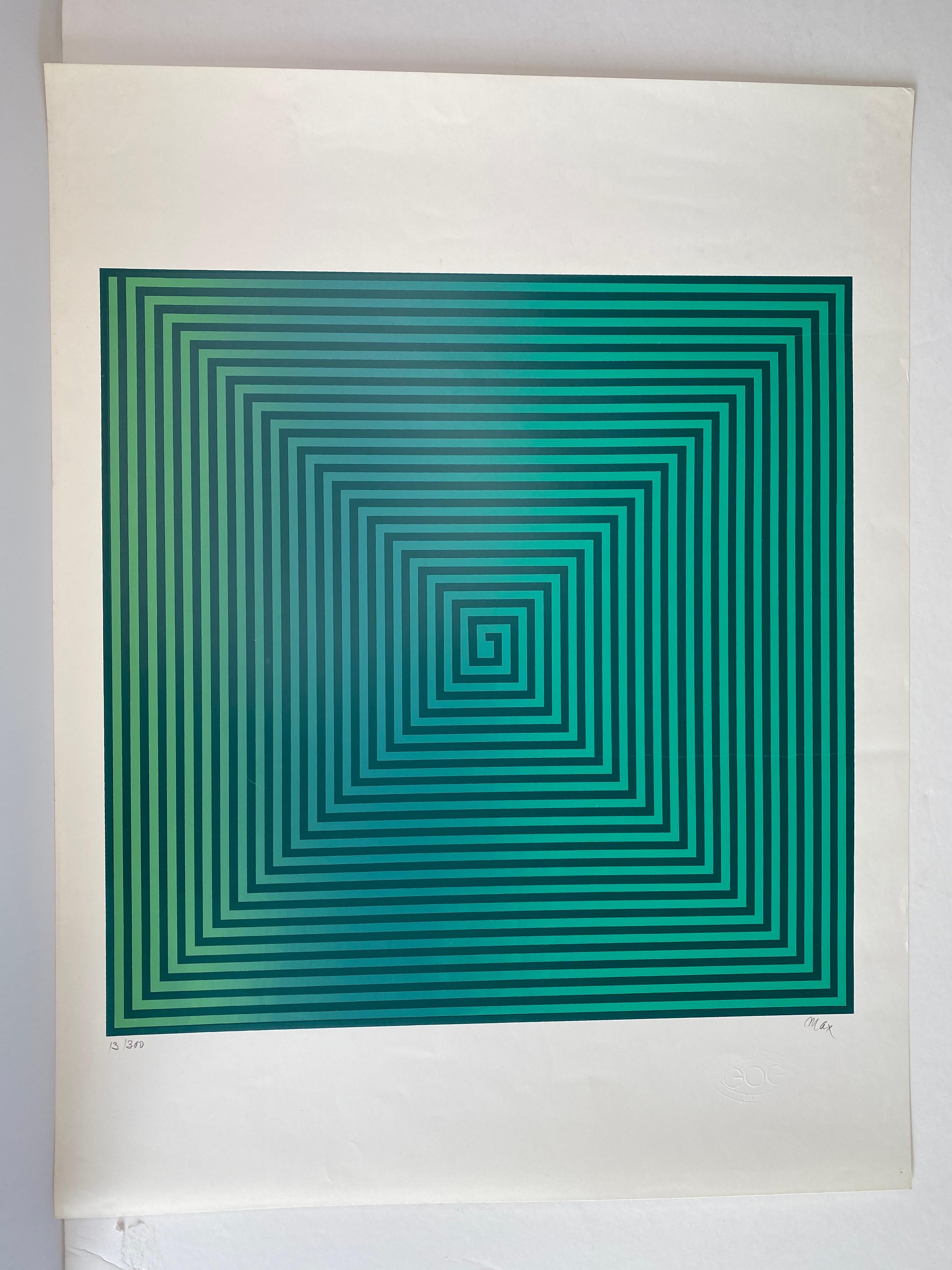
Untitled #5
By Thomas Nozkowski
Located in New York, NY
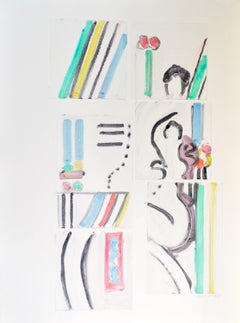
2012, 4-plate aquatint with 22 colors, 21 7/8 x 29 3/8 inches, edition of 25 For over thirty years, Nozkowski has practiced his own form of idiosyncratic abstraction, foregoing a si...
Aquatint
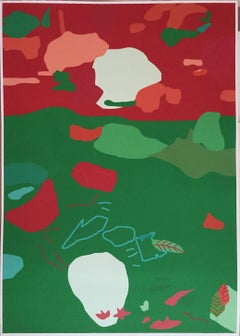
Untitled 67 - signed AP
Located in London, GB
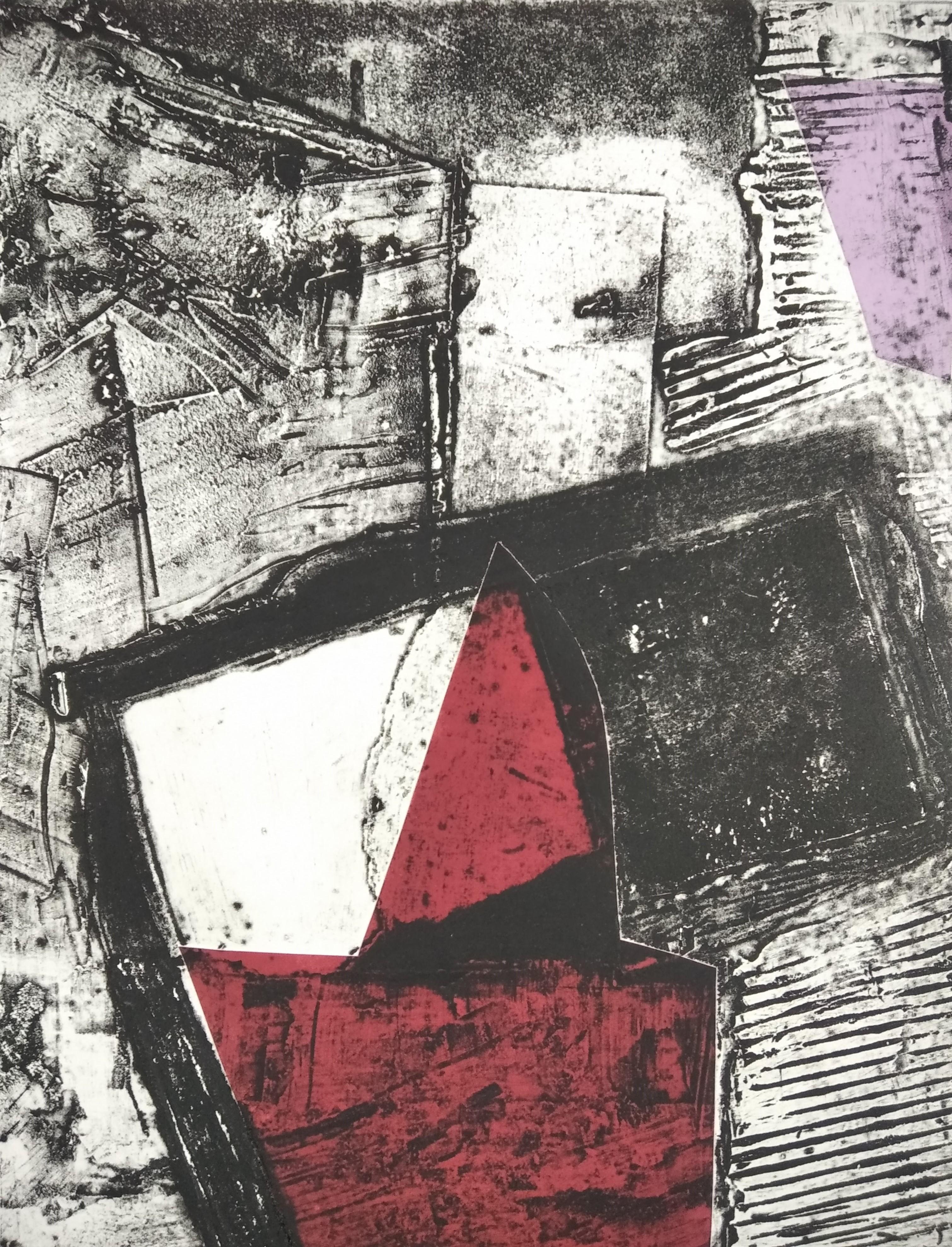
Gfeller + Hellsgård - Untitled 67 Screen-print on paper - signed & numbered - 2016 This is a rare A.P (artist proof) from the Untitled 67 print run. It's handprinted 5 colours as split-fountain. Size 80 x 60 cm, with a 5 cm white border, the condition is good, it will be shipped rolled in a hard tube. Artist info: Gfeller + Hellsgård is an artist duo working in Berlin. They've created an unique painterly screen-print-style which includes colour overlaps, smudges, bleeding, glitches and transparencies. In 1995 while studying at Ecole Supérieur des Arts Décoratifs de Strasbourg, Christian Gfeller (born 1973, Alsace) started publishing screen-printed graph'zines and artists' books under the moniker Bongoût (good taste). Bongoût found it's roots in the french D.I.Y art punk scene and, together with an handful of people, also organised concerts, party's and performances in an old warehouse named Lactina in Kehl, across the Rhine from France. The location became cult with its first techno parties, noise concerts and art performances, as well as exhibitions. Christian's first screen-print studio was located in Lactina and beside zine and book making, he designed and printed posters for the events as well as record covers for the cult garage trash punk label Yakisakana Rcds. In 2000, FLTMSTPC in Paris published a polaroid book by Christian, where this vivid time at Lactina was well documented. During this period Christian also played in several local bands: Pitfall, Elcamino and The Cheeraks. Christian Gfeller met Anna Hellsgård (born 1980, Stockholm) at a concert in Berlin on September 11th 2001. After Anna's short art study at Konstskolan in Stockholm, she was eager to develop her photographic interest and become an assistant to a commercial photographer for 2 years. In the meantine Anna also was Dj-ing in several clubs and bars in Stockholm. A vague memory from 1991 of her first Berlin visit and her music interest draw her to move to Berlin in 2001. There she continued with her B/W photographs and shot hundreds of pictures during her first time in Berlin. When she met Christian, she got immediately drawn to the french underground scene and its subversive graphic art content. Whenever she visited Christian in Strasbourg she would help him with his printing at the Lactina studio. In 2002 the couple moved to Bordeaux and built up a screen-print studio there. This is where they started to work full time together as an artist-duo, publishing their own zines, artist's books as well as designing gig posters and record covers. The year and a half in Bordeaux was very prolific and they grounded together a strong artistic direction and a unique style. Bongoût editions continued to grow there as well.The artist-duo produced over 40 screen-printed books in collaboration with other artists during this time. In 2004 they decided to move back to Berlin, and relocated their studio to the Friedrichshain neighbourhood. Over the years, the duo released over 200 screen-printed zines and artists' books, some by themselves and others in collaboration with artists from around the world: David Sandlin...
Archival Pigment, Screen