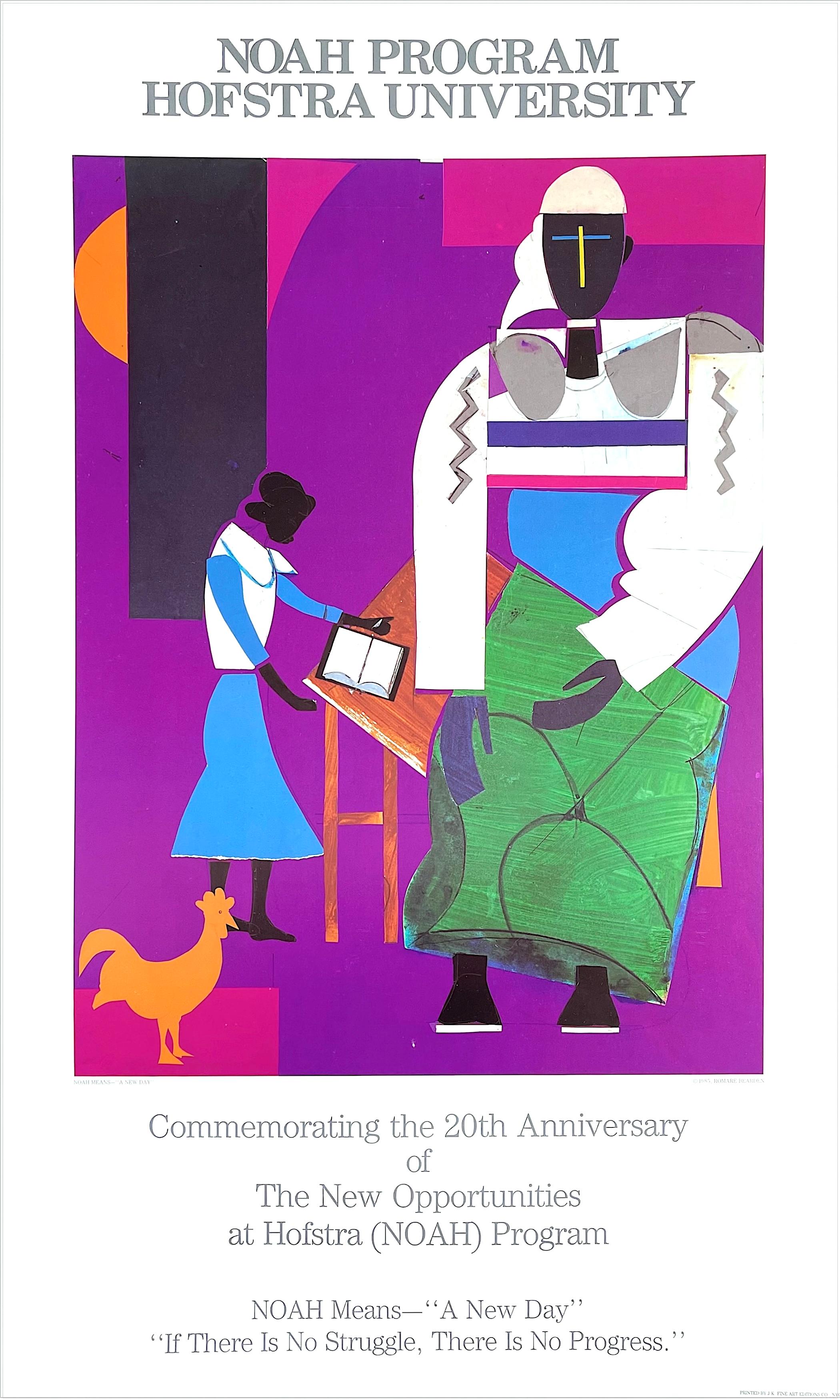
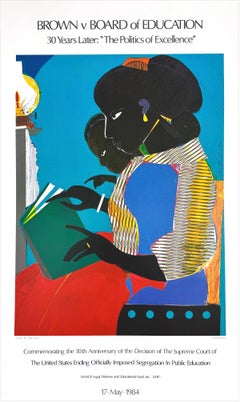
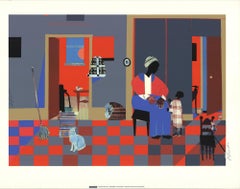
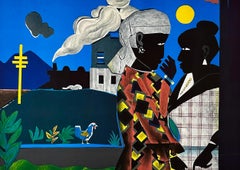
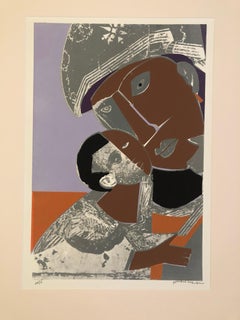
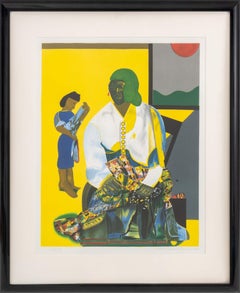
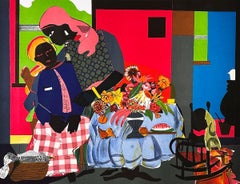
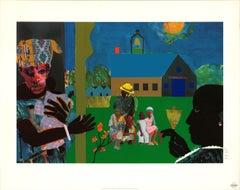
THE LAMP is a hand drawn limited edition color lithograph by the renowned American master artist Romare Bearden, proofed and printed using hand lithography in 19 colors plus silver foil stamping on archival Arches printmaking paper at J K Fine Art Editions Co. NYC.
THE LAMP is a contemporary collage portrait depicting a black mother and her young child seated in profile, reading from a green book beside a glowing oil lamp. Richly printed collage elements of multicolored stripe fabric form the woman's sleeves and collar and bold solid color shapes in intense red, black, brown, yellow, light gray, and forest green complete this exceptional, historically significant Romare Bearden composition.
Note: THE LAMP was commissioned by the NAACP Legal Defense and Educational Fund in commemoration of the 30th anniversary of the landmark case: Brown vs. Board of Education in 1954. The NAACP Legal Defense and Education Fund used this image on their commemorative poster marking the occasion. Romare Bearden began the sketch for this work while lunching with Susan Taylor, writer, journalist and former editor-in-chief of Essence magazine. In 2004, "The Lamp" became a United States Postal Service stamp as one of the images chosen for the "To Form A More Perfect Union" stamp collection that recognizes 10 significant benchmarks of the Civil Rights Movement.
Print size - 29.5 x 21.5 inches, unframed, excellent condition, hand signed in pencil by Romare Bearden, PP (Printers Proof)aside from the edition of 100. print documentation provided
Image size - 23.5 x 17.5 inches
Edition - 100, plus proofs
Year published -1984
Printer - J K Fine Art Editions Co. NY
Catalogue Reference: Gelburd-Rosenberg GG#112.
Reference: Fig 63, Pg. 81 in - A Graphic Odyssey: Romare Bearden as Printmaker
by Gail Gelburd, Pub. Univ. of Penn.
Artist statement:
“When I conjure these memories, they are of the present to me,” NPR quoted Bearden as saying. “Because, after all, the artist is a kind of enchanter in time.”
Romare Bearden, in full Romare Howard Bearden, (born September 2, 1911, Charlotte, North Carolina, U.S.—died March 12, 1988, New York City, New York), American painter, whose collages of photographs and painted paper on canvas depict aspects of American black culture in a style derived from Cubism. He is considered one of the most important African American artists of the 20th century.
Bearden was born in North Carolina but grew up in New York City and Pittsburgh. He studied at the Art Students League in New York City with George Grosz (1936–37) and at Columbia University (1943). His early paintings were realistic and often religious in theme (e.g., The Annunciation, 1942). After military service during World War II, he lived in Paris (1950–51), studied at the Sorbonne, and traveled extensively in Europe. During this period he developed his mature, semiabstract collage style. He first achieved recognition in the mid-1940s, and by the 1960s he had come to be regarded as the preeminent collagist in the U.S.
The narrative structure of Bearden’s paintings is simple and archetypal; ritual, music, and family are his pervasive themes. His works’ complexity lies in their poetic abstraction, in which layered fragments of colour and pattern evoke the rhythms, textures, and mysteries of a people’s experience (e.g., in Family, 1969).
Bearden also was a songwriter and book illustrator, and he occasionally designed sets for the Alvin Ailey American Dance Company. In 1990 the Romare Bearden Foundation was established to promote his work and to support African American artists.
Artist bio - Encyclopedia Britannica