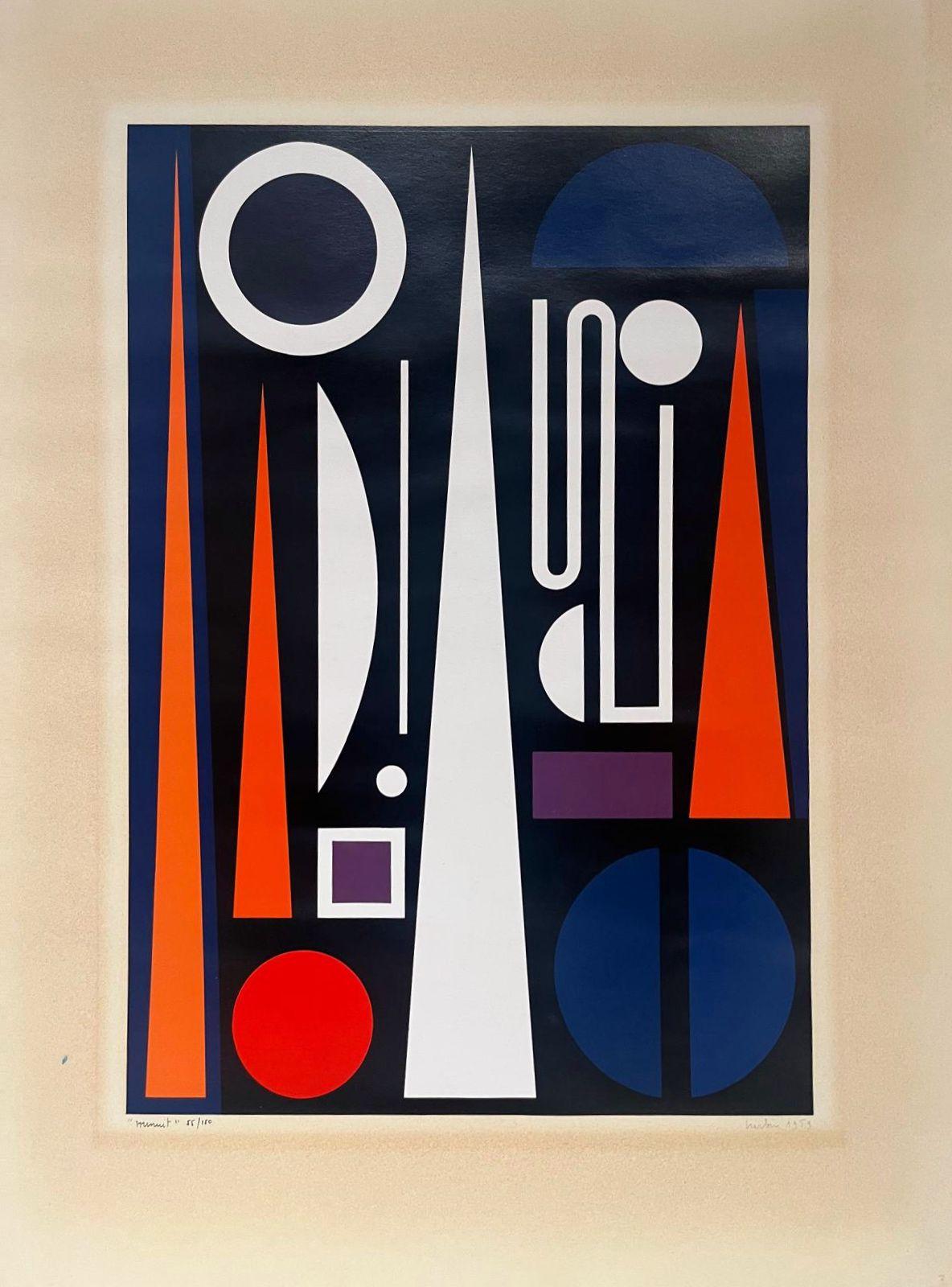
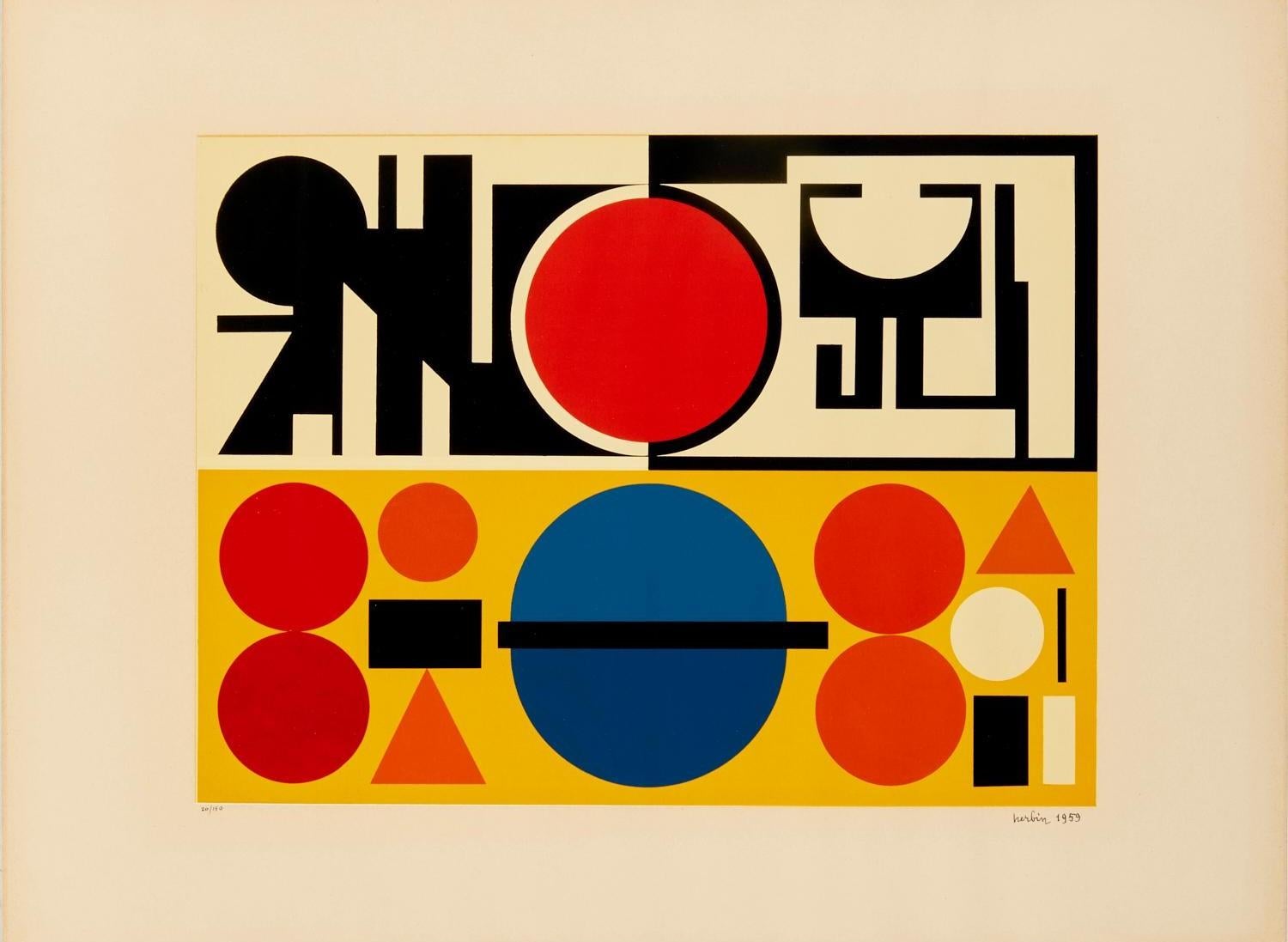
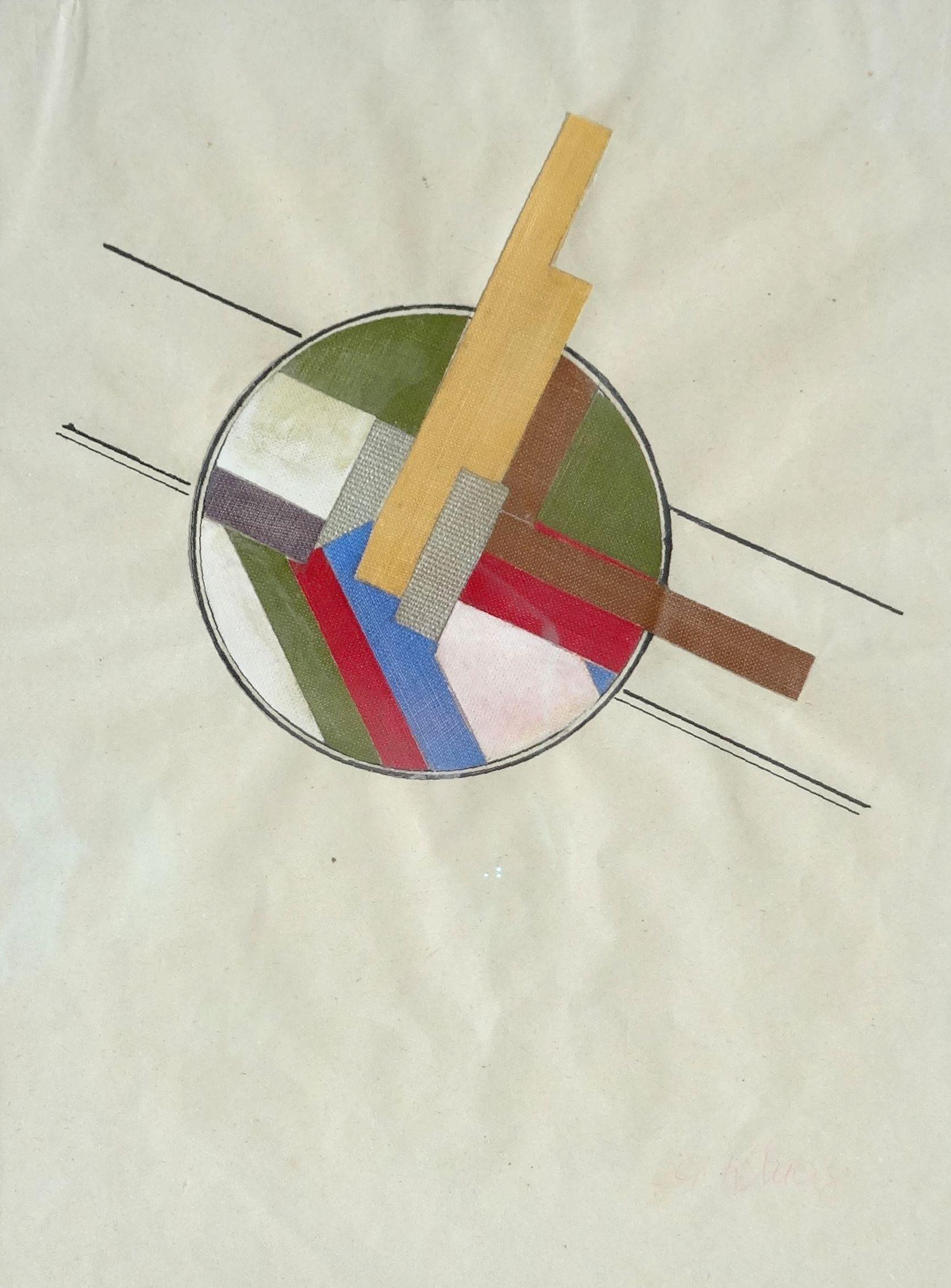
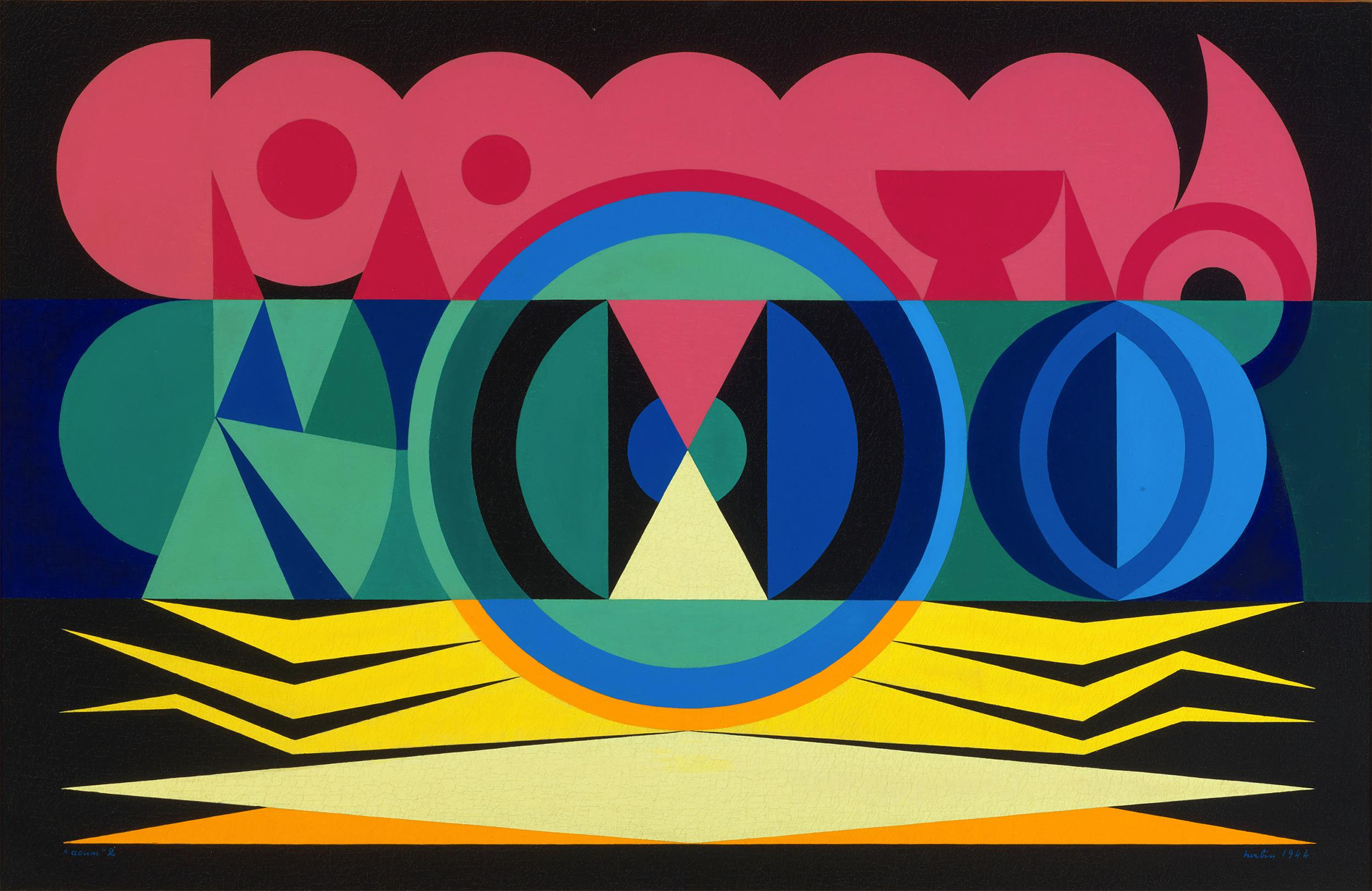
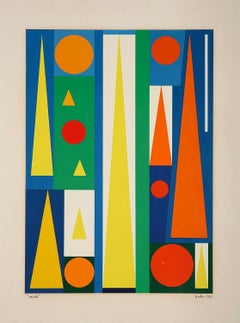
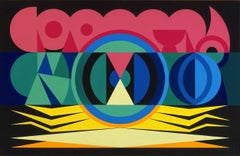
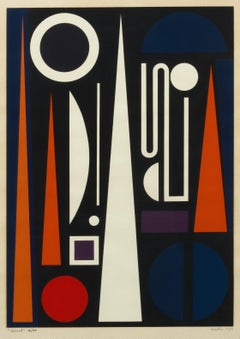
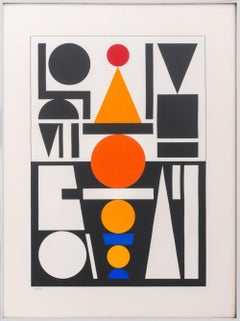
This exquisite lithograph and pochoir after Auguste Herbin (1882–1960), titled Composition sur fond vert (Composition on Green Background), from the album L'Art Cubiste, Theories et Realisations, Etude Critique (Cubist Art, Theories and Achievements, Critical Study), originates from the 1929 edition published by Editions Charles Moreau, Paris, and printed by Atelier Daniel Jacomet, Paris, May 1929. Composition sur fond vert (Composition on Green Background) exemplifies Herbin’s transition from the structural clarity of Cubism to the vibrant logic of geometric abstraction. Through interlocking planes of color and precisely calibrated forms, Herbin constructs a dynamic yet harmonious composition that reveals his mastery of rhythm and balance. The work’s architectural geometry and chromatic contrasts embody the principles that would later define his “Alphabet Plastique,” linking color, shape, and meaning in a universal visual language. This early example of Herbin’s mature style foreshadows his lifelong commitment to order, proportion, and expressive harmony through pure abstraction.
Executed as a lithograph and pochoir on velin paper, this work measures 10.83 x 8.27 inches. Signed in the plate and unnumbered as issued. The edition exemplifies the exceptional craftsmanship of Atelier Daniel Jacomet, Paris, under the direction of Editions Charles Moreau, Paris.
Artwork Details:
Artist: After Auguste Herbin (1882–1960)
Title: Composition sur fond vert (Composition on Green Background), from the album L'Art Cubiste, Theories et Realisations, Etude Critique (Cubist Art, Theories and Achievements, Critical Study), 1929
Medium: Lithograph and pochoir on velin paper
Dimensions: 10.83 x 8.27 inches (27.5 x 21 cm)
Inscription: Signed in the plate and unnumbered as issued
Date: May 1929
Publisher: Editions Charles Moreau, Paris
Printer: Atelier Daniel Jacomet, Paris
Condition: Well preserved, consistent with age and medium
Provenance: From the album L'Art Cubiste, Theories et Realisations, Etude Critique, published by Editions Charles Moreau, Paris, and printed by Atelier Daniel Jacomet, Paris, May 1929
Notes:
Excerpted from the album (translated from French): This album was composed in Didot Characters and completed to print in May 1929 by Ducros et Colas, Maitres-Imprimeurs in Paris. Boards have been executed by D. Jacomet in an edition of D examples, numbered on the colophons.
About the Publication:
L'Art Cubiste, Theories et Realisations, Etude Critique (Cubist Art, Theories and Achievements, Critical Study), published in 1929 by Editions Charles Moreau, remains one of the most distinguished publications dedicated to the intellectual and aesthetic evolution of Cubism. Conceived as both a theoretical text and a visual anthology, the album features essays and color plates printed in lithograph and finished by hand in pochoir under the supervision of Daniel Jacomet. The volume includes works by pioneers such as Pablo Picasso, Georges Braque, Juan Gris, Fernand Leger, Albert Gleizes, Andre Lhote, Louis Marcoussis, and Auguste Herbin, each contributing to the movement’s ongoing dialogue between structure, abstraction, and modernity. Printed on fine velin paper in a limited edition, the album embodies the artistic and technical excellence of early 20th-century French publishing. Its synthesis of intellectual rigor and artisanal craftsmanship positions it among the great monuments of the livre d’artiste tradition and a cornerstone of modernist visual culture.
About the Artist:
Auguste Herbin (1882–1960) was a pioneering French painter, theorist, and master of geometric abstraction whose lifelong pursuit of color harmony, form, and visual logic established him as one of the most significant innovators of 20th-century modernism. Born in Quievy, France, Herbin studied at the Ecole des Beaux-Arts in Lille before moving to Paris in 1901, where he became part of the avant-garde circle at Montmartre alongside Georges Braque, Henri Matisse, and Pablo Picasso. His early work reflected the energy of Post-Impressionism and Fauvism, but by 1909, he was deeply involved in Cubism, exhibiting at the Salon des Independants and Salon d’Automne with Picasso and Braque. His Cubist paintings combined structural rigor with lyrical color, laying the groundwork for his lifelong exploration of harmony and abstraction. After World War I, Herbin gradually abandoned representation to develop a pure visual language of geometry, rhythm, and color theory, co-founding Abstraction-Creation in 1931 with Jean Helion, Jean Arp, and Georges Vantongerloo, a movement that promoted non-figurative art as a universal expression of order and spirit. In 1942, he created his groundbreaking “Alphabet Plastique” (Plastic Alphabet), an innovative system that linked letters, colors, and shapes to form a universal visual language combining music, mathematics, and art—a conceptual framework that influenced generations of abstract and conceptual artists. His compositions, built on precise geometric relationships and radiant chromatic harmonies, embodied his conviction that abstraction could express emotion as directly as sound or poetry. A peer of Pablo Picasso, Alexander Calder, Alberto Giacometti, Salvador Dali, Joan Miro, Wassily Kandinsky, Marcel Duchamp, and Man Ray, Herbin shared their revolutionary desire to redefine art as a language of universal meaning. His influence extended to later masters such as Victor Vasarely, Max Bill, Ellsworth Kelly, Bridget Riley, and Josef Albers, who expanded his legacy in Op Art, Minimalism, and Color Field painting. As president of the Salon des Realites Nouvelles after World War II, Herbin championed geometric abstraction internationally, shaping the course of postwar modern art. His works are now held in major collections including the Centre Pompidou, Musee d’Art Moderne de Paris, Tate Modern, the Stedelijk Museum, and The Museum of Modern Art in New York. Standing alongside Pablo Picasso, Alexander Calder, Alberto Giacometti, Salvador Dali, Joan Miro, Wassily Kandinsky, Marcel Duchamp, and Man Ray, Auguste Herbin remains a central figure in the history of abstraction—a painter, philosopher, and theorist whose art united science, emotion, and universal harmony. The highest auction record for Auguste Herbin was achieved by Composition sur fond noir (Composition on a Black Background), which sold for $1,037,000 USD at Sotheby’s, Paris, on December 6, 2017, confirming his lasting legacy as one of the most important and collectible figures in modern art.
After Auguste Herbin Composition sur fond vert, Herbin L'Art Cubiste, Herbin Atelier Daniel Jacomet, Herbin Editions Charles Moreau, Herbin pochoir lithograph, Herbin Cubism.