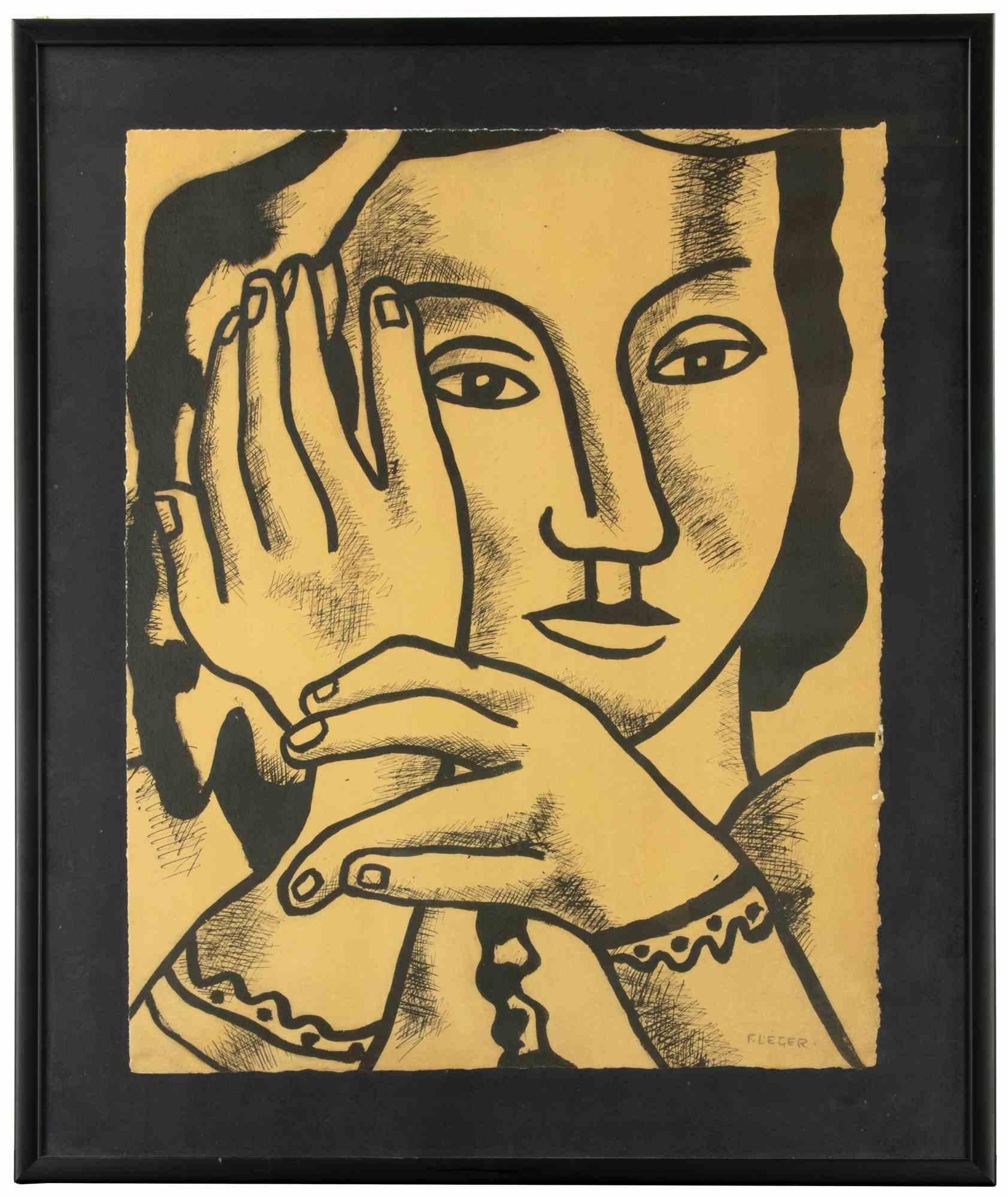
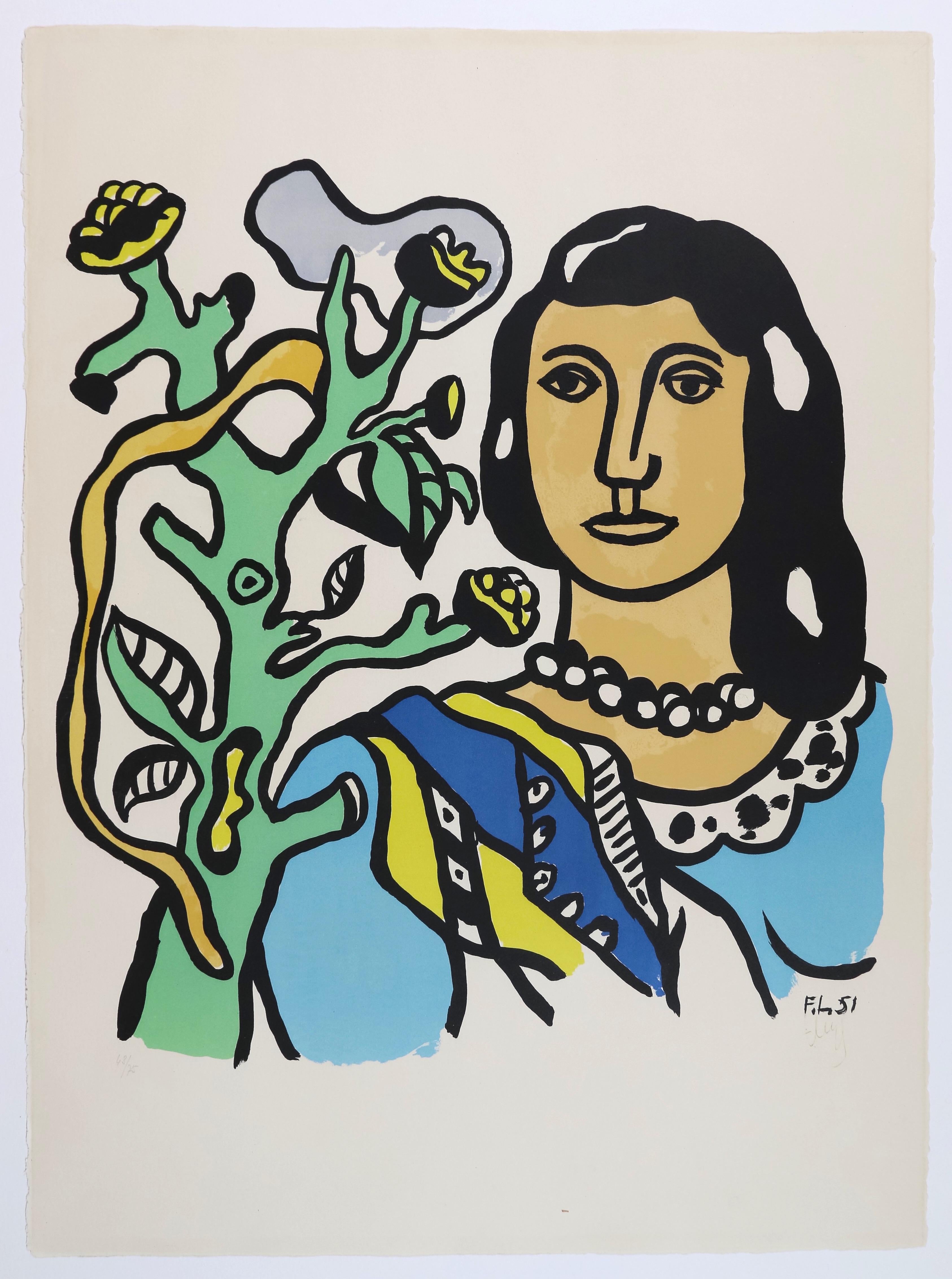
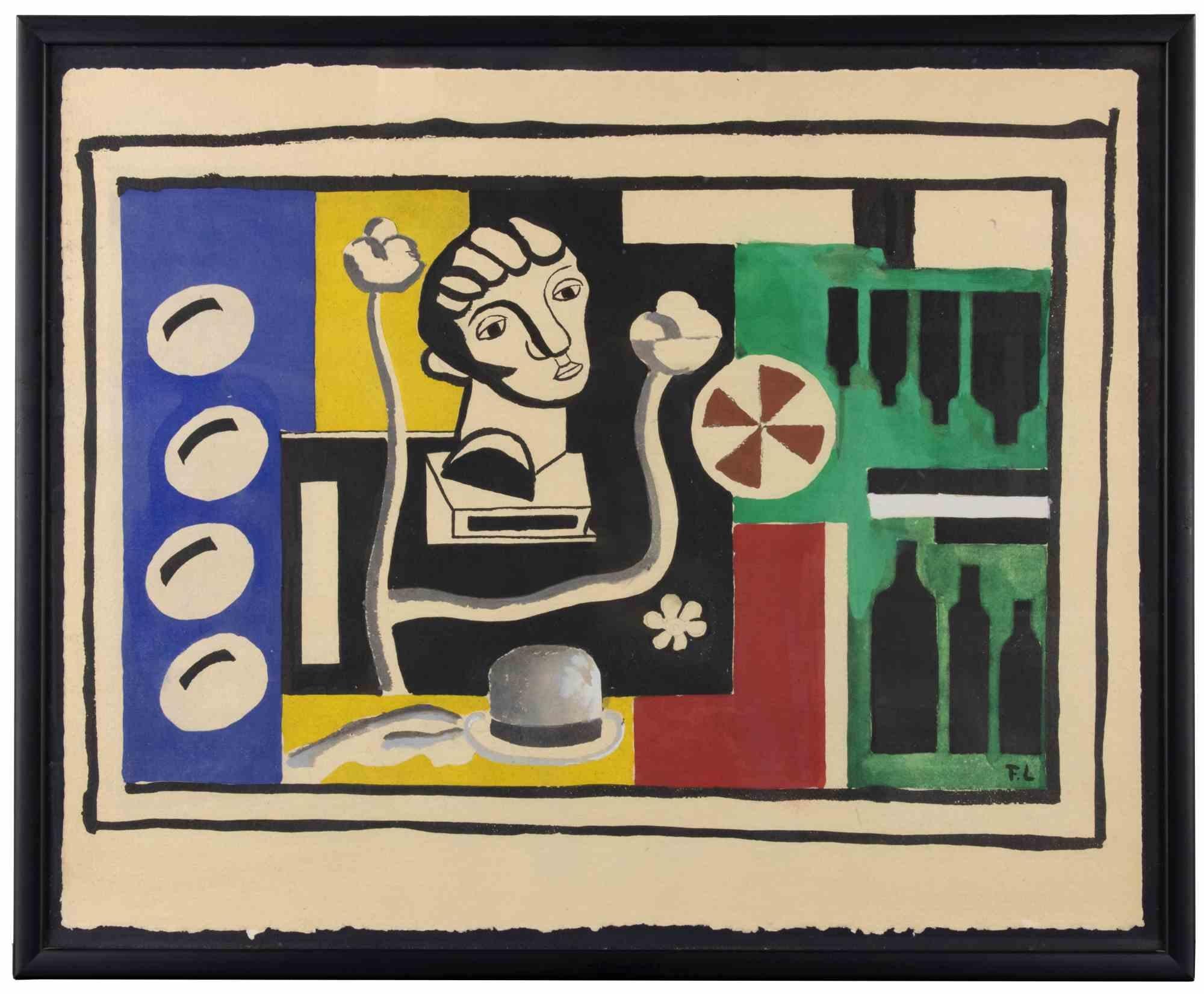
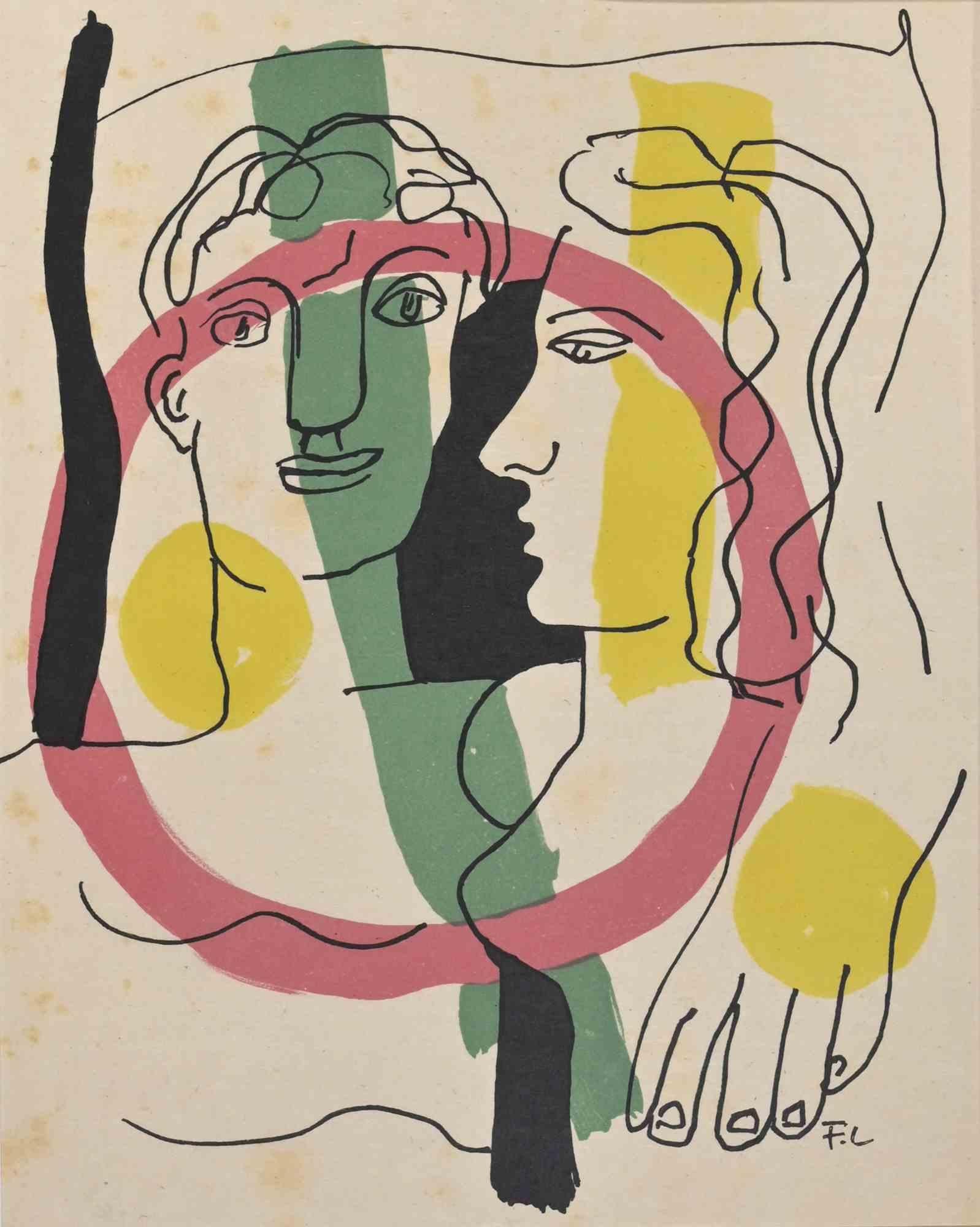
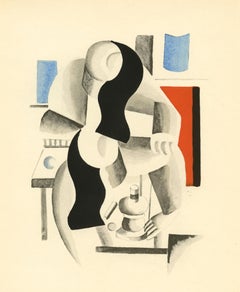
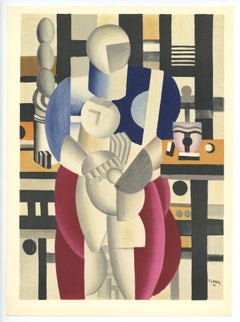
This exquisite lithograph and pochoir after Fernand Leger (1881–1955), titled La Femme au Vase (Woman with a Vase), from the album L'Art Cubiste, Theories et Realisations, Etude Critique (Cubist Art, Theories and Achievements, Critical Study), originates from the 1929 edition published by Editions Charles Moreau, Paris, and printed by Atelier Daniel Jacomet, Paris, May 1929. La Femme au Vase (Woman with a Vase) captures Leger’s synthesis of Cubist structure and industrial modernity, where the human figure becomes an architectural construction of form, color, and rhythm. Through the bold interlocking planes and cylindrical geometry that define his visual language, Leger transforms the classical motif of the female figure into a symbol of modern harmony—mechanical yet human, dynamic yet serene. Executed with the precision of lithography and the luminosity of hand-applied pochoir, this work exemplifies Leger’s mastery of composition and his celebration of art as both mechanical and poetic.
Executed as a lithograph and pochoir on velin paper, this work measures 10.83 x 8.27 inches. Unsigned and unnumbered as issued. The edition exemplifies the exceptional craftsmanship of Atelier Daniel Jacomet, Paris, under the direction of Editions Charles Moreau, Paris.
Artwork Details:
Artist: After Fernand Leger (1881–1955)
Title: La Femme au Vase (Woman with a Vase), from the album L'Art Cubiste, Theories et Realisations, Etude Critique (Cubist Art, Theories and Achievements, Critical Study), 1929
Medium: Lithograph and pochoir on velin paper
Dimensions: 10.83 x 8.27 inches (27.5 x 21 cm)
Inscription: Unsigned and unnumbered as issued
Date: May 1929
Publisher: Editions Charles Moreau, Paris
Printer: Atelier Daniel Jacomet, Paris
Condition: Well preserved, consistent with age and medium
Provenance: From the album L'Art Cubiste, Theories et Realisations, Etude Critique, published by Editions Charles Moreau, Paris, and printed by Atelier Daniel Jacomet, Paris, May 1929
Notes:
Excerpted from the album (translated from French): This album was composed in Didot Characters and completed to print in May 1929 by Ducros et Colas, Maitres-Imprimeurs in Paris. Boards have been executed by D. Jacomet in an edition of D examples, numbered on the colophons.
About the Publication:
L'Art Cubiste, Theories et Realisations, Etude Critique (Cubist Art, Theories and Achievements, Critical Study), published in 1929 by Editions Charles Moreau, stands as a landmark of early modernist publishing and one of the most significant printed tributes to the Cubist movement. Combining critical essays with hand-finished lithographs and pochoirs by the foremost Cubist masters—Pablo Picasso, Georges Braque, Juan Gris, Fernand Leger, Albert Gleizes, Andre Lhote, Louis Marcoussis, Auguste Herbin, Georges Valmier, and Henri Laurens—the album exemplified the union of intellectual theory and visual experimentation. Under the supervision of Daniel Jacomet, the lithographs were enhanced by pochoir coloring to preserve the tonal richness and chromatic balance of the original works. The result was an extraordinary collaboration between artists, printers, and publishers, celebrating the scientific rigor, formal innovation, and emotional vitality that defined Cubism’s contribution to 20th-century art.
About the Artist:
Fernand Leger (1881–1955) was a visionary French painter, sculptor, designer, and filmmaker whose groundbreaking fusion of modern industry, vivid color, and geometric form transformed the course of 20th-century art. Born in Argentan, Normandy, Leger began as an architectural draftsman before studying at the Academie Julian and the Ecole des Beaux-Arts in Paris, where he absorbed the lessons of Paul Cezanne’s structural rigor and the revolutionary ideas of Cubism. Alongside Pablo Picasso and Georges Braque, he became one of the leading innovators of the avant-garde, yet his work stood apart through its embrace of mechanical rhythm, bold contrasts, and industrial modernity—earning him the title “the painter of the machine age.” His art celebrated the beauty of technology, urban life, and the human form rendered in dynamic, interlocking cylinders and planes, evoking the pulse of the modern world. Immersed in the vibrant Parisian art scene, Leger worked in dialogue with peers and contemporaries such as Alexander Calder, Alberto Giacometti, Salvador Dali, Joan Miro, Wassily Kandinsky, Marcel Duchamp, and Man Ray, all of whom shared his commitment to innovation and the reimagining of artistic expression. Beyond painting, Leger’s creative reach extended into film, design, and monumental public art—his 1924 collaboration on Ballet Mecanique with Dudley Murphy and Man Ray remains a landmark of avant-garde cinema. His later works evolved toward greater clarity and monumentality, celebrating the unity of form, color, and humanity through large-scale murals and mosaics that bridged fine art and architecture. Leger’s synthesis of Cubism, Futurism, and abstraction paved the way for movements such as Pop Art and influenced generations of artists including Roy Lichtenstein, Ellsworth Kelly, Robert Indiana, and Alexander Calder, who admired his fusion of structure, energy, and optimism. Today, his works are prized by major museums and collectors worldwide for their bold visual power and enduring modernity. His highest auction record was achieved by La femme en rouge et vert (1914), which sold for $39,241,000 at Sotheby’s, New York, on May 7, 2008.
After Fernand Leger La Femme au Vase, Leger L'Art Cubiste, Leger Atelier Daniel Jacomet, Leger Editions Charles Moreau, Leger pochoir lithograph, Leger Cubism.