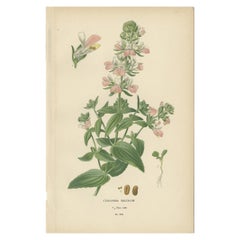
Artist: Nathaniel Wallich (Danish, 1786-1854)
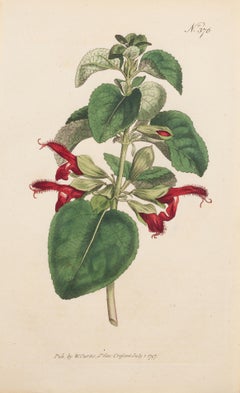
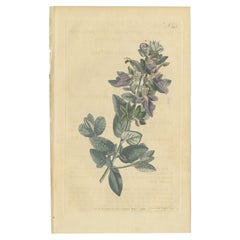
Title: "Salvia cana (Woolly Sage)" (Plate 116)
Portfolio: Plantae Asiaticae Rariores; or, Descriptions and Figures of a Select Number of Unpublished East Indian Plants
Year: 1830-1832
Medium: Original Hand-Colored Lithograph on J. Whatman paper
Limited edition: 254
Printer: Engelmann, Graf, Coindet & Co., London, UK
Publisher: Richard Taylor for Treuttel & Würtz, London, UK
Sheet size: 21.13" x 14.25"
Reference: Nissen BBI No. 2099; Pritzel No. 9957; Stafleu-Cowan No. 16583; Dunthorne No. 326
Condition: Some scattered tiny handling creases to sheet. Has been professionally stored away for decades. In excellent condition with strong colors
Rare
Notes:
Provenance: private collection - Aspen, CO. Lithography by Maltese artist Maxim Gauci (1774-1854) after a watercolor painting by Indian artist Gorachand (Active: Early 19th Century). Hand-coloring by English artist John Clark (Active: Early 19th Century). Comes from Wallich's three volume "Plantae Asiaticae Rariores; or, Descriptions and Figures of a Select Number of Unpublished East Indian Plants", (1830-2832), which consists of 294 hand-colored lithographs. Though printed on J. Whatman paper, this particular example has no watermark. Gold gilded edges as issued.
"Plantae Asiaticae Rariores" was published in London, Paris and Strassburg between 1829 and 1832 and consisted of 3 volumes bound from the 12 original parts in folio size with 294 hand-coloured plates lithographed by Maxim Gauci. Wallich went on extended leave in 1828 to supervise the printing and hand-colouring of the illustrations in England. Foremost of the watercolour artists who executed the original paintings were two Indian artists, Vishnupersaud, responsible for 114 plates and Gorachand for 87. Vishnupersaud (occasionally referred to as Vishnu Prasad) was an Indian artist frequently employed by naturalists working in India, such as John Forbes Royle and Francis Buchanan-Hamilton. Vishnupersaud's skill was legendary and Wilfrid Blunt included one of his watercolours in his book The Art of Botanical Illustration as displaying great craftsmanship. The remaining plates were done by Charles M. Curtis (7), William Griffith (3), Sarah Drake, and various others. A double-page engraved map of India created by John Arrowsmith, showed the routes followed by various botanists. A noteworthy point is that plate number 6 is an engraving by H. Weddell, and not a lithograph.
Wallich writes in the introduction, "The present Work consists of a selection of plants made chiefly from a series of 1200 drawings, executed under my direction by Native Artists." He goes on to praise the work of the lithographer Maxim Gauci and the colourist John Clark: "For both of these worthy men and admirable artists I beg to express my sincere respect."
Woolly Sage is a white-woolly-haired perennial of drier areas, growing only less than a foot high. Blue flowers occur in many separated whorls, in a spike at the top of the stem. Flowers are about 2.5 cm long, flower-tube not longer than the calyx. Sepals tube is sticky hairy, ribbed, 2-lipped with spine-tipped teeth. Bracts rounded, broader than long, abruptly pointed. Leaves are only at the base, narrow, oblong-lancelike, without a stalk, mostly 8-15 cm. The leaves are also densely white-woolly beneath, obscurely toothed. Woolly Sage is found in the Himalayas, from Pakistan to W. Nepal, at altitudes of 1500-3000 m. Flowering April-June.
Biography:
Nathaniel Wolff Wallich FRS FRSE (28 January 1786 – 28 April 1854) was a surgeon and botanist of Danish origin who worked in India, initially in the Danish settlement near Calcutta and later for the Danish East India Company and the British East India Company. He was involved in the early development of the Calcutta Botanical Garden, describing many new plant species and developing a large herbarium collection which was distributed to collections in Europe. Several of the plants that he collected were named after him.