Want more images or videos?
Request additional images or videos from the seller
1 of 5

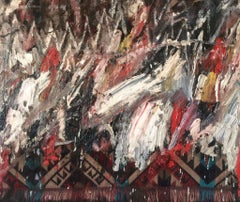
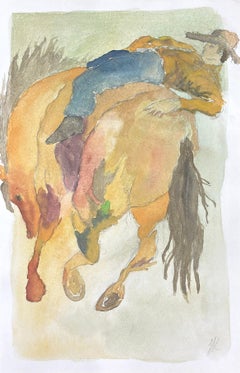
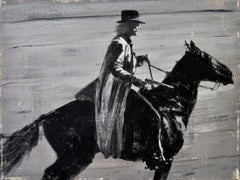
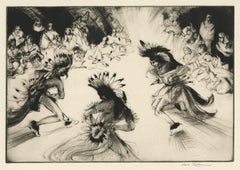
Thom Ross
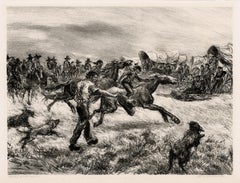
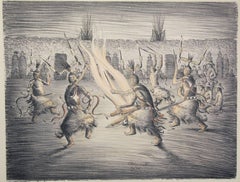
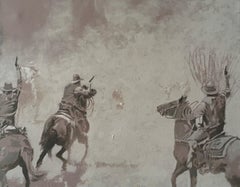
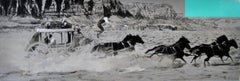
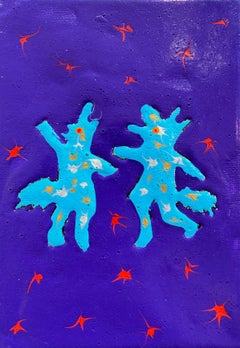
Victory Dance, Gun Fight at the OK Corral, ed. 4/50

Price:$1,100
$1,350List Price

You May Also Like

Indian Friendship Dance

Gene KlossIndian Friendship Dance, 1953

$2,500

H 8.19 in W 11.94 in

Indian Friendship Dance

By Gene Kloss

Located in Fairlawn, OH

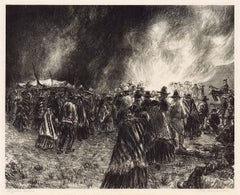
Indian Friendship Dance Drypoint, 1953 Signed in pencil lower right, (see photo) Edition 200 Published by The Society of American Graphic Artists, New York An impression is in the collection of SAAM, Washington and RISD Museum, Condition: Excellent Very rich impression with burr and selective whiping of the ink for atmospheric nocturnal effect. Image/Plate size: 8 3/16 x 11 15/16 inches Sheet size: 11 1/8 x 17 inches Reference: Kloss 450 "'Indian Friendship Dance' is an eloquent statement of something which Gene Kloss has both observed and participated in. It is an Indian dance that is thought of as entertainment, rather than ceremony, but it is essentially an idea expressed in action, and an idea that has universal meaning. The young men who dance wear costumes of exquisite workmanship, intricately wrought with beads and feathers and subtle combinations of colors. The dancers are trained from childhood but develop their own steps and exhibit distinctive strength and grace. Singers and a tom-tom accompany the dance and since it usually takes place at night, a campfire is the source of light. The conclusion occurs when all the onlookers, old and young and from many places, join hands with the dancers in a slow revolving movement, while those who can, sing the difficult but meaningful Indian song that flows with the rhythmical dance step and speaks of fellowship, brotherhood, friendship." - An excerpt from a descriptive statement, written by Lynd Ward, and distributed with the drypoint at the time of publication." Courtesy Old Print Shop Born Alice Glasier in Oakland, CA, Kloss grew up amid the worldly bustle of the San Francisco Bay Area. She attended the University of California at Berkeley, graduating with honors in art in 1924. She discovered her talents in intaglio printmaking during a senior-year course in figurative drawing. The professor, Perham Nahl, held up a print from Kloss’ first plate, still damp from the printing process, and announced that she was destined to become a printmaker. In 1925, Gene married Phillips Kloss, a poet and composer who became her creative partner for life. The match was uncanny, for in her own way Gene, too, was a poet and a composer. Like poetry, her artworks capture a moment in time; like music, her compositions sing with aesthetic harmony. Although she was largely self-taught, Kloss was a printmaking virtuoso. On their honeymoon the Klosses traveled east from California, camping along the way. They spent two week is Taos Canyon – with a portable printing press cemented to a rock near their campsite – where Gene learned to appreciate the wealth of artistic subject matter in New Mexico. The landscape, the cultures, and the immense sky left an indelible impression on the couple, who returned every summer until they made Taos their permanent home 20 years later. Throughout her life, Kloss etched more than 625 copper plates, producing editions ranging from five to 250 prints. She pulled every print in every edition herself, manually cranking the wheel of her geared Sturges press until she finally purchased a motorized one when she was in her 70s. Believing that subject matter dictated technique, she employed etching, drypoint, aquatint, mezzotint, roulette, softground, and a variety of experimental approaches, often combining several techniques on the same plate. She also produced both oil and watercolor paintings. Kloss’ artworks are filled with drama. Her prints employ striking contrasts of darkness and light, and her subjects are often illuminated by mysterious light sources. Though she was a devout realist, there is also a devout abstraction on Kloss’ work that adds an almost mythical quality. For six decades Kloss documented the cultures of the region-from images of daily life to those of rarely seen ceremonies. She and her husband shared a profound respect for the land and people, which made them welcome among the Native American and Hispanic communities. Kloss never owned a camera but relied instead on observation and recollection. Her works provide an inside look at the cultures she depicted yet at the same time communicate the awe and freshness of an outsider’s perspective. Although Kloss is best known for her images of Native American and Penitente scenes, she found artistic inspiration wherever she was. During the early years of their marriage, when she and Phil returned to the Bay Area each winter to care for their aging families, she created images of the California coast. And when the Klosses moved to southwestern Colorado in 1965, she etched the mining towns and mountainous landscapes around her. In 1970 the Klosses returned to Taos and built a house north of town. Though her artwork continued to grow in popularity, she remained faithful to Taos’ Gallery A, where she insisted that owner Mary Sanchez keep the prices of her work reasonable regardless of its market value. Kloss continued to etch until 1985, when declining health made printmaking too difficult. From her first exhibition at San Francisco’s exclusive Gump’s in 1937 to her 1972 election to full membership in the National Academy of Design, Kloss experienced a selective fame. She received numerous awards, and though she is not as well known as members of the Taos Society of Artists...

Category

1950s American Realist Figurative Prints

Materials

Drypoint

Cowboy Dancers

Kate BoxerCowboy Dancers, 2025

$1,059

H 11.03 in W 17.01 in D 0.04 in

Cowboy Dancers

Located in Deddington, GB

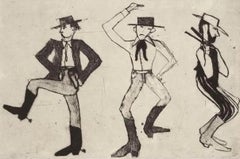
Cowboy dancers by Kate Boxer is a drypoint and carborundum print on paper. Additional information: Limited edition print Edition of 30 Signed by artist and inscribed with edit...

Category

21st Century and Contemporary Contemporary Figurative Prints

Materials

Drypoint

'Navajo Courtship Dance' — Southwest Regionalism, Native American Subject

'Navajo Courtship Dance' — Southwest Regionalism, Native American Subject

By Ira Moskowitz

Located in Myrtle Beach, SC

Ira Moskowitz, 'Navajo Courtship Dance (Squaw Dance)', lithograph, 1946, edition 30, Czestochowski 161. Signed and titled in pencil. Signed and dated in the stone, lower left. A fine...

Category

1940s American Modern Landscape Prints

Materials

Lithograph

Keresan Dancers

Gene KlossKeresan Dancers, 1962

$2,250

H 13.88 in W 10.88 in

Keresan Dancers

By Gene Kloss

Located in Fairlawn, OH

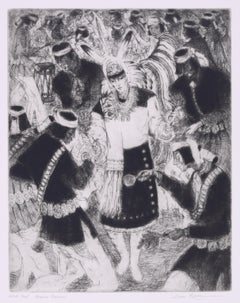
Keresan Dancers Etching & drypoint, 1962 Signed lower right (see photo) Inscribed lower left: "Artist's Proof Keresan Dancers" Depicts Keresan speaking peoples at Sam Felipe Pueblo Contemporary Puebloans are customarily described as belonging to either the eastern or the western division. The eastern Pueblo villages are in New Mexico along the Rio Grande and comprise groups who speak Tanoan and Keresan languages. Tanoan languages such as Tewa are distantly related to Uto-Aztecan, but Keresan has no known affinities. The western Pueblo villages include the Hopi villages of northern Arizona and the Zuni, Acoma, and Laguna villages, all in western New Mexico. Born Alice Glasier in Oakland, CA, Kloss grew up amid the worldly bustle of the San Francisco Bay Area. She attended the University of California at Berkeley, graduating with honors in art in 1924. She discovered her talents in intaglio printmaking during a senior-year course in figurative drawing. The professor, Perham Nahl, held up a print from Kloss’ first plate, still damp from the printing process, and announced that she was destined to become a printmaker. In 1925, Gene married Phillips Kloss, a poet and composer who became her creative partner for life. The match was uncanny, for in her own way Gene, too, was a poet and a composer. Like poetry, her artworks capture a moment in time; like music, her compositions sing with aesthetic harmony. Although she was largely self-taught, Kloss was a printmaking virtuoso. On their honeymoon the Klosses traveled east from California, camping along the way. They spent two week is Taos Canyon – with a portable printing press cemented to a rock near their campsite – where Gene learned to appreciate the wealth of artistic subject matter in New Mexico. The landscape, the cultures, and the immense sky left an indelible impression on the couple, who returned every summer until they made Taos their permanent home 20 years later. Throughout her life, Kloss etched more than 625 copper plates, producing editions ranging from five to 250 prints. She pulled every print in every edition herself, manually cranking the wheel of her geared Sturges press until she finally purchased a motorized one when she was in her 70s. Believing that subject matter dictated technique, she employed etching, drypoint, aquatint, mezzotint, roulette, softground, and a variety of experimental approaches, often combining several techniques on the same plate. She also produced both oil and watercolor paintings. Kloss’ artworks are filled with drama. Her prints employ striking contrasts of darkness and light, and her subjects are often illuminated by mysterious light sources. Though she was a devout realist, there is also a devout abstraction on Kloss’ work that adds an almost mythical quality. For six decades Kloss documented the cultures of the region-from images of daily life to those of rarely seen ceremonies. She and her husband shared a profound respect for the land and people, which made them welcome among the Native American and Hispanic communities. Kloss never owned a camera but relied instead on observation and recollection. Her works provide an inside look at the cultures she depicted yet at the same time communicate the awe and freshness of an outsider’s perspective. Although Kloss is best known for her images of Native American and Penitente scenes, she found artistic inspiration wherever she was. During the early years of their marriage, when she and Phil returned to the Bay Area each winter to care for their aging families, she created images of the California coast. And when the Klosses moved to southwestern Colorado in 1965, she etched the mining towns and mountainous landscapes around her. In 1970 the Klosses returned to Taos and built a house north of town. Though her artwork continued to grow in popularity, she remained faithful to Taos’ Gallery A, where she insisted that owner Mary Sanchez keep the prices of her work reasonable regardless of its market value. Kloss continued to etch until 1985, when declining health made printmaking too difficult. From her first exhibition at San Francisco’s exclusive Gump’s in 1937 to her 1972 election to full membership in the National Academy of Design, Kloss experienced a selective fame. She received numerous awards, and though she is not as well known as members of the Taos Society of Artists...

Category

1960s American Realist Figurative Prints

Materials

Drypoint

Dancing to a Memory Lithograph on Paper, Hand Signed, Edition of 300

Dancing to a Memory Lithograph on Paper, Hand Signed, Edition of 300

By Michael Cywink

Located in Aventura, FL

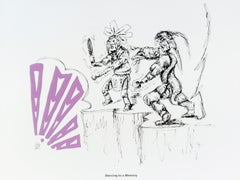
Lithograph on paper. Hand signed and numbered by the artist. Edition of 300. Certificate of Authenticity Included. Artwork in Excellent Condition. All reasonable offers will be ...

Category

Late 20th Century Contemporary Figurative Prints

Materials

Paper, Lithograph

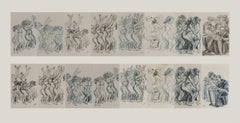
Dancers and Drummers

Dancers and Drummers

By Allan Rohan Crite

Located in New York, NY

Frieze format group of 16 color offset lithographs (each approximately 13 x 8 inches) presented as a collage (overall dimensions 28 x 64 inches). Each sheet is signed and dated by t...

Category

1980s American Modern Figurative Prints

Materials

Lithograph, Color

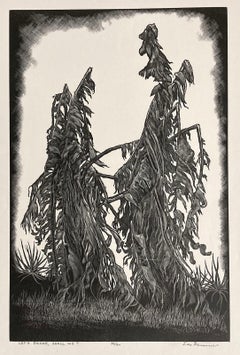
Leo Meissner, Let's Dance, Shall We?

Leo Meissner, Let's Dance, Shall We?

By Leo Meissner

Located in New York, NY

Detroit-born Leo Meissner lived in New York and was respected as a painter, draftsman, and illustrator, but is most known for his wood engravings. His ski...

Category

Mid-20th Century Modern Figurative Prints

Materials

Woodcut

The Dance - Drawing by George Martin - Mid 20th century

The Dance - Drawing by George Martin - Mid 20th century

Located in Roma, IT

The Dance is a drawing in ink and watercolor on paper realized in the mid-20th century by George Martin. The state of preservation is good. The artwork represents the dancing figur...

Category

Mid-20th Century Modern Figurative Prints

Materials

Ink, Watercolor

Apache Mountain Spirit Dancers, lithograph, Apache, Allan Houser Haozous black

Apache Mountain Spirit Dancers, lithograph, Apache, Allan Houser Haozous black

By Allan Houser

Located in Santa Fe, NM

Apache Mountain Spirit Dancers, lithograph, Apache, Allan Houser Haozous black Hand colored original lithograph edition by Allan Houser hand printed in Santa Fe, New Mexico Allan Houser (Haozous), Chiricahua Apache (1914-1994) Selected Collections Centre Georges Pompidou, Paris, France * “They’re Coming”, bronze Dahlem Museum, Berlin, Germany Japanese Royal Collection, Tokyo, Japan “The Eagle”, black marble commissioned by President William J. Clinton United States Mission to the United Nations, New York City, NY *"Offering of the Sacred Pipe”, monumental bronze by Allan Houser © 1979 Presented to the United States Mission to the United Nations as a symbol of World Peace honoring the native people of all tribes in these United States of America on February 27, 1985 by the families of Allan and Anna Marie Houser, George and Thelma Green and Glenn and Sandy Green in New York City. National Portrait Gallery, Smithsonian, Washington, DC * Portrait of Geronimo, bronze National Museum of American Art, Smithsonian, Washington, D.C. * “Buffalo Dance Relief”, Indiana limestone...

Category

1970s Contemporary Figurative Prints

Materials

Color Pencil, Lithograph

More From This Seller

View All
Cowboying

Cowboying

By Gordon McConnell

Located in Bozeman, MT

This is a framed original painting. Biography Creating paintings inspired by western movies and by Remington and Russell, he is a native of the West, having been born and raised in rural Colorado. He studied art at Baylor University in Waco, Texas; at the California Institute of the Arts in Valencia, and at the University of Colorado, Boulder where he earned a Master's Degree in 1979. For two decades he worked as curator at the Yellowstone Art Museum in Billings, Montana, before leaving in 1999 to begin work as a full-time painter and independent curator. His work is in the collections of the Buffalo Bill Historical Center in Cody, Wyoming; the Art Museum of Missoula; and the Yellowstone Art Museum; the Federal Reserve Bank in Helena, Montana; and the Deaconness Medical Center in Billings, Montana. Artist Statement For a long time, the images in my paintings have been identifiably, even iconically, western-stagecoaches and false-front main streets, poker games and gun battles, cowboys, Indians, cavalry troopers and horses, all suspended in a choreographed matrix of dancing paint. Distinct from the traditional western genre-which inventories the minutia of cowboy gear or tells sentimental stories of rangeland romance-my paintings embody something more elemental and timeless, animated and abstract. The images tend to be stark, graphic, and charged with painterly energy. Though they are derived from fugitive television images, the paintings, as paintings, are still, silent and non-ephemeral. They register the technological transfer of primal shadows onto the electroluminescent screens of our collective consciousness, a shimmering blur of perception and memory transposed in an interchange of gesture and description, painted marks simultaneously arresting and embodying movement. I've always liked what a painter friend, Marc Vischer, wrote in 1988 about an early group of my western paintings. Now, I'm fourteen years closer to actualizing my vision for this work, and his astute remarks seem more pertinent today than they did then. He wrote in part, "For McConnell, a searing light emanates from a new desert: that of television. And from that most desolate backdrop, he salvages fragments from a movie world that spoke of honor in a land that was lawless. In a romantic sense, McConnell's works are a visual seance. Figures, like specters distorted through intense heat waves, are captured from their eternity of 24 frames a second. Their shapes and shadows are brought back into a radically different world and given substance and texture. It is an impossible attempt to freeze them, to arrest the present's ceaseless molestation of the past, to close off the continuum. Sometimes this is done darkly and thickly as an emphatic gesture of permanence. In other works a few light strokes quickly applied suggest the ephemeral nature of film and perhaps the fleeting nature of our own lives." I have been examining new imagery in my paintings, drawing subjects from Mexican graphic novelas, modern women and men of romance and mystery from the mid-20th century, motorcycles and airplanes. The end titles of movies, stated in several languages, have inspired me to begin a new series of cross-media translations in both acrylic and watercolor. My paintings have long begun where the movies have left off. The elements of water and light co-mingle in some pieces from this series and in others which take the viewpoint of a swimmer, watching other swimmers from the wet side of this aqueous membrane, looking up toward the light. My arrival in Montana in 1982 brought me into intimate contact with some of the most storied places of the historic West and also gave me the opportunity to study the paintings of two of the most influential codifiers of western imagery, Frederic Remington and Charlie Russell...

Category

2010s Contemporary Figurative Paintings

Materials

Canvas, Acrylic

Leaping From the Box

Leaping From the Box

By Gordon McConnell

Located in Bozeman, MT

This is a framed painting on paper. Biography Creating paintings inspired by western movies and by Remington and Russell, he is a native of the West, having been born and raised in rural Colorado. He studied art at Baylor University in Waco, Texas; at the California Institute of the Arts in Valencia, and at the University of Colorado, Boulder where he earned a Master's Degree in 1979. For two decades he worked as curator at the Yellowstone Art Museum in Billings, Montana, before leaving in 1999 to begin work as a full-time painter and independent curator. His work is in the collections of the Buffalo Bill Historical Center in Cody, Wyoming; the Art Museum of Missoula; and the Yellowstone Art Museum; the Federal Reserve Bank in Helena, Montana; and the Deaconness Medical Center in Billings, Montana. Artist Statement For a long time, the images in my paintings have been identifiably, even iconically, western-stagecoaches and false-front main streets, poker games and gun battles, cowboys, Indians, cavalry troopers and horses, all suspended in a choreographed matrix of dancing paint. Distinct from the traditional western genre-which inventories the minutia of cowboy gear or tells sentimental stories of rangeland romance-my paintings embody something more elemental and timeless, animated and abstract. The images tend to be stark, graphic, and charged with painterly energy. Though they are derived from fugitive television images, the paintings, as paintings, are still, silent and non-ephemeral. They register the technological transfer of primal shadows onto the electroluminescent screens of our collective consciousness, a shimmering blur of perception and memory transposed in an interchange of gesture and description, painted marks simultaneously arresting and embodying movement. I've always liked what a painter friend, Marc Vischer, wrote in 1988 about an early group of my western paintings. Now, I'm fourteen years closer to actualizing my vision for this work, and his astute remarks seem more pertinent today than they did then. He wrote in part, "For McConnell, a searing light emanates from a new desert: that of television. And from that most desolate backdrop, he salvages fragments from a movie world that spoke of honor in a land that was lawless. In a romantic sense, McConnell's works are a visual seance. Figures, like specters distorted through intense heat waves, are captured from their eternity of 24 frames a second. Their shapes and shadows are brought back into a radically different world and given substance and texture. It is an impossible attempt to freeze them, to arrest the present's ceaseless molestation of the past, to close off the continuum. Sometimes this is done darkly and thickly as an emphatic gesture of permanence. In other works a few light strokes quickly applied suggest the ephemeral nature of film and perhaps the fleeting nature of our own lives." I have been examining new imagery in my paintings, drawing subjects from Mexican graphic novelas, modern women and men of romance and mystery from the mid-20th century, motorcycles and airplanes. The end titles of movies, stated in several languages, have inspired me to begin a new series of cross-media translations in both acrylic and watercolor. My paintings have long begun where the movies have left off. The elements of water and light co-mingle in some pieces from this series and in others which take the viewpoint of a swimmer, watching other swimmers from the wet side of this aqueous membrane, looking up toward the light. My arrival in Montana in 1982 brought me into intimate contact with some of the most storied places of the historic West and also gave me the opportunity to study the paintings of two of the most influential codifiers of western imagery, Frederic Remington and Charlie Russell...

Category

2010s Contemporary Figurative Paintings

Materials

Acrylic, Archival Paper

Dancing Coyotes

Dancing Coyotes

By Joe Fay

Located in Bozeman, MT

In 1993, a window of opportunity opened as a result of several different situations that were occurring. I was participating in an Artist-in-Residence program in Yellowstone Nationa...

Category

2010s Animal Paintings

Materials

Acrylic

Untitled Curio Appropriation No. 3

Untitled Curio Appropriation No. 3

By Patrick Dean Hubbell

Located in Bozeman, MT

Patrick Dean Hubbell is Dine' (Navajo). He is To'ahani'(Near to Water Clan), Born for Dibe'lizhini (Black Sheep), Maternal Grandfather is Kinyaa'aanii (Towering House People), Patern...

Category

2010s Abstract Abstract Paintings

Materials

Mixed Media

Gravity Is A Lie We Tell The Ground (Sketch 12)

Gravity Is A Lie We Tell The Ground (Sketch 12)

By Jess Kellner

Located in Bozeman, MT

Jess Kellner is a multi-disciplinary artist whose work has a strong focus on exploring the human condition. It’s a theme that you see in his artwork, which frequently captures the gr...

Category

2010s Contemporary Figurative Paintings

Materials

Watercolor

Colt Dragoon

Colt Dragoon

By Gordon McConnell

Located in Bozeman, MT

Biography Creating paintings inspired by western movies and by Remington and Russell, he is a native of the West, having been born and raised in rural Colorado. He studied art at Baylor University in Waco, Texas; at the California Institute of the Arts in Valencia, and at the University of Colorado, Boulder where he earned a Master's Degree in 1979. For two decades he worked as curator at the Yellowstone Art Museum in Billings, Montana, before leaving in 1999 to begin work as a full-time painter and independent curator. His work is in the collections of the Buffalo Bill Historical Center in Cody, Wyoming; the Art Museum of Missoula; and the Yellowstone Art Museum; the Federal Reserve Bank in Helena, Montana; and the Deaconness Medical Center in Billings, Montana. Artist Statement For a long time, the images in my paintings have been identifiably, even iconically, western-stagecoaches and false-front main streets, poker games and gun battles, cowboys, Indians, cavalry troopers and horses, all suspended in a choreographed matrix of dancing paint. Distinct from the traditional western genre-which inventories the minutia of cowboy gear...

Category

2010s Contemporary Figurative Paintings

Materials

Canvas, Acrylic