Want more images or videos?
Request additional images or videos from the seller
1 of 2

Alfred Gilbert
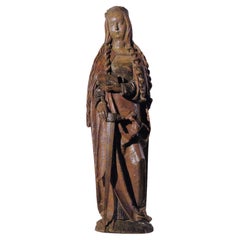
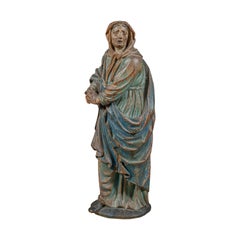
St Catherine (The Miraculous Wedding)

Circa 1898

$30,221.33
£23,980VAT Included
€26,211.17
CA$42,413.03
A$42,994.19
CHF 24,453.83
MX$523,360.70
NOK 286,819.67
SEK 287,520.66
DKK 195,928.58

About the Item

Alfred Gilbert (1854–1934) was probably the greatest and best known sculptor in pre-20th century British art. Works such as The Shaftesbury Memorial (Eros) located at the southeastern side of Piccadilly Circus, The Alexandra Memorial opposite St James Palace, and The Clarence Tomb at St George’s Chapel, Windsor are just a few of his public monuments. Gilbert was just nineteen years old when he joined the Royal Academy of Arts, where he was exposed to the influence of Lord Frederic Leighton and Aimé-Jules Dalou (at that time exiled in London and teaching at the South Kensington School of Art). In 1875 Gilbert moved to Paris, and then, three years later, to Rome. This contact with European arts was hugely influential, and the impact of the Italian Renaissance would continue as a thread throughout his career (Donatello's David (c. 1440s) and Cellini's Perseus with the Head of a Medusa (1545-1554) come to mind in Gilbert's work). Known as The Miraculous Wedding the present statuette depicts Saint Catherine and thus refers to both St Catherine of Alexandria, the 4th century Egyptian royal who converted to Christianity, and St Catherine of Siena, the 14th century Italian member of the Dominican Order. Both experienced visions in which they mystically wed the Christ child. The present bronze makes reference to each through the heavy veils which could variously be interpreted as those of the Egyptian royal or the Dominican nun, who were both frequently represented in the artistic tradition: imagery with which Gilbert would have been well acquainted. It was conceived by Gilbert in his working of figures of Saints to surround his masterpiece, the tomb of the Duke of Clarence (1892-1928), which dominates the Albert Memorial Chapel at Windsor Castle. Notably the present statuette stands on a base of swirling clouds and dragon scales which compares directly to the base of St George, the most celebrated Saint from the series. Additional casts are in the Birmingham Art Gallery and the Ashmolean Museum, Oxford, and one sold at Sotheby’s, London, 20 November 1997, lot 131. Alfred Gilbert’s work is held in major public collections around the world including in the Tate Gallery, London; The Victoria & Albert Museum, London; The Metropolitan Museum, New York; Detroit Institute of Arts and The Musée d'Orsay, Paris. Provenance: Ernst Beyeler, Paris, 1960s Private collection, UK Exhibitions: 1986: Alfred Gilbert: Sculptor of Eros, Royal Academy; 1978-1979: Victorian High Renaissance: George Frederick Watts (1817-1904); Frederic Leighton (1830-1896); Albert Moore (1841-1893); Alfred Gilbert (1854-1934), City Art Gallery, Manchester, UK; Minneapolis Institute of Arts; The Brooklyn Museum; 1909: Exhibition of Fair Women, International Society of Sculptors, Painters and Gravers, London, ref. no. 302 Literature: Robert Bowman, Sir Alfred Gilbert and the New Sculpture (London: The Fine Art Society, 2008); Robert Bowman, Craft and Creation (London: Robert Bowman Gallery, 2005), pp. 68-69; Anon, Gibson to Gilbert: British Sculpture 1840-1914, Exh. cat. (London: The Fine Art Society, 1992), No. 33; Richard Dorment, Alfred Gilbert: Sculptor and Goldsmith, Exh. cat. (London: Royal Academy, 1986), No. 98; Richard Dorment, Alfred Gilbert (London: Yale University Press, 1985), pp. 213-5; Anon, Victorian High Renaissance: George Frederick Watts 1817-1904; Frederick Leighton 1830-1896; Albert Moore 1841-1893; Alfred Gilbert 1854-1934 (Minneapolis: Minneapolis Institute of Arts, 1978); Anon, A Catalogue of the Pictures, Drawings, Prints and Sculptures in the Exhibition of Fair Women arranged by the International Society of Sculptors, Painters and Gravers (London: Ballantyne & Co Limited, 1909), p. 47
  • Creator:
    Alfred Gilbert (1854 - 1934, British)
  • Creation Year:
    Circa 1898
  • Dimensions:
    Height: 19.69 in (50 cm)Width: 10.24 in (26 cm)Depth: 9.85 in (25 cm)
  • Medium:
  • Movement & Style:
  • Period:
  • Condition:
  • Gallery Location:
    London, GB
  • Reference Number:
    1stDibs: LU2915217930262

More From This Seller

View All
Boulonnaise Carrying her Infant

Boulonnaise Carrying her Infant

By Aimé-Jules Dalou

Located in London, England

Aimé-Jules Dalou (1838-1902) was one of only a handful of leading late-nineteenth century French Sculptors, whose reputation was perhaps second only to his contemporaries, Henri Chap...

Category

1870s Victorian Figurative Sculptures

Materials

Bronze

Charity, also known as Maternity

Charity, also known as Maternity

By Aimé-Jules Dalou

Located in London, England

Aimé-Jules Dalou (1838-1902) was one of only a handful of leading late-nineteenth century French Sculptors, whose reputation was perhaps second only to his contemporaries, Henri Chapu (1833-1891) and Marius Jean Antonin Mercié (1845-1916). Dalou was hugely influential and was a founding member of the Société des Artistes Français and later a founder of the Société Nationale des Beaux-Arts. He was officially rewarded with the highest rank of the Légion d'Honneur two years before his death, with the inauguration of the Triumph of the Republic, in 1899. He started his artistic training in 1852 at the Petite Ecole after being encouraged to do so by Jean-Baptiste Carpeaux, where he studied drawing and modelling. Carpeaux continued to support Dalou throughout his career and influenced his sculpture greatly. Dalou began employment in the field of decorative sculpture working for two companies in Paris, Lefèvre and Favière goldsmiths. During this time he contributed towards the architectural features of Hôtel de la Païva, the then home of the infamous French courtesan Esther Lachmann known as La Païva. Dalou's unique approach lay in his broad range of subject, painterly and sculptural source material, though which he absorbed an impressive spectrum of inspiration. The work of an eighteenth-century sculptor, Louis-François Roubiliac, played a significant role in Dalou's artistic development, whose sculptures he studied whilst in London. Dalou's work includes friezes, maquettes, reliefs, and individual bronze figures. He is known for Baroque-inspired allegorical group compositions, as much as for his depictions of the French rural labouring classes. Dalou encouraged students of art to free themselves from the constraints of established traditions, with his style and teachings thought to have awakened a new generation of young British sculptors whose work was later aligned to the New Sculpture movement. Dalou’s first public commission in England was to create a large public fountain which still sits behind the Royal Exchange in London entitled Charity, featuring a mother and two children. This maquette is an early sketch, modelled in 1877. During his time in Britain, Dalou’s artistic focus shifted to increasingly domestic scenes that celebrated mothers and children of all social backgrounds. During a time when the Industrial Revolution was making life increasingly frenzied, more pastoral, idealised visions of a simpler life became an increasingly popular escape. It is thought that the shrinking of Dalou’s social circle during his exile to encompass his family and close friends prompted him to focus more on intimate family scenes such as this one. In Charity the mother and her children are fused together in their embrace. Dalou creates a sense of intimacy by focusing the mother’s gaze away from the viewer - the trio are entirely in their own world. Charity’s intended position at one of the city’s key financial centres would have acted as a provocative reminder of what Dalou considered the responsibilities owed to the poor of London by the ruling elite, as aligned with his socialist leanings. Provenance: Alfred Drury...

Category

1870s Victorian Figurative Sculptures

Materials

Bronze

Boulonnaise at Prayer

Boulonnaise at Prayer

By Aimé-Jules Dalou

Located in London, England

Aimé-Jules Dalou (1838-1902) was one of only a handful of leading late-nineteenth century French Sculptors, whose reputation was perhaps second only to his contemporaries, Henri Chapu (1833-1891) and Marius Jean Antonin Mercié (1845-1916). Dalou was hugely influential and was a founding member of the Société des Artistes Français and later a founder of the Société Nationale des Beaux-Arts. He was officially rewarded with the highest rank of the Légion d'Honneur two years before his death, with the inauguration of the Triumph of the Republic, in 1899. He started his artistic training in 1852 at the Petite Ecole after being encouraged to do so by Jean-Baptiste Carpeaux, where he studied drawing and modelling. Carpeaux continued to support Dalou throughout his career and influenced his sculpture greatly. Dalou began employment in the field of decorative sculpture working for two companies in Paris, Lefèvre and Favière goldsmiths. During this time he contributed towards the architectural features of Hôtel de la Païva, the then home of the infamous French courtesan Esther Lachmann known as La Païva. Dalou's unique approach lay in his broad range of subject, painterly and sculptural source material, though which he absorbed an impressive spectrum of inspiration. The work of an eighteenth-century sculptor, Louis-François Roubiliac, played a significant role in Dalou's artistic development, whose sculptures he studied whilst in London. Dalou's work includes friezes, maquettes, reliefs, and individual bronze figures. He is known for Baroque-inspired allegorical group compositions, as much as for his depictions of the French rural labouring classes. Dalou encouraged students of art to free themselves from the constraints of established traditions, with his style and teachings thought to have awakened a new generation of young British sculptors whose work was later aligned to the New Sculpture movement. This rough plaster model was kept in the studio of Alfred Drury...

Category

1870s Victorian Figurative Sculptures

Materials

Plaster

Griselda

Griselda

Located in London, England

Alfred Drury's (1856-1944) body of work locates him as a leading figure in the New Sculpture movement, yet his position as an innovator and conduit betwee...

Category

1890s Victorian Figurative Sculptures

Materials

Bronze

The Milkmaid

The Milkmaid

By Aimé-Jules Dalou

Located in London, England

Aimé-Jules Dalou (1838-1902) was one of only a handful of leading late-nineteenth century French Sculptors, whose reputation was perhaps second only to his contemporaries, Henri Chap...

Category

1890s Victorian Figurative Sculptures

Materials

Bronze

You May Also Like

Saint Catherine of Alexandria

Saint Catherine of Alexandria

Located in Saint-Ouen, FR

SAINT CATHERINE OF ALEXANDRIA ORIGIN : SWABIA, ULM REGION PERIOD : ca. 1510-1520 Height : 118 cm Length : 39 cm Depth : 17 cm Limewood...

Category

Antique 16th Century Figurative Sculptures

Materials

Wood

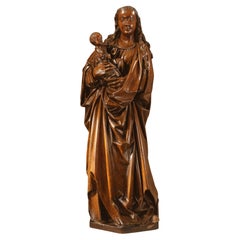
Gothic Virgin and Child from Flanders

Gothic Virgin and Child from Flanders

Located in Saint-Ouen, FR

Exhibition Museum Cantini, 1952, The art of the Middle Ages in the Marseille collections, n°101 Provenance Former collection Louis Bresset (before 1952) Former collection Profe...

Category

Antique 15th Century and Earlier Dutch Gothic Figurative Sculptures

Materials

Oak

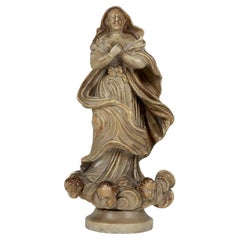
Virgin Of The Immaculate Conception, 18th-century Luso-brazilian Sculpture

Virgin Of The Immaculate Conception, 18th-century Luso-brazilian Sculpture

Located in Gorssel, GE

Nossa Senhora da Conceição (The Immaculate Conception) Brazil (Minas Gerais), 18th century, or Luso-Brazilian Carved steatite (pedra sabão) with traces of original polychromy; mounte...

Category

Antique 18th Century Brazilian Baroque Figurative Sculptures

Materials

Soapstone

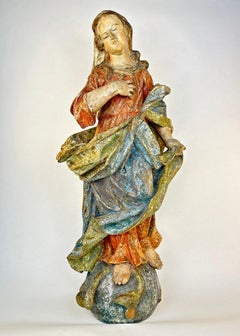
Mary, Mother of God, South German Master circa 1760, Carved Wood

Mary, Mother of God, South German Master circa 1760, Carved Wood

Located in Eltville am Rhein, DE

Madonna, Mary Mother of God South Germany, circa 1760 Linden wood, painted Dimensions: 69 x 32 x 21 cm Painting damaged in places Authenticity guaranteed in writing

Category

1760s Baroque Figurative Sculptures

Materials

Wood

Baroque Italian master - 17/18th century figure sculpture - The Virgin

Baroque Italian master - 17/18th century figure sculpture - The Virgin

Located in Varmo, IT

Italian sculptor (17th–18th century) - Praying Madonna. 25 x 20 x h 65 cm. Full-round figure in carved, lacquered and painted wood. The sculpture depicts the Virgin Mary in a pra...

Category

Late 17th Century Baroque Figurative Sculptures

Materials

Wood, Paint