Want more images or videos?
Request additional images or videos from the seller
1 of 3

Augustus Saint-Gaudens
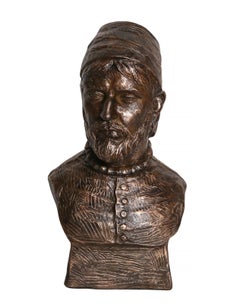
"Jules Bastien LePage" Augustus Saint-Gaudens, Bas Relief of French Painter

$18,000
£13,609.66
€15,934
CA$25,609.54
A$26,049.57
CHF 14,949.80
MX$313,146.42
NOK 174,388.79
SEK 176,030.50
DKK 119,121.15

About the Item

Augustus Saint-Gaudens Jules Bastien LePage Bronze 14 1/4 x 10 1/8 inches Augustus Saint-Gaudens was born in 1848 in Dublin, Ireland. His father, Bernard, was a shoemaker from Aspet in Gascony, France, who married an Irishwoman, Mary McGuiness. A few months after Augustus' birth, the family emigrated to the United States to escape the famine, settling in New York City. In 1861 Augustus began his apprenticeships to French cameo cutters in New York, first in the studio of Louis Avet and later, in 1864, with Jules Le Brethon. He also attended classes at the National Academy of Design and the Cooper Union. Early in 1867, with his parents' backing, Saint-Gaudens embarked for Paris. Supporting himself as a cameo cutter, he studied first at the Ecole gratuite de Dessin (Petite Ecole) and, beginning in 1868, in the atelier of the sculptor François Jouffroy (1806-1882), who recommended his admission to the Ecole des Beaux-Arts. Saint-Gaudens became one of the first Americans to study sculpture at the Ecole. In November of 1870, the Franco-Prussian War prompted Saint-Gaudens to move to Rome, where he began modeling Hiawatha (marble, 1874-1875; private collection) and made cameos and busts of American visitors. With assistance from one patron, Montgomery Gibbs, he returned to New York in September 1872 and began work on trademark panels for the Adams Express Building in Chicago. He taught his younger brother Louis (1854-1913) cameo cutting, and the two went to Rome together in 1873. Augustus modeled a number of portrait busts and copies after the antique, produced in marble in collaboration with Louis and other assistants. But he was above all a modeler whose greatest achievements would be realized in bronze. In 1874 he became engaged to Augusta Homer, who was in Rome studying painting. Seeking commissions that would provide security for his marriage, Saint-Gaudens returned to New York in 1875, where he designed ornamental metalwork for Tiffany Studios. Around that time he met the painter John LaFarge (1835-1910) and the architects Stanford White (1854-1906) and Charles McKim (1847-1909), who became life-long friends and collaborators. La Farge encouraged Saint-Gaudens to try modeling portrait reliefs and to seek the commission for a monument to Admiral Farragut planned for Madison Square Park. He secured the Farragut commission in 1876. In 1876-1877 he also obtained commissions for tombs and monuments and, with La Farge's help and collaboration, for the reredos for Saint Thomas' Church (polychrome cement composition relief panels, 1877; destroyed by fire in 1905). After a sketch of his was rejected for the National Academy of Design exhibition, Saint-Gaudens joined Richard and Helena Gilder and others in founding the Society of American Artists. He finally married Augusta Homer on 4 June 4 1877; they left for Paris two days later. In Paris Saint-Gaudens began modeling the portraits in low relief, which would become a leitmotiv of his career, and worked on the Farragut Monument. Stanford White, who came to live with the newlyweds, collaborated on designs for the base, the first of many such projects. With its allusions to Donatello's Saint George (c. 1416-1417, Florence, Museo Nazionale del Bargello), the Farragut Monument evoked the style of the Italian Renaissance as well as the French Ecole des Beaux-Arts, spurning the neo-classicism that had prevailed in American monuments. It was completed in 1880, just as Saint-Gaudens' son Homer (1880-1958) was born, and unveiled in 1881. Its quality and innovative character won Saint-Gaudens his first great public success. Numerous commissions followed in the 1880s and 1890s. These included two major interior decorative projects for New York mansions between 1881 and 1883: the home of Cornelius Vanderbilt II (mantelpiece preserved in the Metropolitan Museum of Art, New York) and the Henry Villard House. The latter was designed by McKim, Mead, and White, with sculpture executed by Louis Saint-Gaudens under his brother's direction. Monument commissions included The Puritan for Merrick Park in Springfield, Massachusetts (1883-1886), and the standing statue of Abraham Lincoln for Lincoln Park, Chicago (1884-1887). An eighteen-foot statue of a nude Diana (1886-1891), made of gilded sheet copper to stand as a weather vane atop Stanford White's Madison Square Garden, proved too large and was replaced by a thirteen-foot version (1892-1894, Philadelphia Museum of Art). Simultaneously he worked on his most celebrated funerary monument, the Adams Memorial (1886-1891, Rock Creek Cemetery, Washington, D.C.), designed by Stanford White. The heavily veiled, seated figure, with its shadowed, introspective face, summons myriad emotions only beginning with grief for Marion Adams, the wife of historian Henry Adams, who committed suicide in 1885. Diana and the Adams Memorial statues, at opposite ends of the expressive spectrum, share an ideal of beauty that came to life for the sculptor in his model Davida Johnson Clark, who became his mistress in the early 1880s, and bore him a son, Louis P. Clark, in 1889. Aside from Diana, works that are generally recognized as portraits of Davida include the much-admired Amor Caritas, an entranced, standing winged woman in richly modeled drapery, executed in variously sized bronze high reliefs, beginning in 1898. This figure was evidently conceived around 1880 for the tomb of Edward D. Morgan (unfinished, models destroyed), employed for the Vanderbilt mantelpiece caryatids in 1881-1883, and perfected on the tomb of Anna Maria Smith (1897, Newport, Rhode Island; signed by Louis Saint-Gaudens). Arguably Saint-Gaudens' masterpiece is the Shaw Memorial on Boston Common, in progress from 1884 to 1897, combining statuary and high relief in bronze. It commemorates the young Colonel Robert Gould Shaw and the regiment of African-American volunteers who died in great numbers with him in a heroic assault on Fort Wagner, South Carolina, in 1863. Saint-Gaudens' gifts for portraiture, cadenced composition, and reserved expression calling forth projected emotions make this an exceptionally powerful war memorial. His last great public commission was the Sherman Monument of 1892-1903 on Grand Army Plaza in Central Park, New York, with a statue of General William Tecumseh Sherman on horseback led forward by a winged Victory. In his peripatetic career Saint-Gaudens shuttled between Paris, Rome, his New York studio, and the one at his country estate of Aspet, in Cornish, New Hampshire, which was purchased in 1891 and named for the French town where his father was born. Diagnosed with cancer in 1900, he continued working with the help of assistants, recovering from a disastrous studio fire in 1904 and persevering until his death in Cornish in 1907. His late productions included the Stevenson Memorial of 1902 for Saint Giles' Cathedral, Edinburgh, incorporating a version of the famous portrait relief of Robert Louis Stevenson that he had modeled in 1887. In 1905-1907 he designed a new classical coinage for the United States mint, including ten-dollar and twenty-dollar gold pieces.
  • Creator:
    Augustus Saint-Gaudens (1848 - 1907, American)
  • Dimensions:
    Height: 14.25 in (36.2 cm)Width: 10.125 in (25.72 cm)
  • Medium:
  • Movement & Style:
  • Period:
  • Condition:
  • Gallery Location:
    New York, NY
  • Reference Number:
    1stDibs: LU1841215173022

More From This Seller

View All
"Stepping Out" Margarett W. McKean Sargent, Female Figure, Emerging Forms

"Stepping Out" Margarett W. McKean Sargent, Female Figure, Emerging Forms

Located in New York, NY

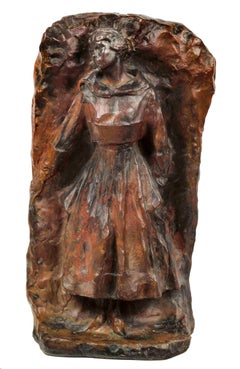
Margarett W. McKean Sargent Stepping Out, 1916 Signed and dated on base Bronze 14 x 6 x 8 inches Provenance Private Collection, Hingham, Massachusetts Walker-Cunningham Fine Art, St. Louis, Missouri, 2007 Exhibited New York, Hawthorne Fine Art...

Category

Early 1900s Ashcan School Figurative Sculptures

Materials

Bronze

"Portrait of an Italian Fencer, " John Frederick Kensett, Hudson River School

"Portrait of an Italian Fencer, " John Frederick Kensett, Hudson River School

By John Frederick Kensett

Located in New York, NY

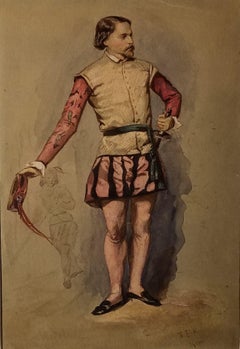
John Frederick Kensett (1816 - 1872) Portrait of an Italian Fencer, circa 1845-47 Watercolor on wove paper 13 1/8 x 8 1/8 inches Signed with initials and inscribed lower right "J.F.K. Rome" From October 1845 through the spring of 1847, Kensett lived in Rome. He attended classes where he sketched from live models, and he sketched in the countryside outside Rome and around Florence, Perugia, and Venice, places he visited with his artist friends. He fulfilled commissions for paintings from Americans in Italy, and by 1847 his career was well established. Son of an English immigrant engraver, John Kensett lacked enthusiasm for that medium and became one of the most accomplished painters of the second generation of Hudson River School painters. His reputation is for Luminism, careful depiction of light, weather, and atmosphere as they affect color and texture of natural forms. He was particularly influenced by the painting of Asher Durand in that he focused on realism and detail rather than the highly dramatic views associated with Thomas Cole. Going to the western United States in the mid 1850s and the 1860s, he was the first of the Hudson River School painters to explore and paint the West. Kensett was born and raised in Cheshire, Connecticut, and learned his engraving from his father, Thomas Kensett with whom he worked in New Haven, Connecticut until 1829. He continued working until 1840 as an engraver of labels, banknotes and maps and was employed part of that time by the American Bank Note Company in New York City. There he met Thomas Rossiter, John Casilear, and other artists who urged him to pursue painting. In 1840, he and Rossiter, Asher Durand, and Casilear went to Europe where Kensett stayed for seven years and supported himself by doing engraving but became accomplished in landscape painting. Having sent canvases of Italian landscapes back to New York, he had a reputation for skillful painting that preceded him. When he returned to New York City in 1847, he was an "instant success" and very sought after by collectors. Two of his Italian landscapes had already been purchased by the American Art Union. By 1849, he was a full member of the National Academy of Design and was generally popular among his peers. His studio was a gathering place with travelers stopping by to see his canvases and to identify "precise locations in the Catskills or Newport or New England in the oil sketches and drawings that covered his walls." (Zellman 170). For the women, he was a popular bachelor, "romantic looking with high forehead and sensitive expression." (Samuels 262) He was also sought after by many organizations. Among his activities were serving on the committee to oversee the decoration of the United States Capitol in Washington DC, and becoming one of the founders of the Metropolitan Museum in New York. An inveterate traveler, Kensett spent summers on painting excursions away from New York City. One of these trips was a special painting excursion with fifteen other artists sponsored by the B & O Railroad from Baltimore, Maryland to Wheeling, West Virginia. Unlike many of the Hudson River painters...

Category

1840s Hudson River School Figurative Paintings

Materials

Paper, Watercolor

"Portrait of Louis Prang" William Merritt Chase, Impressionist Portrait

"Portrait of Louis Prang" William Merritt Chase, Impressionist Portrait

By William Merritt Chase

Located in New York, NY

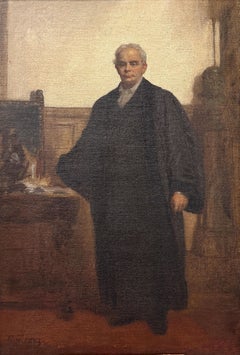
William Merritt Chase Portrait of Louis Prang, 1884 Signed center right "WM M Chase" Oil on canvas 41 1/2 x 30 1/2 inches Provenance The artist Louis Prang Gift from the sitter to R...

Category

1880s American Impressionist Figurative Paintings

Materials

Canvas, Oil

You May Also Like

Locomotive Engineer, Early 20th Century Bronze Laborer, Cleveland School

Locomotive Engineer, Early 20th Century Bronze Laborer, Cleveland School

By Max Kalish

Located in Beachwood, OH

Max Kalish (American, 1891-1945) Locomotive Engineer, 1926 Bronze Signed and dated on base, foundry mark: Meroni Radice Cire Perdue Paris 15.5 x 6 x 5 inches Born in Poland March 1, 1891, figurative sculptor Max Kalish came to the United States in 1894, his family settling in Ohio. A talented youth, Kalish enrolled at the Cleveland Institute of Art as a fifteen-year-old, receiving a first-place award for modeling the figure during studies with Herman Matzen. Kalish went to New York City following graduation, studying with Isidore Konti and Herbert Adams...

Category

1920s Figurative Sculptures

Materials

Bronze

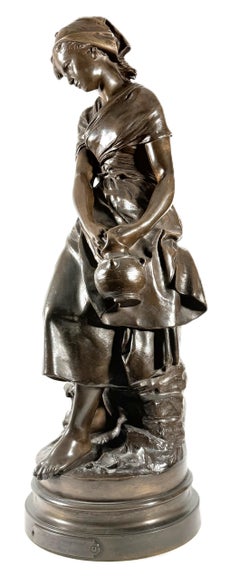
Beautiful late 19th-century bronze sculpture by Mathurin Moreau

Beautiful late 19th-century bronze sculpture by Mathurin Moreau

By Mathurin Moreau

Located in Berlin, DE

Beautiful late 19th-century bronze sculpture by Mathurin Moreau "YOUNG WOMAN ON A ROCK" BY MATHURIN MOREAU (1822-1912) Young girl with a broken jug, Bronze circa 1880/1890, France ...

Category

Late 19th Century Jugendstil Figurative Sculptures

Materials

Bronze

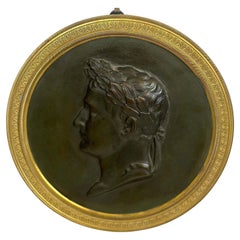
19th Century Bronze Neoclassical Relief Plaque of Napoleon

19th Century Bronze Neoclassical Relief Plaque of Napoleon

Located in Los Angeles, CA

Important 19th Century bronze relief plaque depicting Napoleon's historic 'Baptism of the King of Rome' portrait after the work of the great medalist Bertrand Andrieu. Dimensions: 8...

Category

Antique 19th Century French Historical Memorabilia

Materials

Bronze

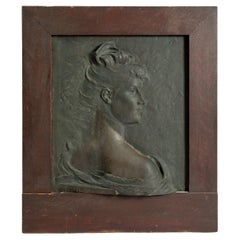
Paul Du Bois: Art-Nouveau bas-reliëf in bronze, casted Peterman Brussels

Paul Du Bois: Art-Nouveau bas-reliëf in bronze, casted Peterman Brussels

By Paul Dubois

Located in Zemst, BE

A Plaquettte in casted bronze by Paul Du Bois (often written as Paul Dubois) (1859-1938) Representing a profile of a lady. Belgian art-nouveau artist, pupil of the famous Charles V...

Category

Early 20th Century Belgian Art Nouveau Sculptures and Carvings

Materials

Bronze