Want more images or videos?
Request additional images or videos from the seller
1 of 5

Olaf Wieghorst
Campfire and Buffalo Skull

You May Also Like

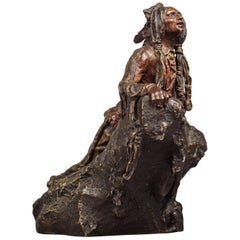
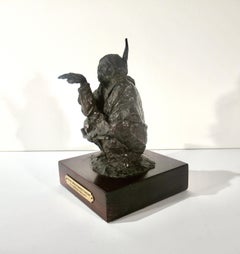
Speaks with Forked Tongue

Speaks with Forked Tongue

By Gordon Phillips

Located in San Francisco, CA

This artwork titled "Speaks with a forked tongue" c. 1970, is a bronze sculpture by renown American Western artist Gordon Dale Phillips, 1927-2011. It is signed and numbered 37/40 on...

Category

Late 20th Century American Realist Figurative Sculptures

Materials

Bronze

Somewhere on the Reservation, Bronze, Sculpture, Allan Houser, Apache, Singer

Somewhere on the Reservation, Bronze, Sculpture, Allan Houser, Apache, Singer

By Allan Houser

Located in Santa Fe, NM

Somewhere on the Reservation, Bronze,Sculpture, by Allan Houser, Apache, Singers Allan Houser (Haozous), Chiricahua Apache 1914-1994 recipient of the National Medal of Arts in 1992. Allan Houser's father Sam, was part of the small band of Apaches who traveled with Geronimo and surrendered in southern Arizona in 1886. Allan's parents were imprisoned with that group in Ft. Sill, Oklahoma. He was the first child to be born in freedom to those Apaches and a fluent speaker of the Chiricahua language. Allan Houser is an important artist in that he is of the culture he depicts in his artwork. Allan's parents would tell stories and sing songs recalling the experiences on the warpath. Our gallery represented Allan Houser from 1974 until his passing in 1994 and were investors and provided quality control in the foundry process. Allan Houser's work is many international collections including the Georges Pompidou Centre, The Smithsonian National Portrait Gallery, The Dahlem Museum among others. Allan Houser (Haozous), Chiricahua Apache (1914-1994) Selected Collections Centre Georges Pompidou, Paris, France * “They’re Coming”, bronze Dahlem Museum, Berlin, Germany Japanese Royal Collection, Tokyo, Japan “The Eagle”, black marble commissioned by President William J. Clinton United States Mission to the United Nations, New York City, NY *"Offering of the Sacred Pipe”, monumental bronze by Allan Houser © 1979 Presented to the United States Mission to the United Nations as a symbol of World Peace honoring the native people of all tribes in these United States of America on February 27, 1985 by the families of Allan and Anna Marie Houser, George and Thelma Green and Glenn and Sandy Green in New York City. National Portrait Gallery, Smithsonian, Washington, DC * Portrait of Geronimo, bronze National Museum of American Art, Smithsonian, Washington, D.C. * “Buffalo Dance Relief”, Indiana limestone National Museum of the American Indian, Smithsonian, Washington, D.C. *Sacred Rain Arrow, (Originally dedicated at the US Senate Committee on Indian Affairs, US Senate Building) “Goat”, “To The Great Spirit” - dedicated in 1994 at the Vice President’s Residence in Washington, D.C.. Ceremony officiated by Hillary Rodham Clinton and Tipper Gore. Oklahoma State Capitol, Oklahoma City, Ok * “As Long As the Waters Flow”, bronze Gilcrease Museum, Tulsa, OK *Sacred Rain Arrow, bronze Fort Sill, Oklahoma *”Chiricahua Apache Family”, bronze Donated and dedicated to Allan Houser’s parents Sam and Blossom Haozous by Allan Houser and Glenn and Sandy Green The Heard Museum, Phoenix, Arizona *Earth Song, marble donated by Glenn and Sandy Green The Clinton Presidential Library, Arkansas * “May We Have Peace”, bronze The George H.W. Bush Presidential Library, College Station, Texas *"Offering to the Great Spirit", bronze The British Royal Collection, London, England *Princess Anne received "Proud Mother", bronze in Santa Fe Allan Houser’s father Sam Haozous, surrendered at the age of 14 with Geronimo and his band of Warm Springs Chiricahua Apache people in 1886 in Southern Arizona. This was the last active war party in the United States. This group of Apache people was imprisoned for 27 years starting in Fort Marion, Florida and finally living in captivity in Fort Sill, Oklahoma. Allan Houser was born in 1914. His artwork is an ongoing testimony to Native life in America – its beauty, strength and poignancy. Allan Houser is from the culture and portrayed his people in an insightful and authentic way. Because of the era in which he lived, he had a rare understanding of American Indian life. Allan was the first child born after the Chiricahua Apaches were released from 27 years of captivity. Allan grew up speaking the Chiricahua dialect. Allan heard his father’s stories of being on the warpath with Geronimo and almost nightly heard his parents singing traditional Apache music. Allan’s father knew all of Geronimo’s medicine songs. Allan had an early inclination to be artistic. He was exposed to many Apache ceremonial art forms: music, musical instruments, special dress, beadwork, body painting and dynamic dance that are integral aspects of his culture. His neighbors were members of many different tribes who lived in Oklahoma. Allan eagerly gained information about them and their cultures. Allan gathered this information and mentally stored images until he brought them back to life, years later, as a mature artist. Allan Houser was represented by Glenn Green Galleries (formerly known as The Gallery Wall, Inc.) from 1973 until his death in 1994. The gallery served as agents, advocates, and investors during this time. In 1973 the Greens responded enthusiastically to the abstraction and creativity in Houser’s work. They were impressed, not only with his versatility and talent but with the number of mediums he employed. His subject matter was portrayed in styles ranging from realism, stylized form to abstraction. With encouragement from the Greens, Houser at the age of 61, retired from his post as the head of the sculpture department at the Institute of American Indian Arts in Santa Fe, New Mexico in 1975 to begin working full-time creating his art. The next 20-year period was an exciting time for Allan, the gallery, and for the Green family. He created a large body of sculpture in stone, wood and bronze. For many years Glenn Green Galleries co-sponsored many editions of his bronzes and acted as quality control for the bronze sculptures according to Houser’s wishes. As both agents and gallery representatives, the Greens promoted and sold his art in their galleries in Phoenix and Scottsdale, Arizona and in Santa Fe, New Mexico. They had bi-annual exhibits in their galleries to feature Houser’s newest work and sponsored and arranged international museum shows in America, Europe and Asia. They travelled for these events including a trip to Carrara, Italy to the famed quarries of Michelangelo and together co-financed and arranged the purchase of 20 tons of marble. A watershed event for Allan Houser’s career occurred in the early 1980’s when Glenn Green Galleries arranged with the US Information Agency a touring exhibit of his sculpture through Europe. This series of exhibits drew record attendance for these museums and exposed Houser’s work to an enthusiastic art audience. This resulted in changing the perception of contemporary Native art in the United States where Houser and Glenn Green Galleries initially faced resistance from institutions who wanted to categorize him in a regional way. The credits from the European exhibits helped open doors and minds of the mainstream art community in the United States and beyond. Senator Daniel Inouye of Hawaii was a supporter of Allan Houser’s artwork. We worked with Senator Inouye on many occasions hosting events at our gallery and in Washington D.C in support of the formation of the Smithsonian’s National Museum of the American Indian in Washington, D.C. and other causes supporting Native Americans. Allan Houser is shown below presenting his sculpture “Swift Messenger” to Senator Inouye in Washington, D.C.. This sculpture was eventually given to the National Museum of the American Indian, Smithsonian’s permanent collection. It is now currently on loan and on display in the Oval Office. President Biden’s selection of artwork continues our gallery’s and Allan’s connection to the White House from our time working with Allan Houser from 1974 until his passing in 1994. “It was important for President Biden to walk into an Oval that looked like America and started to show the landscape of who he is going to be as president,” Ashley Williams...

Category

1970s Contemporary Figurative Sculptures
Materials

Bronze

Victor Hugo Castañeda Bronze Sculpture, Mexico 1988, Edition 1/20

Victor Hugo Castañeda Bronze Sculpture, Mexico 1988, Edition 1/20

By Victor Hugo Castaneda

Located in Los Angeles, CA

Rare bronze sculpture by renowned Mexican artist Victor Hugo Castañeda (b. 1947), signed and dated Victor H. Castañeda, 1988, and marked Edition 1 of 20. This intimate and contemplat...

Category

Vintage 1980s Canadian Aesthetic Movement Figurative Sculptures

Materials

Bronze

After the Dance, bronze sculpture, realism, Native American, Man, Woman, Embrace

After the Dance, bronze sculpture, realism, Native American, Man, Woman, Embrace

By Allan Houser

Located in Santa Fe, NM

After the Dance, bronze sculpture, realism, Native American, Man, Woman, Embrace limited bronze edition, lifetime casting Allan Houser (Haozous), Chiricahua Apache (1914-1994) Selected Collections Centre Georges Pompidou, Paris, France * “They’re Coming”, bronze Dahlem Museum, Berlin, Germany Japanese Royal Collection, Tokyo, Japan “The Eagle”, black marble commissioned by President William J. Clinton United States Mission to the United Nations, New York City, NY *"Offering of the Sacred Pipe”, monumental bronze by Allan Houser © 1979 Presented to the United States Mission to the United Nations as a symbol of World Peace honoring the native people of all tribes in these United States of America on February 27, 1985 by the families of Allan and Anna Marie Houser, George and Thelma Green and Glenn and Sandy Green in New York City. National Portrait Gallery, Smithsonian, Washington, DC * Portrait of Geronimo, bronze National Museum of American Art, Smithsonian, Washington, D.C. * “Buffalo Dance Relief”, Indiana limestone National Museum of the American Indian, Smithsonian, Washington, D.C. *Sacred Rain Arrow, (Originally dedicated at the US Senate Committee on Indian Affairs, US Senate Building) “Goat”, “To The Great Spirit” - dedicated in 1994 at the Vice President’s Residence in Washington, D.C.. Ceremony officiated by Hillary Rodham Clinton and Tipper Gore. Oklahoma State Capitol, Oklahoma City, Ok * “As Long As the Waters Flow”, bronze Gilcrease Museum, Tulsa, OK *Sacred Rain Arrow, bronze Fort Sill, Oklahoma *”Chiricahua Apache Family”, bronze Donated and dedicated to Allan Houser’s parents Sam and Blossom Haozous by Allan Houser and Glenn and Sandy Green The Heard Museum, Phoenix, Arizona *Earth Song, marble donated by Glenn and Sandy Green   The Clinton Presidential Library, Arkansas * “May We Have Peace”, bronze The George H.W. Bush Presidential Library, College Station, Texas *"Offering to the Great Spirit", bronze The British Royal Collection, London, England *Princess Anne received "Proud Mother", bronze in Santa Fe Allan Houser’s father Sam Haozous, surrendered at the age of 14 with Geronimo and his band of Warm Springs Chiricahua Apache people in 1886 in Southern Arizona. This was the last active war party...

Category

1970s Figurative Sculptures

Materials

Bronze

Patinated Bronze Figure of a Native American Scout by Carl Kauba, circa 1910

Patinated Bronze Figure of a Native American Scout by Carl Kauba, circa 1910

By Carl Kauba

Located in Brighton, West Sussex

A fine patinated bronze figure of a Native American scout by Carl Kauba. Austrian, circa 1910. Signed in the cast 'Carl Kauba'. The figure cast as an American Native scou...

Category

Early 20th Century Austrian Figurative Sculptures

Materials

Bronze

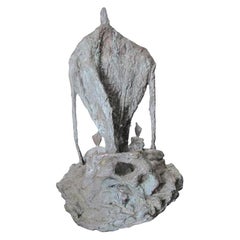
Bronze Sculpture "Sanctuaire des Solitudes" 1999, by Catherine Val

Bronze Sculpture "Sanctuaire des Solitudes" 1999, by Catherine Val

By Catherine Val

Located in Saint-Ouen, FR

Unique piece, Lalloz Foundry. Bibliography: Invitation aux Journées du Patrimoine, Jardin Toulaho (Le Caron, architecte), Clamart, 2000.  

Category

20th Century French Abstract Sculptures

Materials

Bronze

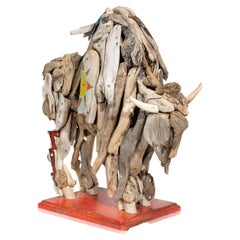
Driftwood Buffalo "Teton Warrior" Sculpture by Tina Milsavljevich

Driftwood Buffalo "Teton Warrior" Sculpture by Tina Milsavljevich

By Tina Milsavljevich

Located in Coeur d'Alene, ID

Large driftwood buffalo. Natural ends with scrap yard steel by a Montana artist. 21” x 20” x 9” Period: Contemporary Origin: Montana, United States Size: 21” x 20” x 9” Tina ...

Category

2010s American Animal Sculptures

Materials

Driftwood

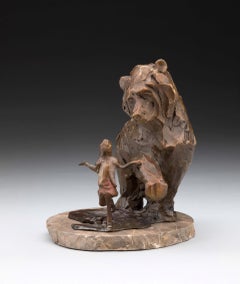
"A Likely Story" (2020) By Linda Prokop, Original Bronze Sculpture

"A Likely Story" (2020) By Linda Prokop, Original Bronze Sculpture

Located in Denver, CO

"A Likely Story" (2020) By Linda Prokop is an original bronze sculpture that depicts an abstracted portrait of a young girl standing next to a large bear. About the Artist: Linda Pr...

Category

2010s Expressionist Figurative Sculptures

Materials

Bronze

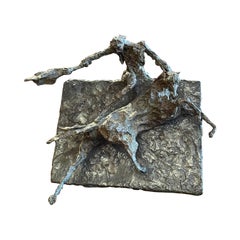
Magdalena Reinharez, Hommage to Géricault, 1992

Magdalena Reinharez, Hommage to Géricault, 1992

$9,408

H 19.3 in W 15.75 in D 6.7 in

Magdalena Reinharez, Hommage to Géricault, 1992

By Magdalena Reinharez

Located in Saint-Ouen, FR

Magdalena Reinharez (1925 – 2012) Homage to Géricault 1992 Bronze sculpture with brown patina Signed "M. Reinharez 2/8" Foundry mark : Chapon, Paris Biography Born in Central Europe, Magdalena Reinharez arrives in France at a young age. She takes her painting class with masters such as Fernand Léger and André Lothe...

Category

1990s French Animal Sculptures

Materials

Bronze

More From This Seller

View All
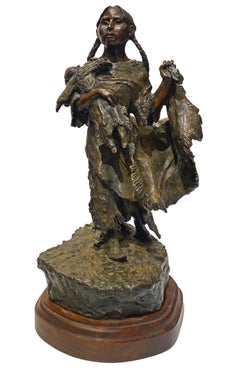
Native American Girl with Doll

Native American Girl with Doll

By Dave Powell

Located in Missouri, MO

Native American Girl with Doll By Dave Powell (American, b. 1954) Signed on Back 17.5" x 8" Dave Powell is a native son of Montana, in a world of change and transition; few can say they have roots in a single geography that go back four generations. Dave's pedigree in art is just about as deep. He is the son of artists Ace Powell and Nancy McLaughlin Powell. That heritage leads back to the likes of Charlie Russell and Joe De Young, both famous for their abilities to "tell the story" through their art. His father, Ace Powell, was a prolific Western artist whose first childhood paint-box set was a gift from Charlie and Nancy Russell. Dave became a serious student of art in his mid-teens, and has been a professional artist most of his adult life. Over the years he has worked with Bob Scriver, Ned Jacob and Robert Lougheed. Dave will be the first to give thanks...

Category

20th Century American Realist Figurative Sculptures

Materials

Bronze

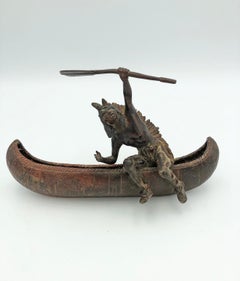
Native American in Canoe

Native American in Canoe

By Carl Kauba

Located in Missouri, MO

Carl Kauba (1865-1922) "Native American in Canoe" Polychrome Bronze Signed approx 5.5 x 10 x 2.75 inches This Austrian sculptor was born in Vienna in 1865. His teachers were Karl Waschmann (1848-1905), known for his ivory sculptures and portrait plaquettes of contemporary celebrities, and Stefan Schwartz (1851-1924), who exhibited in Paris, including the Exposition Universelle of 1900 where he won a gold medal. Kauba's intricate bronzes, imported to the United States between 1895 and 1912, were cast at the Roman Bronze Works. Kauba was part of the nineteenth-century tradition of polychrome bronze sculpture. There were several types of patinas on a single statue: he could render the color of buckskin, variously tinted shirts, blankets, feathers, as well as beaded moccasins. Reportedly, Kauba came to America around 1886. Inspired by the Western tales of German author Karl May, he traveled to the West and made sketches and models. Critics, however, pointed out inaccuracies of costume and other details. For instance, the guns that his "mid-nineteenth-century" figures use are models produced after 1898. Apparently he did all of his works back in Vienna. Besides the variety of color, Kauba's bronzes show a great range of textures and his style is highly naturalistic. The sculptor loved ornament, some of which he rendered with coiled wire for reins, rope and feathers in headdresses. He successfully rendered figures in motion and often executed compositions with more than one figure. Berman (1974) illustrates non-Western subjects by Kaula, such as the pendants Where? and There (ca. 1910), a seated Scottish couple, impressive in the expressions and the details on patterned fabrics of both sitters. Another genre piece is Buster Brown...

Category

Early 20th Century Realist Figurative Sculptures

Materials

Bronze

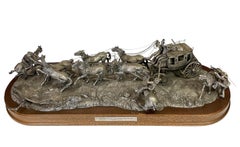
The Holdup of the Overland Stagecoach

The Holdup of the Overland Stagecoach

By Gordon Phillips

Located in Missouri, MO

The Holdup of the Overland Stagecoach By. Gordon Phillips (American, 1927-2011) Initialed and Edition 493/750 Gordon Phillips was born in 1927 in Boone, North Carolina. He studied a...

Category

20th Century American Realist Figurative Sculptures

Materials

Metal

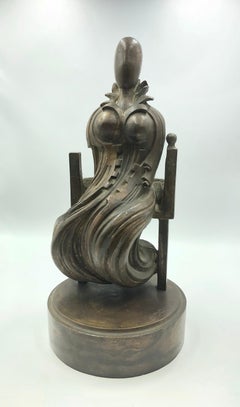
Regina Enthroned

Regina Enthroned

By Lazzaro Donati

Located in Missouri, MO

Lazzaro Donati (Italian 1926-1977) "La Regina" Bronze Signed on Base Size: approx 19 x 9 x 9 inches Lazzaro Donati (1926-1977) was born in Florence in 1926 and attended the Academy of Fine Arts. He began to paint in 1953, and in 1955 held his first exhibition at the Indiano Gallery in Florence. Within three years eleven exhibitions followed in Italy, and as his reputation grew he was invited to give major exhibitions in London, Paris, New York, Chicago, Rio de Janeiro and Montevideo. He is considered one of the foremost contemporary Italian painters and his paintings hang in museums and private collections throughout the Americas, Europe and Asia. Mr. Donati lived and worked at 24 Piazza Donatello in Florence, the square where generations of artists have created works worthy of the great Florentine tradition. As you entered the narrow hallway to his studio, a gilded life-size Venetian angel beckoned you to his door. Once inside, the present faded away and you found yourself in an atelier where early masters might have worked during the Renaissance. Within, luxurious Persian rugs set off the innumerable objects d'art and antique furnishings. Light poured in through the sloping glass wall on the north side. A dramatic stairway led to an overhanging balcony which served as a private gallery where the artist hung some of his favorite early works. To the left of the entrance was a smaller studio where Donati sculpted, with a window overlooking the famous old English cemetery where tourists laid flowers on the grave of Elizabeth Barrett Browning. In the main studio itself, where Donati received his clients in an atmosphere as polished as an office of a top executive, one hardly realized that it was here that the artist actually painted. His easel was covered with Persian blue velvet, the painting on the easel was already framed, his chair was upholstered in red velvet and on his palette the colors were arranged with the precision of a Byzantine mosaic. In a corner stand were his latest works, framed and ready to be sent off to his next exhibition in Europe or America. Donati was a born host with a warm welcome, an elegant man who possessed enormous charm a good nature and a keen sense of humor. Apparently shy, he preferred to speak on subjects extraneous to his art, purposely distracting you from his paintings, then leading you back to them, tactfully and without pretension. He spoke fluent French and English as well as some Spanish and German. "After all", he said, "you've got to know how to sell a painting to everyone." He had no sympathy for the "drip and splash" studios of his contemporaries, preferring to keep his studio tidy and spotless. "Painting is a matter of precision", he said, "If a painter can't put his paint where he wants it to go, I don't see how he can call himself a painter. For me it is absolutely necessary to control the paint." When asked to reveal the technique he used to achieve the enamel-like finish typical of his paintings he answered, "That is a secret between me and my butler. Actually, most of my paintings are done by him!" But in fact behind the façade, Donati was a serious craftsman who devoted to his painting as a way of life and means of expression. From the beginning of his career, his paintings revealed a striving for perfection and continual research in problems of style and technique. His early works indicated a momentary interest in surrealism and abstract art; they were predominantly two dimensional, depending on line and strong color. But by 1958, with his painting The Lady with a Fan...

Category

Late 20th Century Modern Figurative Sculptures

Materials

Bronze

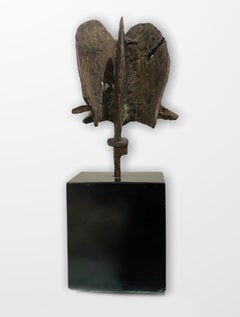
Piccolo Guerriero (Little Warrior)

Piccolo Guerriero (Little Warrior)

By Luciano Minguzzi

Located in Missouri, MO

Luciano Minguzzi (Italian, 1911-2004) Piccolo Guerriero (Little Warrior) c. 1950s Bronze Monogrammed and Numbered 1/5 Height From Base to Top: approx. 12" High Bronze: 6 3/4 inches x 4W x 3D Luciano Minguzzi was born in Bologna in 1911 and died in Milan in 2004. In 1943 he took part in the Fourth Quadrennial of Rome. In 1950 he was awarded the grand prize for sculpture at the XXV Venice Biennale, and attended again in 1952. His works can be found at Museum of the Fabbrica del Duomo, in the Museum of Modern Art in the Vatican and in the Galleries of Modern Art in Rome, Milan, Bologna, Florence, Trieste, Verona, Carrara, Padova, as well as abroad and overseas. Additional Biography (translated from Italian): Luciano Minguzzi ( Bologna , 24 May 1911 - Milan , 30 May 2004 ) was a sculptor and medalist Italian . Image of the exhibition Luciano Minguzzi: sculptures and gouaches 1950-1970 in the Romanesque cloister of the Cathedral of Prato ( Museo dell'Opera del Duomo ), 24 April - 24 May 1971. Photo by Paolo Monti . Index: He made his first experiences under the wise guidance of his father, also a sculptor , continuing his studies at the Academy of Fine Arts in Bologna following the engraving courses held by Giorgio Morandi , those of sculpture under the guidance of Ercole Drei , attending at ' university the lessons Roberto Longhi. Thanks to a scholarship, he stayed in Paris and London , starting to exhibit in 1933 and already at the Roman Quadrennial of 1943 he obtained his first prize, which was followed by others including the Angelicum of 1946 and the first place ex aequo at the Biennale del 1950. Immediately after the war he created the monument to the Partisan and the Partisan for his hometown , located near Porta Lame , in the area where an epic battle between Nazi-Fascists and partisans took place in 1944 .
The work, composed of two figures of young people - one of which armed - caught in a moment of great naturalness, was forged with cast bronze from the equestrian statue of Benito Mussolini (by Giuseppe Graziosi ) which was located inside the current "Renato Dall'Ara" Stadium, in turn made with some cannons stolen from the Austrians during the Bolognese Risorgimento uprisings of 1848. Still on the theme linked to war , but with a changed style with more dramatic and expressionist tones , in the fifties he created a series of sculptures inspired by the theme of the men of the Lager and the unknown and anonymous victims, obtaining in 1953 the third prize in the competition for the "Monument to the Unknown Political Prisoner " announced by the Tate Gallery ( London ). In 1950 he won the competition for the "Quinta Porta" of the Milan Cathedral , completed in 1965 . In 1962 he participated, together with the most important international sculptors of the time, in the exhibition Sculptures in the city organized by Giovanni Carandente as part of the V Festival dei Due Mondi in Spoleto . He presented a 1958 iron and bronze sculpture entitled Pas-de-quatre. In 1970 he was given the task of building the "Door of good and evil" of the basilica of St. Peter in the Vatican , on which he worked with vigor and passion for seven years. In 2012, on the occasion of the centenary of the artist's birth, a posthumous anthological exhibition was set up in Bologna at the Fondazione del Monte [1] . He also worked as a medalist: his example is the silver 500 lire coin...

Category

Mid-20th Century Modern Abstract Sculptures

Materials

Bronze