Video Loading
Want more images or videos?
Request additional images or videos from the seller
1 of 15

Unknown
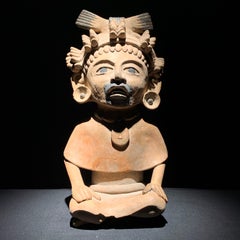
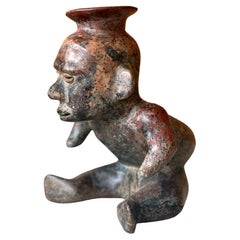
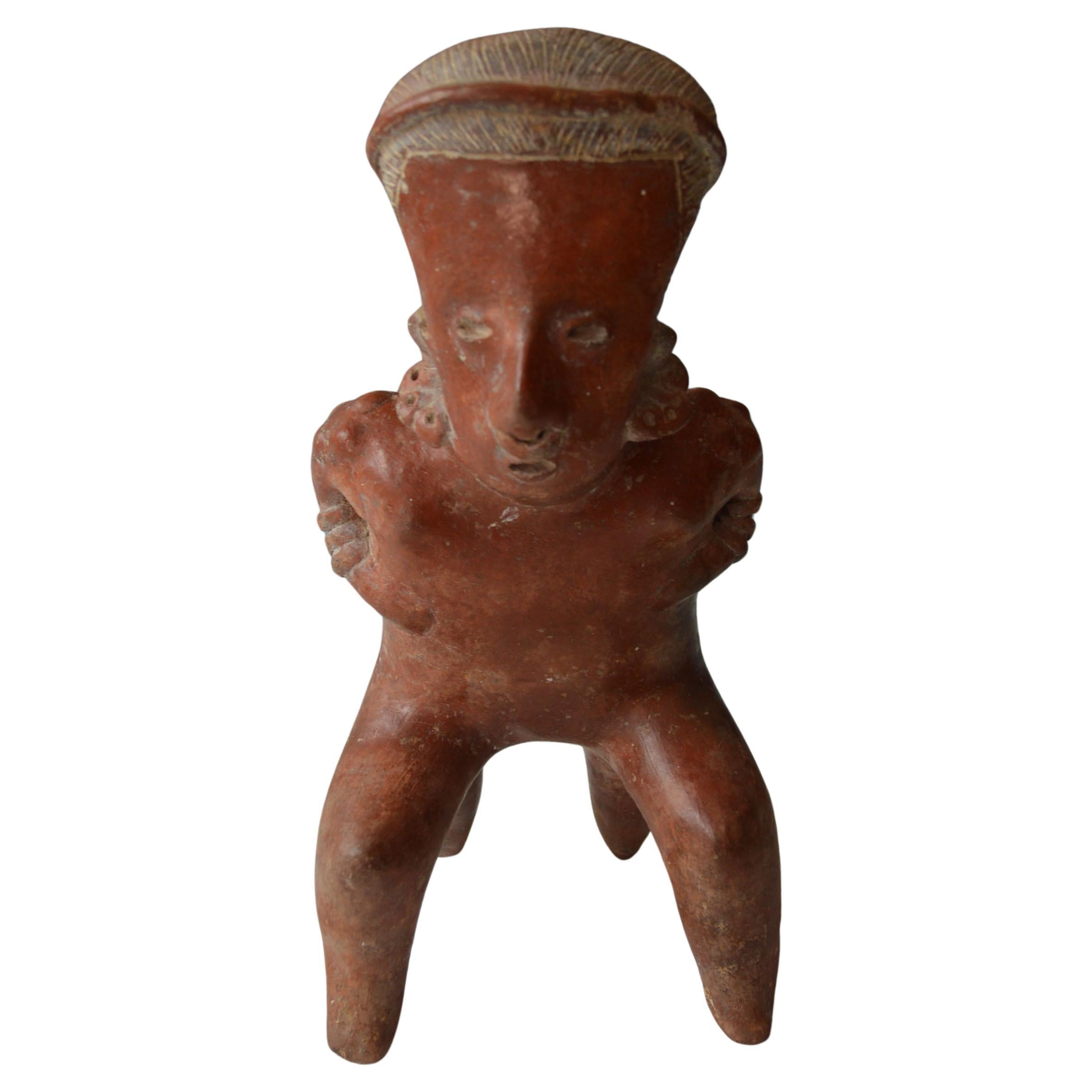
Pre-Columbian Colima Shaman terracotta figure vessel Mexican sculpture

ca. 300 BCE - 300 CE

$6,000
£4,531.55
€5,305.41
CA$8,524.29
A$8,672.36
CHF 4,970.13
MX$104,420.65
NOK 58,091.65
SEK 58,346.60
DKK 39,662.70

About the Item

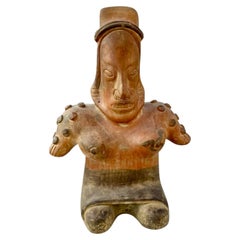
Seated Shaman Colima culture Mexico ca. 300 BCE - 300 CE Pre-Columbian, West Mexico, Colima, ca. 300 BCE to 300 CE. A hollow-cast and highly-burnished terracotta hunchback shaman figural vessel. Hunchbacks were considered sacred in Pre Columbian cultures and are often depicted as shamans or as assistants to royalty. The shaman holds an oval vessel and shakes a rattle in his lively role within a feasting ritual. Feasting was one of the four most important themes portrayed in West Mexican art, along with kinship, status, and power (Butterwick, Heritage of Power, 2005, p. 12). Feasting ceremonies were an integral part of a community that solidified economic and social interaction within and between villages, engaging all levels of the society. It is suggested that the rattles were peyote buttons which would be integral to any shamanic activity surrounding a religious feast. The known intoxicating liquids included octli, or pulque from agave plants, or tesvino, maize beer (Butterwick, in Townsend, ed., Ancient West Mexico, 1998, p. 103). This figure also wears the insignia of rank with the shell projection on the forehead secured with the incised band wrapped carefully around the chin and head. The stylized head faces the bowl with a solemn, determined visage comprised of coffee bean eyes, a pronounced pointed nose, pursed lips, and sensitively contoured facial planes, all topped by a caplike headdress with a horn rising from the center. A very unusual element is the small nose ring. The most curious aspect is the specific abnormality of the figure's spine. His back exhibits a protrusion not unlike an animal's tail, suggesting that the figure was based on a specific shaman. Overall, the graceful lines and studied proportions place this example among those of the highest distinction. Colima, located on Mexico's southwestern coast, was during this time part of the shaft tomb culture, along with neighbors to the north in Jalisco and Nayarit. In this culture, the deceased were buried down shafts - ranging from 3 to 20 meters deep - that were dug vertically or near vertically through the volcanic tuff known as "tepetate" that makes up the geology of the region. The base of the shaft would open into one or more horizontal chambers with a low ceiling. These shafts were almost always dug beneath a dwelling, probably a family home, and seem to have been used as family mausoleums, housing the remains of many related individuals. Ornate vessels and finely modeled figures like this one were placed in the tombs in order to hold offerings and protect the soul of the deceased. Condition: Thumb and bowl on left hand have broken off as one piece and have been reattached. Otherwise intact. Covered with nice burnishing marks. All items legal to buy/sell under U.S. Statute covering cultural patrimony Code 2600, CHAPTER 14, and are guaranteed to be as described or your money back. A Certificate of Authenticity will accompany all purchases
  • Creation Year:
    ca. 300 BCE - 300 CE
  • Dimensions:
    Height: 12 in (30.48 cm)Width: 12.25 in (31.12 cm)Depth: 8 in (20.32 cm)
  • Medium:
  • Period:
  • Condition:
  • Gallery Location:
    Wilton Manors, FL
  • Reference Number:
    1stDibs: LU24525339032

More From This Seller

View All
Veracruz Mexico Pre-Columbian ceramic Warrior figure sculpture

Veracruz Mexico Pre-Columbian ceramic Warrior figure sculpture

Located in Wilton Manors, FL

Figure of a Chanting Warrior Ceramic with bitumen highlights 300-600 CE (Classic Period) Mexico, Veracruz, possibly Nopiloa Veracruz Culture Pre-Columbian, Mexico, Vera Cruz culture...

Category

15th Century and Earlier Figurative Sculptures

Materials

Ceramic

Kuba African Warthog Divining Figure tribal arts sculpture

Kuba African Warthog Divining Figure tribal arts sculpture

Located in Wilton Manors, FL

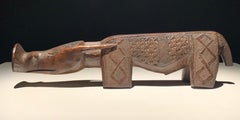
Warthog Divining Figure. Kuba, DRC. Late 19th century. Carved wood with palm oil patina, 12.5 incehes (l), 3.25 inches (h), 2 5/8 inches (d). Loss evident at tip of right ear and on snout. Provenance: Ex. collection Martin and Faith-Dorian Wright; J.J. Klegman; Angelo Caggiula-Carulucci, chief magistrate in Belgian Congo for King Leopold...

Category

Late 19th Century Abstract Figurative Sculptures

Materials

Wood

Standing Figure

Standing Figure

By Tom Cramer 1

Located in Wilton Manors, FL

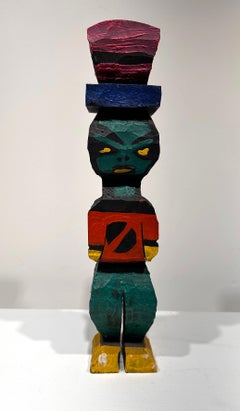
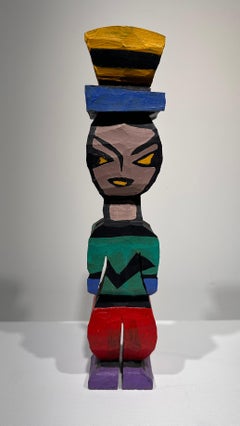
Tom Cramer (b.1960). Standing Figure, 1988. Carved wood and polymer paint. Measures 11.5 inches high. Excellent condition. Signed and dated under base. Tom Cramer is an American artist working in Portland, Oregon noted for his intricately carved and painted wood reliefs and ubiquity throughout the city of Portland. Often called the unofficial Artist Laureate of Portland,[2] Cramer is one of the most visible and successful artists in the city. The influences on his work are both organic and technological. He is widely collected and is in many prominent west coast museum and private collections. He is in the permanent collections of the Portland Art Museum[3] in Portland Oregon, the Halle Ford Museum in Salem Oregon, the Jordan Schnitzer Museum in Eugene, Oregon, the Boise Art Museum in Idaho. Cramer made a name for himself in the 1980s and 1990s becoming a bridge between historical Oregon artists like Clifford Gleason and Milton Wilson...

Category

Late 20th Century Neo-Expressionist Figurative Sculptures
Materials

Wood, Latex

Standing Figure

Standing Figure

By Tom Cramer 1

Located in Wilton Manors, FL

Tom Cramer (b.1960). Standing Figure, 1980. Carved wood and polymer paint. Measures 11.5 inches high. Excellent condition. Signed and dated under base. Tom Cramer is an American artist working in Portland, Oregon noted for his intricately carved and painted wood reliefs and ubiquity throughout the city of Portland. Often called the unofficial Artist Laureate of Portland,[2] Cramer is one of the most visible and successful artists in the city. The influences on his work are both organic and technological. He is widely collected and is in many prominent west coast museum and private collections. He is in the permanent collections of the Portland Art Museum[3] in Portland Oregon, the Halle Ford Museum in Salem Oregon, the Jordan Schnitzer Museum in Eugene, Oregon, the Boise Art Museum in Idaho. Cramer made a name for himself in the 1980s and 1990s becoming a bridge between historical Oregon artists like Clifford Gleason and Milton Wilson...

Category

Late 20th Century Neo-Expressionist Figurative Sculptures
Materials

Wood, Latex

Cubist Fashion Women Figures bronze Brutalist sculpture

Cubist Fashion Women Figures bronze Brutalist sculpture

Located in Wilton Manors, FL

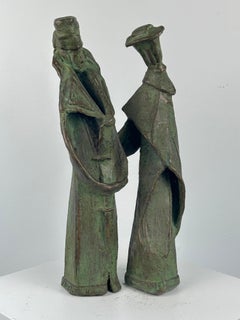
Max Fleisher (1914-1977) Two Fashionable Women, 1971. Bronze, measuring 14.5 x 6.5 x 3 inches. Weighs 16 lbs. Signed and dated on base.

Category

1970s Cubist Figurative Sculptures
Materials

Bronze

You May Also Like

1973 Mexican Colima Nayarit Style Terracotta Figural Sculpture

1973 Mexican Colima Nayarit Style Terracotta Figural Sculpture

Located in Stafford, TX

1973 Mexican Colima Nayarit Style Terracotta Figural Sculpture Handcrafted in Mexico in 1973, this expressive terracotta sculpture is a faithful interpretation of the celebrated cer...

Category

Vintage 1970s Mexican Primitive Sculptures and Carvings

Materials

Terracotta

Pre Columbian Large Jalisco Figure West Mexico Circa B.C. 100-300 A.D

Pre Columbian Large Jalisco Figure West Mexico Circa B.C. 100-300 A.D

Located in London, GB

A Pre Columbian Jalisco warrior figure Jalisco West Mexico circa B.C. 100-300 A.D, A stunning large pottery warrior figure wearing a banded headdress with disco arm ornaments , ...

Category

Antique 15th Century and Earlier Mexican Antiquities

Materials

Pottery

Pre Columbian Rare Central Mexican Terracotta Figure with Bowl C. 600–1200 CE

Pre Columbian Rare Central Mexican Terracotta Figure with Bowl C. 600–1200 CE

Located in London, GB

Pre Columbian Rare Central Mexican Terracotta Figure with Bowl A Pre-Columbian terracotta figure from the Central Highlands of Mexico, depicting a standing figure holding a large bow...

Category

Antique 15th Century and Earlier Mexican Antiquities

Materials

Pottery

Pre-Columbian Vessel in the Form of a Shaman's Head, Colima, West Mexico

Pre-Columbian Vessel in the Form of a Shaman's Head, Colima, West Mexico

Located in Point Richmond, CA

Pre-Columbian Terracotta Vessel, Colima, Western Mexico A classic shaman’s head vessel having a horn strapped onto the forehead with a slip-painted headband, coffee bean eyes, sharp...

Category

Antique 15th Century and Earlier Mexican Pre-Columbian Jars

Materials

Terracotta

Ceramic Pre-Columbian Colima Hunchback Figure Vessel

Ceramic Pre-Columbian Colima Hunchback Figure Vessel

Located in Atlanta, GA

A pre-Columbian figural vessel from West Mexico Colima culture (circa 300BC-400AD). Made of molded clay, the stoneware vessel depicts a seated hunchback...

Category

Antique 15th Century and Earlier Mexican Pre-Columbian Figurative Sculpt...

Materials

Ceramic

Nayarit Chinesco-Style Figure

Nayarit Chinesco-Style Figure

Located in Chicago, IL

This seated effigy figure was crafted in 300 BC to 300 AD from the ancient Nayarit region of Mexico and was likely used as a ritual or burial offering. The ceramic works of the Chine...

Category

Antique 15th Century and Earlier Mexican Pre-Columbian Figurative Sculpt...

Materials

Ceramic