The style of 18th-century French furniture was guided by the court. When Louis XV, who reigned from 1715–74, focused royal life on the smaller salons of Versailles rather than its grand chambers, it transformed the aesthetics away from the imposing and angular furniture that characterized the style of Louis XIV. A broader focus on comfort and more delicate forms define antique Louis XV furniture, with nature-inspired carvings, wood inlays, curved cabriole legs, asymmetrical shapes and rounded oval seat backs. The furnishings changed throughout the king’s life, as he ascended to the throne as a child and then grew to establish his own tastes.
Pieces like the bergère, an upholstered armchair with a wide cushion that fit the flowing dresses in fashion at the time, reflected this more informal court. Introduced at the start of Louis XV’s reign, bergère chairs in this style were deeper and broader than other chairs of the period.
Louis XV tapestries and carpets tended to be floral and colorful, and design elements were borrowed from Asia. Dutch-born cabinetmaker Bernard van Risenburgh brought lacquer techniques influenced by Japan and China into his luxuriously made furniture. Along with its fine details, the furniture of the era also featured new innovations including mechanical devices. Jean François Oeben, a royal cabinetmaker, created such intricate pieces as a mechanical table for Madame de Pompadour, Louis XV’s mistress. It involved a sliding top and a writing surface that extended from its marquetry panels.
During the later years of Louis XV’s reign, there was a shift from the ostentatious rocaille style, part of the exuberantly decorative Rococo movement in Europe for which designers such as Nicolas Pineau and Juste-Aurèle Meissonier are known. The style under Louis XVI would return to boxier forms, but with a neoclassical touch inspired by the ancient world.
Find antique Louis XV bedroom furniture, seating, tables and decorative objects on 1stDibs.
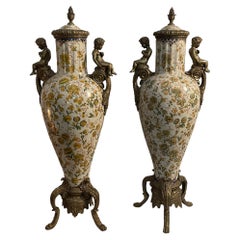
Whether it’s a Chinese Han dynasty glazed ceramic wine vessel, a work of Murano glass or a hand-painted Scandinavian modern stoneware piece, a fine vase brings a piece of history into your space as much as it adds a sophisticated dynamic.
Like sculptures or paintings, antique and vintage vases are considered works of fine art. Once offered as tributes to ancient rulers, vases continue to be gifted to heads of state today. Over time, decorative porcelain vases have become family heirlooms to be displayed prominently in our homes — loved pieces treasured from generation to generation.
The functional value of vases is well known. They were traditionally utilized as vessels for carrying dry goods or liquids, so some have handles and feature an opening at the top (where they flare back out). While artists have explored wildly sculptural alternatives over time, the most conventional vase shape is characterized by a bulbous base and a body with shoulders where the form curves inward.
Owing to their intrinsic functionality, vases are quite possibly versatile in ways few other art forms can match. They’re typically taller than they are wide. Some have a neck that offers height and is ideal for the stems of cut flowers. To pair with your mid-century modern decor, the right vase will be an elegant receptacle for leafy snake plants on your teak dining table, or, in the case of welcoming guests on your doorstep, a large ceramic floor vase for long tree branches or sticks — perhaps one crafted in the Art Nouveau style — works wonders.
Interior designers include vases of every type, size and style in their projects — be the canvas indoors or outdoors — often introducing a splash of color and a range of textures to an entryway or merely calling attention to nature’s asymmetries by bringing more organically shaped decorative objects into a home.
On 1stDibs, you can browse our collection of vases by material, including ceramic, glass, porcelain and more. Sizes range from tiny bud vases to massive statement pieces and every size in between.