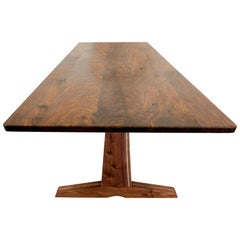
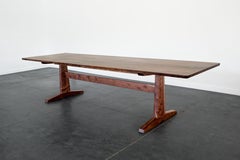
84" Columbia Trestle Table by Studio Moe in Oregon Walnut
Located in Portland, OR
Table pictured is longer than 84".
Category
2010s American Modern Dining Room Tables
Materials
Walnut
84" Columbia Trestle Table by Studio Moe in Oregon Walnut
Located in Portland, OR
Table pictured is longer than 84".
Walnut
The late 19th and early 20th centuries saw sweeping social change and major scientific advances — both of which contributed to a new aesthetic: modernism. Rejecting the rigidity of Victorian artistic conventions, modernists sought a new means of expression. References to the natural world and ornate classical embellishments gave way to the sleek simplicity of the Machine Age. Architect Philip Johnson characterized the hallmarks of modernism as “machine-like simplicity, smoothness or surface [and] avoidance of ornament.”
Early practitioners of modernist design include the De Stijl (“The Style”) group, founded in the Netherlands in 1917, and the Bauhaus School, founded two years later in Germany.
Followers of both groups produced sleek, spare designs — many of which became icons of daily life in the 20th century. The modernists rejected both natural and historical references and relied primarily on industrial materials such as metal, glass, plywood, and, later, plastics. While Bauhaus principals Marcel Breuer and Ludwig Mies van der Rohe created furniture from mass-produced, chrome-plated steel, American visionaries like Charles and Ray Eames worked in materials as novel as molded plywood and fiberglass. Today, Breuer’s Wassily chair, Mies van der Rohe’s Barcelona chair — crafted with his romantic partner, designer Lilly Reich — and the Eames lounge chair are emblems of progressive design and vintage originals are prized cornerstones of collections.
It’s difficult to overstate the influence that modernism continues to wield over designers and architects — and equally difficult to overstate how revolutionary it was when it first appeared a century ago. But because modernist furniture designs are so simple, they can blend in seamlessly with just about any type of décor. Don’t overlook them.
Vintage, new and antique conference tables are key to designing functional offices, setting the tone through shape and materials.
The evolution of floor plans and office furniture such as desks or office chairs shows how the workplace has changed over the years. One trend in the 20th century was the open floor plan, which was pioneered by Frank Lloyd Wright. The profoundly influential architect’s design for the 1936 office building for SC Johnson Wax was an early example. Soon, major American furniture manufacturers would take aim at creating furnishings for the workplace.
In 1942, Herman Miller, anticipating a postwar economic boom, began making office furniture for the first time, while at Knoll, a special office-focused division created by Florence Knoll in the mid-1940s designed office spaces for the likes of GM and CBS.
Open-floor-plan offices became mainstream by the mid-century as a way to reflect a company’s values. Working in an open space meant that employees were equal and the design was aimed at improving communication and cooperation. The conference table was key to this vision. Businesses with an open floor plan needed a place for meetings and this ensured that the conference table and conference room became staples of the modern office.
A round conference table is egalitarian and informal, getting people to participate and share ideas. A rectangular conference table is more structured, allowing executives to sit at the end of the table to conduct the meeting.
The style and color of the table are also important. A bold color can make participants feel more creative; a unique shape can evoke innovation and modernity. Creatives often invest in eye-catching furniture to express their company’s individuality.
A variety of conference tables can be found on 1stDibs, from postmodern conference tables for forward-looking businesses to new and custom options to make a conference room stand out.
The Louisiana-born and -bred architect talks to 1stdibs about the art of making timeless places that matter.
Damon Liss and Stelle Lomont Rouhani Architects collaborated on this serene getaway for a minimalism-minded Manhattan family of four.
The Palm Springs interior decorator developed a mid-century style that defined the vacation homes of celebrities and other notables, including Bob Hope and Lucille Ball.
Wielding her influence on the international scene, founding partner Andrea Cesarman expands the platform for Mexican artisans.
The houses from this New York studio cloak modernist tendencies within what are often more traditional trappings.
For the California designer, authenticity and the unusual are the keys to cool, timeless interiors.