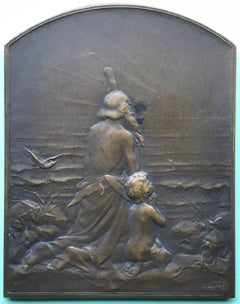
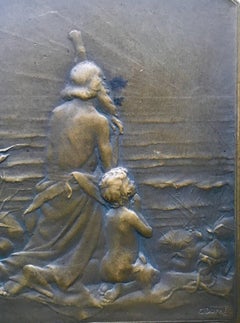
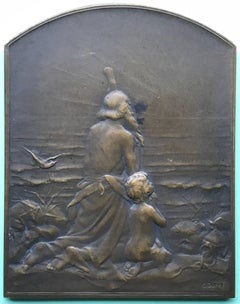
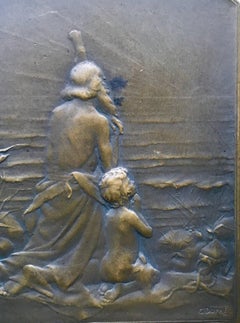
During the Renaissance, the first European fine art academies were established in Italy and would guide the style and standards of visual culture in the following centuries. Academic art became dominant across the continent in the 17th century, with artists coming together to offer instruction in this style of painting and sculpture.
The academic art period represented a significant change from the previous era when painters, sculptors and other artists were part of guilds and seen more as artisans than purveyors of culture. While patronage from the elite and the church remained pivotal, young artists were able to support themselves for the first time through academic exhibitions and an independent marketplace. The leading academies included the French Académie Royale de Peinture et de Sculpture founded in Paris in 1648 (which became the Académie des Beaux-Arts after the French Revolution) and the London Royal Academy of Arts formed in 1768 under the inaugural leadership of painter Joshua Reynolds.
Academy students sketched drawings based on prints, sculptures and, finally, live models. Movements including neoclassicism and romanticism were particularly popular in these art schools and institutions where the influence of Raphael and Nicolas Poussin was prominent. Beaux Arts architecture and furniture design drew on these movements, too, and, as they also originated at the Académie des Beaux-Arts, the disciplines share common ground with academic painting and sculpture.
Although academic art was a major shift for artistic status when it began, by the middle of the 19th century it was viewed as stodgy and resistant to new ideas, with the subject matter of artists such as William-Adolphe Bouguereau and Jean-Léon Gérôme generally limited to allegorical or mythological themes. Impressionism, realism and the other movements that engaged with contemporary issues that followed were direct reactions to the academic tradition, although it continued to inform the avant-garde as artists like Gustav Klimt and Pablo Picasso started their practices as academic realists.
Find a collection of academic paintings, sculptures, prints and more art on 1stDibs.
Figurative sculptures mix reality and imagination, with the most common muse being the human body. Animals are also inspirations for these sculptures, along with forms found in nature.
While figurative sculpture dates back over 35,000 years, the term came into popularity in the 20th century to distinguish it from abstract art. It was aligned with the Expressionist movement in that many of its artists portrayed reality but in a nonnaturalistic and emotional way. In the 1940s, Alberto Giacometti — a Swiss-born artist who was interested in African art, Cubism and Surrealism — created now-iconic representational sculptures of the human figure, and after World War II, figurative sculpture as a movement continued to flourish in Europe.
Lucian Freud and Francis Bacon were some of the leading figurative artists during this period. Artists like Jeff Koons and Maurizio Cattelan propelled the evolution of figurative sculpture into the 21st century.
Figurative sculptures can be whimsical, uncanny and beautiful. Their materials range from stone and wood to metal and delicate ceramics. Even in smaller sizes, the sculptures make bold statements. A bronze sculpture by Salvador Dalí enhances a room; a statuesque bull by Jacques Owczarek depicts strength with its broad chest while its thin legs speak of fragility. Figurative sculptures allow viewers to see what is possible when life is reimagined.
Browse 1stDibs for an extensive collection of figurative sculptures and find the next addition to your collection.