Long before trend-bucking creative director Alessandro Michele brought his hallucinatory “Utopian Fantasy” campaign to Gucci, it was a modest Italian leather shop. Today, it’s an internationally renowned luxury house with an iconic logo, and vintage Gucci clothing, handbags and shoes are among high fashion's most covetable goods.
Guccio Gucci (1881–1953) admired the stylish suitcases he saw wealthy guests arrive with at the Savoy Hotel in London, where he worked as a bellhop. So, in 1921, after a stint at Franzi, a luggage company in his hometown of Florence, he opened a leather goods shop of his own.
At first, Gucci’s Florence business specialized in equestrian accessories. But as its reputation flourished, particularly among the English aristocracy, so too did its footprint. In 1938, he brought three of his sons — Aldo, Vasco and Rodolfo — into the business and expanded it to Rome and later Milan. In the mid-1930s, a League of Nations embargo against Italy pushed Gucci to experiment with alternatives to imported leather. Its woven hemp fabric from Naples, adorned with the brand’s signature diamond print, was a hit, especially among A-list celebrities. The material was first used on suitcases before finding enduring popularity on handbags. (No list of revered designer purses would be complete without Gucci.)
In the 1950s, Elizabeth Taylor carried one of Gucci’s bamboo-handled tote bags, another adaptation to material rationing. After Jackie Kennedy was seen sporting a slouchy Gucci tote in 1961, it was renamed for the First Lady. Then Grace Kelly, on a visit to the boutique in Milan, inspired Rodolfo Gucci to work with Italian illustrator and Gucci textile designer Vittorio Accornero on the Flora print in 1966. Taking cues from Sandro Botticelli’s Primavera, with its pattern of flora and insects, it was painted entirely by hand and featured no fewer than 37 colors.
In 1953, just 15 days after opening his first store on New York’s 5th Avenue, Guccio passed away at 72. The early 1970s saw store openings in Tokyo and Hong Kong, but by the late 1980s, Gucci was floundering. Rodolfo Gucci took charge in 1982, but family drama and lawsuits ensued. In 1993, Rodolfo’s son, Maurizio, transferred his shares in the company to Investcorp, ending the family’s involvement in Gucci. Dawn Mello, then-president of Bergdorf Goodman, joined as creative director in 1989. But it was Tom Ford, who took over as creative director in 1994, who ultimately revived the brand.
Ford’s racy ads, shot by photographers such as Mario Testino, stirred controversy. And his potent vision of sexed-up femininity — with “jewel-toned satin shirts unbuttoned to there,” as Vogue described his breakthrough 1995 runway show — was wildly successful. The new millennium brought new ownership — Pinault Printemps Redoute in 2004 — and a more toned-down vision from Frida Giannini, who became sole creative director in 2006. Alessandro Michele was named creative director in 2015, and the storied brand took a giant leap forward.
Find vintage Gucci clothing and accessories on 1stDibs.
A flashy symbol of wealth during the early 20th century, antique and vintage cocktail rings have gained broader appeal in the decades since for the hefty dose of glamour they bring to any ensemble.
Cocktail rings earned their name for their frequent appearances during glitzy cocktail parties at the height of the Prohibition era. Back then, these accessories were seen not only as statement pieces but as statements in and of themselves. They openly represented a sense of freedom and independence as well as a demonstration of opulence. After all, the 1920s heralded the Harlem Renaissance and Art Deco design, and a slew of social and cultural shifts meant that women in particular were breaking from pre–World War I conventions and embracing newfound freedoms to express themselves as individuals.
Women expressly wore cocktail rings on the fingers of their right hand versus the left, which was “reserved” for an engagement ring or wedding band, accessories definitely paid for by a suitor. And for cocktail rings, the bigger the colored gem at the center — which is usually mounted in a high setting — and the more elaborate the design, the stronger the likelihood of being noticed.
Cocktail rings remained a popular piece of jewelry for women until the 1930s, when the Great Depression and the onset of war marked a change in behaviors nationwide. While the 1960s and ’70s saw a return in visibility for the accessory, it wasn’t until the 1980s that cocktail rings once again assumed their position as a beacon of luxury and glitz.
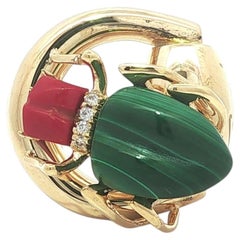
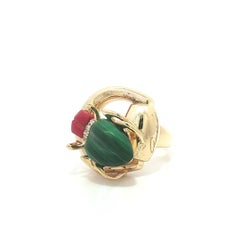
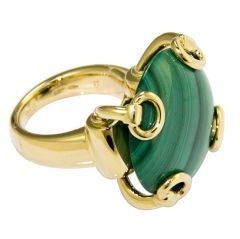
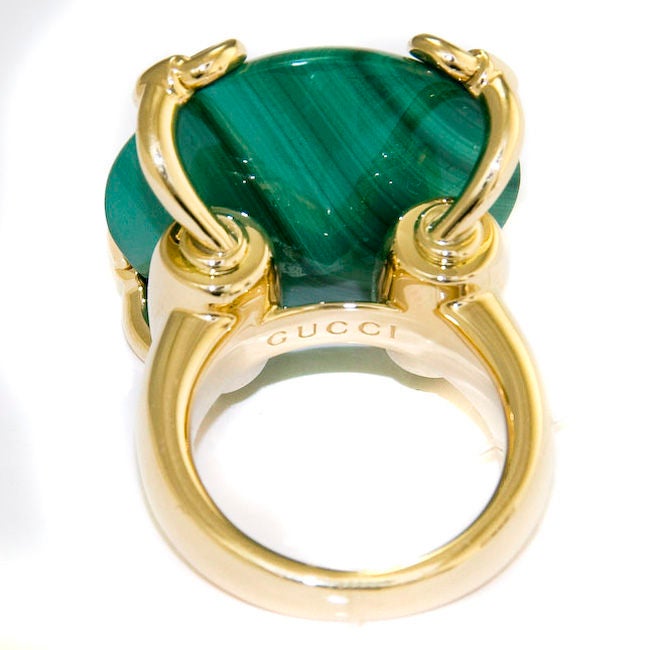
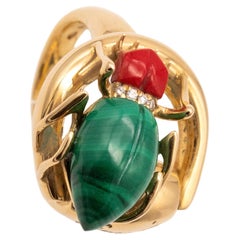
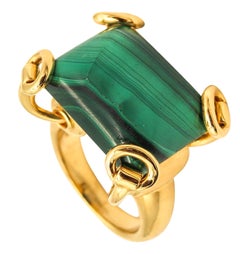
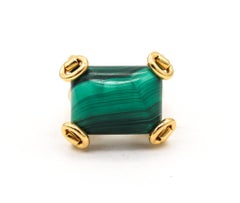
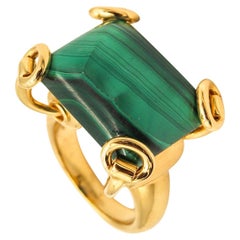
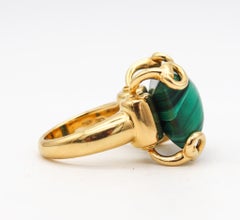
During the 20th century, the range of dazzling cocktail rings seems to have been limitless, from glimmering gold rings set with carved jade diamonds designed by David Webb to Pomellato’s pink quartz confections to striking Gucci butterfly rings with accent diamonds set in a pavé fashion.
So, how do you wear a cocktail ring? Cocktail rings “can be worn for almost anything — dinners, date nights, parties, special events, on the red carpet,” explains David Joseph of New York-based jewelry brand Bochic.
Can you wear cocktail rings with other rings? “In my opinion, cocktail rings should stand on their own since they showcase a large gem in the center,” says Joseph.
These glamorous jewels can be worn inside or outside crowded taverns, in either daytime or nighttime with casual or dressy attire. On 1stDibs, find a wide variety of antique and vintage cocktail rings, including those offered by Chanel, whose elegant cocktail rings often feature pearls and, of course, diamonds, and sometimes were styled after showy flowers like the camellia, and Van Cleef & Arpels, whose detailed and intricate designs are viewed as miniature pieces of wearable art.