Surely you’ll find the exact helen la france you’re seeking on 1stDibs — we’ve got a vast assortment for sale. There are many
contemporary,
abstract and
Impressionist versions of these works for sale. You’re likely to find the perfect helen la france among the distinctive items we have available, which includes versions made as long ago as the 19th Century as well as those made as recently as the 21st Century. When looking for the right helen la france for your space, you can search on 1stDibs by color — popular works were created in bold and neutral palettes with elements of
beige,
gray,
white and
blue. Creating a helen la france has been a part of the legacy of many artists, but those crafted by
Stefanie Schneider,
Willard Dixon,
Jenny Nelson,
Seren Morey and
Frederick B. Serger are consistently popular. Artworks like these — often created in
polaroid,
paper and
c print — can elevate any room of your home.
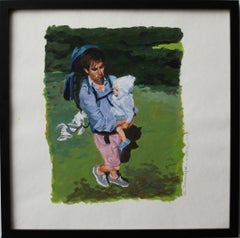
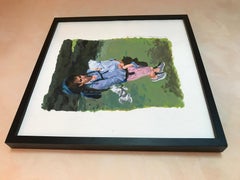
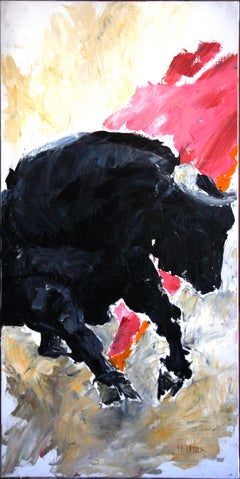
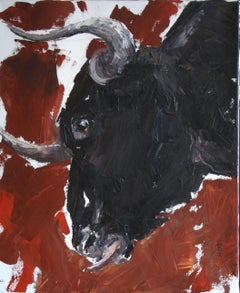
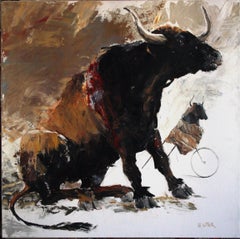
Helen Uter is an established Franco-American painter born in 1955 who lives and works in Donnery, near Orléans, France. Heavily influenced by Edward Hopper, she creates works that explore everyday life in our current, highly technological society, along with its relationship to the natural world. Working within narrative figuration, Helen Uter ultimately proposes visual metaphors that reveal profound truths about fiction and reality. After her artistic studies, where she shows predispositions for drawing, Helen enters a career dedicated to images: illustrator, art director and eventually art and history of art teacher. Alongside her employment she carries out her own research when finding the time to do so. Around thirty years old, the knack was given to her by Edward Hopper ’s artwork. « It occurred to me that you could express powerful feelings with a very simple way to paint, without making a great fuss » Helen Uter paints, sculpts and has exhibitions since 1995. Fed by artist’s artwork such as Caillebotte, Hopper, Vélikovic, Freud, Bacon, or from the Narrative Figuration like Monory, she took the advice: « Don’t learn how to paint! Just do it !». The originality of her work stands probably by her American roots, affecting some of the subjects of her work, as well as the way of painting them. She finds inspiration by thinking over the relationship between nature and our technical civilization. Helen Uter’s figurative pictures combine natural patterns interacting with her own inventions. Those imaginary representations are like metaphors that express invisible realities. Helen Uter likes to confront fiction with the real world, nature, and artefacts. « I consider my images have reached their goal when they blur interpretations and stir up trouble in the watcher’s mind ». This approach is similar to that of the Narrative figuration. She doesn’t seek to paint « beautiful » images, but ones that make sense. «I paint to tell thrills, feelings, moods, stories that go beyond me. My brushes guide my hand, they teach me something about myself, and about the world too. It’s a demanding task, an alternate universe, invading and transcendent. When she’s asked to enlighten her artworks, she gladly cites Francis Bacon: If you can talk about it, why paint it?
Painting is an art form that has spanned innumerable cultures, with artists using the medium to tell stories, explore and communicate ideas and express themselves. To bring abstract paintings, landscape paintings, still-life paintings and other original paintings into your home is to celebrate and share in the long tradition of this discipline.
When we look at paintings, particularly those that originated in the past, we learn about history, other cultures and countries of the world. Like every other work of art, paintings — whether they are contemporary creations or works that were made during the 19th century — can often help us clearly see and understand the world around us in a meaningful and interesting way.
Cave walls were the canvases for what were arguably the world’s first landscape paintings, which depict natural scenery through art. Portrait paintings and drawings, which, along with sculpture, were how someone’s appearance was recorded prior to the advent of photography, are at least as old as Ancient Egypt. In the Netherlands, landscapes were a major theme for painters as early as the 1500s. Later, artists in Greece, Rome and elsewhere created vast wall paintings to decorate stately homes, churches and tombs.
Today, creating a wall of art is a wonderful way to enhance your space, showcase beautiful pieces and tie an interior design together.
No matter your preference, whether you favor Post-Impressionist paintings, animal paintings, Surrealism, Pop art or another movement or specific period, arranging art on a blank wall allows you to evoke emotions in a room while also showing off your tastes and interests. A symmetrical wall arrangement may comprise a grid of four to six pieces or, for an odd number of works, a horizontal row. Asymmetrical arrangements, which may be small clusters of art or large, salon-style gallery walls, have a more collected and eclectic feel.
Download the 1stDibs app, which includes a handy “View on Wall” feature that allows you to see how a particular artwork will look on a particular wall, and read about how to arrange wall art. And if you’re searching for the perfect palette for your interior design project, what better place to turn than to the art world’s masters of color?
On 1stDibs, you’ll find an expansive collection of paintings and other fine art for your home or office. Browse abstract paintings, portrait paintings, paintings by emerging artists and more today.