Homoerotic Photographs For Sale on 1stDibs
Find a variety of homoerotic photographs available on 1stDibs. Finding the perfect
modern,
contemporary or
Old Masters examples of these works for your space is difficult — today, we have a vast range of variations and more on offer. These items have been produced for many years, with earlier versions available from the 20th Century and newer variations made as recently as the 21st Century. Adding a colorful piece of art to a room that is mostly decorated in warm neutral tones can yield a welcome change — see the homoerotic photographs on 1stDibs that include elements of
black,
gray,
brown,
red and more. Many versions of these artworks are appealing in their rich colors and composition, but
Jose Sierra,
Robert Mapplethorpe,
Ian Sanderson,
Jim French and
Bob Mizer produced especially popular works that are worth a look. Frequently made by artists working in
pigment print,
archival pigment print and
paper, all of these available pieces are unique and have attracted attention over the years.
How Much are Homoerotic Photographs?
Prices for art of this kind can differ depending upon size, time period and other attributes — homoerotic photographs in our inventory begin at $80 and can go as high as $83,000, while the average can fetch as much as $2,000.
George Dureau for sale on 1stDibs
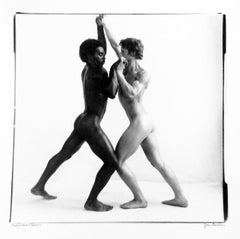
George Dureau was an American artist whose long career was most notable for charcoal sketches and black and white photography of poor white and black athletes, dwarfs, and amputees. Dureau was born to Clara Rosella Legett Dureau and George Valentine Dureau in the Irish Channel, New Orleans, Louisiana. He was raised in Mid-City. He graduated with a fine arts degree from LSU in 1952, after which he began architectural studies at Tulane University. Dureau briefly served in the U.S. Army. Before being able to survive as an artist, he worked for Maison Blanche, a New Orleans department store, as a display designer/window dresser. For the vast majority of his life, he lived in the French Quarter, where he was well known for his eccentricity and hospitality. His friend and student, Robert Mapplethorpe restaged many of his earlier black and white photographs. Many of his pieces are held at the Ogden Museum of Southern Art. Several of his works are displayed publicly throughout New Orleans, most notably, the pediment sculpture for Harrah's Casino and his cast-bronze sculptures stand sentinel at the entrance gates of New Orleans City Park. Dureau’s depiction of a Mardi Gras parade dominates one wall in Gallier Hall. One of his more popular set of works, Black 1973–1986, a series of black and white photographs concentrating on young black men, toured throughout the USA to rave reviews. Dureau died of Alzheimer's disease in 2014.
A Close Look at Contemporary Art
Used to refer to a time rather than an aesthetic, Contemporary art generally describes pieces created after 1970 or being made by living artists anywhere in the world. This immediacy means it encompasses art responding to the present moment through diverse subjects, media and themes. Contemporary painting, sculpture, photography, performance, digital art, video and more frequently includes work that is attempting to reshape current ideas about what art can be, from Felix Gonzalez-Torres’s use of candy to memorialize a lover he lost to AIDS-related complications to Jenny Holzer’s ongoing “Truisms,” a Conceptual series that sees provocative messages printed on billboards, T-shirts, benches and other public places that exist outside of formal exhibitions and the conventional “white cube” of galleries.
Contemporary art has been pushing the boundaries of creative expression for years. Its disruption of the traditional concepts of art are often aiming to engage viewers in complex questions about identity, society and culture. In the latter part of the 20th century, contemporary movements included Land art, in which artists like Robert Smithson and Michael Heizer create large-scale, site-specific sculptures, installations and other works in soil and bodies of water; Sound art, with artists such as Christian Marclay and Susan Philipsz centering art on sonic experiences; and New Media art, in which mass media and digital culture inform the work of artists such as Nam June Paik and Rafaël Rozendaal.
The first decades of the 21st century have seen the growth of Contemporary African art, the revival of figurative painting, the emergence of street art and the rise of NFTs, unique digital artworks that are powered by blockchain technology.
Major Contemporary artists practicing now include Ai Weiwei, Cecily Brown, David Hockney, Yayoi Kusama, Jeff Koons, Takashi Murakami and Kara Walker.
Find a collection of Contemporary prints, photography, paintings, sculptures and other art on 1stDibs.
Finding the Right Black-white-photography for You
There’s a lot to love about black and white photography.
The unique and timeless quality of a black and white photograph accentuates any room. Some might argue that we’re naturally drawn to color photography because it’s the world we know best. This is a shared belief, particularly in the era of camera-phone photography, editing apps and the frenetic immediacy of sharing photos on social media. But when we look at black and white photography, we experience deep, rich shadows and tonal properties in a way that transfixes us. Composition and textures are crisp and engaging. We’re immediately drawn to the subjects of vintage street photography and continue to feel the emotional impact of decades-old photojournalism. The silhouettes of mountains in black and white landscape photography are particularly pronounced, while portrait photography and the skylines of urban cityscapes come to life in monochrome prints.
When decorating with fine photography, keep in mind that some color photographs may not be suitable for every space. However, you can be more daring with black and white photos. The gray tones are classic, sophisticated and generally introduce elegance to any corner of your home, which renders black and white prints amazingly versatile.
Black and white photography adapts to its surroundings like a chameleon might. A single large-scale black and white photograph above the sofa in your living room is going to work with any furniture style, and as some homeowners and designers today are working to introduce more muted tones and neutral palettes to dining rooms and bedrooms, the integration of black and white photography — a hallmark of minimalist decor — is a particularly natural choice for such a setting.
Another advantage to bringing black and white photography into your home is that you can style walls and add depth and character without worrying about disrupting an existing color scheme. Black and white photographs actually harmonize well with accent colors such as yellow, red and green. Your provocative Memphis Group lighting and bold Pierre Paulin seating will pair nicely with the black and white fine nude photography you’ve curated over the years.
Black and white photography also complements a variety of other art. Black and white photos pair well with drawings and etchings in monochromatic hues. They can also form part of specific color schemes. For example, you can place black and white prints in colored picture frames for a pop of color. And while there are no hard and fast rules, it’s best to keep black and white prints separate from color photographs. Color prints stand out in a room more than black and white prints do. Pairing them may detract attention from your black and white photography. Instead, dedicate separate walls or spaces to each.
Once you’ve selected the photography that best fits your space, you’ll need to decide how to hang the images. If you want to hang multiple photos, it’s essential to know how to arrange wall art. A proper arrangement can significantly enhance a living space.
On 1stDibs, explore a vast collection of compelling black and white photography by artists such as Mark Shaw, Jack Mitchell (a photographer you should know), Berenice Abbott and David Yarrow.