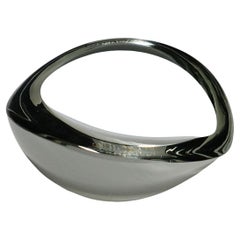
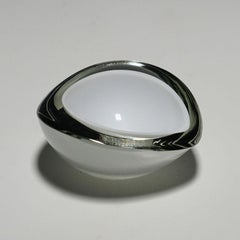
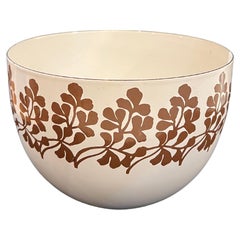
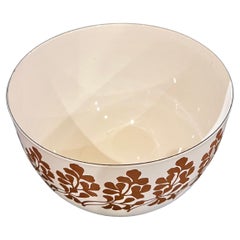
Kaj Gabriel Franck was a leading figure in 20th-century Finnish design, specializing in ceramics and glass. As the creative director of Arabia Ceramics, now part of Iittala, he, along with fellow Finns Timo Sarpaneva and Tapio Wirkkala, helped popularize the bright, warm and curvy aesthetic of Scandinavian modernism. Design Forum Finland’s Kaj Franck Design Prize, established in 1992 and awarded each year around his birthday, is among the country’s most prestigious honors for designers.
Franck was born in 1911 in the city of Vyborg, which now belongs to Russia, but was then part of the Grand Duchy of Finland. He studied furniture design at the Central School of Industrial Design in Helsinki, and after graduating in 1932, worked as a catalogue illustrator for the Riihimäki glassworks, exploring interior and textile design on the side.
Having served in the Finnish armed forces during World War II, Franck joined Arabia in 1945 as their head of design. He remained with the company for many years, steering its line of tableware in a dynamic new direction. Franck professed an aversion to superfluous ornament. His ceramic designs were nevertheless complex and eye-catching, animated with playful, geometric forms. One of his most famous creations for Arabia was the Origami dish from the early 1960s, a glossy all-white serving piece resembling a subtly folded piece of paper with four shallow sections for holding food.
Although his Arabia ceramics became household staples for consumers in Scandinavia and beyond, Franck is better known among collectors for his glass designs, particularly those he created for Iittala starting in the late 1940s. In a 1947 Iittala-sponsored glass competition, Franck shared the top prize with Tapio Wirkkala. In 1950, he designed the company’s iconic Kartio series of pressed-glass pitchers and glasses, which came in different colors that consumers could “mix and match” rather than having to buy a homogeneous set. In 1977, Franck redesigned the series, renamed Teemaa.
Franck’s designs for Iittala embodied the Finnish concept of pelkistetty, which literally means “reduced” and in the design world refers to the pared-down, minimal qualities of modernism. This principle, evidenced in objects like his elegant, unfussy sets of jewel-toned drinking glasses from the 1960s, informed Franck’s view of the manufacturing process as well. Critical of mass production and consumerism, he was one of the country’s first professionals in his field to advocate recycling. He became known as the “conscience of Finnish design,” a role he embraced as a professor and later artistic director at the University of Art and Design in Helsinki.
In honor of Franck’s 100th birthday, in 2011, Iittala reissued Kartio glasses, Teema tableware and Purnukka jars, among other of his designs that retain their contemporary feel decades after their creation.
Find vintage Kaj Franck glass, vases and other furniture and decor on 1stDibs.
Every time you move into a house or an apartment — or endeavor to refresh the home you’ve lived in for years — life for that space begins anew. The right home accent, be it the simple placement of a decorative bowl on a shelf or a ceramic vase for fresh flowers, can transform an area from drab to spectacular. But with so many materials and items to choose from, it’s easy to get lost in the process. The key to styling with antique and vintage decorative objects is to work toward making a happy home that best reflects your personal style.
Ceramics are a versatile addition to any home. If you’ve amassed an assortment of functional pottery over the years, think of your mugs and salad bowls as decorative objects, ideal for displaying in a glass cabinet. Vintage ceramic serveware can pop along white open shelving in your dining area, while large stoneware pitchers paired with woven baskets or quilts in an open cupboard can introduce a rustic farmhouse-style element to your den.
Translucent decorative boxes or bowls made of an acrylic plastic called Lucite — a game changer in furniture that’s easy to clean and lasts long — are modern accents that are neutral enough to dress up a coffee table or desktop without cluttering it. If you’re showcasing pieces from the past, a vintage jewelry box for displaying your treasures can spark conversation: Where is the jewelry box from? Is there a story behind it?
Abstract sculptures or an antique vessel for your home library can draw attention to your book collection and add narrative charm to the most appropriate of corners. There’s more than one way to style your bookcases, and decorative objects add a provocative dynamic. “I love magnifying glasses,” says Alex Assouline, global vice president of luxury publisher Assouline, of adding one’s cherished objects to a home library. “They are both useful and decorative. Objects really elevate libraries and can also make them more personal.”
To help with personalizing your space and truly making it your own, find an extraordinary collection of decorative objects on 1stDibs.