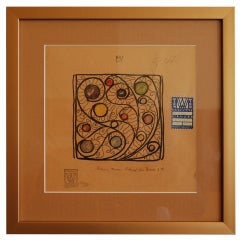
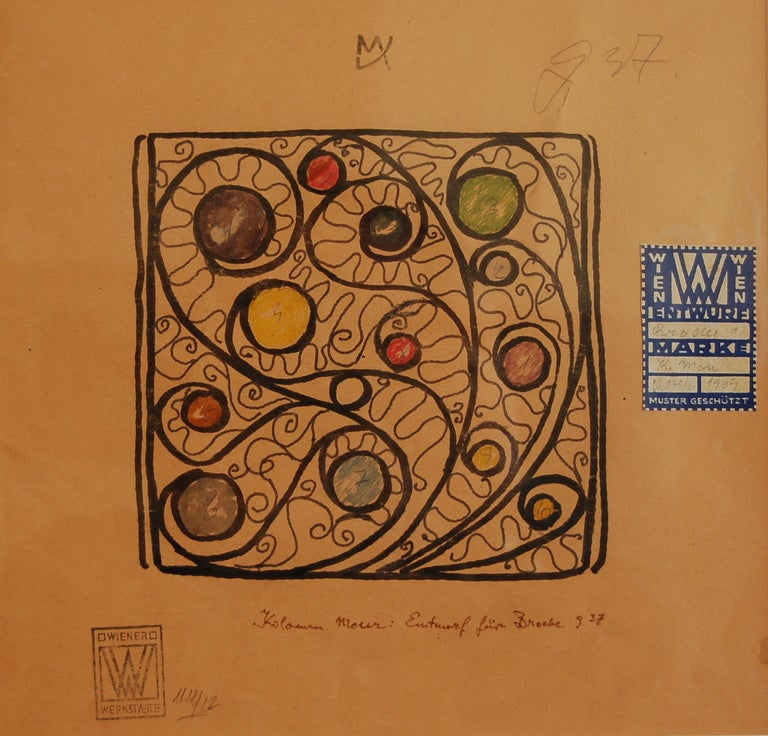
Born in Vienna in 1868, Koloman Moser briefly attended trade school, honoring his father’s wish to see him in commerce. But he soon surrendered to his artistic inclinations, enrolling in 1885 in Vienna’s Academy of Fine Arts, where he studied painting.
When his father died unexpectedly in 1888, leaving the family in financial straits, Moser (1868–1918) helped out by doing illustrations for books and magazines. Meanwhile, he continued his painting studies, at the academy and then at the School of Arts and Crafts, starting in 1892. That was also the year that Moser, along with other young artists revolting against the Viennese art world’s devotion to naturalism, formed the Siebner Club, the precursor to the Vienna Secession.
Moser’s introduction during his last term at school to Gustav Klimt’s Allegory of Sculpture proved a turning point for the young artist. Christian Witt-Dörring, guest curator of the 2018–19 exhibition “Koloman Moser: Universal Artist between Gustav Klimt and Josef Hoffmann” at the MAK in Vienna, noted a change in the artist’s drawing style. “Primarily inspired by the art of Japan, [Klimt] introduces new paper sizes, fragmented image details, and an emphasis on the line as opposed to the surface,” wrote Witt-Dörring in the exhibition’s catalogue.
A year later, in 1897, Moser together with Klimt, Carl Moll, Joseph Olbrich and Josef Hoffmann founded the Vienna Secession, a union of artists and designers determined to upend Austria’s artistic conservatism. The members were committed to making total works of art: Gesamtkunstwerken. Looking to the English Arts and Crafts Movement, with its guiding principle of unity of the arts, the group attempted to bring art back into everyday life and introduce a local modernism to fin-de-siècle Vienna. Moser, whose membership in the club also afforded him entry into upper-class Viennese society, turned his back on oil painting and forged ahead with Gesamtkunstwerk.
Moser created everything from exhibition design to facade ornamentation for the Secession Building, to graphic materials. Moser also produced posters and advertisements in his “modern style” for various companies. In 1898, he presented his first decor pieces, including hand-knotted rugs and cushion covers. In 1899, Moser began what would become a lifelong professorship at the School of Arts and Crafts. His repertoire now expanded to include furniture, ceramics and patterns like his trademark checkerboard design. He also moved into scenography and fashion and established himself as an interior designer.
The artist decorated his own home in 1902, after which he received a series of important commissions, notably the villa of textile industrialist Fritz Waerndorfer. It was Waerndorfer who provided the financial support that enabled Moser and Hoffmann in 1903 to found the Wiener Werkstätte, a platform for fully realizing their ideal of Gesamtkunstwerk. Two years later, Moser married Edith Mautner von Markhof, the daughter to one of Austria’s great industrial barons, and his work thrived.
In 1907, the Wiener Werkstätte ran into financial trouble. Losing faith in the unity of the arts and disillusioned with the group’s dependency on wealthy patrons like Waerndorfer, Moser left the Werkstätte. He returned to his original discipline, painting, which he continued to practice until his untimely death from cancer, in 1918.
Today, Koloman Moser’s work, from his metal vases to his jewelry to his interiors, remains sought-after and revered. Browse Moser's radically modern creations at 1stDibs.
Revitalize your interiors — introduce drawings and other wall decorations to your home to evoke emotions, stir conversation and show off your personality and elevated taste.
Drawing is often considered one of the world’s oldest art forms, with historians pointing to cave art as evidence. In fact, a cave in South Africa, home to Stone Age–era artists, houses artwork that is believed to be around 73,000 years old. It has indeed been argued that cave walls were the canvases for early watercolorists as well as for landscape painters in general, who endeavor to depict and elevate natural scenery through their works of art.
The supplies and methods used by artists and illustrators to create drawings and paintings have evolved over the years, and so too have the intentions. Artists can use their drawing and painting talents to observe and capture a moment, to explore or communicate ideas and convey or evoke emotion. No matter if an artist is working in charcoal or in watercolor and has chosen to portray the marvels of the pure human form, to create realistic depictions of animals in their natural habitats or perhaps to forge a new path that references the long history of abstract visual art, adding a drawing or watercolor painting to your living room or dining room that speaks to you will in turn speak to your guests and conjure stimulating energy in your space.
When you introduce a new piece of art into a common area of your home — a figurative painting by Italian watercolorist Mino Maccari or a colorful still life, such as a detailed botanical work by Deborah Eddy — you’re bringing in textures that can add visual weight to your interior design. You’ll also be creating a much-needed focal point that can instantly guide an eye toward a designated space, particularly in a room that sees a lot of foot traffic.
When you’re shopping for new visual art, whether it’s for your apartment or weekend house, remember to choose something that resonates. It doesn’t always need to make you happy, but you should at least enjoy its energy.
On 1stDibs, browse a wide-ranging collection of drawings and other wall décor for sale. And find out how to arrange wall art when you’re ready to hang your new works.