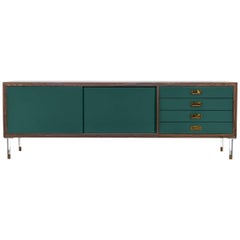
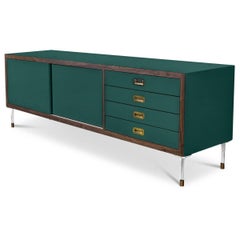
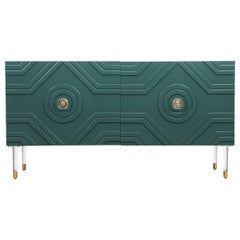
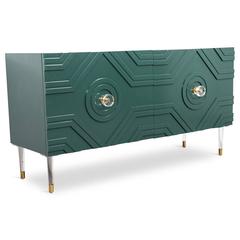
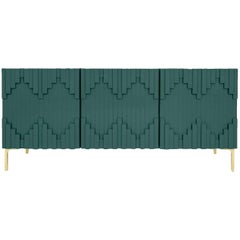
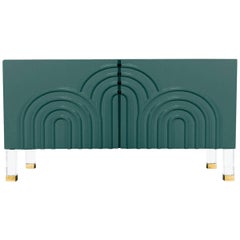
Family-owned and -operated furniture company Modshop not only specializes in creating what the founders call “home furnishings and accessories for your soul,” but it is also turning heads among Hollywood’s elite. The brand’s eclectic designs draw on Scandinavian modernism, 1960s flamboyance and Hollywood Regency as much as they do industrial and urban lofts-style decor — and almost everything else in between.
Founded by husband-and-wife team John and Taryn Bernard in Los Angeles, California, Modshop — which began with a single retail location in 2000 — is fueled by the Bernards’ background in fashion design. The owners create unique, on-trend modern furniture such as plush ottomans with polished brass frames, patterned credenzas in the Art Deco style and sleek lucite dining tables that appeal to a comfortable and relaxed lifestyle. Custom furniture is also a Modshop speciality, as the brand frequently consults with clients to create personalized furniture designs.
Over the years, Modshop has counted Hollywood’s hottest celebrities among their clientele. Music moguls Jay-Z and Beyoncé outfitted their New York City offices with 14 pieces of Modshop-created artwork, while the brand created custom furniture for talk show host Ellen Degeneres’s Hollywood Hills home as well as for the homes of media personalities and models Paris and Nicky Hilton.
Modshop has also taken on interior design projects for notable restaurants, hotels and retailers throughout the United States, such as Nordstrom and Valentino. Sushi restaurant Katsuya features numerous Modshop designs in its downtown Los Angeles location, and the company designed the interiors and guest rooms of the Palm Springs Hotel. In recent years, Modshop collaborated with interior design firm Davis Ink Ltd to create furniture and decor for numerous Southern California nightclubs.
Modshop has showrooms in Los Angeles, New York, Dallas, Miami and Chicago. The company's vibrant and fun designs are favorites of interior decorators and furniture collectors around the world.
On 1stDibs, discover an extraordinary range of Modshop seating, case pieces and storage cabinets, tables and more.
Organically shaped, clean-lined and elegantly simple are three terms that well describe vintage mid-century modern furniture. The style, which emerged primarily in the years following World War II, is characterized by pieces that were conceived and made in an energetic, optimistic spirit by creators who believed that good design was an essential part of good living.
ORIGINS OF MID-CENTURY MODERN FURNITURE DESIGN
CHARACTERISTICS OF MID-CENTURY MODERN FURNITURE DESIGN
MID-CENTURY MODERN FURNITURE DESIGNERS TO KNOW
ICONIC MID-CENTURY MODERN FURNITURE DESIGNS
VINTAGE MID-CENTURY MODERN FURNITURE ON 1STDIBS
The mid-century modern era saw leagues of postwar American architects and designers animated by new ideas and new technology. The lean, functionalist International-style architecture of Le Corbusier and Bauhaus eminences Ludwig Mies van der Rohe and Walter Gropius had been promoted in the United States during the 1930s by Philip Johnson and others. New building techniques, such as “post-and-beam” construction, allowed the International-style schemes to be realized on a small scale in open-plan houses with long walls of glass.
Materials developed for wartime use became available for domestic goods and were incorporated into mid-century modern furniture designs. Charles and Ray Eames and Eero Saarinen, who had experimented extensively with molded plywood, eagerly embraced fiberglass for pieces such as the La Chaise and the Womb chair, respectively.
Architect, writer and designer George Nelson created with his team shades for the Bubble lamp using a new translucent polymer skin and, as design director at Herman Miller, recruited the Eameses, Alexander Girard and others for projects at the legendary Michigan furniture manufacturer.
Harry Bertoia and Isamu Noguchi devised chairs and tables built of wire mesh and wire struts. Materials were repurposed too: The Danish-born designer Jens Risom created a line of chairs using surplus parachute straps for webbed seats and backrests.
The Risom lounge chair was among the first pieces of furniture commissioned and produced by celebrated manufacturer Knoll, a chief influencer in the rise of modern design in the United States, thanks to the work of Florence Knoll, the pioneering architect and designer who made the firm a leader in its field. The seating that Knoll created for office spaces — as well as pieces designed by Florence initially for commercial clients — soon became desirable for the home.
As the demand for casual, uncluttered furnishings grew, more mid-century furniture designers caught the spirit.
Classically oriented creators such as Edward Wormley, house designer for Dunbar Inc., offered such pieces as the sinuous Listen to Me chaise; the British expatriate T.H. Robsjohn-Gibbings switched gears, creating items such as the tiered, biomorphic Mesa table. There were Young Turks such as Paul McCobb, who designed holistic groups of sleek, blond wood furniture, and Milo Baughman, who espoused a West Coast aesthetic in minimalist teak dining tables and lushly upholstered chairs and sofas with angular steel frames.
Generations turn over, and mid-century modern remains arguably the most popular style going. As the collection of vintage mid-century modern chairs, dressers, coffee tables and other furniture for the living room, dining room, bedroom and elsewhere on 1stDibs demonstrates, this period saw one of the most delightful and dramatic flowerings of creativity in design history.
Whether burnished or lacquered, antique, new and vintage brass furniture can elevate a room.
From traditional spaces that use brass as an accent — by way of brass dining chairs or brass pendant lights — to contemporary rooms that embrace bold brass decor, there are many ways to incorporate the golden-hued metal.
“I find mixed metals to be a very updated approach, as opposed to the old days, when it was all shiny brass of dulled-out silver tones,” says interior designer Drew McGukin. “I especially love working with brass and blackened steel for added warmth and tonality. To me, aged brass is complementary across many design styles and can trend contemporary or traditional when pushed either way.”
He proves his point in a San Francisco entryway, where a Lindsey Adelman light fixture hangs above a limited-edition table and stools by Kelly Wearstler — also an enthusiast of juxtapositions — all providing bronze accents. The walls were hand-painted by artist Caroline Lizarraga and the ombré stair runner is by DMc.
West Coast designer Catherine Kwong chose a sleek brass and lacquered-parchment credenza by Scala Luxury to fit this San Francisco apartment. “The design of this sideboard is reminiscent of work by French modernist Jean Prouvé. The brass font imbues the space with warmth and the round ‘portholes’ provide an arresting geometric element.”
Find antique, new and vintage brass tables, case pieces and other furnishings now on 1stDibs.
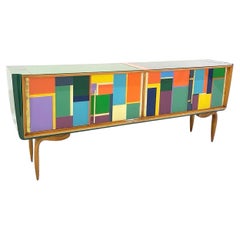
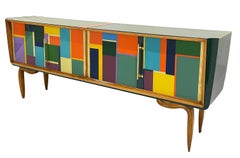
Mid-century modern credenzas descend from the Renaissance-era sideboard, once used to serve and store food and dishware. The clean-lined, low-profile version prized today emerged from Italian and Scandinavian design in the mid-20th century, defined by tapered legs and warm walnut or teak veneers.
Styles to Know
Mid-century modern credenzas are one of the most searched storage silhouettes on 1stDibs. Sliding-door and open-shelf configurations serve different needs: books and displayed objects suit open shelving, while electronics and linens are better behind doors. A matching mid-century modern dresser extends the look to the bedroom, or an apothecary cabinet offers more drawer storage in a smaller footprint.
How to Choose the Right Vintage Credenza
Hardware and veneer condition vary considerably from piece to piece, so listing photographs deserve a close look; our guide to case pieces covers what else to look for in construction. Every credenza comes from a vetted 1stDibs seller, with era, designer and condition on record, and the 1stDibs Promise stands behind every purchase.