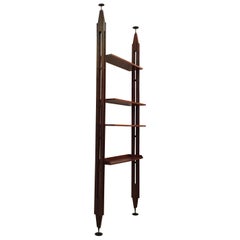
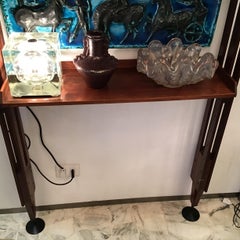
Franco Albini Library “Poggi” Wood Metal Iron, 1955, Italy
By Franco Albini
Located in Milano, IT
Franco Albini Library “Poggi” wood metal iron, 1955, Italy.
Category
1950s Italian Other Vintage Franco Albini Console Tables
Materials
Wood
While working under the polymath Gio Ponti — arguably the most important figure in 20th-century Italian modernism — furniture designer Franco Albini nurtured a love for modern forms combined with traditional craft techniques.
Albini is widely known for working with organic materials such as rattan and cane for his chairs and other seating, but he also played a pivotal role in the Italian rationalist movement of the early 20th century, which saw architects and furniture makers applying a strict emphasis on geometry in their work. Rationalists drew on Ancient Roman architecture but rejected ornament, much in the way that Le Corbusier and celebrated Bauhaus figures such as Ludwig Mies van der Rohe had in their modernist furniture.
Albini received his degree in architecture from the Polytechnic University of Milan in 1929, and, in 1931, he founded his practice in Milan, where he tackled workers’ housing and other reconstruction projects. A gifted urban planner, he also developed the Palazzo Bianco, Palazzo Rosso and Tesoro di San Lorenzo museums in Genoa. While Albini is revered for his Margherita chair — a Triennale Milano award winner created for Bonacina in 1951 — he also collaborated with manufacturers Poggi and Cassina in the 1940s on seating, tables and more that embodied his artistic vision. Of that mid-century work, the one piece that perhaps best captures this vision is the iconic Luisa chair.
With its cherry red upholstery and sinuous wooden legs that seem to float aboveground, the Luisa is a genuine masterpiece. It is also a testament to Albini’s perfectionism, as it endured several prototypes — including one made by Knoll in the late 1940s — and took approximately 15 years to design. Poggi launched the final version of the armchair in 1955, earning Albini the prestigious Compasso d’Oro from Italy’s Association for Industrial Design. It is produced today by Cassina. Albini named the chair for someone who likely saw the process firsthand: his personal secretary of two decades, Luisa Colombini.
Find vintage Franco Albini furniture on 1stDibs.
Franco Albini Library “Poggi” Wood Metal Iron, 1955, Italy
By Franco Albini
Located in Milano, IT
Franco Albini Library “Poggi” wood metal iron, 1955, Italy.
Wood
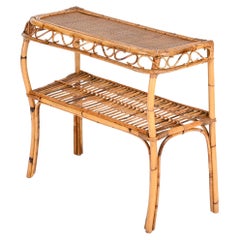
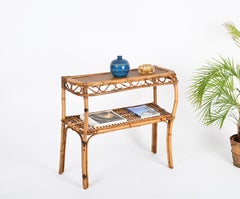
Franco Albini Midcentury Console Table in Bamboo and Rattan, Italy, 1960s
By Franco Albini
Located in Roma, IT
Wonderful mid-century console table in curved bamboo, rattan and hand-woven wicker. This stunning organic piece was designed by the mastery of Franco Albini and produced in Italy dur...
Bamboo, Rattan, Wicker
$1,403
H 13.39 in W 25.6 in D 10.63 in
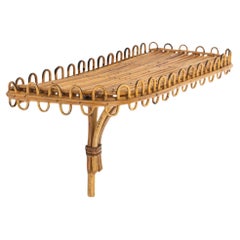
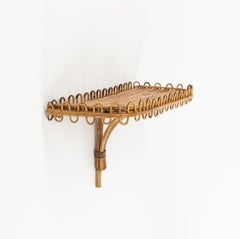
Midcentury Rattan & Bamboo Wall Shelf or Console Att. Franco Albini, Italy 1960s
By Franco Albini
Located in Rome, IT
Midcentury amazing rectangular wall shelf or console in rattan and bamboo attributed to Franco Albini. Made in Italy in the 1960s.
Bamboo, Wicker, Rattan
$3,494
H 31.11 in W 33.47 in D 17.92 in
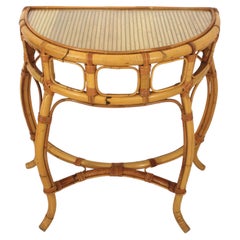
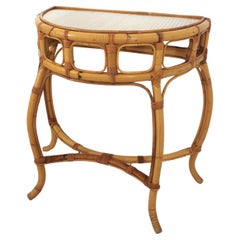
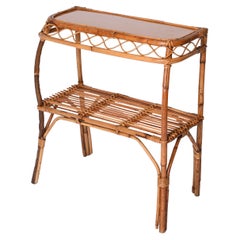
Demilune Console Table in Rattan and Bamboo, Italian Designer, 1960s
Located in Barcelona, ES
Eye-catching bamboo and rattan arched console table with. In the style of Franco Albini and Vivai del Sud. Italy, 1960s. This console table stands...
Bamboo, Rattan

$2,800
H 34.65 in W 33.08 in D 17.33 in
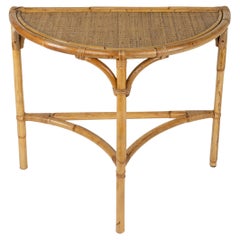
Midcentury Bamboo and Rattan Cocktail Console Table after Franco Albini, 1960s
By Franco Albini
Located in Roma, IT
Stunning console table in bamboo and rattan. This amazing piece was produced in the style of Franco Albini in Italy during the 1960s. Fully handmade, perfect example of Italian ma...
Bamboo, Wicker, Rattan
$1,750
H 28.35 in W 31.89 in D 16.15 in
Midcentury Console Table in Rattan and Bamboo Franco Albini Style, Italy 1970s
By Franco Albini
Located in Rome, IT
Midcentury beautiful demilune console table in rattan and bamboo in the style of Franco Albini. Made in Italy in the 1970s.
Bamboo, Wicker, Rattan
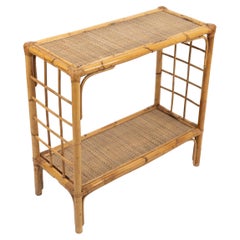
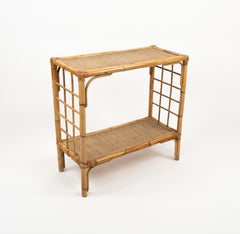
Midcentury Rattan and Bamboo Console Table, Italy 1970s
By Vivai del Sud
Located in Rome, IT
Midcentury beautiful console table in rattan and bamboo. Made in Italy in the 1970s.
Bamboo, Rattan, Cane, Wicker
$11,112
H 28.75 in W 40.95 in D 70.87 in
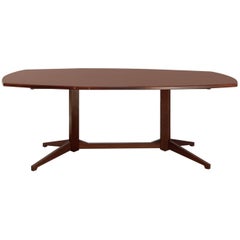
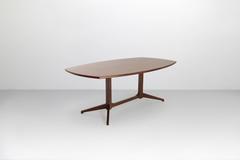
Franco Albini Mahogany mid-centry Italian Table Model TL-22 produced by Poggi
By Franco Albini
Located in Barcelona, ES
Franco Albini & Franca Helg. Dining table model no. TL22. Manufactured by Poggi, Italy, 1958. Mahogany. Measurements: 180.3 cm x 104.1 cm x 73 H cm. 70.98 in x 40.98 in x 28.74 in. Literature: Giuliana Gramigna, Repertorio 1950/1980, Milan, 1985, p. 123. Franco Albini, was born in 1905 and died in 1977. He spent his childhood and part of his youth in Robbiate in Brianza, where he was born. Albini, as an adolescent moved with his family to Milan. Here he enrolled in the Faculty of Architecture of the Polytechnic and graduated in 1929. He started his professional activity in the studio of Gio Ponti and Emilio Lancia, with whom he collaborated for three years. At the 1929 International Exhibition in Barcelona (where Gio Ponti curated the Italian pavilion and Mies van der Rohe realized that of Germany) and in Paris where, as Franca Helg recounted, he had the opportunity to visit the studio by Le Corbusier. In those three years, the works he carried out are admittedly of the twentieth century imprint. It is the meeting with Edoardo Persico that marked a clear turning point towards rationalism and the approach to the group of editors of "Casabella". The partly ironic and partly very harsh comments of the Neapolitan critic to a series of drawings, made by Albini for the design of some office furniture, caused him a great disturbance. “I spent days of real anguish - Albini recalls - I had to answer all the questions. I also had a fever, a large and long fever. " The meted provoked Albini to openen a professional studio in via Panizza with Renato Camus and Giancarlo Palanti. The group of architects began to deal with public housing by participating in the competition for the Baracca district in San Siro in 1932 and then building the IFACP neighborhoods: Fabio Filzi (1936/38), Gabriele D'Annunzio and Ettore Ponti (1939). During this period, Albini also worked on his first villa (Pestarini), which Giuseppe Pagano, architect and critic of the time, presented as follows: “This coherence, which the superficial rhetoric of fashionable jugglers calls intransigence, and which is instead the basis of understood between the fantasy of art and the reality of the craft, in Franco Albini, it is so rooted that it transforms theory into a moral attitude ". But it is above all in the context of the exhibitions that the Milanese master experienced his compromise between that "rigor and poetic fantasy" of which Pagano speaks, coining the elements that became a recurring theme in his . The opening in 1933 of the new Triennale headquarters in Milan, in the Palazzo dell'Arte, was an important opportunity to express the strong innovative character of rationalist thinking, a gym in which to freely experiment with new materials and new solutions, but above all a "method". "Cultivated as a communication laboratory, the art of setting up was for the rationalists of the first generation what the perspective had been for the architects of humanism: the field open to a hypothesis of space that needed profound reflections before landing the concreteness of the construction site ". Together with Giancarlo Palanti, Albini on the occasion of the V Triennale di Milano set up the steel structure house (with R. Camus, G. Mazzoleni, G. Minoletti and with the coordination of G. Pagano), for which he also designed the 'furniture. At the following Triennale of 1936, Persico dided, together with a group of young designers gathered by Pagano in the previous edition of 1933, Franco Albini took care of the preparations of the home exhibition. The setting up of Stanza per un uomo, at that same Triennale, allows us to understand the acute and ironic approach of Albini, as a man and as a designer: "Celebrating the beauty of mechanics was the imperative to which, for example, the surprising displays by Franco Albini who managed, in the subtle way of a refined and rarefied style, to sublimate their practical content in the metaphysics of daring still lifes: flying objects which marked in the void refined frames and metal intricacies the nodes of a fantastic cartography where industry finally became art free from purpose ". That same year Albini and Romano designed the exhibition of the Ancient Italian Goldsmithery: vertical uprights, simple linear rods, designed the space. A theme, of the "flagpole", seemed to be the center of the evolution of production and the creative process. The concept is reworked over time, with the technique of decomposition and recomposition typical of Albinian design: in the preparation of the Scipione Exhibition and contemporary drawings (1941) the tapered flagpoles, on which the paintings and display cases were hung, are supported by a grid of steel cables; in the Vanzetti stand (1942) they take the V-shape; in the Olivetti shop in Paris (1956) the polished mahogany uprights support the shelves for the display of typewriters and calculators. The flagpole is found, however, also in other areas. In the apartments he designed, it is used as a pivot on which the paintings can be suspended and rotated to allow different points of view, but at the same time as an element capable of dividing the spaces. The Veliero bookcase...
Mahogany
$3,977
H 27.17 in W 26.38 in D 18.51 in
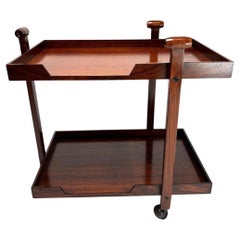
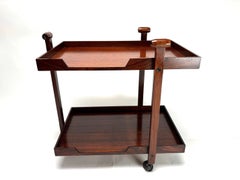
Wooden bar trolley ''CR20'' by Franco Albini for Poggi, Italy, 1958
By Franco Albini
Located in Argelato, BO
Rare "CR20" trolley in rosewood designed by the famous Italian architect and designer Franco Albini for the Poggi company, Italy. it is an authentic icon of style, which perfectly ...
Wood
$3,153
H 31.11 in W 32.29 in D 13.78 in
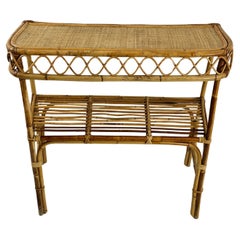
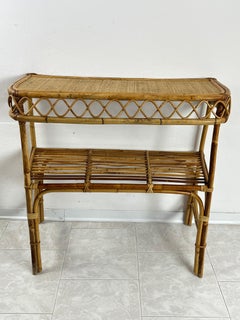
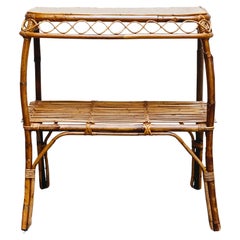
Mid-Century Wicker and Bamboo Console Attributed to Franco Albini 1960s
By Franco Albini
Located in Palermo, IT
Mid-Century wicker and bamboo console attributed to Franco Albini, 1960s Complete and in good condition. Imperceptible signs of time.
Bamboo, Wicker
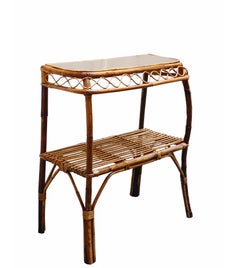
$1,750
H 34.65 in W 30.71 in D 13.39 in
Franco Albini Attrib. Rattan and brass console table, Italy 1960s
By Franco Albini
Located in Naples, IT
Gorgeous rattan console table with brass top. This amazing piece was produced in the style of Franco Albini in Italy during the 1960s. Entirely handmade, perfect example of 1960s Ita...
Brass
$4,900 / set
H 8.87 in W 15.5 in D 9.37 in
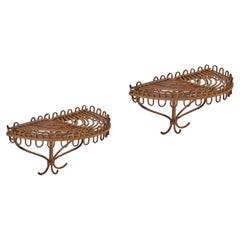
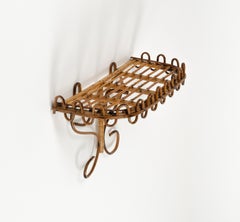
Italian Designer, Pair of Wall-Mounted Consoles, Bamboo, Rattan, 1960s
Located in High Point, NC
A pair of bamboo and rattan wall-mounted consoles designed and produced by an Italian designer, Italy, 1960s. All items ship from High Point, North Carolina.
Bamboo, Rattan
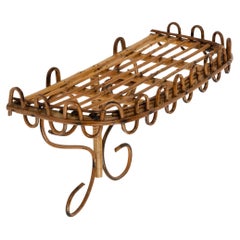
$723
H 10.63 in W 17.33 in D 8.27 in
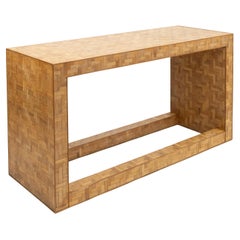
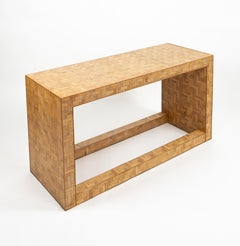
Midcentury Rattan & Bamboo Wall Shelf or Console Att. Franco Albini, Italy 1960s
By Franco Albini
Located in Rome, IT
Midcentury beautiful rectangular wall shelf or console in rattan and bamboo attributed to Franco Albini. Made in Italy in the 1960s.
Bamboo, Rattan
$3,885
H 29.73 in W 54.93 in D 20.48 in
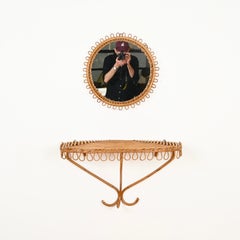
Midcentury Console Table in Bamboo and Rattan Vivai Del Sud Style, Italy 1970s
By Vivai del Sud
Located in Rome, IT
Midcentury wonderful rectangular console table in bamboo and rattan in the style of Vivai Del Sud. Made in Italy in the 1970s. Vivai del sud, Gabriella Crespi and Arpex were th...
Bamboo, Rattan, Wood
Sold
H 18.12 in W 31.89 in D 12.21 in
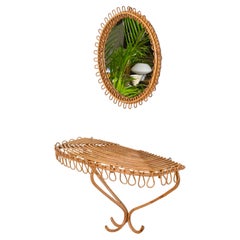
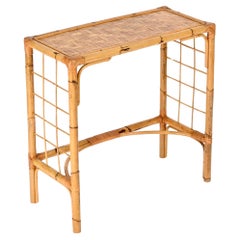
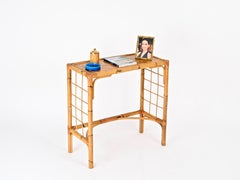
Franco Albini Set of Large Console and Mirror in Rattan and Bamboo, Italy, 1960s
By Franco Albini
Located in Roma, IT
Stunning and unique Mid-Century organic set composed of a large rectangular wall shelf or console and a round mirror, all handmade in curved rattan and bamboo. This stylish and disti...
Bamboo, Wicker, Cane, Rattan
Sold
H 31.89 in W 33.08 in D 14.97 in
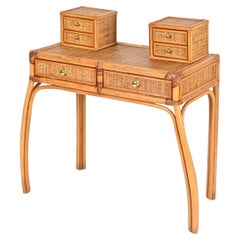
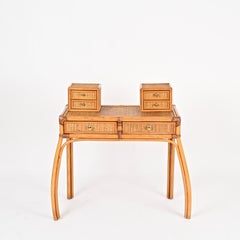
Franco Albini Midcentury Console Table in Bamboo, Rattan and Wicker, Italy 1970s
By Franco Albini
Located in Roma, IT
Stunning mid-century console table fully made of bamboo, rattan, and hand-woven wicker. This delightful organic piece was designed by the mastery of Franco Albini and produced in Ita...
Bamboo, Wicker, Rattan, Cane
Sold
H 38.98 in W 40.16 in D 18.9 in
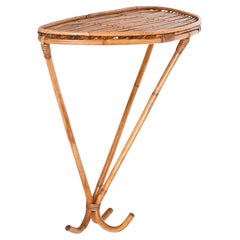
Italian Vanity or Console Table in Bamboo and Rattan by Vivai del Sud, 1970s
By Franco Albini
Located in Roma, IT
Wonderful Mid-Century vanity or console table fully made in bamboo, rattan, hand-woven wicker, and brass. This stylish and unique piece was designed by Vivai del Sud and produced in ...
Brass

Sold
H 32.29 in W 35.44 in D 17.33 in
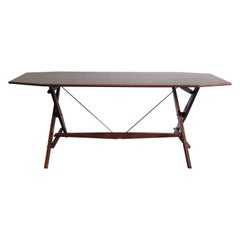
Franco Albini Midcentury Wall Shelf or Console in Rattan and Bamboo, Italy, 1960
By Franco Albini
Located in Roma, IT
Wonderful midcentury large wall shelf or console in curved bamboo, rattan and hand-woven wicker. This incredibly charming piece was designed by the mastery of Franco Albini and produ...
Bamboo, Wicker, Cane, Rattan
Sold
H 27.96 in W 70.87 in D 27.56 in
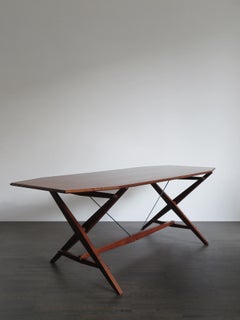
Franco Albini Midcentury Italian Wood ‘TL2’ Model Treste Table for Poggi, 1950s
By Poggi, Franco Albini
Located in Reggio Emilia, IT
Italian midcentury modern design trestle table model TL2 designed by Franco Albini and manufactured by Poggi, table designed according to structuralist criteria with solid wood trest...
Metal
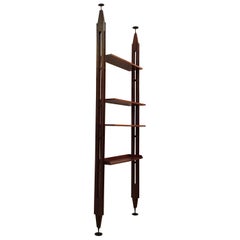
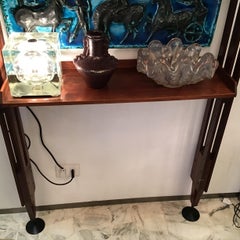
Franco Albini Library “Poggi” Wood Metal Iron, 1955, Italy
By Franco Albini
Located in Milano, IT
Franco Albini Library “Poggi” wood metal iron, 1955, Italy.
Wood
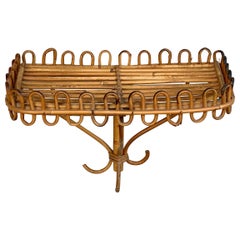
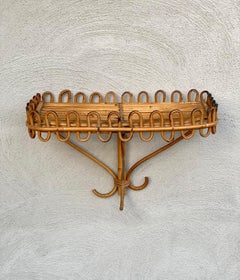
Sold
H 11.82 in W 15.75 in D 9.06 in
Rattan Bedside Wall Mounted Table Shelf by Franco Albini, Italy, 1960s
By Franco Albini
Located in Rome, IT
Bedside wall-mounted shelf in rattan by the Italian designer Franco Albini. Made in Italy, circa 1960.
Bamboo, Wicker, Cane, Rattan