Want more images or videos?
Request additional images or videos from the seller
1 of 9

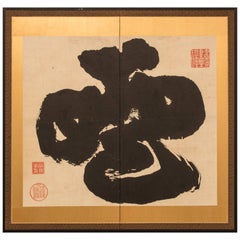
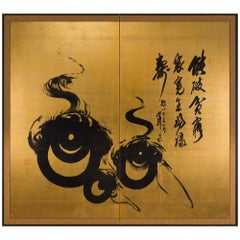
Japanese Two-Panel Screen, Enso

$13,500List Price

You May Also Like

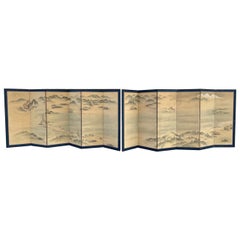
Pair of Japanese Edo Six Panel Screens the Seven Sages

Pair of Japanese Edo Six Panel Screens the Seven Sages

$15,000 / set

H 42.5 in W 102.5 in D 0.5 in

Pair of Japanese Edo Six Panel Screens the Seven Sages

Located in Rio Vista, CA

Fantastic pair of 19th century Japanese late Edo/early Meiji period six-panel screens titled The seven sages of the bamboo grove. The Kano school screens...

Category

Antique 19th Century Japanese Edo Paintings and Screens

Materials

Brass, Gold Leaf

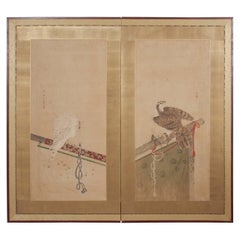
Japanese Edo Period Two-Panel Screen

Japanese Edo Period Two-Panel Screen

$6,500

H 66 in W 72 in D 1.5 in

Japanese Edo Period Two-Panel Screen

Located in Stamford, CT

A Japanese Edo Period two panel folding screen with white and brown hawks of ink and color on paper.

Category

Antique Mid-19th Century Japanese Edo Paintings and Screens

Materials

Paper

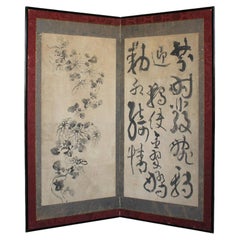
B126 Japanese Antiques 2panels Byobu, folding Screen, Chrysanthemum Calligraphy

B126 Japanese Antiques 2panels Byobu, folding Screen, Chrysanthemum Calligraphy

Located in Niiza, JP

Material: paper, fabric on wooden frame One piece: W750×H1580mm×D18mm Unfolded size: W1500mm Folded size: W750×H1580mm×D36mm, 7kg Packaging (sandwiched with 5-10mm plywood): 10cm x ...

Category

Antique 19th Century Japanese Paintings and Screens

Materials

Paper

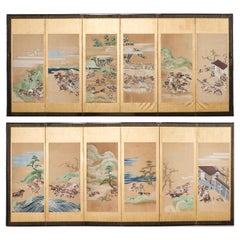
Pair of Japanese Edo/Tokugawa Screens Tale of Heiki

Pair of Japanese Edo/Tokugawa Screens Tale of Heiki

$6,800 / set

H 67 in W 148.5 in D 0.75 in

Pair of Japanese Edo/Tokugawa Screens Tale of Heiki

Located in Rio Vista, CA

Monumental pair of late 18th century Japanese Edo/Tokugawa period byobu screens depicting the battles between Taira and Minamoto. The screens have six panels each with individual sce...

Category

Antique 19th Century Japanese Edo Paintings and Screens

Materials

Brass, Gold Leaf

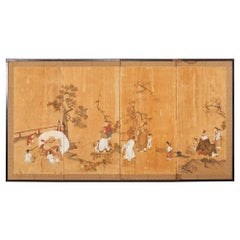
17th Century Japanese Edo Four Panel Screen Hotei with Chinese Sages

17th Century Japanese Edo Four Panel Screen Hotei with Chinese Sages

Located in Rio Vista, CA

Beautifully weathered late 17th/early 18th century Japanese edo period four panel byobu screen depicting hotei (fat monk) in a treed landscape with Chinese sages engaged in leisurely...

Category

Antique 17th Century Japanese Edo Paintings and Screens

Materials

Brass

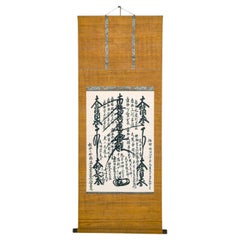
Japanese Gohonzon Buddhist Calligraphy Mandala Scroll Meiji Period

Japanese Gohonzon Buddhist Calligraphy Mandala Scroll Meiji Period

Located in Atlanta, GA

A Japanese sumi ink calligraphy Buddhist mandala mounted as a paper hanging scroll known as Kakejiku or sometimes Moji mandala. Termed as gohonzon in Japanese, it is a venerated object within Nichiren Buddhism (Hokkeshu; lotus sect). The originally concept was developed by the 13th century Buddhist priest Nichiren to guide the energy of the devotional chanting to...

Category

Antique Early 1900s Japanese Meiji Paintings and Screens

Materials

Paper

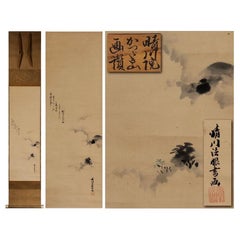
Lovely Japanese 18/19th c Edo Scroll Kano Osanobu Nihonga Painting Mountain

Lovely Japanese 18/19th c Edo Scroll Kano Osanobu Nihonga Painting Mountain

Located in Amsterdam, Noord Holland

Kano Osanobu (狩野養信) Osanobu Kano (born August 18, 1796; died June 12, 1846) was the ninth painter of the Kobikicho Kano School in the Edo period. His common name was Shozaburo. His father was Naganobu KANO, and Tadanobu KANO was his son. His Go (pen name) was Osanobu Seisenin, Kaishinsai, and Gyokusen. Brief Personal History He was born the eldest son of Naganobu ISENIN during the Edo period. He was first sent to serve at Edo Castle at the age of 15, and it appears that he was apparently pushed by his father to perform various public tasks for the Kanon School. He kept a diary for 36 years, starting from the day before he first went into service at Edo Castle until the day before he died. The diary is entitles "Official Service Diary" (it consists of 52 volumes that are maintained at the Tokyo National Museum, and 4 volumes that are separately maintained at the different families), and have become the focus of a lot of attention in recent years for the detailed information they present on the daily life and work of a prestigious official painter. The reading of the characters of his name was originally "Takenobu"; however, with the birth of the first son of the Shongun Ieyoshi TOKUGAWA in 1813, whose name was Takechiyo, having a sylable with the same pronunciation of "Take"was deemed to be inappropriate, and was therefore changed to "Osanobu". Because Takenobu died the following year, after which he was referred to as Gyokujuin, Osanobu changed his pen name Gyokusen he had used until that point to Seisenin, in order to avoid using the same Chinese charcter pronounced alike. In 1819, he attained the second highest rank for a Buddhist priest, Hogen, and assumed the role of head of the family after his father passed away in 1828. In 1834 he attained the highest rank for a Buddhist priest, Hoin. He oversaw the rennovation of the wall paintings of Nishinomaru Palace of Edo Castle from 1838 to 1839, and Honmaru Palace of it from 1844 to 1846. It is thought that Osanobu later died due to the fatigue...

Category

Antique 18th Century Edo Paintings

Materials

Silk

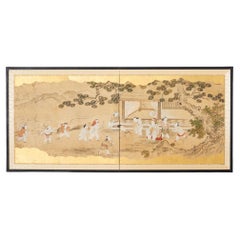
19th Century Japanese Edo Screen Kano School Garden Terrace

19th Century Japanese Edo Screen Kano School Garden Terrace

Located in Rio Vista, CA

Fantastic 19th century Japanese Edo/Tokugawa period two-panel byobu screen featuring Chinese children frolicking on a garden terrace with a pavilion and large pine tree. Made in the ...

Category

Antique 19th Century Japanese Edo Paintings and Screens

Materials

Brass, Gold Leaf

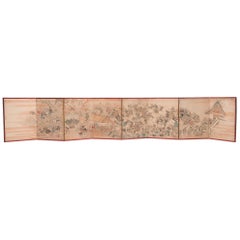
Japanese Edo Period Festival Screen, c. 1750

Japanese Edo Period Festival Screen, c. 1750

$9,280

H 23.75 in W 143.5 in D 0.75 in

Japanese Edo Period Festival Screen, c. 1750

Located in Chicago, IL

This 18th century folding screen is a stunning example of Japanese artistry. Beautifully painted with delicate brushwork, the evocative sc...

Category

Antique Mid-18th Century Japanese Edo Paintings and Screens

Materials

Paper

Pair of 19th Century Japanese Screens

Pair of 19th Century Japanese Screens

$3,702Sale Price / set|30% Off

H 68.9 in W 152.37 in D 0.71 in

Pair of 19th Century Japanese Screens

Located in Bagshot, GB

A pair of large 19th century Japanses Screens of Japanese scenery. The screens also come with a wooden crate which would have been built for them at a later date in order to move ...

Category

Antique 19th Century Asian Other Decorative Art

Materials

Paper

More From This Seller

View All
Japanese Two Panel Screen, Zen Calligraphy Character Cloud

Japanese Two Panel Screen, Zen Calligraphy Character Cloud

Located in Hudson, NY

Meiji period (1868 - 1912) calligraphy painting. Abstract character reads: Kumo (cloud). Seal on the upper right reads Shogazen, seal on the upper left reads Hosai. Ink on mulberr...

Category

Early 20th Century Japanese Meiji Paintings and Screens

Materials

Silk, Wood, Paper

Japanese Two-Panel Screen Three Jewels of Buddhism

Japanese Two-Panel Screen Three Jewels of Buddhism

Located in Hudson, NY

Japanese two-panel screen: Three Jewels of Buddhism. Meiji period (1868-1912) painting. The three jewels of Buddhism are the teacher, the lesson, and the ...

Category

Antique Late 19th Century Japanese Meiji Paintings and Screens

Materials

Silk, Wood, Paper

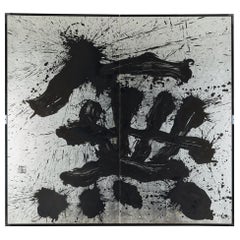
Japanese Two Panel Screen: Mu (Nothing)

Japanese Two Panel Screen: Mu (Nothing)

Located in Hudson, NY

Calligraphy reads: Mu (Nothing). Ink on silver in a black lacquered wooden trim. Seal is illegible.

Category

Early 20th Century Japanese Paintings and Screens

Materials

Silver

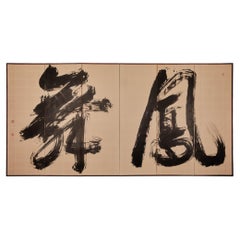
Japanese Six Panel Screen: Calligraphy reads Dancing Phoenix

Japanese Six Panel Screen: Calligraphy reads Dancing Phoenix

Located in Hudson, NY

Strong brush strokes in sumi ink on mulberry paper. Dark red lacquer trim with original intricate silver hardware. Top seal reads: Soushoan, Bottom seal reads: Getsujo

Category

20th Century Japanese Paintings and Screens

Materials

Silver

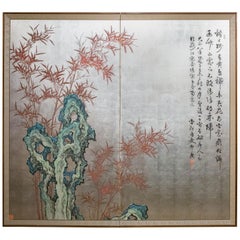
Japanese Two-Panel Screen Chinese Style Painting with Calligraphy

Japanese Two-Panel Screen Chinese Style Painting with Calligraphy

Located in Hudson, NY

Painting of a perforated garden stone with red bamboo growing behind. Chinese zekku poem reads, "Returning home to my grass hut on a spring evening," by the Tang-poet Qian Qi. Screen...

Category

Early 20th Century Japanese Taisho Paintings and Screens

Materials

Silk, Paper, Wood

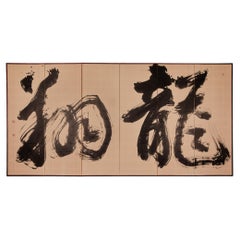
Japanese Six Panel Screen: Calligraphy reads Flying Dragon

Japanese Six Panel Screen: Calligraphy reads Flying Dragon

Located in Hudson, NY

Strong brush strokes in sumi ink on mulberry paper. Dark red lacquer trim with original intricate silver hardware. Top seal reads: Soushoan, Bottom seals read: Getsujo

Category

20th Century Japanese Paintings and Screens

Materials

Silver