Want more images or videos?
Request additional images or videos from the seller
1 of 14

Mid 18th Century Japanese Screen Pair. Crows & Pines by Unkoku Toshuku.

$64,000List Priceper set

You May Also Like

More From This Seller

View All
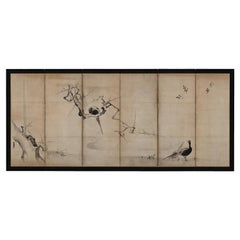
17th Century Japanese Screen. Ink Plum Tree & Birds by Kano Naonobu.

17th Century Japanese Screen. Ink Plum Tree & Birds by Kano Naonobu.

Located in Kyoto, JP

Kano Naonobu (1607-1650) Plum Tree and Birds Six-fold Japanese Screen. Ink and slight color on paper. In this evocative ink work spread over a six-panel folding screen, we see the consummation of the elegance and refinement of the Edo Kano school. This 17th century screen is a rare surviving example of a large-scale bird and flower painting by Kano Naonobu, the younger brother of Kano Tanyu...

Category

Antique 17th Century Japanese Edo Paintings and Screens

Materials

Wood, Paper

17th Century Japanese Screen. Flowers & Birds of Winter and Early Spring.

17th Century Japanese Screen. Flowers & Birds of Winter and Early Spring.

Located in Kyoto, JP

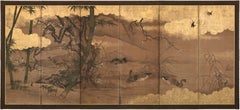
Signed Unkoku Toyu (1660-1716) Flowers & Birds of Winter and Early Spring A Six-panel Japanese Screen. Ink, color and gold leaf on paper. This later 17th century Japanese screen is signed Unkoku Tōyū (1660–1716), a leading figure of the Unkoku school in the early Edo period. Tōyū was the eldest son of Unkoku Tōji, and he carried forward a lineage that deliberately anchored itself in the authority of Sesshū Tōyō. The mood of the scene is observational and seasonal, not emblematic of power as were many screens from the more wide-spread Kano school. The composition is unified by wind and atmosphere. Everything — bamboo, plum, reeds, water, birds — participates in a single directional force moving from left to right. Unlike certain later screens that flatten elements across the surface, this composition preserves a sense of depth. Yet the recession is moderated by gold clouds and frontal placement of forms. The result is a balanced tension between depth and surface. The compositional structure — with its expansive sweep across the panels — reflects the decorative ambition of Momoyama screen...

Category

Antique Late 17th Century Japanese Edo Paintings and Screens
Materials

Gold Leaf

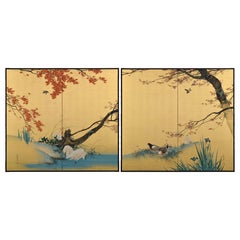
Meiji Era, Circa 1900 Japanese Screen Pair, Flowers & Birds of Spring & Autumn

Meiji Era, Circa 1900 Japanese Screen Pair, Flowers & Birds of Spring & Autumn

Located in Kyoto, JP

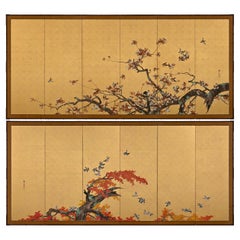
Flowers & Birds of Spring and Autumn Unknown artist. Japan. Meiji period, circa 1900. A pair of six-fold screens. Ink, color, gofun and gold leaf on paper. Signed: Gaga S...

Category

Antique 1890s Japanese Meiji Paintings and Screens

Materials

Gold Leaf

Japanese Screen. Two-panel. Aged Pines by Suzuki Shonen. Meiji period.

Japanese Screen. Two-panel. Aged Pines by Suzuki Shonen. Meiji period.

Located in Kyoto, JP

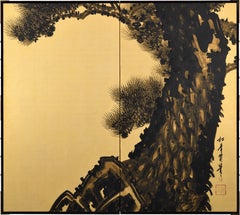
Suzuki Shonen (1848-1918) Aged Pine Meiji period (1868-1912). Circa 1900. Two-panel Japanese screen. Ink and gold leaf on paper. This commanding two-panel screen by Suzuki Shōnen...

Category

Early 20th Century Meiji Paintings and Screens

Materials

Gold Leaf

Meiji era Japanese Screen Pair, Two-panel. Spring & Autumn Birds & Flowers.

Meiji era Japanese Screen Pair, Two-panel. Spring & Autumn Birds & Flowers.

Located in Kyoto, JP

Spring and Autumn Birds & Flowers Hasegawa Gyokujun (1863-1921) Meiji period, circa 1900. Ink, color and gofun on silk. Dimensions of each screen: H. 172 cm x W. 188 cm (68’’ x 7...

Category

Early 20th Century Japanese Meiji Paintings and Screens

Materials

Gold Leaf