Want more images or videos?
Request additional images or videos from the seller
1 of 5

Japanese Meiji Lacquer Writing Set

$28,500
£21,303.66
€24,889.01
CA$40,092.01
A$40,576.20
CHF 23,265.27
MX$492,138.68
NOK 270,565.71
SEK 275,409.76
DKK 186,054.31

About the Item

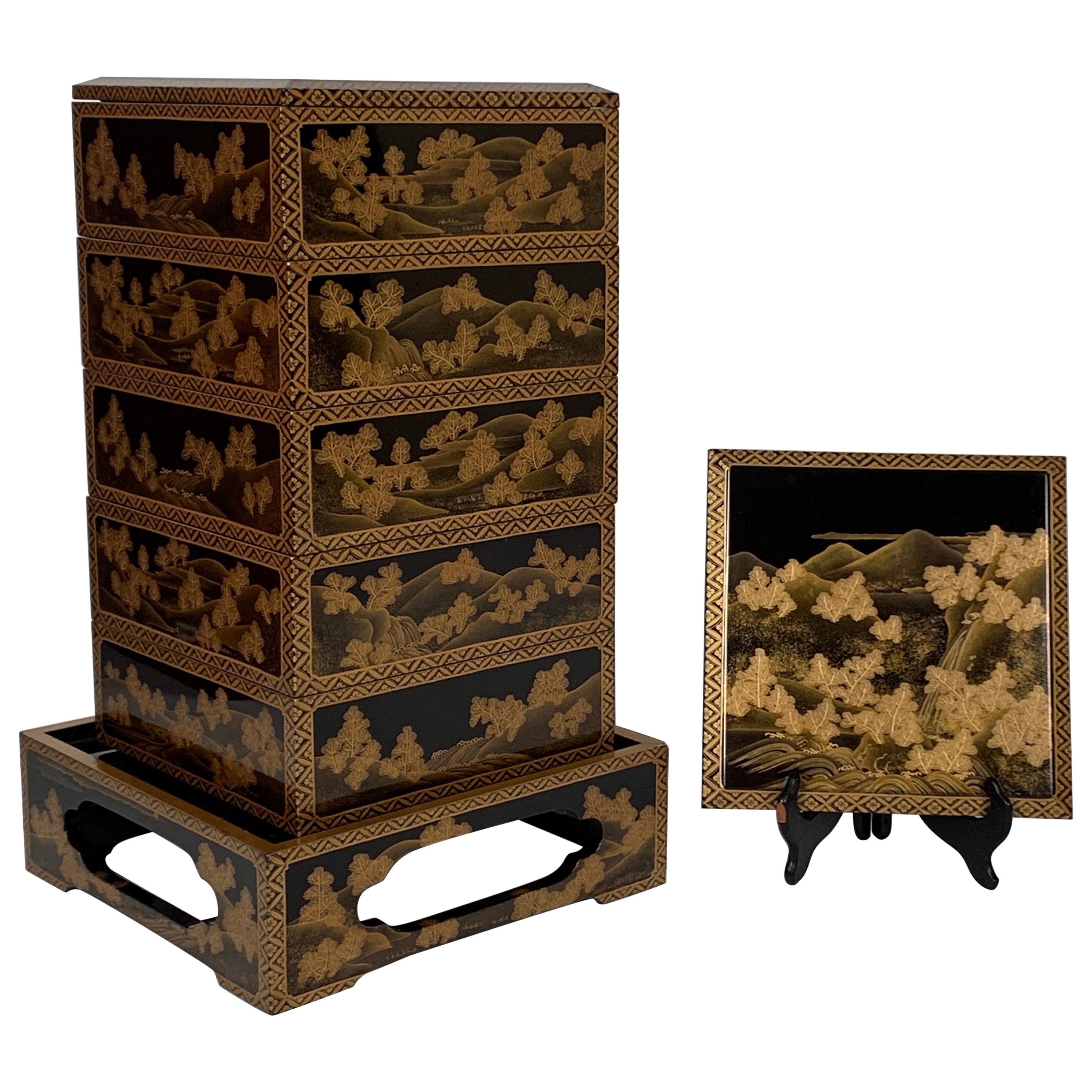
This remarkable Japanese portable writing set contains the instruments of sublime artistic expression. Also known as a yatate, this Meiji-period set includes a low writing table, an ink stone, or suzuri and water dropper, or mizusashi, in a compact or silk-covered saturation pad, and a set of five metal implements. Incredible lacquer decoration of tree-lined, rolling hills distinguish the larger items, and all of these are held inside a finely crafted box of bare wood, which is marked with a Japanese inscription and bound with a ribbon handle. Yatate, which means “arrow stand,” were first invented during the Kamakura period (1185-1333). Before they were invented, whenever anyone wanted to write or draw in ink, he had to make his own by grinding the ink stick in water on the grinding stone. Samurai warriors often had to write letters and reports from the field, and therefore carried their writing tools with them, including a small grinding stone set in a drawer at the bottom of their arrow quiver. This grinding stone became known as the yatate no suzuri (arrow stand's grinding stone), then simply “yatate.” As it was burdensome to have to pull out one’s writing implements every time one needed to write, the idea of saturating a piece of cotton or silk in liquid ink was born. This could be carried about in a simple container without any worry of spills. If a dispatch was required, the warrior need simply to slide open the lid and press his brush into the cotton, circa 1890 Measures: 9" wide x 1 1/2" deep x 10 3/4" high.
  • Dimensions:
    Height: 10.75 in (27.31 cm)Width: 9 in (22.86 cm)Depth: 1.5 in (3.81 cm)
  • Style:
    Meiji (Of the Period)
  • Materials and Techniques:
  • Place of Origin:
  • Period:
  • Date of Manufacture:
    circa 1890
  • Condition:
  • Seller Location:
    New Orleans, LA
  • Reference Number:
    Seller: 29-91141stDibs: LU891110411843

More From This Seller

View All
Gold Lacquer Incense Box

Gold Lacquer Incense Box

Located in New Orleans, LA

A Gold Lacquer Kōbako (Incense Box) Edo Period (1615–1868), Circa 1850 This exquisite gold lacquer kōbako (incense box) exemplifies the refined craftsmans...

Category

Antique 19th Century Japanese Edo Decorative Boxes

Materials

Gold, Silver, Gold Leaf

Japanese Lacquer Box

Japanese Lacquer Box

Located in New Orleans, LA

This exquisite Meiji-period lacquer document box known as a ryoshibako showcases the meticulous artistry of maki-e, a technique of raised lacquer decoration. Adorned with gold and vi...

Category

Antique 19th Century Asian Meiji Lacquer

Materials

Gold

Edo-Period Lacquerware Chest

Edo-Period Lacquerware Chest

Located in New Orleans, LA

Edo-Period Lacquerware Chest 19th-century This exquisite chest, inspired by Hasami-Bako travel trunks, is a striking example of Japanese lacquerware. The hiramaki-e technique—applie...

Category

Antique 19th Century Japanese Edo Decorative Boxes

Materials

Gold

Japanese Lacquer and Gold Tray

Japanese Lacquer and Gold Tray

Located in New Orleans, LA

This Meiji-period lacquer tray represents the mastery of Japanese craftsmen in the art of lacquer work. Precious materials are precisely inlaid in the lacquer base, creating a highly...

Category

Antique Late 19th Century Asian Meiji Lacquer

Materials

Gold

Chinese Cinnabar Lacquer Cuspidor

Chinese Cinnabar Lacquer Cuspidor

Located in New Orleans, LA

This intriguing Chinese zhadou is intricately carved of fine cinnabar lacquer. A work of exceptional artistry, this covered bowl is adorned with an intricately carved floral motif on all surfaces, including the cover and the wide rim. Also known as a cuspidor or spittoon, this rare container would have been used by members of the imperial family and scholar- officials at the court. Carved during the Kangxi period (1662-1722), this charming piece exhibits the high detail and charm associated with items from that period, making it a true treasure, Early 18th century (Kangxi dynasty) Measures: 6 ¼” wide x 3 ¼” high Cinnabar has been revered for its color all over the world. It has been found in the royal burial chambers of the Mayas, in the rituals of India, and in the ruins of ancient Greece and Rome. In China, cinnabar and gold were the two most important elements in alchemy. Mined since the Neolithic Age, cinnabar is the ore of mercury, and as such, it can be incredibly toxic, especially when mining. In fact, during the Roman Empire, miners at Spain’s Almadén mine in Spain were frequently exposed to mercury fumes, and the subsequent, often fatal, sickness was considered an occupational hazard. The most popular known use of cinnabar is in Chinese carved lacquer-ware, a technique that is believed to have originated in the Song Dynasty, in which cinnabar is ground to a powder and added to clear lacquer. As with mining, there was inherent danger of mercury poisoning for those who carved the lacquer, as mercury was also released into the air when artisans ground the pigments. Most antique cinnabar...

Category

Antique 18th Century Chinese Other Lacquer
Materials

Lacquer

Japanese Lacquer Tray With Cards

Japanese Lacquer Tray With Cards

Located in New Orleans, LA

This Meiji-period lacquer tray represents the mastery of Japanese craftsmen in the art of lacquer work. Precious materials are precisely inlaid in the lacquer base, creating a highly...

Category

Antique Late 19th Century Japanese Meiji Lacquer

Materials

Gold

You May Also Like

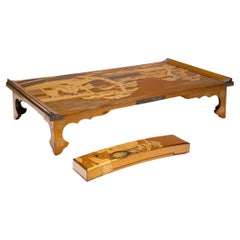
Japanese writting set in waqasa lacquer including bundai ryoshibako and fudebako

Japanese writting set in waqasa lacquer including bundai ryoshibako and fudebako

Located in PARIS, FR

Set of bundai, ryōshibako and fudebako in wakasa lacquer with an old rose background and black traditional Japanese patterns. The saya pattern (or sayagata) is composed by Chinese svastikas. This symbol linked to Buddhism, mean intelligence, power and peace. It is a good omen sign. The kanoko pattern reminds stains on fawn back. The sakura (cherry blossom) pattern is emblematic of Japan. The blossoming in a short time marks spring beginning and is a symbol of renewal and ephemeral beauty. There are also traces of calligraphy brush, in reference to the function of the objects. Bundai is a low table used to put books or scrolls and, later, to write. Rectangular ryōshibako (letter and document box) with a slightly domed Fudebako (pencil case) of rectangular format very narrow in its length with two rounded corners, flat cover. Wakasa lacquerware...

Category

Early 20th Century Japanese Taisho Lacquer

Materials

Lacquer

Japanese Meiji Gilt Lacquer Writing Desk & Poem Box

Japanese Meiji Gilt Lacquer Writing Desk & Poem Box

Located in Chicago, IL

With intricate construction and exquisite decoration, this fine tabletop writing set is a masterpiece of Japanese lacquerware. The matching set includes a writing table (bundai) and poem box (tanzaku bako), both decorated with gilt lacquer in the style of takamaki-e and hiramaki-e urushi lacquer. Framed by everted ends, the lacquered table top is masterfully worked, depicting a robed man seated on a veranda within an idyllic mountain-and-water landscape. Swirling clouds drift overhead and pine trees bend towards the sky, formed of raised lacquer (takamaki-e) and mother of pearl inlay (raden). Dark lacquer at the corners imitate metal hardware and the sculptural corner legs are decorated with raised motifs of maple leaves. The writing table includes a matching poem box (tanzaku bako), used for storing paper cards of painted calligraphy and poetry. The lid is similarly decorated in shimmering gilt lacquer with a raised design of a fine carriage beneath a pine tree, draped in cloths and shaded by bamboo blinds...

Category

Early 20th Century Japanese Meiji Lacquer

Materials

Mother-of-Pearl, Wood

Early Edo Nashiji Maki-e Tiered Writing & Incense Box

Early Edo Nashiji Maki-e Tiered Writing & Incense Box

Located in Taichung, TW

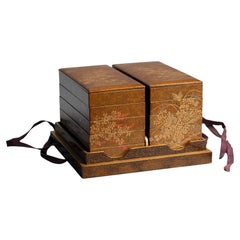
The Design & Impact: This museum quality, tiered writing box (kasane suzuribako) represents a breathtaking convergence of traditional calligraphy (shodo) and the highly formalize...

Category

Antique 17th Century Japanese Lacquer

Materials

Wood, Urushi lacquer

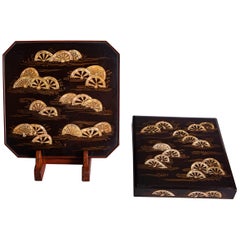
18th Century Japanese Lacquer Writing Box and Tray Set

18th Century Japanese Lacquer Writing Box and Tray Set

Located in Hudson, NY

Wheels Submerged in flowing water motif, believed to be a subject popular in samurai families. Example of the same subject matter in Tokyo National Museum.

Category

Antique 18th Century Japanese Lacquer

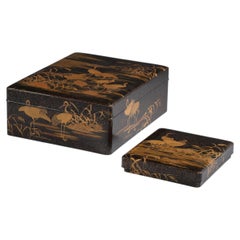
Japanese lacquer writing box and paper storage box set with crane design

Japanese lacquer writing box and paper storage box set with crane design

Located in Amsterdam, NL

An impressive matching set comprising a ryôshibako (document box) and a suzuribako (writing box), both decorated with cranes, young pine trees, and celestial motifs of sun (hi) and m...

Category

Antique Early 19th Century Japanese Lacquer

Materials

Gold Leaf, Silver