Want more images or videos?
Request additional images or videos from the seller
1 of 7

Two Japanese Bronze Shells

$9,000per set
£6,794.77per set
€7,952.80per set
CA$12,789.01per set
A$13,007.63per set
CHF 7,437.98per set
MX$157,337.95per set
NOK 87,148.34per set
SEK 87,127.41per set
DKK 59,451.70per set

About the Item

These charming bronze shells were cast in Japan in the 19th century. They lived for many years in the collection of the Paris artist Pierre Le-Tan. One of the shells is a lidded box in the form of an abalone (3 3/4" wide). Inside, it has a mottled-green patination that replicates the mother-of-pearl lining found in natural specimens. The other shell is a dolphin snail (2" high). When turned upside down, it sits on stubby spikes to serve as a small cup. Both the abalone and the dolphin snail are found off the coasts of Japan, an island nation surrounded by the Sea of Japan, the East China Sea, the Philippine Sea, and the Pacific Ocean. The Japanese have always been keen observers of nature. This is not unconnected to their indigenous religion of Shinto, which is based on the principle that spirits, or kami, inhabit all things in nature. This predisposed the Japanese to collect natural specimens, like rocks and shells, which they prized for the beauty of their forms. Not surprisingly, the most important collection of shells in the world is said to have been formed by the Japanese emperors. One particularly rare one is called the emperor’s shell, because, whenever a fisherman found one, he was obliged to surrender it to the ruler. In Europe, from the 16th to the 18th century, shells were also collected by kings, aristocrats, and learned men, who incorporated them in their cabinets of curiosities. Only in Japan, however, did collectors convene to contemplate them one by one. In an exercise of poetic free association, each participant compared a shell’s form to that of something else — perhaps a cloud, dragon, bird, or feminine hairstyle.
  • Dimensions:
    Height: 2 in (5.08 cm)Diameter: 3.75 in (9.53 cm)
  • Sold As:
    Set of 2
  • Style:
    Edo (Of the Period)
  • Materials and Techniques:
  • Place of Origin:
  • Period:
  • Date of Manufacture:
    circa 1850
  • Condition:
    Wear consistent with age and use.
  • Seller Location:
    New York, NY
  • Reference Number:
    1stDibs: LU1061426168982

More From This Seller

View All
John Bradstreet Bronze Lotus, circa 1900

John Bradstreet Bronze Lotus, circa 1900

By John Scott Bradstreet

Located in New York, NY

From the 1890s until his death in 1914, John Bradstreet, the important American Arts and Crafts furniture and interior designer, worked from The Crafts House, his landscaped orientalist compound in Downtown Minneapolis. There, he also received his clients, and dealt in Asian art acquired on frequent trips to the Far East. He used similar bronze Japanese lotuses...

Category

Antique Early 1900s American Arts and Crafts Garden Ornaments

Materials

Bronze
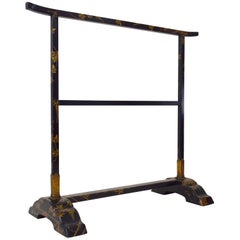
Elegant Japanese Edo Period Rack

Elegant Japanese Edo Period Rack

Located in New York, NY

This refined object dates to the first half of the 19th century, and was probably used for obi, kimono sashes, which were hung over it. The gold decorations on the black-lacquered g...

Category

Antique 1830s Japanese Edo Lacquer

Materials

Lacquer

31 Brazilian Silver Amulets

31 Brazilian Silver Amulets

Located in New York, NY

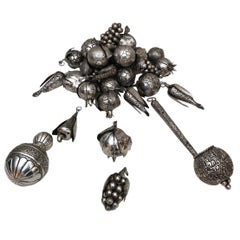
These 31 Brazilian amulets, or balangada, were hammered from sheets of silver in the 19th century to form pomegranates, sugar apples, guava, and other...

Category

Antique Mid-19th Century Brazilian Folk Art Tribal Art

Materials

Silver

1920s Swedish Grace Sculpture

1920s Swedish Grace Sculpture

Located in New York, NY

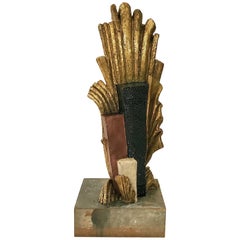
This abstract 1920s Swedish sculpture of painted-and-gilded plaster, on a painted-wood base, is pleasing from all angles. At the time and place where it...

Category

Vintage 1920s Swedish Modern Abstract Sculptures

Materials

Plaster, Wood

Kitsune from the Edo Period

Kitsune from the Edo Period

Located in New York, NY

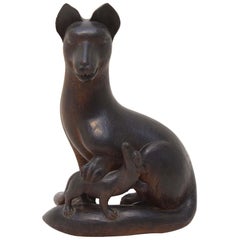
According to Japanese folklore the fox, or kitsune, can assume human form to protect and trick humble country folk. Dating to the 18th century, this fox protects its own pup. Carved ...

Category

Antique 18th Century Japanese Sculptures and Carvings

Materials

Wood

American Arts & Crafts Sculpture of a Pelican, Circa 1910

American Arts & Crafts Sculpture of a Pelican, Circa 1910

Located in New York, NY

The unknown sculptor of this fine, gilded-mahogany pelican appears to have been influenced by the turn-of-the-century Symbolist movement in Europe. The breast feathers are subtly car...

Category

Antique Early 1900s American Arts and Crafts Animal Sculptures

Materials

Wood

You May Also Like

Pair of Antique Japanese Quality Meiji Bronze Vases

Pair of Antique Japanese Quality Meiji Bronze Vases

Located in Suffolk, GB

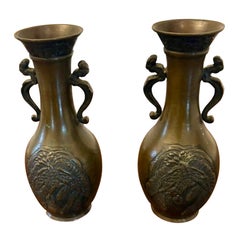
An exquisite pair of Japanese Meiji-period bronze vases beautifully cast and finely detailed. Each vase displays an elegant baluster silhouette enriched with crisply modelled foliate...

Category

Early 20th Century Japanese Vases

Materials

Bronze

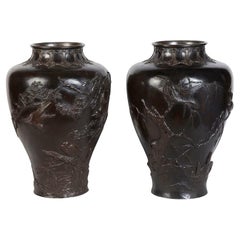
Pair Meiji period Japanese bronze vases, 19th century

Pair Meiji period Japanese bronze vases, 19th century

Located in Brighton, Sussex

A striking pair of late 19th Century (Meiji period, 1868-1912) Japanese patinated bronze vases, each with relief decoration depicting flying among trees. We can have these vases conv...

Category

Antique 19th Century Japanese Vases

Materials

Bronze

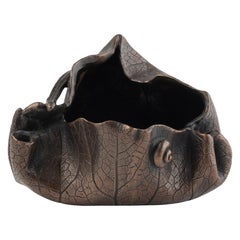
Japanese bronze sculpture in the form of a lotus leaf and snail shell

Japanese bronze sculpture in the form of a lotus leaf and snail shell

Located in PARIS, FR

An interesting bronze sculpture, ashtray or incense burner, depicting a lotus leaf folded to form a receptacle, decorated with a snail shell. In Japan, the snail is a symbol of wisdo...

Category

Antique Late 19th Century Japanese Meiji Sculptures and Carvings

Materials

Bronze

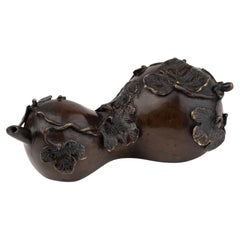
A Bronze cucurbit sculpture designed to be used as a watterdropper or suiteki

A Bronze cucurbit sculpture designed to be used as a watterdropper or suiteki

Located in PARIS, FR

An elegant bronze suiteki, or water dropper, in the shape of a gourd. The suiteki is one of the essential objects of the literati, used to hold the water needed for grinding ink. Far...

Category

Antique Late 19th Century Japanese Meiji Scholar's Objects

Materials

Bronze

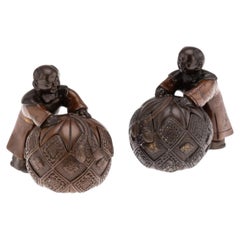
19thC Japanese Meiji Period Pair Of Bronze Vessels In The Form Of Karako c.1890

19thC Japanese Meiji Period Pair Of Bronze Vessels In The Form Of Karako c.1890

Located in Royal Tunbridge Wells, Kent

Antique 19th Century Japanese Meiji period pair of bronze vessels in the form of karako (Chinese boys). Each figure is cast standing and leaning forward with their hands resting on a...

Category

Antique 19th Century Japanese Other Jars

Materials

Bronze

Pair Chinese 18th Century Late Ming Bronze Archaistic Gu Vases

Pair Chinese 18th Century Late Ming Bronze Archaistic Gu Vases

Located in Dallas, TX

Near Pair of Chinese Archaic bronze Gu vases. 18th century Late Ming Period, Measures: Height: 11.4 inches. Diameter: 6.4 Inches Condition: Very good with ...

Category

Antique Mid-18th Century Chinese Archaistic Vases

Materials

Bronze