Want more images or videos?
Request additional images or videos from the seller
1 of 13

Rare Chinese Parcel-Gilt Bronze Figure of Lu Dongbin, Ming ca. 1600

$1,309.80
£950
€1,127.77
CA$1,812.83
A$1,819.42
CHF 1,060.96
MX$22,118.81
NOK 12,191.46
SEK 12,538.30
DKK 8,429.99

About the Item

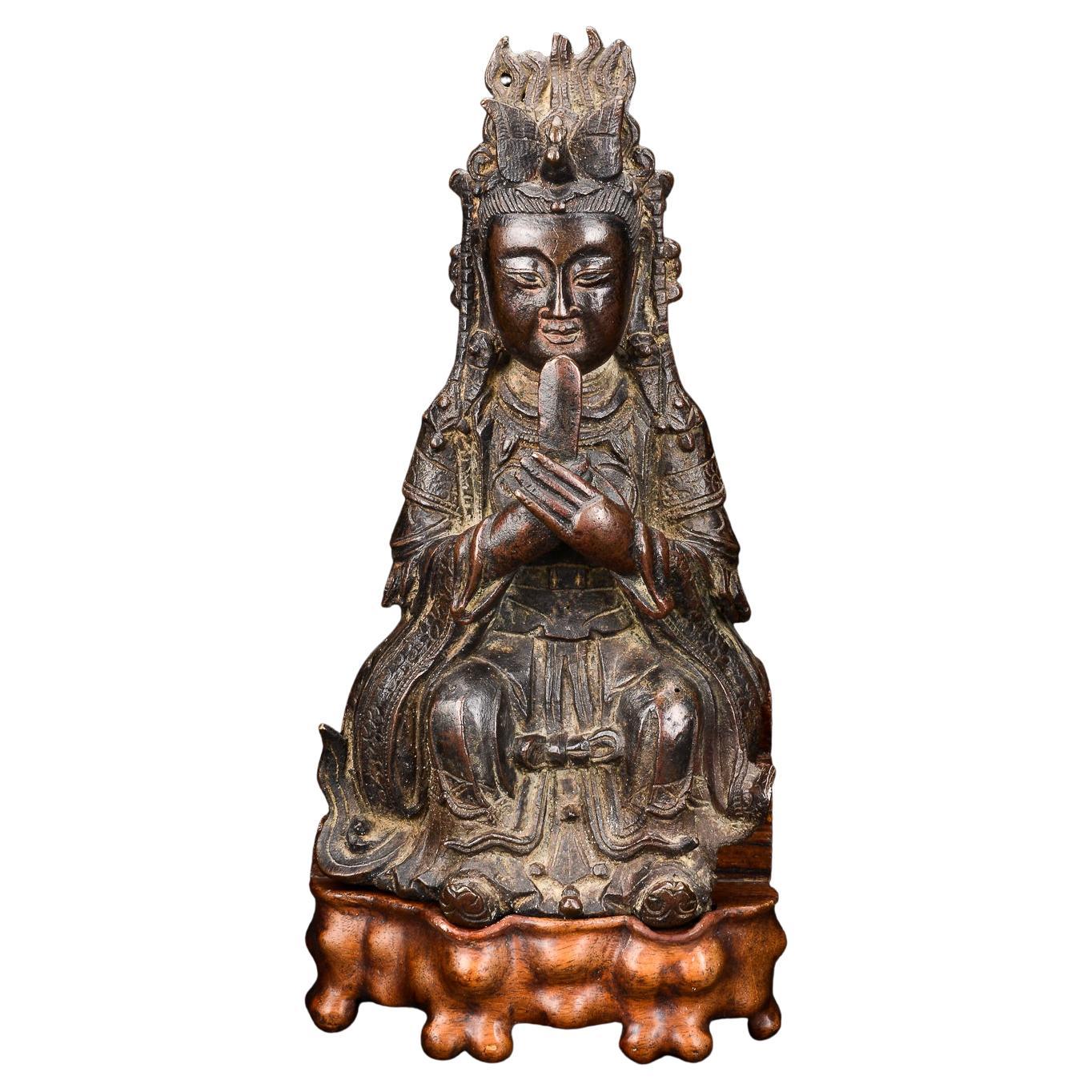
From the Ming dynasty onwards, bronze figures of Daoist deities and immortals occupied an important place within the domestic interior. They appeared on household altars, scholar's desks, incense burners and ritual stands, serving both devotional and decorative purposes. Parcel gilding was frequently applied to emphasise significant details, creating a striking interplay between brilliant gold highlights and the darker bronze beneath. Among the most revered subjects were the Eight Immortals, whose distinctive attributes made them immediately recognisable and whose presence conveyed blessings of longevity, protection and prosperity. This finely cast figure represents Lu Dongbin, the scholar-swordsman and perhaps the most celebrated of the Eight Immortals. Associated with wisdom, self-cultivation and the triumph of virtue over temptation, Lu Dongbin remains one of the most enduring figures in Daoist tradition. He is depicted seated in a contemplative pose, his ample robes gathered around him in deeply modelled folds that pool gracefully at the front of the composition. The torso leans slightly forward, lending the figure an engaging sense of immediacy and introspection. His hair is arranged in a high topknot, while a long flowing beard, articulated with finely incised striations, frames a dignified and authoritative expression. Held delicately in his left hand is a rolled scroll, an attribute that reflects his scholarly nature and distinguishes him within the Daoist pantheon. His right hand is concealed within the sleeve of his robe in a gesture of restraint and quiet composure. Despite its compact scale, the figure possesses a remarkable sense of weight and presence, with refined modelling evident in the facial features, hands and drapery. Traces of the original parcel gilding survive across the chest, sleeves and folds of the garment, providing flashes of luminosity against the rich brown patina acquired over centuries. To the reverse, an oval aperture and unfinished attachment points indicate that the figure was originally mounted to a larger object, most likely an incense burner, altar fitting or ritual stand. The open underside and visible casting pits are entirely consistent with workshop practices of the late Ming and early Qing periods, offering an appealing insight into the methods of manufacture. Combining devotional significance, sculptural refinement and the atmospheric beauty of age, this early bronze is a compelling example of Chinese Daoist art and a tangible survival from the spiritual culture of the seventeenth century. Condition Presented in good antique condition with expected wear consistent with age and use. The parcel gilding has naturally rubbed over time, and there are minor surface knocks and casting flaws visible throughout. Openings from its original attachment remain evident to the rear and underside. The figure is structurally sound, displaying an even, attractive patina and excellent decorative presence. We ship internationally, tracked and insured.
  • Dimensions:
    Height: 2.76 in (7 cm)Diameter: 1.19 in (3 cm)
  • Materials and Techniques:
  • Period:
    1600-1609
  • Date of Manufacture:
    ca. 1600
  • Condition:
  • Seller Location:
    Nottingham, GB
  • Reference Number:
    1stDibs: LU9003250490622

More From This Seller

View All
Chinese Carved Hardwood Sculpture of Zhongli Quan on Naturalistic Rootwood Stand

Chinese Carved Hardwood Sculpture of Zhongli Quan on Naturalistic Rootwood Stand

Located in Nottingham, GB

Among the most beloved figures of Daoist tradition are the Eight Immortals, each distinguished by their unique attributes and symbolic virtues. Their images were widely incorporated ...

Category

Antique Late 19th Century Sculptures and Carvings

Materials

Wood

Takamura Kōun Japanese Part-Gilt Bronze Figure of Kannon, Meiji Period

Takamura Kōun Japanese Part-Gilt Bronze Figure of Kannon, Meiji Period

Located in Nottingham, GB

A superb Japanese bronze figure of Kannon, Goddess of Mercy, attributed to the celebrated sculptor Takamura Kōun (1852–1934) and dating to the late 19th or early 20th century. Elegantly modelled with exceptional attention to detail, Kannon stands in flowing robes with her hair arranged in a high topknot and adorned with an elaborate hōkan, or jewelled crown. She is depicted holding a fish basket, identifying the figure with the Fish-Basket Kannon (Gyōran Kannon) tradition. Selectively gilded details provide a subtle contrast against the rich, dark patination of the bronze. The figure bears an impressed Kōun seal to the base and is accompanied by its original signed wooden box and certificate. Takamura Kōun (1852–1934) was one of the most important Japanese sculptors of the Meiji period, renowned for combining the traditions of Japanese wood carving with the emerging sculptural practices of modern Japan. He became a professor at the Tokyo School of Fine Arts and played an influential role in the development of modern Japanese sculpture...

Category

Antique Late 19th Century Sculptures and Carvings

Materials

Bronze

Late 19th Century Gilded Burmese Devotional Figure in Carved Wood

Late 19th Century Gilded Burmese Devotional Figure in Carved Wood

Located in Nottingham, GB

Nat figures are central to the spiritual and cultural heritage of Myanmar, serving as representations of guardian spirits and intermediaries for those who passed under extraordinary ...

Category

Antique Late 19th Century Sculptures and Carvings

Materials

Wood

Mid-20th CTibetan Gilt Bronze Samantabhadra and Samantabhadri Yab-Yum Statue

Mid-20th CTibetan Gilt Bronze Samantabhadra and Samantabhadri Yab-Yum Statue

Located in Nottingham, GB

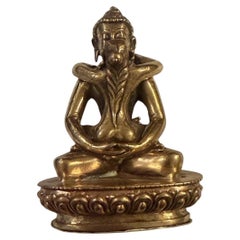
A striking mid-20th century Tibetan gilt-bronze devotional sculpture, traditionally identified as Samantabhadra (Kuntuzangpo) in sacred union with his consort Samantabhadri, an impor...

Category

Mid-20th Century Sculptures and Carvings

Materials

Bronze

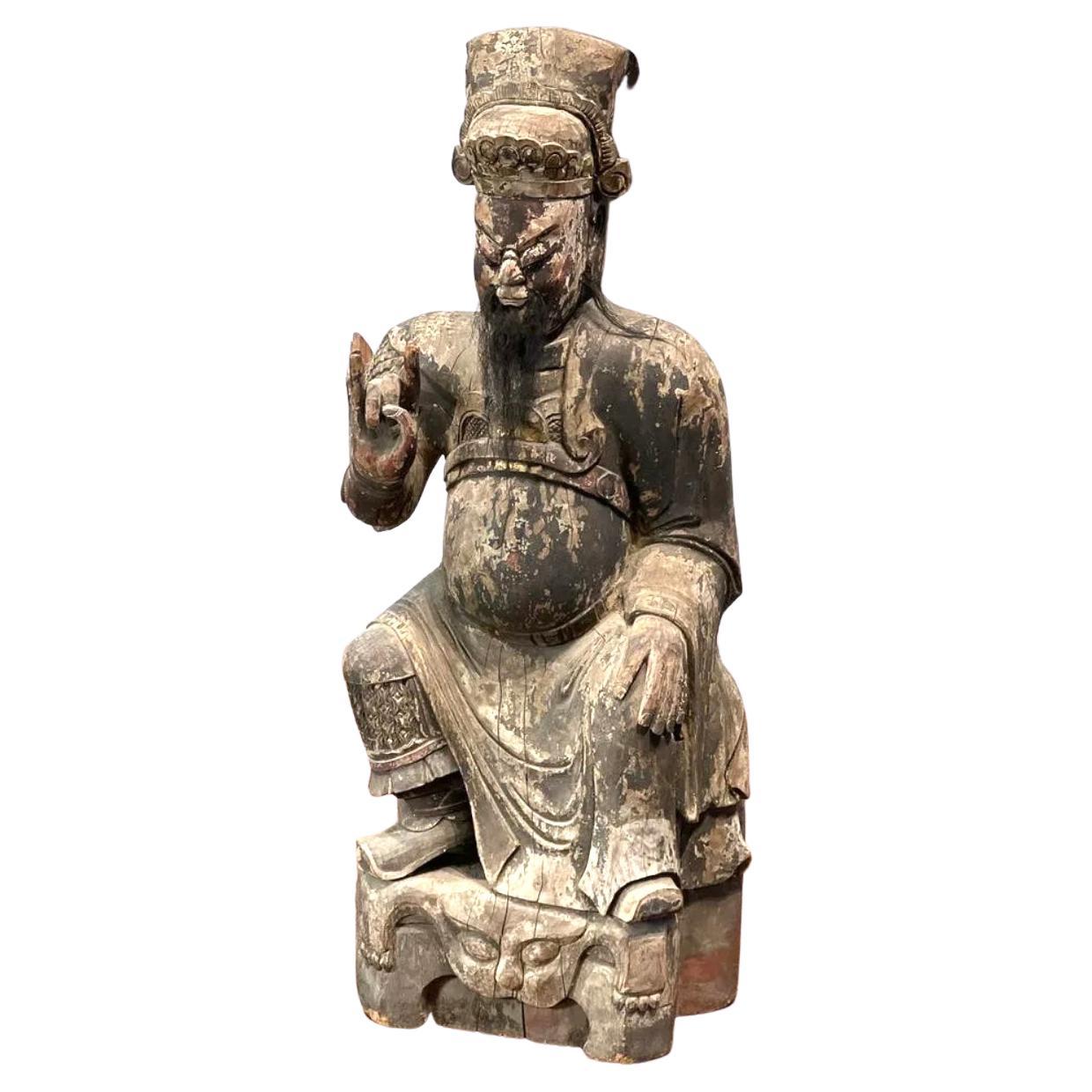
Southeast Asian Thai Giltwood Monk Monastic Sculpture, Folk Design

Southeast Asian Thai Giltwood Monk Monastic Sculpture, Folk Design

Located in Nottingham, GB

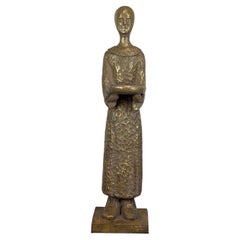
Theravada Buddhism has shaped the spiritual and cultural life of Thailand for centuries, fostering a close relationship between the monastic community and the lay population. At the heart of this exchange is the practice of merit making, whereby offerings of food and daily necessities are given to monks as acts of generosity believed to generate spiritual benefit. The alms bowl occupies a central role in this tradition, serving as the vessel through which monks receive offerings during their morning rounds and within temple settings. Beyond their religious duties, members of the Thai sangha have long held an important place within society as teachers, advisors, and custodians of cultural values. As a result, images of monks have become enduring symbols of humility, compassion, and spiritual discipline, appearing not only in places of worship but also within domestic interiors. This striking carved wooden sculpture depicts a standing Thai monk...

Category

Antique Late 19th Century Sculptures and Carvings
Materials

Wood

Japanese Kutani Figure of Hotei with Polychrome Enamels, Late Meiji Period

Japanese Kutani Figure of Hotei with Polychrome Enamels, Late Meiji Period

Located in Nottingham, GB

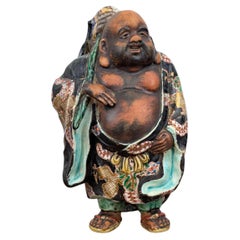
This expressive Kutani porcelain figure dates to the late Meiji period and portrays Hotei, one of Japan's most beloved deities of good fortune. Known as the god of contentment, happi...

Category

Antique Late 19th Century Ceramics

Materials

Porcelain

You May Also Like

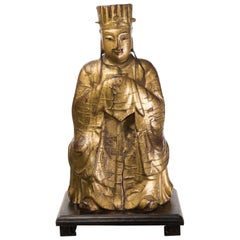
Gilt Bronze Figure of Xi-Wang-Mu, Qing Dynasty, Qianlong Kingdom

Gilt Bronze Figure of Xi-Wang-Mu, Qing Dynasty, Qianlong Kingdom

Located in Torino, IT

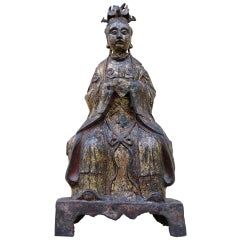
The queen mother of the west is cast in a seated position with her hands held before her chest holding a "gui". She is dressed in long-sleeved robes. Her face is framed by an elabora...

Category

Antique 1790s Chinese Qing Sculptures and Carvings
Materials

Bronze

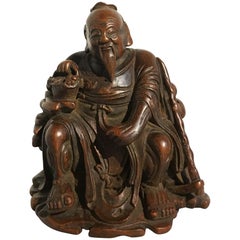
Chinese Carved and Lacquered Figure of Zhenwu, Qing Dynasty, 19th century, China

Chinese Carved and Lacquered Figure of Zhenwu, Qing Dynasty, 19th century, China

Located in Austin, TX

A powerful Chinese figure of the Taoist diety Zhenwu (Xuanwu), carved and lacquered wood with applied lacquer details, Qing Dynasty, 19th century or earlier, China. Zhenwu, also kno...

Category

Antique 19th Century Chinese Qing Sculptures and Carvings
Materials

Wood, Hardwood

16th Century Chinese Standing Bronze Figure of a Nobleman

16th Century Chinese Standing Bronze Figure of a Nobleman

Located in Hudson, NY

Hongzhi Period (1487 - 1505) sculpture of an important man, possibly Confucius. Comes with box.

Category

Antique 16th Century Chinese Metalwork

Materials

Bronze

Chinese Dignatary Figure in Gilded and Painted Wood, 18th Century

Chinese Dignatary Figure in Gilded and Painted Wood, 18th Century

Located in Saint-Ouen, FR

Chinese Dignatary figure in gilded and painted wood. 18th century. On a modern wood base.

Category

Antique 18th Century Chinese Antiquities

Materials

Giltwood

Bronze Figure of a Seated Luohan, Ming Dynasty, 1368-1644

Bronze Figure of a Seated Luohan, Ming Dynasty, 1368-1644

Located in Torino, IT

Cast seated wearing a simple robe with his right hand resting on the hilt of a snake-entwined sword, the left hand held aloft, his face with meditative expre...

Category

Antique Early 1600s Chinese Ming Sculptures

Materials

Bronze