Want more images or videos?
Request additional images or videos from the seller
1 of 10

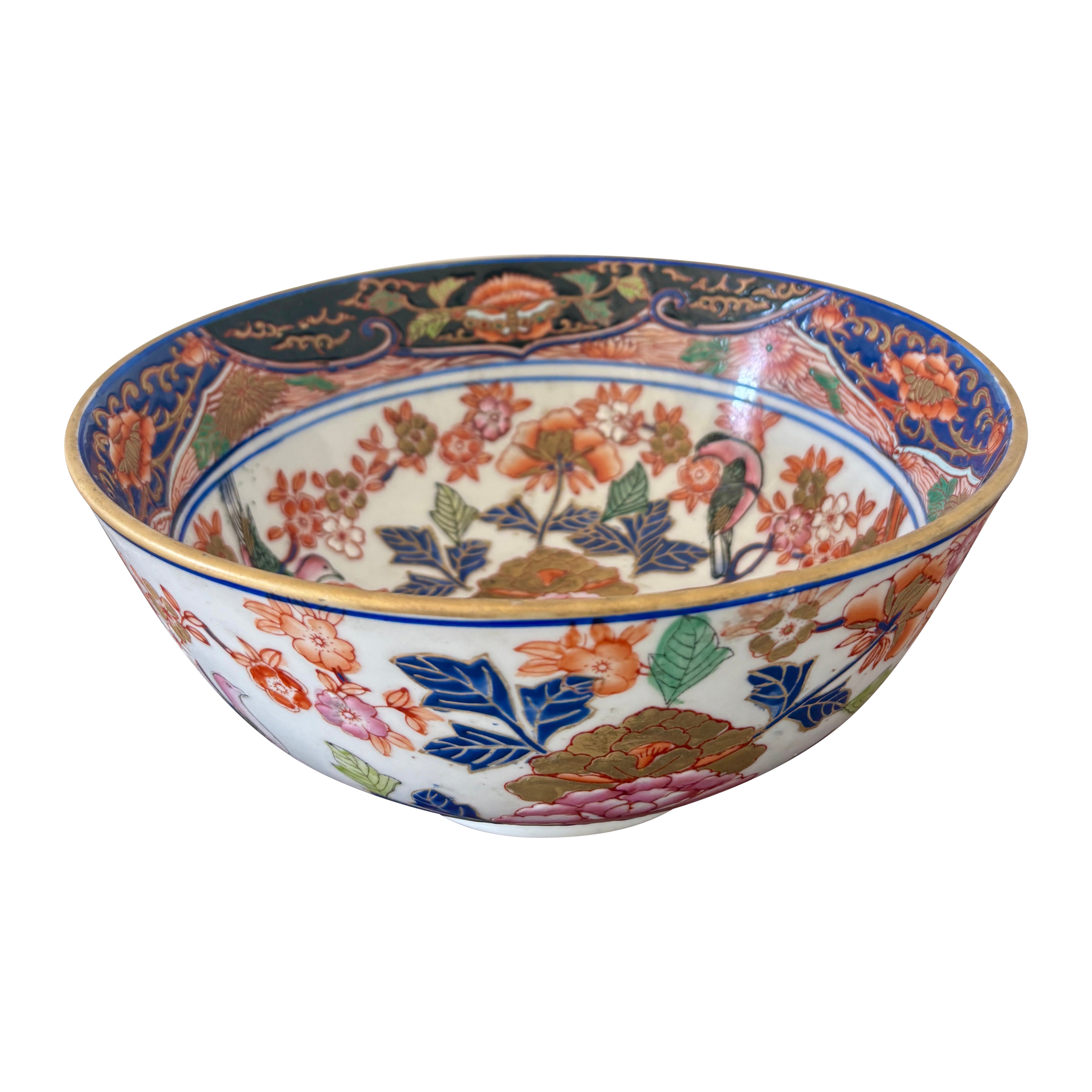
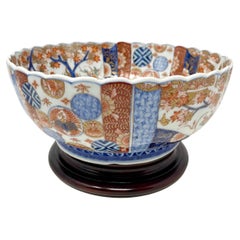
Chinese Export Porcelain Imari Rouge de Fer Large Punch Bowl, Circa 1735–1750

$12,500
£9,432.56
€10,978.13
CA$17,646.64
A$17,710.80
CHF 10,327.72
MX$215,311.80
NOK 118,675.73
SEK 122,051.93
DKK 82,060.28

About the Item

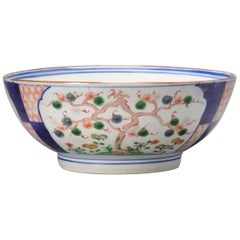
Chinese Export Porcelain Imari Rouge de Fer Large Punch Bowl, Circa 1735–1750 This large Chinese Export porcelain punch bowl is painted in the Imari palette of underglaze blue, iron-red and gilding, with the iron-red laid on so densely across the exterior that the type is known in the trade by the French name rouge de fer. The exterior is covered with a fine iron-red diaper ground on which large roundels, each painted with an underglaze blue peony picked out in gold within a border of scrolling clouds, alternate with branches of iron-red and gilt peonies with underglaze blue leaves. Beneath the rim runs a broader band of iron-red fret diaper centered on a gilt and iron-red chrysanthemum head and reserved with oval panels, edged in underglaze blue, of scrolling iron-red foliage and small chrysanthemums. A narrow chain of iron-red loops encircles the foot and the rim is gilt. The interior has a matching band of iron-red trellis diaper strewn with gilt and iron-red flowerheads and reserved with blue-edged oval panels of chrysanthemums and feathery sprigs. The well is painted with a butterfly hovering above flowering branches that issue from a mound, the large peonies in iron-red and gold with underglaze blue leaves among grasses and a thorny branch of small flowers, all enclosed by a thin underglaze blue line. Dimensions Diameter: 13 3/4 inches (34.9 cm) Height: 5 1/2 inches (14 cm) Provenance The Benjamin F. Edwards III Collection, St. Louis (paper collection label numbered 2920) Earle D. Vandekar of Knightsbridge Condition [Condition to be confirmed in hand — the firm’s live 1stDibs listing states “Wear consistent with age and use”] Historical Context From the opening years of the eighteenth century the kilns at Jingdezhen took up the palette of underglaze blue, iron-red and gilding that the Dutch had been shipping from Japan through the port of Imari, and Chinese Imari soon undercut the Japanese original in the European market. By the Yongzheng and early Qianlong reigns the palette was a staple of the export trade. Bowls on which the iron-red dominates, spread as diaper grounds and scrolling branches with the gilding and the blue held to accents, are called rouge de fer, and a bowl of this size was made for punch, the mixed drink at the center of fashionable sociability in Georgian England and the American colonies. Benjamin F. Edwards III (1931–2009), chairman and chief executive of the St. Louis brokerage A.G. Edwards & Sons, founded by his great-grandfather in 1887, formed a collection of Chinese export porcelain that ran to more than three thousand pieces, chosen for rarity and charm. The collection was dispersed in three sales at Christie’s New York in January 2002, 2003 and 2004, with further property sold there in January 2010, and this bowl retains his numbered collection label.
  • Dimensions:
    Height: 5.5 in (13.97 cm)Diameter: 13.75 in (34.93 cm)
  • Style:
    Chinese Export (Of the Period)
  • Materials and Techniques:
  • Place of Origin:
  • Period:
  • Date of Manufacture:
    1730-1750
  • Condition:
    Wear consistent with age and use.
  • Seller Location:
    Downingtown, PA
  • Reference Number:
    Seller: NY10253-mnir1stDibs: LU861033722992

More From This Seller

View All
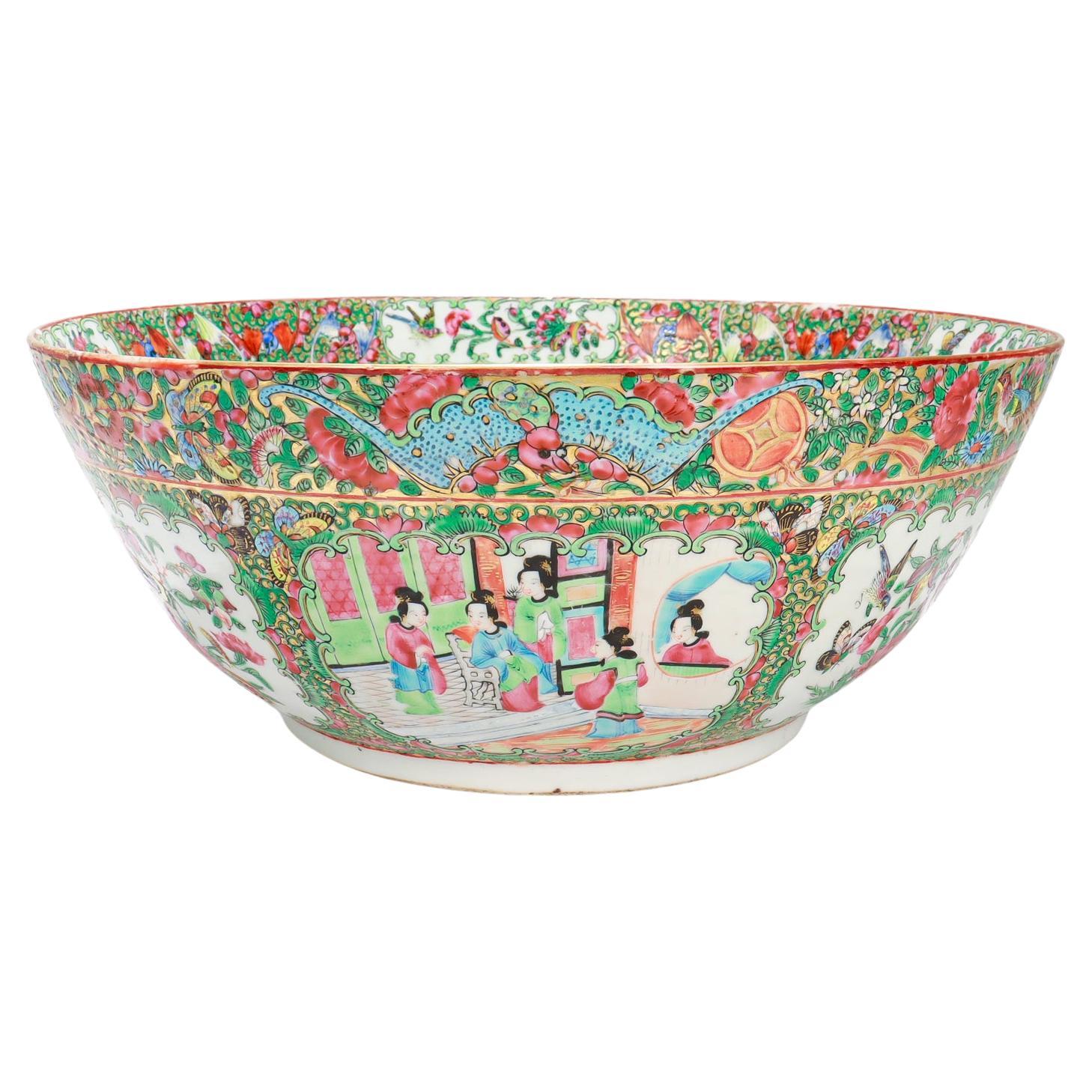
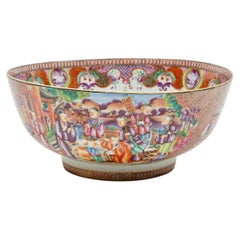
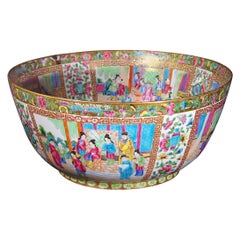
Chinese Export Porcelain Punch Bowl, Famille Rose Mandarin, Qianlong c. 1780

Chinese Export Porcelain Punch Bowl, Famille Rose Mandarin, Qianlong c. 1780

Located in Downingtown, PA

Chinese Export Porcelain Mandarin Famille Rose Punch Bowl Qianlong period, circa 1780–1785 This Chinese Export punch bowl is of deep circular form, raised on a short slightly spread...

Category

Antique 1780s Chinese Chinese Export Decorative Bowls

Materials

Porcelain

Chinese Export Famille Rose Hundred Antiques Porcelain Bowl, Yongzheng-Qianlong

Chinese Export Famille Rose Hundred Antiques Porcelain Bowl, Yongzheng-Qianlong

Located in Downingtown, PA

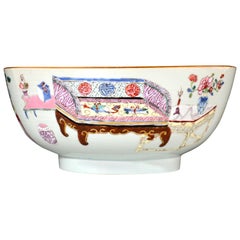
A fine Chinese Export porcelain punch bowl, Yongzheng–early Qianlong period, circa 1735–1740, painted in the famille rose palette with a distinctive version of the "Hundred Antiques" theme, unusual for its focus on furniture and precious objects rather than figures. Around the exterior are ranged a canopied couch and red-lacquer scholar's stands set with vases, flowering branches, and jardinières of peonies, together with tables bearing brush pots, censers, and boxes — a catalogue of the furnishings and treasures of the cultivated Chinese interior, giving the bowl an almost interior-portrait quality. The interior is centered with a beribboned vase of flowers within a cell-diaper and floral-panel border. The famille rose palette — named for the opaque rose-pink enamel derived from colloidal gold, introduced in the 1720s — transformed export porcelain in the second quarter of the 18th century. Bowls of the 1730s such as this, painted at the transition from the Yongzheng to the Qianlong reign, are among the most delicately enamelled of all export wares. The "Hundred Antiques" was a favored auspicious theme, a gathering of objects emblematic of scholarship and good fortune; the present bowl's emphasis on domestic...

Category

Antique 1730s Chinese Chinese Export Porcelain

Materials

Porcelain

Chinese Export Porcelain "Queen Charlotte" Pattern Tea Bowl & Saucer, Kangxi Per

Chinese Export Porcelain "Queen Charlotte" Pattern Tea Bowl & Saucer, Kangxi Per

Located in Downingtown, PA

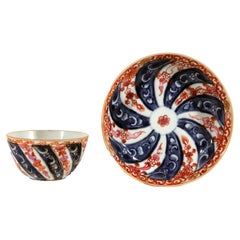
Chinese Export Porcelain Tea Bowl and Saucer Kangxi Period, Early 18th Century This finely potted Chinese export porcelain tea bowl and saucer is decorated in a striking polychrome ...

Category

Antique Early 18th Century Chinese Chinese Export Porcelain

Materials

Porcelain

Massive Rose Canton Porcelain Punch Bowl, Edmé Samson et Cie, Paris

Massive Rose Canton Porcelain Punch Bowl, Edmé Samson et Cie, Paris

By Edmé Samson

Located in Downingtown, PA

Paris Massive Rose Medallion Punch Bowl, Edme Samson et Cie, Paris, circa 1880 This massive porcelain punch bowl is a spectacular example of 19th-century European ceramic mastery an...

Category

Antique 19th Century French Chinese Export Decorative Bowls

Materials

Porcelain

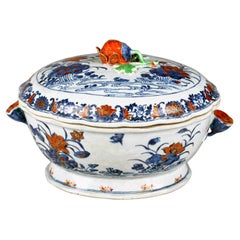
18th Century Chinese Export Porcelain Imari Tureen and Cover-Duck in Pond

18th Century Chinese Export Porcelain Imari Tureen and Cover-Duck in Pond

Located in Downingtown, PA

Chinese export porcelain Imari Tureen and cover, Circa 1780 The Chinese Export porcelain tureen and cover are painted in the Imari palette. The body and cover are painted in underglaze blue and iron-red with ducks on a pond surrounded by water lilies . The unusual handles are in the form of upturned water lily pods. The finial is shaped as a closed flower with leaves and the rim of the tureen and the edge of the cover have an undulating design. Dimensions: 9 inches high x 13 1/2 inches wide x 9 3/4 inches deep. Provenance: Chinese Porcelain Company...

Category

Antique 1770s Chinese Chinese Export Soup Tureens

Materials

Porcelain

Chinese Export Porcelain Punch Bowl Sailor Farwell & Return with Royal Navy Ship

Chinese Export Porcelain Punch Bowl Sailor Farwell & Return with Royal Navy Ship

Located in Downingtown, PA

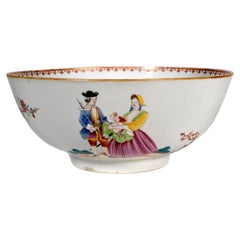
Chinese Export Porcelain Sailor’s Farewell & Return Punch Bowl, Royal Navy Ship This Chinese export porcelain punch bowl was painted in famille rose enamels for the English market with the paired subjects known as The Sailor’s Farewell and The Sailor’s Return, one on either side of the exterior, the two scenes divided by large flowering branches of chrysanthemum and prunus in iron-red, rose and turquoise. The bowl is of deep rounded form on a short straight foot ring, the interior plain but for a spray of the same flowering branches in the well and a narrow border at the rim, so that the two figure subjects carry the whole of the decoration and can be read in turn as the bowl is passed around a table. In the Farewell, a couple stand embracing on a rocky shore, the man in a black tricorn and blue coat, the woman in a striped bodice and full orange-yellow skirt, his free arm thrown out to point across the water at the ship that will carry him away. She is a three-masted vessel lying close inshore, her hull and rigging drawn in iron-red and fine grey-black line, her sails left in reserve and outlined only, with red streamers at the mastheads and a blue ensign with the union in the canton at the stern. The sea is drawn as a band of fine wave lines washing over a green shoal, with a rocky islet and dark blue-green scrub at the water’s edge. In the Return, the same couple stand on a rocky ground scattered with blue-green shrubs, the man now facing his sweetheart across the fortune he has brought home. He wears a black tricorn edged in gilt over a powdered wig, a white cravat, a blue coat lined in puce with wide turned-back cuffs, a striped waistcoat bordered in yellow, an embroidered belt in brown and turquoise, orange-red breeches and white stockings, and he carries a long slender cane with a sword hanging behind him. From his raised right hand, the wrist deep in lace, he dangles a gold pocket watch by its chain over the green apron the woman holds up between them; in the apron lie some ten gold coins and a dark purse studded with gold. She wears a lace-edged cap with blue and yellow lappets, a coral bead necklace, a white stomacher, a yellow jacket with a green shawl and a full ribbed puce skirt, and in her right hand she holds a red flower. Both figures are dressed as gentlefolk rather than as seafarers, which is usual on bowls of this class, the compositions having been copied at Canton from European genre prints rather than drawn from life. The rim is finished with a gilt line at the edge, and inside it a narrow border of pendant trefoils in iron-red with dotted terminals hangs from a second gilt line, the only border on the piece. The flags repay a second look. From 1707 until 1864 the Royal Navy was divided into red, white and blue squadrons, each wearing an ensign of its own color, while British merchantmen wore the red; the blue ensign here therefore marks the vessel as a naval one rather than an East Indiaman, and it is that identification which sets this bowl apart from the more commonly encountered versions flying the striped ensign of the East India Company. The Sailor’s Farewell and The Sailor’s Return were among the most widely circulated of English popular subjects through the eighteenth century, sustained by ballad and by cheap print, and a customer placing an order at Canton sent out the engraving for the Chinese painters to copy, color for color, from an image whose language they could not read. Dimensions Diameter: 10¼ inches (26.0 cm) Height: 4½ inches (11.4 cm) Marks None. Chinese export porcelain painted to European order in this period is characteristically unmarked. Provenance Elinor Gordon, Villanova, Pennsylvania Collection of Roy and Ruth Nutt Earle D. Vandekar of Knightsbridge Condition Very good, with some fading to the grey-black line work of the ship’s sails and rigging, light wear to the gilt at the rim, a few dark firing specks in the glaze and light soiling to the unglazed foot rim. No cracks, chips or restoration. References David S...

Category

Antique 1760s Chinese Chinese Export Decorative Bowls
Materials

Porcelain

You May Also Like

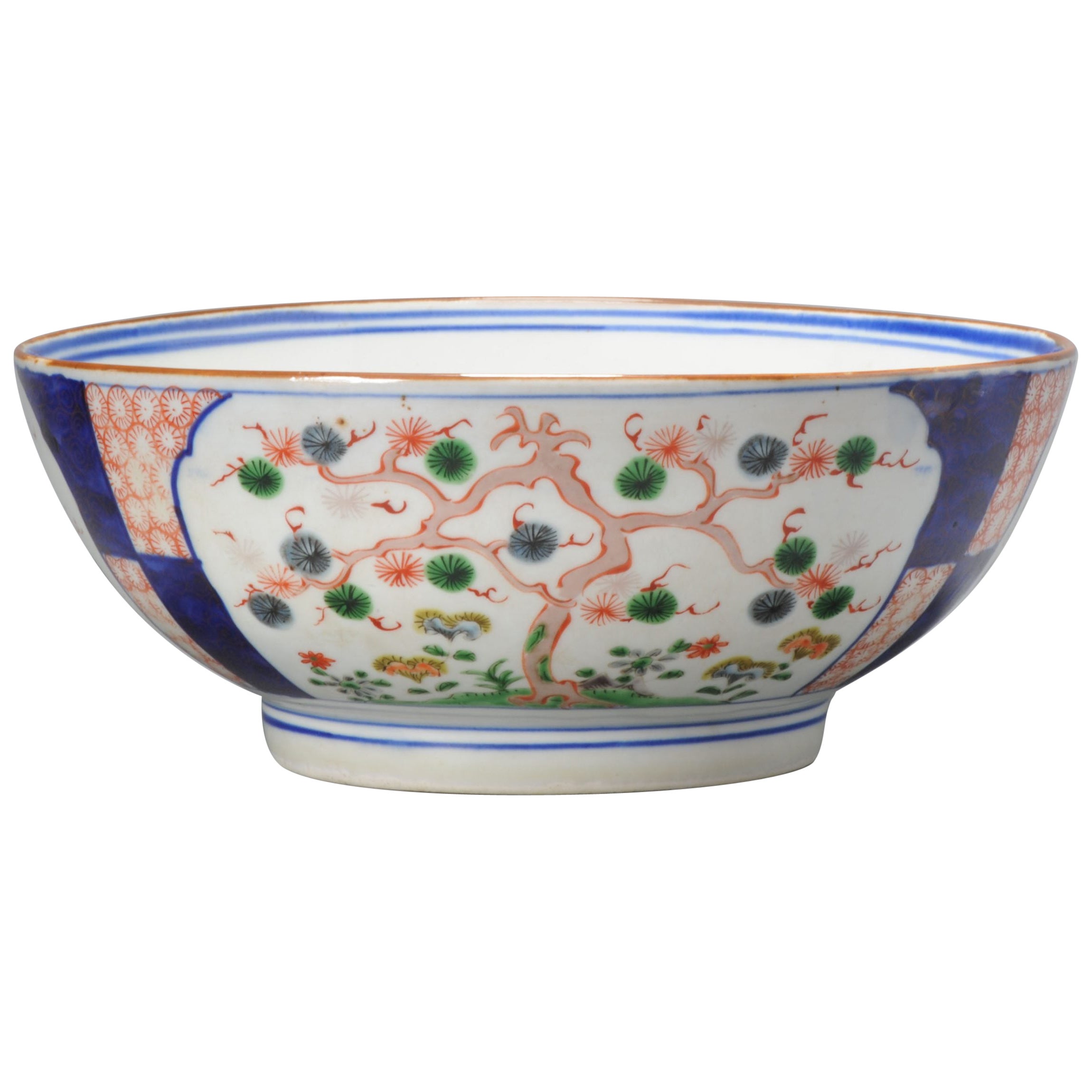
A Beautiful and Large Japanese Porcelain Imari Bowl Japan Antique, 19th Century

A Beautiful and Large Japanese Porcelain Imari Bowl Japan Antique, 19th Century

Located in Amsterdam, Noord Holland

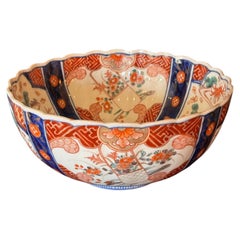
A wonderfull and high quality painted Japanese imari punch bowl, with an unusal scene. Additional information: Material: Porcelain & Pottery Region of Origin: Japan Period: 19th cen...

Category

Antique 19th Century Japanese Decorative Bowls

Materials

Porcelain

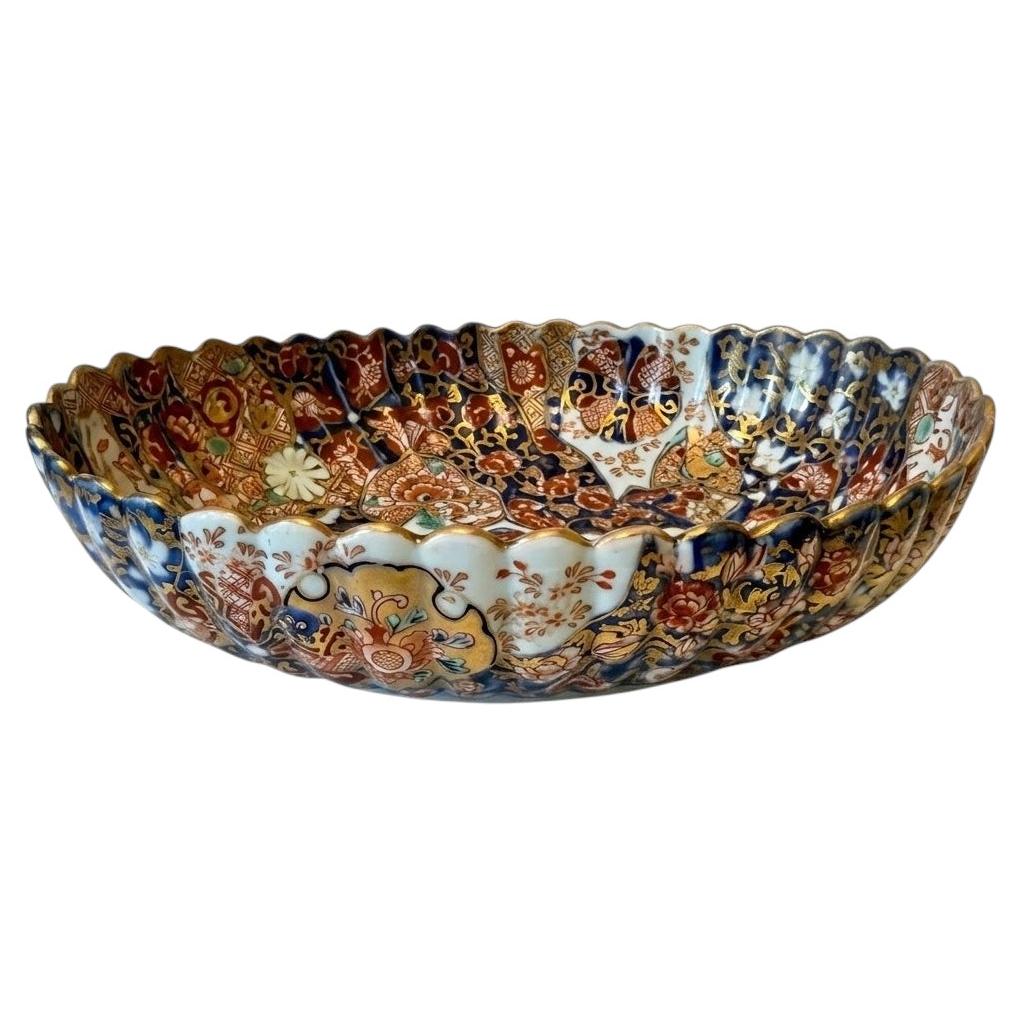
hand-painted Imari porcelain bowl with an elegant scalloped rim

hand-painted Imari porcelain bowl with an elegant scalloped rim

Located in BEEKBERGEN, NL

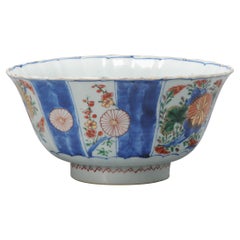
Beautiful hand-painted Imari porcelain bowl with an elegant scalloped rim. The bowl is richly decorated in the characteristic Imari colors: deep cobalt blue, iron red, and green on a...

Category

Antique 1890s Japanese Porcelain

Materials

Porcelain

Large Japanese Imari Porcelain Display Bowl

Large Japanese Imari Porcelain Display Bowl

Located in Fort Lauderdale, FL

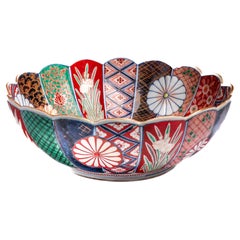
A large Imari porcelain display bowl from the early 20th century. The bowl features a gently scalloped rim and is decorated with exquisitely painted enamels in blue, orange, red, and...

Category

Early 20th Century Japanese Anglo-Japanese Decorative Bowls

Materials

Porcelain

Antique Japanese Meiji Period Imari Porcelain Punch Bowl or Centerpiece

Antique Japanese Meiji Period Imari Porcelain Punch Bowl or Centerpiece

Located in Philadelphia, PA

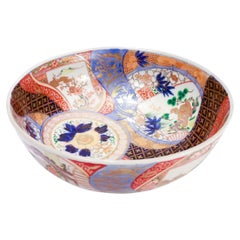
A fine large antique Japanese Meiji porcelain bowl. With a white ground and extensively gilt throughout. Primarily decorated in red, blue, and gold with bits of green, brown, and ...

Category

Early 20th Century Japanese Meiji Ceramics

Materials

Porcelain

Antique Imari Porcelain Fluted Bowl, Circa 1890.

Antique Imari Porcelain Fluted Bowl, Circa 1890.

Located in New Orleans, LA

Antique Imari Porcelain Fluted Bowl, Circa 1890.

Category

Antique Late 19th Century Decorative Bowls

Materials

Porcelain