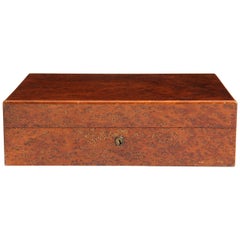
Humidor from USA
Located in Sagaponack, NY
A humidor made of warmly toned burled maple with a cedar and glass interior.
Category
Vintage 1950s American American Craftsman Cigar Boxes and Humidors
Materials
Maple, Cedar
Humidor from USA
Located in Sagaponack, NY
A humidor made of warmly toned burled maple with a cedar and glass interior.
Maple, Cedar
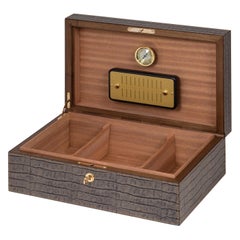
Large Santiago Humidor
By Giobagnara
Located in Milan, IT
This superb humidor is a perfect gift or precious companion for the cigar lover. The walnut wood case is externally covered with fine leather that can be customized in color and text...
Leather, Walnut, Cedar
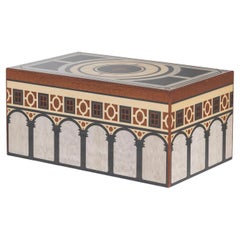
Rinascimento Humidor
By Maccarrone
Located in Milan, IT
This iconic humidor is part of Maccarone's Marquetry collection and can hold up to 150 cigars. The design of this humidor, enriched with laser-engraved detail...
Polyester, Wood
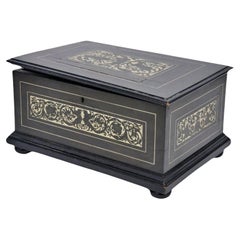
Italian 19th Century Chest
Located in Madrid, ES
Italian 19th century chest. in ebonised wood with an inlaid decor. Measures: 19 x 36.5 x 25.5 cm. Good condition.
Wood
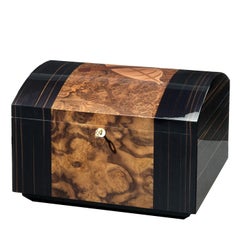
Roma Cigar Case with Ashtray
By Morici
Located in Milan, IT
A singular piece from the Roma Collection, this cigar case boasts a practical and stylish design equipped with a handprinted ceramic ashtray. Masterfully handcrafted of cedar, it combines an ebony and a walnut veneer enriched with a splendid inlay work of a tobacco leaf marking the curved and polished top. Adorned with a small metal key, the piece is also equipped with a hygrometer and Boveda holder. Available with a wooden case upholstered with eco-leather, please ask the Concierge for details. This box is supplied with an handmade wooden suitcase...
Metal
$1,800
H 5.5 in W 12 in D 9 in
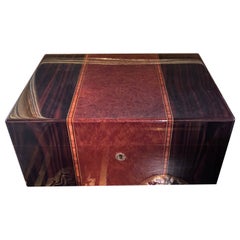
GREAT GIFT. Handsome Exotic Wood Humidor With Fitted Interior, Polished Finish..
Located in Buchanan, MI
Great Holliday Gift. Handsome Exotic Wood Humidor With Fitted Interior, Polished Finish.
Rosewood
Humidor from USA
Located in Sagaponack, NY
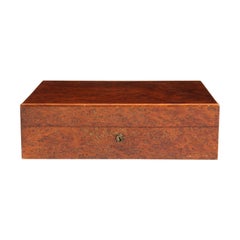
A humidor made of warmly toned burled maple with a cedar and glass interior.
Wood
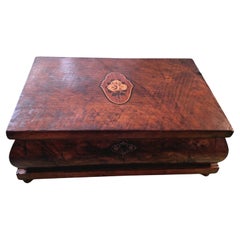
Frencch Art Deco Jewelery or Cigar Box
Located in Los Angeles, CA
Frenche At Deco jewelry box or cigar box .Walnut base and walnut veneer ,the top have a inlade wood work.
Walnut
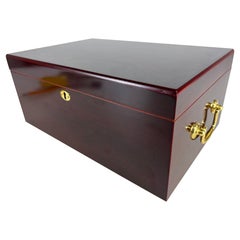
Vintage mahogany handcrafted cigar humidor
Located in Allentown, PA
This is a vintage handcrafted cigar humidor. This humidor has beautiful brass handles on either side with a beautiful brass escutcheon at the front covering the keyhole. This box is ...
Mahogany
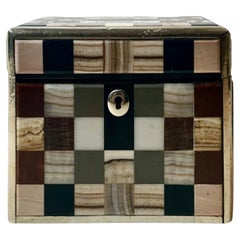
Continental Humidor
Located in Tampa, FL
A wonderful, continental small humidor out of specimen marble. It has the original key. Humidor is trimmed with silver inside and lined in glass and rosewood. The interior is three i...
Marble, Silver
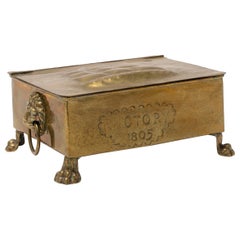
"Victory 1805" Brass Box, Warm Color, Embossed Design, Lion's Head Handle
Located in Bloomfield Hills, MI
SALE ONE WEEK ONLY "Victory 1805" brass box has exceptional details, the lion's head fixtures with brass rings, lions feet on which the box stands and the embossed etching of a sail...
Brass
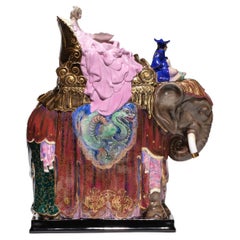
"Princess Badoura" "Royal Doulton Prestige Collection" Porcelain HN2081
By Royal Doulton
Located in Bloomfield Hills, MI
Princess Badoura was the most prestigious and expensive figure ever made by Royal Doulton. It was made to order for wealthy clients for nearly 50 years and a special color version was devised for Harrods of London. In addition, it has 22 carat gold decorations. Three different models are on display in the Fantastique exhibit at Weiner Museum Of Decorative Arts and Princess Badoura is one of the stars of the Celebration of Ceramic Art weekend. The glazes are as rich as luxurious silk and the gold decorations are perfection. It is one of the most sought after in the Princess Badoura productions. This piece was hand-painted. In the Tales of the Arabian Nights, Badoura is a princess of China and the most beautiful woman ever seen upon the earth. She magically falls in love in her sleep with Prince Camar of Persia thanks to the supernatural antics of two genies, who boast of their rival beauty. In defiance of their families, the young couple steadfastly refuse to marry anyone else until they are reunited after a quest for each other across Arabia. Their dreams come true and the princess travels to her wedding in great splendor on the back of an elephant. This enchanting story was illustrated by Edmund Dulac in 1907 and by George Barbier in 1922. This spectacular piece was modeled by Harry Stanton as a centerpiece for the Wembley Exhibition in 1924 and joined the Royal Doulton's Prestige Collection in 1952. Our piece was produced in 1983 and signed by the grandson of the founder, Michael Doulton, in 1985. Each figurine required over 160 hours of intricate painting and five kiln firings before the gilders added the final embellishment of 22 carat gold. This is a limited edition of 500. Royal Doulton is an English ceramic and home accessories manufacturer that was founded in 1815 by John Doulton at Lambeth, London in association with John Watts...
Gold
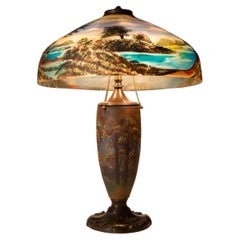
Pittsburgh Glass Company Nicolas Kopp Reverse Glass Painting Shade & Lamp
Located in Bloomfield Hills, MI
SALE ONE WEEK ONLY "Pittsburgh Glass Company Lamp" Landscape, Reverse Glass Paintng The landscape painting on the reverse side of the glass shade is an exceptionally fine example of...
Brass
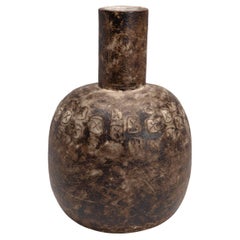
Claude Conover Ceramic Stoneware Vessel Signed "Comitan" Inscribed Decorations
By Claude Conover
Located in Bloomfield Hills, MI
SALE ONE WEEK ONLY "Comitan" is a stoneware vessel, 1980s, with a handsome elongated neck and full-body. The surface has a rich warm patina with cryptic scratches, stripes and hatchings marking the body. This gorgeous piece is a perfect example of Conover's best work. Claude Conover was a ceramic sculpture artist described as falling within the styles of American, Modern and Contemporary Design. In 1983 he won The Cleveland Arts Prize competition in the visual arts for his bold and unique ceramic pieces that reflect strength of form and endurance unusual in the field. Using his own clay stoneware and mostly monochromatic colors, Conover decorated the surfaces with cryptic scratches, stripes and hatchings. Although decorative in intent, the indecipherable incised lines on his ceramics suggest some prehistoric unreadable script. The resultant works evoke a timeless monumentality reminiscent of ancient vessels whose utilitarian purpose is now lost to us. Within this limited repertoire, he produced beautiful, eternal works of art. Although Conover’s large impressive pots are his best work, he also made other forms, such as bowls, lamps, and ceramic animal sculpture. Conover was born in Pittsburgh and educated at the Cleveland Institute of Art, where a number of prominent artists also attended: Brian Michael Bendis, Marc...
Ceramic, Stoneware
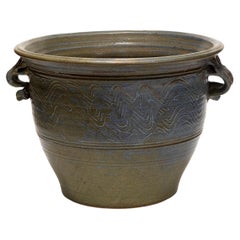
John Glick Ceramic Garden Planterette Signed
By John Glick
Located in Bloomfield Hills, MI
The Ceramic Garden Planterette is an example of the kind of work by which John Glick became so famous. He was seduced by the effects of the reduction kiln, which decreased the levels of oxygen during firing, inducing the flame to pull oxygen out of the clay and glazes changing the colors of the glazes depending on their iron and copper content. In this way he achieved the rich gradients of ochre and umber and variations in stippling and opacity. The piece is signed by Glick and stamped with the name of his studio: Plum Street Pottery on the verso. John was an American Abstract Expressionist ceramicist born in Detroit, MI. Though open to artistic experimentation, Glick was most influenced by the styles and aesthetics of Asian pottery—an inspiration that shows in his use of decorative patterns and glaze choices. He has said that he is attracted to simplicity, as well as complexity: my work continually reflects my re-examination that these two poles can coexist… or not, in a given series. Glick also took influences from master potters of Japan, notably Shoji Hamada and Kanjrio Kawai, blending their gestural embellishments of simple forms with attitudes of Abstract Expressionism. He was particularly drown to the work of Helen Frankenthaler whose soak-stain style resonated with Glick’s multi-layered glaze surfaces, which juxtaposed veils of atmospheric color with gestural marks and pattern. He spent countless hours developing and making his own tools in order to achieve previously unseen results in his work with clay and glaze. Glick’s “Plum Tree Pottery” (now a designated historic landmark in Farmington Hills, Michigan) studio opened around 1965 and closed in the summer of 2016. It was a private studio space for John and a number of his students and assistants. He believed his shapes evolved guided by forces apparently outside his control. This was instinctual, intellectual and due to his openness to change, fusing into what he thought was the most positive force behind a potter’s approach: evolution and growth. Some have called it inspiration. John was not only a major figure in the Detroit creative community, but in the ceramics world at large. According to Shelley Selim in her book on John, “John Glick: A Legacy in Clay” John remains: “one of the most recognizable names in the field of studio pottery – known for lecturing, publishing, and offering workshops widely – and his work has been featured in well over a hundred local, national and international exhibitions since he was a college student in the late 1950s.” Along with this John has mentored over thirty studio apprentices over five and a half decades, received numerous grants and awards for his work, and has been prolific, with an estimated 300,000 ceramic wares throughout the world. He received his Masters from Cranbrook Academy of Art in Bloomfield Hills, Michigan, working with Maija Grotell, a legendary and influential teacher. Grotell was noted for her deep interest in the human connection to nature’s rhythms and patters. These ideas often grounded her dialog with her students including Glick, affecting, a profund and lasting influence on his future work. This famous Art Academy was designed by architect and faculty member, Eliel Saarinen who collaborated with Charles and Ray Eames on chair and furniture design. Numerous creative artists who are alumni of Cranbrook include: Harry Bertoia, Florence Knoll, Jack Lenor Larsen, Donald Lipski, Duane Hanson, Nick Cave, Hani Rashid, George Nelson, Urban Jupena (Nationally recognized fiber artist), Artis Lane (the first African-American artist to have her sculpture, "Sojourner Truth," commissioned for the Emancipation Hall in the Capital Visitor Center in Washington DC), Cory Puhlman (televised Pastry Chef extraordinaire), Thom O’Connor (Lithographs), Paul Evans (Brutalist-inspired sculpted metal furnishings), Eugene Caples (small bronze images/abstract), Morris Brose (Bronze Sculptures), Herb Babcock (blown glass), Larry Butcher (mixed media) and Lauren Anais Hussey...
Ceramic
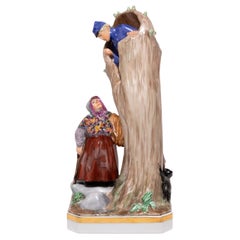
Bing & Grondahl Porcelain "The Tinderbox" Hans C Anderson 8051 Royal Copenhagen
By Jens Jakob Bregnoe
Located in Bloomfield Hills, MI
The Tinder Box is a small exquisite porcelain figurine that shines like a jewel. The figures are carefully created in great detail with much attention paid to the clothes and their decorations, the crutch, the cat, etc. This porcelain was based on the Hans Christian Anderson tale of “The Tinder Box”. A soldier is returning from the wars one day when he meets a witch. She tells him that she can give him riches, if he will do a favor for her. There is a hole at the top of a nearby tree. If the soldier climbs the tree, the witch tells him, and slides down the inside of the hollow trunk...
Porcelain