Want more images or videos?
Request additional images or videos from the seller
1 of 7

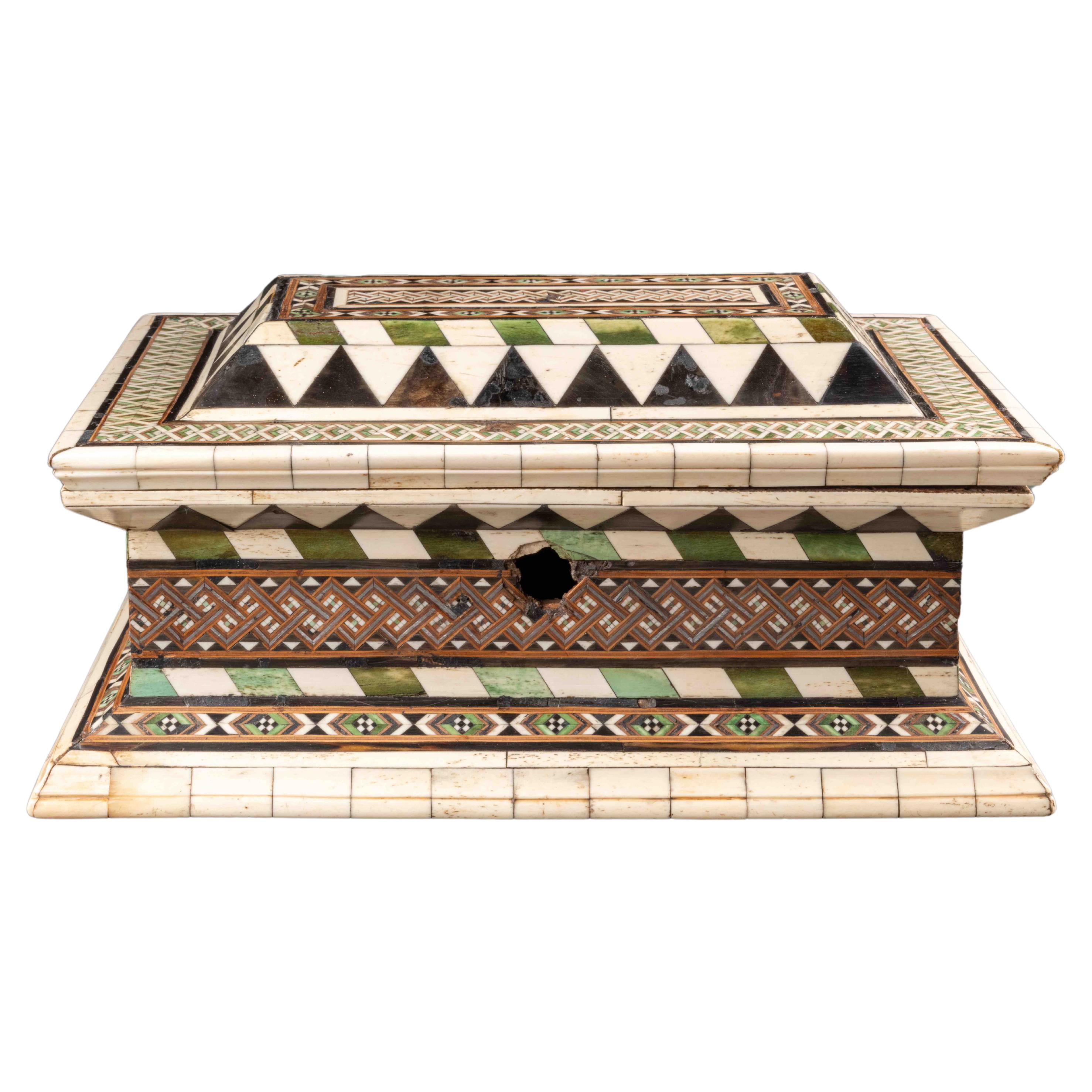
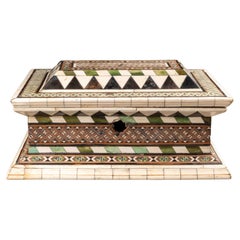
Game box with inlaid bone Embriachi workshop - Italy - - Late 15th century

$11,190.46
£8,313.67
€9,500
CA$15,682.36
A$15,878.77
CHF 9,033.39
MX$192,976.89
NOK 106,779.16
SEK 106,218.21
DKK 72,435.10

About the Item

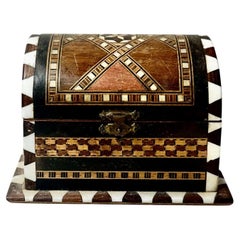
"Embriachi Game Box In Inlaid Bone, Italian Certosina, Renaissance (15th–16th Century)" A rare and authentic Renaissance games box from the Embriachi workshop or Lombard “certosina” tradition, produced in Northern Italy around 1470–1520. Compact in form (15.5 × 15.5 × 7 cm), this box was originally intended to hold chess pieces or tric-trac counters, a highly desirable category among luxury Italian objects of the late Quattrocento. The wooden core is fully clad in finely cut bone plaques and geometric inlays of dark wood, bone, and green-coloured paste, all characteristic of the certosina technique associated with Milanese and Venetian workshops. The diamond patterns, star motifs and interlocking triangular designs reflect the refined ornamental vocabulary of late 15th-century northern Italy. The lock and hinges are made of heavy hand-forged iron, entirely original to the piece. The deep patina and the natural iron-oxide staining absorbed into the bone confirm centuries of aging and an authentic early assembly. Such forged fittings are a key diagnostic element for genuine Renaissance workmanship. The interior shows the typical configuration for storing gaming pieces, further supporting the identification as a games box. Despite its age, the object survives in remarkably coherent and complete condition, displaying the honest wear and patination expected of a five-hundred-year-old utilitarian luxury object. A rare opportunity to acquire a well-preserved example of the refined craftsmanship of the Italian Renaissance.
  • Dimensions:
    Height: 2.56 in (6.5 cm)Width: 5.91 in (15 cm)Depth: 5.91 in (15 cm)
  • Materials and Techniques:
  • Period:
  • Date of Manufacture:
    Unknown
  • Condition:
    Wear consistent with age and use. Minor losses. Overall good condition with some small losses.
  • Seller Location:
    Lommel, BE
  • Reference Number:
    1stDibs: LU11022250594582

More From This Seller

View All
Steel Jewellery box from the Imperial Tula factory  – Russia - Late 19th century

Steel Jewellery box from the Imperial Tula factory – Russia - Late 19th century

Located in Lommel, BE

The metalwork displays a richly elaborate decoration composed of rose garlands, foliage, scrolling motifs, and finely ornamented circular medallions, executed with silver and brass i...

Category

Antique Late 19th Century Jewelry Boxes

Materials

Brass, Steel

Rare Gothic strongbox in forged iron and wood - France - 15th century

Rare Gothic strongbox in forged iron and wood - France - 15th century

Located in Lommel, BE

Rare Gothic forged iron casket, made in France in the mid-15th century, displaying remarkable ironwork and openwork decoration characteristic of the late medieval period. The rectang...

Category

Antique 15th Century and Earlier Decorative Boxes

Materials

Wrought Iron

Small forged iron strongbox or chest - Nuremberg (Germany) - Early 17th century

Small forged iron strongbox or chest - Nuremberg (Germany) - Early 17th century

Located in Lommel, BE

Rare Nuremberg wrought-iron casket, dating from the early 17th century. Rectangular in form, it is constructed from riveted iron plates and fitted with a slightly domed lid, topped w...

Category

Antique Early 17th Century Decorative Boxes

Materials

Wrought Iron

Big Micromosaic table attributed to Michelangelo Barberi - Italy - 19th century

Big Micromosaic table attributed to Michelangelo Barberi - Italy - 19th century

Located in Lommel, BE

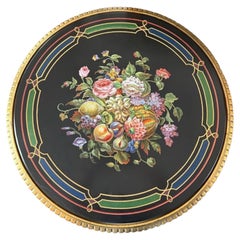
Round table with an exceptionally finely executed micromosaic composition on black Belgian marble, mounted on a gilded wooden pedestal. The central field depicts a rich bouquet of f...

Category

Antique Mid-19th Century Italian Grand Tour Gueridon

Materials

Stone, Belgian Black Marble

Important African Kuba Palmwine cup from the D.R Congo - Late 19th century

Important African Kuba Palmwine cup from the D.R Congo - Late 19th century

Located in Lommel, BE

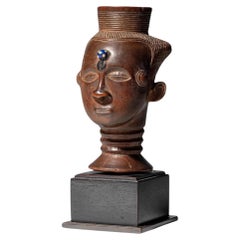
An exceptional Kuba palm wine drinking cup, hand-carved from a single piece of hardwood and sculpted in the form of an idealized human head. Created by the Kuba peoples of the Kasai ...

Category

Antique Late 19th Century Congolese Tribal Tribal Art

Materials

Hardwood

Alabaster of Mechelen by Jasper De Hemeler (1587-1637) - Belgium - 17th century

Alabaster of Mechelen by Jasper De Hemeler (1587-1637) - Belgium - 17th century

Located in Lommel, BE

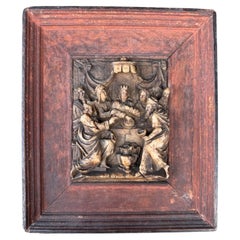
This finely carved alabaster bas-relief, presented in a period molded wooden frame, is a work of the Mechelen school, a renowned center for the production of high-quality religious s...

Category

Antique Early 17th Century Religious Items

Materials

Alabaster

You May Also Like

Moorish Style Spanish Inlaid Box With Mother Of Pearl And Bone

Moorish Style Spanish Inlaid Box With Mother Of Pearl And Bone

Located in Tampa, FL

A beautifully detailed small Moorish style box, finely crafted in Spain and sourced from a shop in San Miguel de Allende. The piece features exquisite inlay work of mother-of-pearl, ...

Category

Vintage 1910s Spanish Decorative Boxes

Materials

Bone, Mother-of-Pearl, Wood

Hispano-Moresque Mudéjar Bone-Inlaid Walnut Chest
 - Spain, 16th century

Hispano-Moresque Mudéjar Bone-Inlaid Walnut Chest
 - Spain, 16th century

Located in Bruxelles, BE

Hispano-Moresque Mudéjar Bone-Inlaid Walnut Chest
 Spain, 16th–17th century 
Walnut, bone inlay, iron fittings
 44.5 × 30.5 × 18 cm This rectangular walnut chest, richly ornamented ...

Category

Antique 16th Century Spanish Renaissance Decorative Boxes

Materials

Bone, Walnut

Embriachi workshop marquetry casket - Northern Italy, 15th century

Embriachi workshop marquetry casket - Northern Italy, 15th century

Located in Bruxelles, BE

Embriachi workshop marquetry casket Northern Italy, 15th century Alla certosina inlays (bone, stained bone, pewter and wood) H 28.2 x W 18 x D 14 cm This beautiful casket of rectangular form is richly decorated with the characteristic geometric patterns of the Embriachi style. The intricate geometric patterns are fashioned by juxtaposing lighter and darker pieces of wood, (colored) bone, horn and pewter. The lid and base are framed by a broad band of horn. When ivory became scarce in Europe due to disrupted trade routes, bone was substituted. The attention to Symmetry and balance created an harmonious visual effect Enhancing the overall aesthetic appeal of the casket. The application of geometrical motifs is in Italy known as marquetry ‘alla Certosina’, named after the Certosina Church in Pavia with its famous altarpiece decorated in this way. This is ‘intarsia technique’, a term derived from the Arabic 'tarsi', which means ‘incrustation' recalling ancient mosaics made from various materials. These geometric elements not only enhance the aesthetic appeal of the caskets but also demonstrate the versatility and skill of the artisans in creating multifaceted works of art. ‘Alla Certosina’ became famous through the Northern Italian Embriachi family who achieved a particularly high standard in working in this technique. Venice in particular was known for the production of these luxurious boxes. The caskets, hexagonal or rectangular, surmounted by a lid decorated in several registers constitute the secular, albeit equally renowned component of the workshop’s production, in addition to mirror frames and various everyday objects. The method of fabrication of those objects was based on two concepts that underlay pre-industrial production: standardization and modularity, thanks to a distribution of skills according to the different phases of fabrication. even the realization of the marquetry motifs (in the form of ingots from which portions of the desired size were cut) were therefore entrusted to various specialized craftsmen, as were the assembly phase. Today better known thanks to the extensive research work recently carried out by Michele Tomasi, this workshop owes its name to its founder and owner, the Florentine Baldassare Ubriachi (or degli Embriachi), a merchant and banker established in the Tuscan capital before he settled in Venice in 1395. Together with sculptor Giovanni di Jacopo, who directed the workshop, from the last years of the fourteenth century, Baldassare oversaw a production that was truly original, and still easily recognizable today, comprising monumental altarpieces and various objects, primarily triptychs and caskets. The precise location of the workshop is unknown, except that it originated in Florence and in ca. 1431 there was apparently a workshop in Venice, in the area of S Luca. They employed local workers specializing in 'certosina' (inlay of stained woods, bone and horn), and the workshop produced items carved in bone (usually horse or ox) with wood and bone marquetry. The geometric decoration of Embriachi caskets reflects the artistic complexity and attention to detail that characterized their work. this inlaid casket is a testament to the skill and artistry of the Embriachi family and serves as a stunning example of the decorative arts of the late Middle Ages. Related Literature : E. Berger, Prunk-Kassetten: Europäischen Meisterwerke aus acht Jahrhunderten / Ornamental Caskets...

Category

Antique 15th Century and Earlier Italian Renaissance Decorative Boxes
Materials

Pewter

Silver and copper Moroccan box with bone and natural stones inlaid

Silver and copper Moroccan box with bone and natural stones inlaid

Located in Winnetka, IL

Beautiful hand crafted copper and silver Moroccan box with bone and natural stones inlaid

Category

Late 20th Century Decorative Boxes

Materials

Silver Plate, Copper