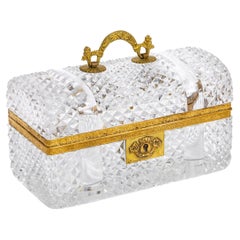
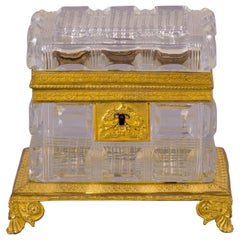
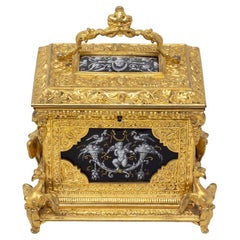
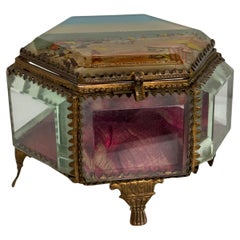
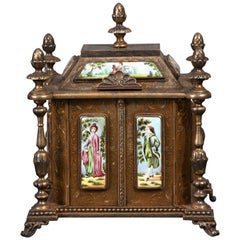
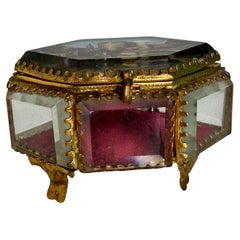
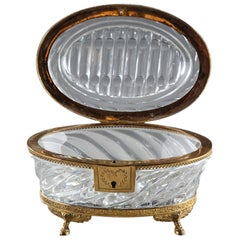
A Highly Important Viennese Enamel, Silver, Lapis Lazuli, and Rock Crystal Mounted Hinged Box, Attributed to Hermann Ratzersdorfer. The box is constructed from silver-gilt and fully mounted with transparent rock crystal panels, a feature that is exceptionally rare in 19th-century decorative arts. Unlike many contemporaneous boxes that incorporate opaque hardstones or painted enamel plaques, this example is composed entirely of clear rock crystal panels, including the vertical sides and domed lid, allowing for uninterrupted visibility of the intaglio-carved imagery and interior details. The use of such large, perfectly clear rock crystal segments requires not only access to high-quality material but also significant technical expertise in carving and fitting. The edges are inset with lapis lazuli framed over with silver and enamel mounts.
The box takes on a circular form with a low profile, resting on four silver-gilt feet with splayed scrolled terminals. Each foot is surmounted by a decorative mount embellished with multicolored champlevé enamel work in deep blue, pale green, red, and yellow, forming floral patterns within tightly cast borders. The main body is composed of four rock crystal panels, each cut to an identical shape and set into a gilt silver frame. These panels are engraved in intaglio with a series of mythological vignettes rendered in high detail. The subjects include seated female deities with flowing robes, cherubs, architectural urns, and stylized landscape elements such as trees, clouds, and rocky outcrops. Despite the density of detail in each carving, the panels remain optically clear, with no occlusions, cloudiness, or backing—an uncommon characteristic in lapidary-mounted objects of this type.
The crystal panels are separated by vertical silver-gilt brackets that rise from the base to the lid. Each bracket is cast in openwork with symmetrical scrolls and floral patterns, then filled with dense polychrome champlevé enamel. The enamels alternate in color—typically cobalt blue, pale green, and crimson—applied in precise recesses so that no enamel bleeds into the adjacent silverwork. A band of finely chased silver-gilt molding runs around the top and bottom perimeter of the box, integrating the lower rock crystal panels with the upper cover through repeated horizontal ornament.
The domed lid is set with four convex oval crystal cabochons arranged around a central oval panel of flat rock crystal. Four rectangular beveled panels are also inset symmetrically between the cabochons. All are mounted flush with the surrounding metal, which is chased and decorated with applied enamel scrolls, rosettes, and scalloped borders. Each rock crystal inset is framed in relief with ridged gilt bands and alternating enamel patterns, forming a radial composition that emphasizes the circular format of the box. The high dome of the lid mirrors the slight curve of the body and adds dimensionality to the overall silhouette. The box opens on a rear hinge, allowing access to a finely finished interior.
The lower interior well is finished in silver-gilt with an enameled floral pattern. The interior side walls reveal the reverse of the intaglio carvings on the exterior rock crystal panels, which are equally legible and unobstructed. The box’s reflective interior surfaces and transparent exterior allow for visibility of all carved imagery and structural decoration, even when closed. The enamel decoration across the object is particularly fine and executed in the champlevé technique. This involves carving recesses into the silver surface and fusing powdered glass within each space before firing. The enamels used here span multiple hues—predominantly turquoise, cobalt, crimson, olive, and opaque white—arranged in precise motifs of vines, scrolls, stylized leaves, and rosettes. Unlike painted enamel, champlevé relies entirely on the precision of the metalwork beneath, and the high level of symmetry, cleanliness, and color separation visible throughout the object demonstrates a high degree of technical skill. The use of enamel in both small brackets and broader lid sections ensures visual continuity between each part of the box’s structure.
This object reflects a synthesis of classical and Renaissance stylistic elements commonly favored in Viennese decorative art of the late 1800s. The mythological subjects, engraved in pure rock crystal, recall ancient intaglios and glyptic art, while the symmetrical structure and rich enameling reflect a revivalist aesthetic. The inclusion of so many panels of carved rock crystal—especially unbacked, free-floating, and visibly clean—sets this example apart from most comparable boxes, which typically rely on more opaque stones, enamel plaques, or painted glass. Given the level of lapidary work, silver mounting, and enamel execution required, such a piece would likely have been produced for exhibition or noble presentation.
Vienna, Circa: 1860