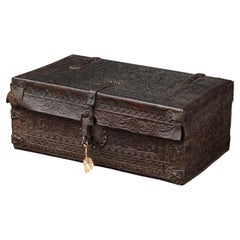
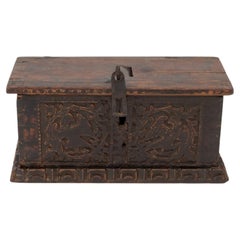
Leather trunk
Spanish, 17th century
Boiled Leather, wood and iron
Measures: 22 x 53 x 32 cm.
Provenance :
- collection Metz-Noblat, Château de Clevant, France
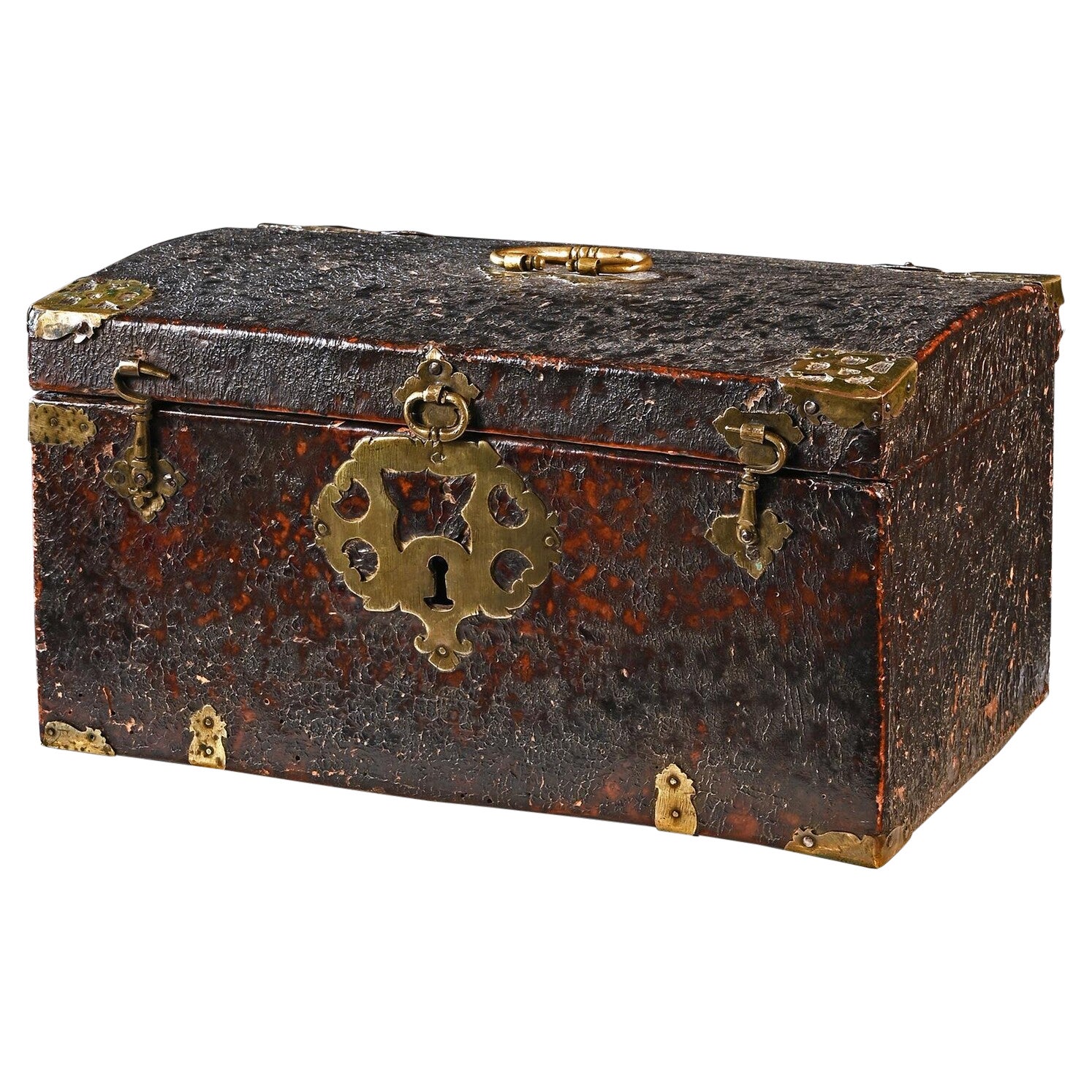
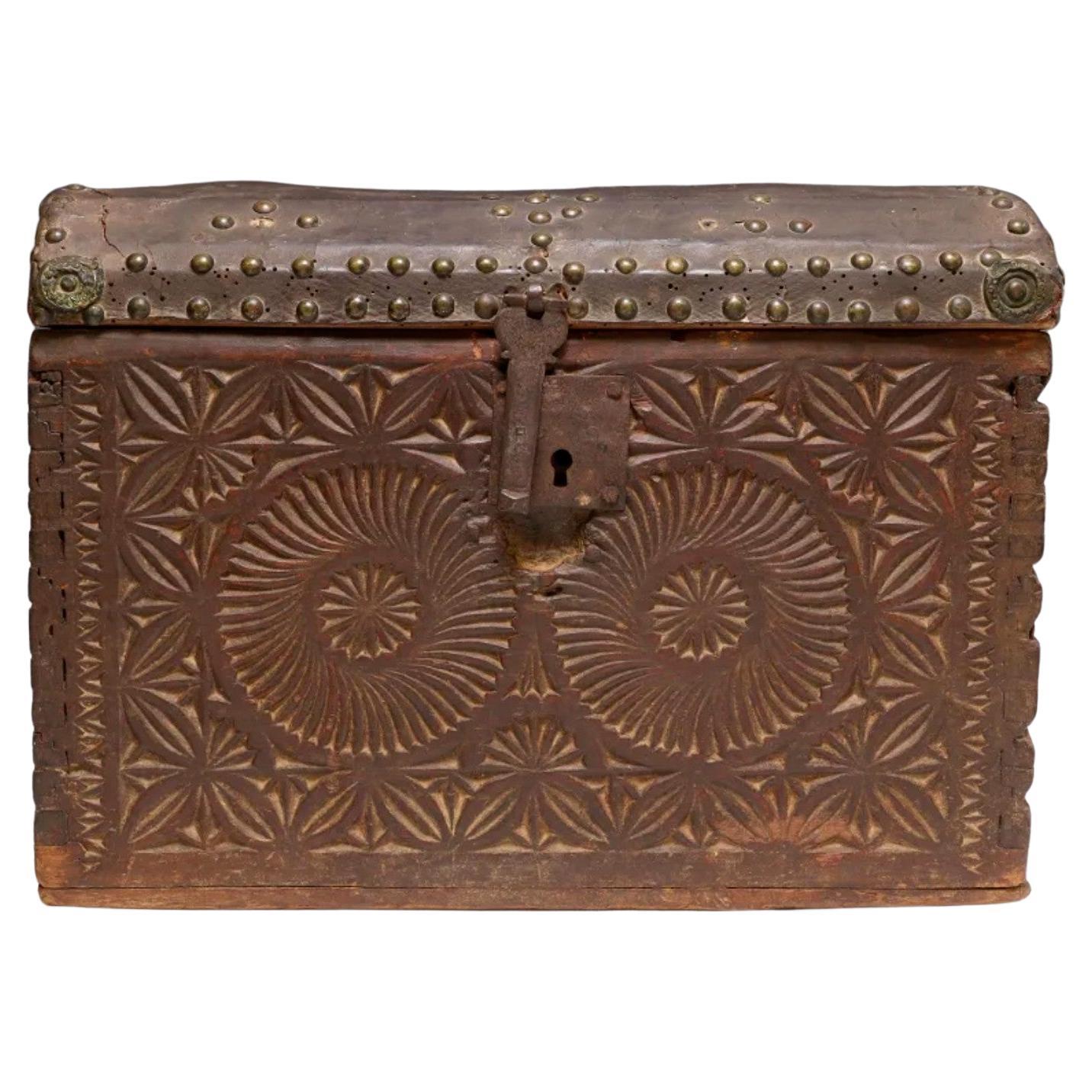
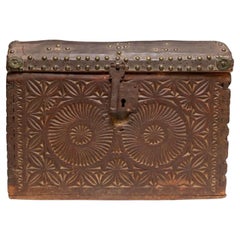
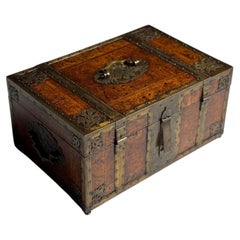
Rectangular trunk of the form and size of a small suitcase with wrought iron hinges and lock-plate.
Wood, covered with leather, cut and embossed with every surface of the thick cow hide covered in interlace, zoomorphic features.
The construction method is boiled leather, often referred to by its French translation cuir-bouilli: a process used to change flexible, vegetable-tanned leather into rigid, moulded objects. For shaping of the vegetable-tanned leather, heat and moisture were used, as indicated by the term boiled leather. No written medieval sources describing the production of decorated cuir bouilli objects survive, so knowledge of the process relies on the important studies of the Scottish leather historian John William Waterer. A large range of methods, materials and techniques could be used in various combinations. The vegetable-tanned leather, made supple with moisture and heat, was stuffed, shaped and nailed to the rigid wooden coffer support. The stuffing material was probably modeled beeswax or stearin wax. To shape the leather, to create its topography, « Cushions » were made by lacing a thread through an awl hole and attaching the flexible leather and stuffing to the rigid wooden support on the bottom. Then the decoration was done: lines were incised through the upper layer of the leather (epidermis) with different thicknesses of knives or needles. Contours were created with deep v-shaped cuts, decoration with thin incision and final details with a needle point. For the incision and pouncing stage, the leather was probably kept heated and moistened for suppleness.
Once dry, the leather would be hard and rigid.
the saturated leather is worked over a form, possibly even damp sand, with the pattern shaped using bone or wooden tools. Compare to metal, leather was lighter and it offered protection from cuts and punctures. Cuir bouilli objects were produced by specialist leather workers and needed skillful craftsmanship.
The surface is filled with roundels shaped foliages enclosing animals, lions and peacocks. The foliate arabesques creating a vegetal connection tweet the animals create the impression of a lush verdant space . The vegetal pattern here employed in combination with geometrical pattern came from the pre-islamic artistic traditions of the Byzantine and Sasanian empires. An aspect of Islamic geometry Is the basic symmetrical repetition and mirroring of the shapes that create a sense of harmony.
The decoration of this truck is inspired by the islamic « arabesque » a form of vegetal ornament composed of spirals, intertwining plants and abstract curvilinear motifs. An arabesque character is given to the birds of the decorations through extreme stylisation. This arabesque maintained the classical tradition of median symmetry, freedom in Detail and heterogeneity of ornament.
The presence of the peacocks is a paradisiacal allusion: in popular Islamic literature they were among the original inhabitants of the garden of Paradise expelled with Adam and Eve. Peacock as a decorative motif may have originated in the West, despite their eastern provenance. There was an ancient belief that the flesh and feathers of peacock do not decay. This led to the peacock becoming a christian symbol for Christ’s resurrection.
Renowned for their decorative wall hangings, seventeenth-century Spanish leatherworkers also produced utilitarian objects, such as this trunk. A similar trunk is on display at the Metropolitan museum of art ( 09.158.1).
Related literature :
Davies L. 2006. Cuir bouilli. Conservation of leather and related materials, 94-102, Oxford: elsevier Butterworth-Heinemann
Grabar, Oleg. The Mediation of Ornament. Princeton: Princeton University Press, 1992
Gabriela Germana Roquez, "El mueble en el Peru en el siglo XVIII...
Category
Antique 17th Century Decorative Boxes