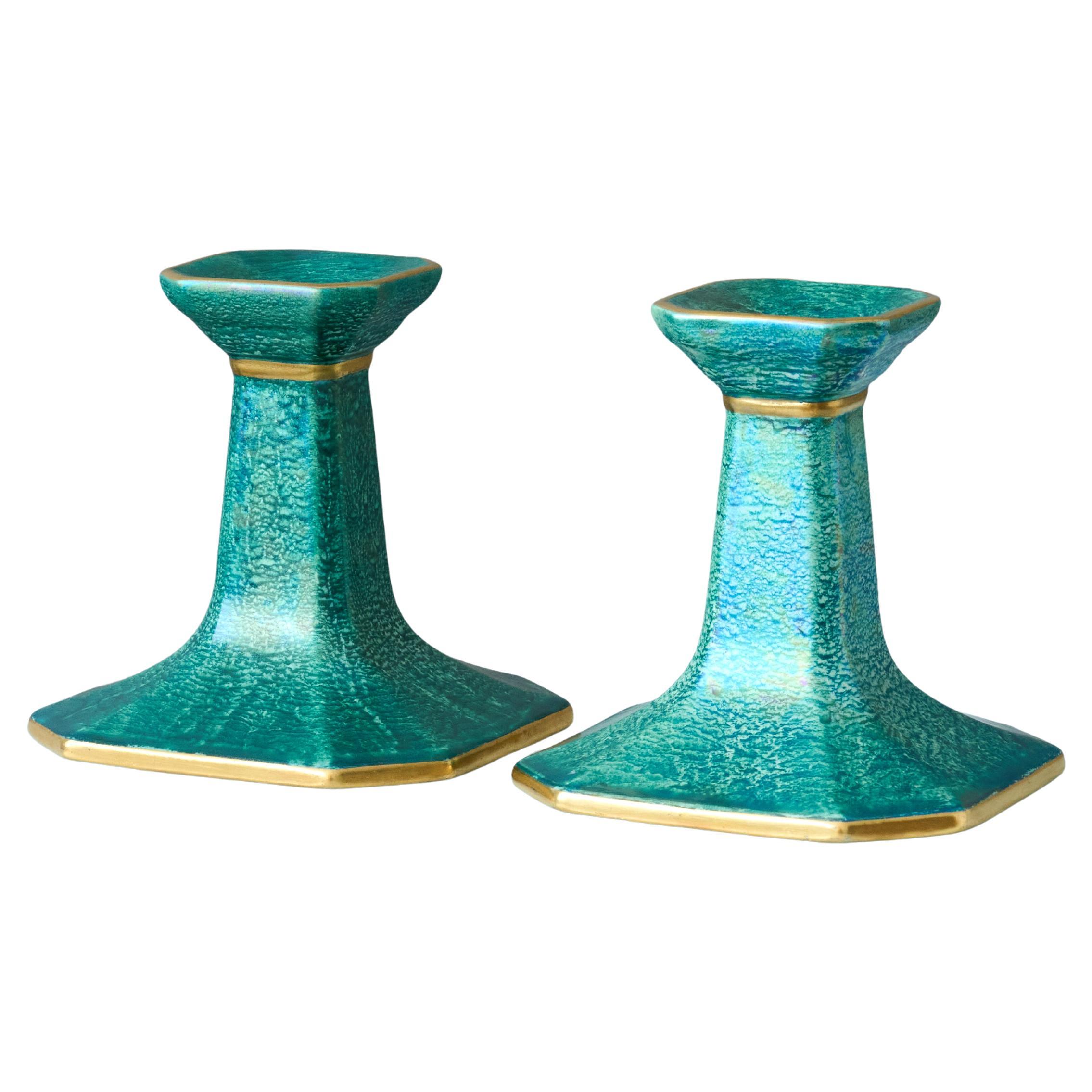
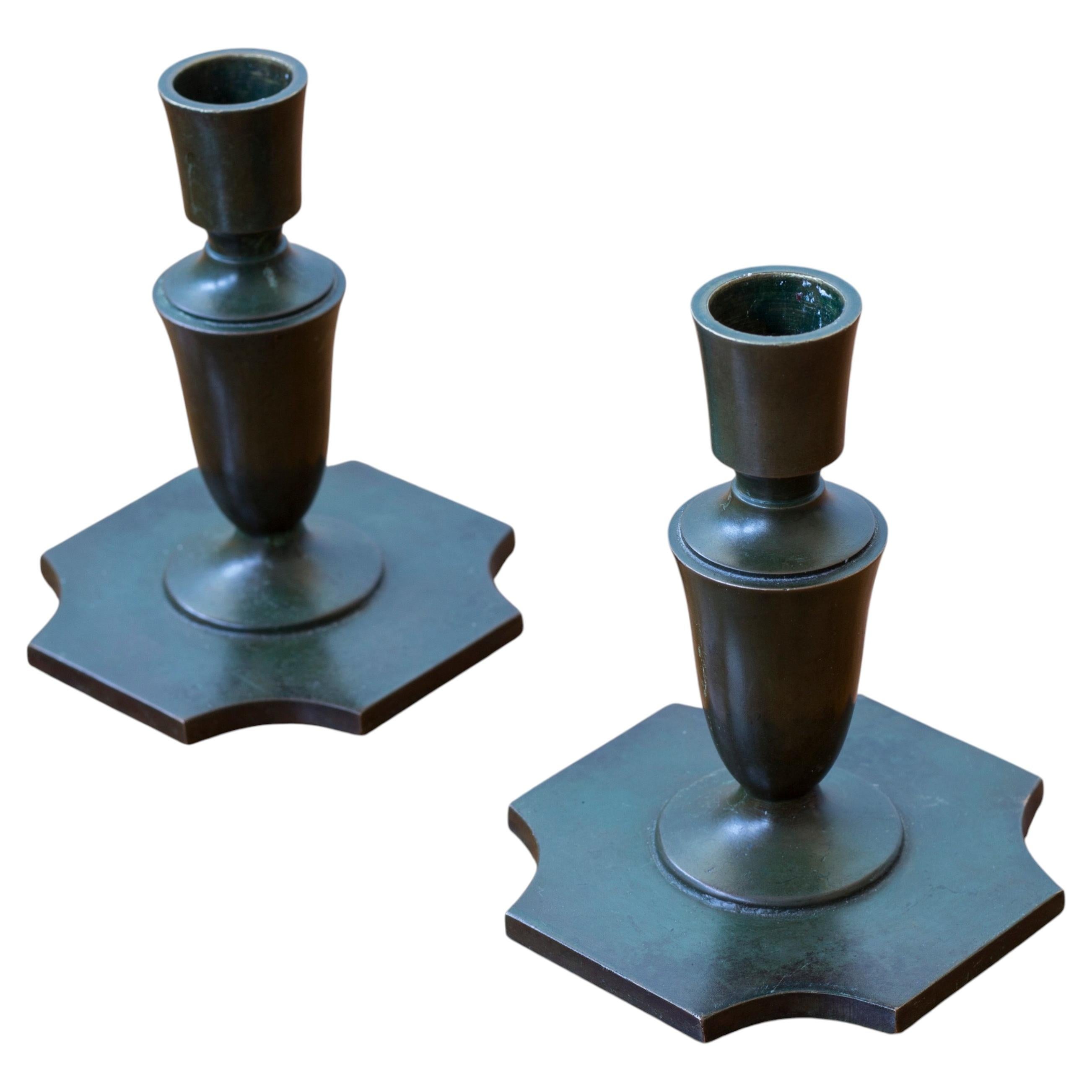
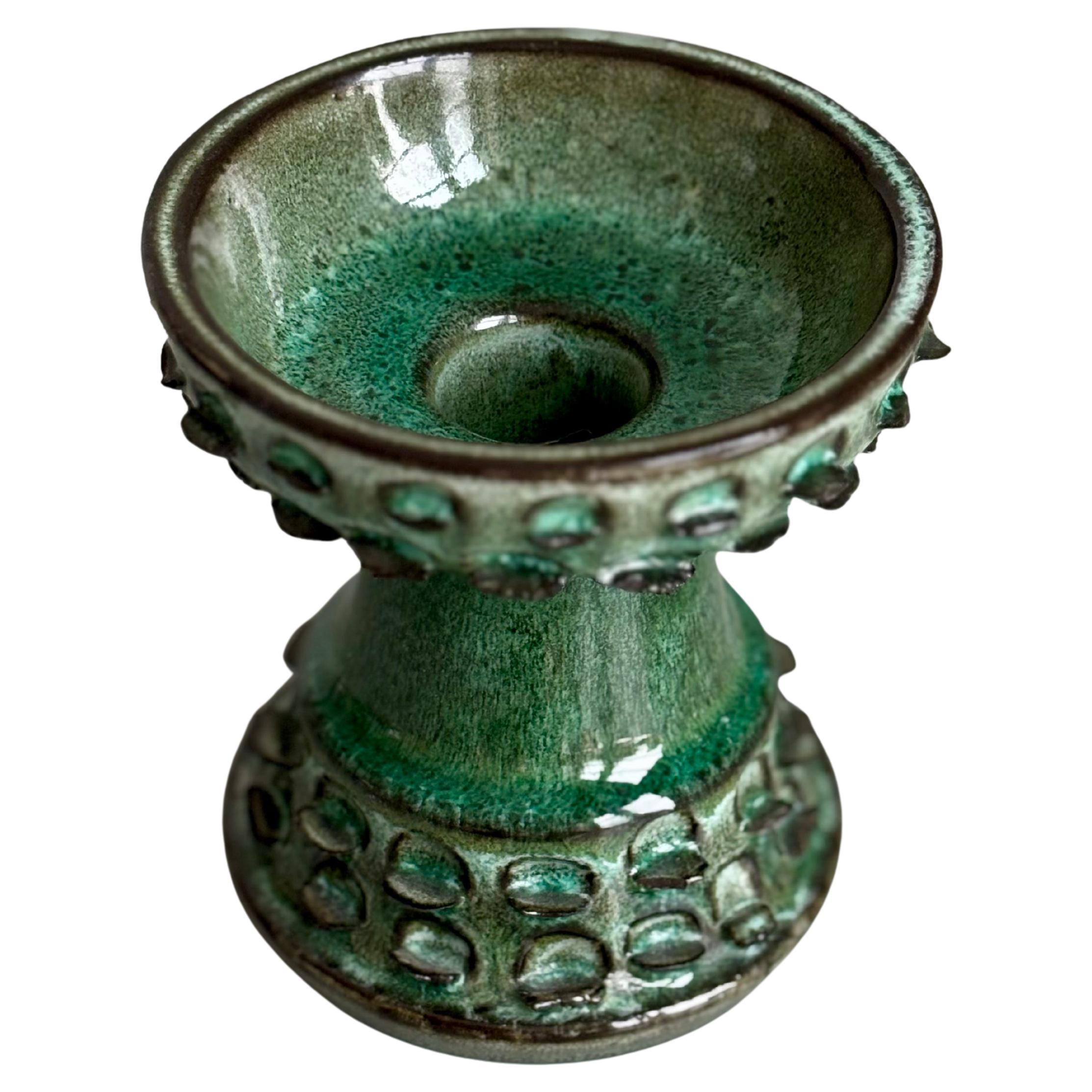
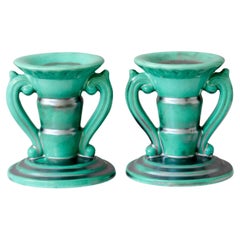
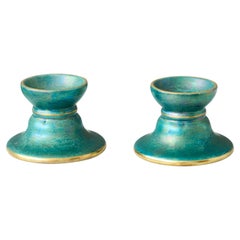
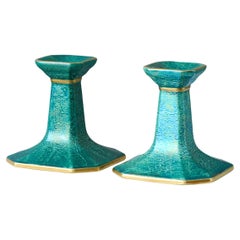
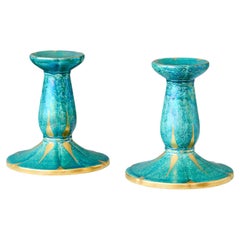
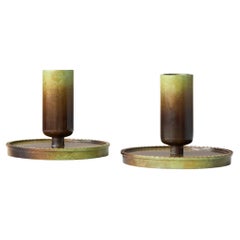
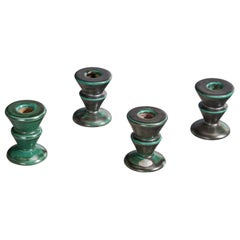
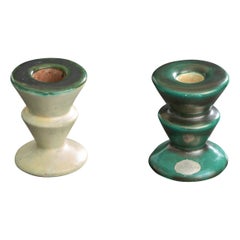
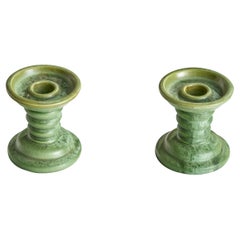
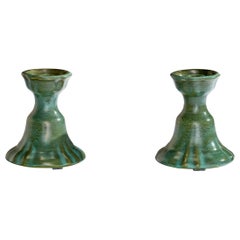
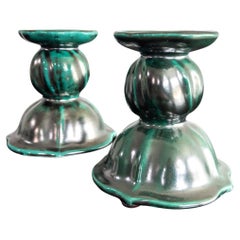
A pair of beautiful Art Deco candlesticks with amazing glaze.
Made by Harald Östergren for Upsala Ekeby in Sweden, 1930s.
Great original condition - no chips, cracks or crazing.
Marked with original sticker with makers mark.
Harald Östergren (1888–1974) was a Swedish ceramic artist, painter, designer, and educator whose work played a significant role in the development of artistic ceramics during the first half of the twentieth century. Best known for his long association with Upsala-Ekeby, he belonged to the generation that transformed Swedish pottery from a primarily utilitarian craft into a respected artistic discipline. Through his innovative forms, decorative experimentation, and commitment to craftsmanship, Östergren helped shape the visual language of Swedish ceramics during a formative period in its history.
Born in Stockholm in 1888, Östergren initially trained as a painter and studied at the Royal Academy of Fine Arts. Seeking to broaden his artistic horizons, he continued his education in Germany, where he developed a particular interest in ceramics and ceramic technology. This combination of academic artistic training and technical ceramic knowledge would become a defining feature of his career, allowing him to move confidently between the worlds of fine art and applied design.
Before joining Upsala-Ekeby, Östergren worked independently and operated a ceramic workshop in Vittinge together with fellow artists Gabriel Burmeister and Edvin Ollers. These early years were marked by experimentation and a search for new artistic expressions within the medium of clay. The experience provided him with a practical understanding of ceramic production while strengthening his interest in form, surface, and glaze.
In 1923, Östergren began what would become a twenty-four-year association with Upsala-Ekeby, one of Sweden’s most important ceramic manufacturers. During his tenure, which lasted until 1947, he served not only as a designer but also periodically as artistic director. His influence extended across much of the factory’s production, from unique artistic pieces to everyday household wares. In fact, many of the factory’s unmarked ceramics from the 1920s, 1930s, and 1940s are now attributed to Östergren, reflecting the breadth of his contribution to the company’s output.
Östergren’s ceramics are characterised by strong silhouettes, carefully balanced proportions, and a keen interest in historical ceramic traditions. He drew inspiration from ancient Greek pottery, African ceramics, and other non-European decorative traditions, interpreting these influences through a distinctly Scandinavian lens. His vessels often combine classical restraint with expressive surface treatments, creating objects that feel both timeless and modern.
Particularly notable was his ability to work across a wide range of styles. Some pieces reveal the geometric elegance associated with Art Deco, while others display a more rustic and handcrafted character. His forms frequently emphasise volume and contour rather than elaborate ornamentation, allowing the shape of the object itself to become the primary means of expression. This sculptural approach reflects his background as both a painter and a modeller.
Alongside his work as a designer, Östergren was an influential teacher. For many years he taught modelling at the Technical School in Uppsala, helping to educate a younger generation of artists and craftsmen. Through both his teaching and his factory work, he contributed to the transmission of ceramic knowledge during a period of rapid artistic and industrial development in Sweden.
Although later generations often associated Upsala-Ekeby with designers such as Anna-Lisa Thomson, Mari Simmulson, and Vicke Lindstrand, Östergren belonged to the group that laid the groundwork for the factory’s artistic success. His designs helped establish the company’s reputation for combining quality craftsmanship with progressive artistic ideals, and his influence remained visible long after his departure from the factory.
When Harald Östergren died in 1974, he left behind a body of work that reflected both artistic versatility and technical mastery. Today his ceramics are increasingly appreciated by collectors and historians who recognise their importance within the development of Swedish art pottery. Whether in the form of a boldly modelled vase, a decorative bowl, or a unique exhibition piece, his work reveals an artist dedicated to exploring the expressive possibilities of clay while remaining deeply rooted in the traditions of craftsmanship. Through his long career, Östergren helped define an important chapter in the history of Swedish ceramics and secured his place among the pioneering figures of Scandinavian ceramic art.