Want more images or videos?
Request additional images or videos from the seller
1 of 6

A Rare Early Victorian Strut Clock by Thomas Cole

$8,331.64
£6,000
€7,133.65
CA$11,496.99
A$11,702.75
CHF 6,661.43
MX$141,260.91
NOK 77,675.93
SEK 78,612.49
DKK 53,328.06

About the Item

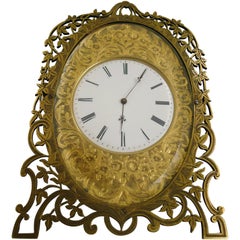
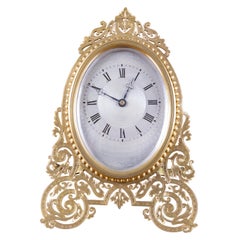
Early Engraved Gilt-Bronze Strut Clock No. 565 by Thomas Cole for C.F. Hancock, circa 1845 A rare and exceptionally early engraved gilt-bronze strut clock by Thomas Cole (1800–1864), numbered 565, circa 1845 and signed for the celebrated London jeweller and silversmith C.F. Hancock. This remarkable clock represents one of the earliest forms of Thomas Cole's newly developed strut clock, dating from the formative period in which Cole conceived the design. The substantial rectangular gilt-bronze case is profusely hand engraved throughout with scrolling foliage, flowers, strapwork and geometric ornament. The decoration extends across virtually every visible surface, including the outer frame, sides, feet, folding rear strut and distinctive suspension handle. The extraordinary quality and density of the engraving are characteristic of Cole's earliest work and represent something of a tour de force of his abilities as both designer and craftsman. The large silvered dial is similarly decorated with elaborate foliate engraving, Roman numerals and finely formed blued steel hands, and is signed C. F. HANCOCK for the retailer. The ingenious case incorporates a folding suspension handle and Cole's characteristic rear easel strut, allowing the clock either to stand upon a table or to be suspended. The underside is stamped with Thomas Cole's early serial number 565. Thomas Cole and the Strut Clock Thomas Cole was one of the most inventive and accomplished English clockmakers of the Victorian period. He initially worked alongside his elder brother, the distinguished chronometer maker James Ferguson Cole, before establishing his independent career as a designer and maker of ornamental clocks. It was around 1845 that Thomas developed the clock form for which he would become most famous: the strut clock. His ingenious design placed a remarkably thin portable clock upon a folding easel support or “strut”, combining precision clockmaking with the appearance of an elaborate piece of decorative art. The development of these clocks was comprehensively documented by John B. Hawkins in his landmark 1975 study Thomas Cole & Victorian Clockmaking. Hawkins has subsequently considerably expanded and refined his research in The Hawkins Pictorial Survey of Cole Clocks, Parts I & II, revised 2025, incorporating numerous previously undocumented clocks discovered during the intervening fifty years. Number 565 places the present clock at the very beginning of Cole's numbered production. Its exceptionally elaborate construction and extensive engraving are consistent with Hawkins' research into Cole's earliest strut clocks and support a date of circa 1845. Cole's strut clocks subsequently became one of the defining luxury clock forms of the Victorian period, and his work achieved international recognition at the Great Exhibition of 1851 and the major international exhibitions that followed. C.F. Hancock The dial is signed for Charles Frederick Hancock, one of London's foremost Victorian jewellers and silversmiths. Hancock had previously been a partner in Hunt & Roskell before establishing his own business, and Thomas Cole is known to have supplied clocks bearing Hancock's name. The combination of Cole's exceptionally early serial number 565, the extraordinarily engraved case and the prestigious C.F. Hancock signature makes this a particularly important example from the earliest development of the celebrated Cole strut clock. English, circa 1845. Literature: John B. Hawkins, Thomas Cole & Victorian Clockmaking, 1975. John B. Hawkins, The Hawkins Pictorial Survey of Cole Clocks, Parts I & II, revised 2025.
  • Dimensions:
    Height: 15 in (38.1 cm)Width: 10.2 in (25.91 cm)Depth: 2.4 in (6.1 cm)
  • Materials and Techniques:
  • Place of Origin:
  • Period:
  • Date of Manufacture:
    1845
  • Condition:
    Wear consistent with age and use.
  • Seller Location:
    London, GB
  • Reference Number:
    1stDibs: LU2015351369942

More From This Seller

View All
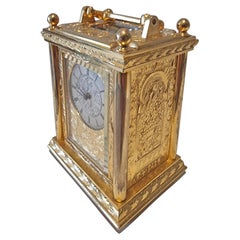
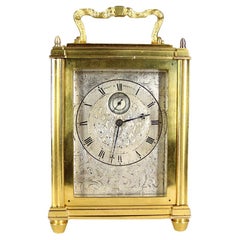
English Fusee Carriage Clock By Thomas Cole and James Ferguson Cole

English Fusee Carriage Clock By Thomas Cole and James Ferguson Cole

Located in London, GB

An Exceptional Early English Fusee Carriage Clock Attributed to Thomas & James Ferguson Cole London, circa 1833–1838 An exceptional early English fusee carriage clock, attributable to Thomas Cole and his brother James Ferguson Cole, two of the most important and innovative English clockmakers of the nineteenth century. Although unsigned by the brothers themselves, this clock can be confidently attributed on stylistic, technical, and constructional grounds, as documented by John Hawkins in The Hawkins Pictorial Survey of Cole Clocks, Part I. This example represents a Phase I, Type I Cole carriage clock, placing it among the very earliest surviving carriage clocks produced by the Cole brothers. The design and engraving are characteristic of Thomas Cole, while the movement is the work of his elder brother James Ferguson Cole, whose bespoke mechanisms are widely regarded as technically superior and highly individual. The clock is fitted with an eight-day single-chain fusee movement with English lever escapement, the backplate numbered 2020. Hawkins illustrates an almost identical backplate on p. 400. Of particular importance is the distinctive reinforcing bridge to the mainspring, a hallmark of early James Ferguson Cole movements. This bridging system was designed to provide additional strength and depth to the mainspring in these miniature fusee clocks...

Category

Antique 1830s English Carriage Clocks and Travel Clocks
Materials

Bronze

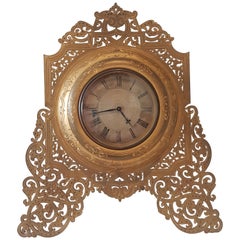
Mid-19th Century Gilt Bronze Strut Clock in the Style of Cole

Mid-19th Century Gilt Bronze Strut Clock in the Style of Cole

Located in London, GB

Mid-19th century gilt bronze strut clock in the style of Cole. Original gilding and very fine engraving make this a most attractive clock. The pierced ormolu frame gives a very light...

Category

Antique 1860s English Table Clocks and Desk Clocks

Materials

Enamel, Ormolu

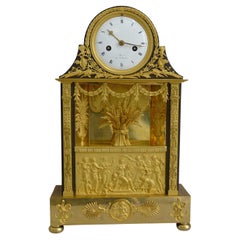
French Empire Clock in Ormolu and Patinated Bronze Signed Revel Rue De Richelieu

French Empire Clock in Ormolu and Patinated Bronze Signed Revel Rue De Richelieu

Located in London, GB

French Empire period ormolu and patinated bronze mantel clock representing Ceres. The crowning of Ceres is a stunning clock of very fine quality and with totally original fire gilded...

Category

Antique Early 1800s French Mantel Clocks

Materials

Bronze, Ormolu

Tortoiseshell and Gilt Bronze Bracket Clock in Queen Anne Style

Tortoiseshell and Gilt Bronze Bracket Clock in Queen Anne Style

Located in London, GB

French Blonde Tortoiseshell Mantel Clock by Samuel Marti, Paris, Queen Anne Style, Circa 1880 A particularly elegant and unusual French mantel clock dating from the late nineteenth c...

Category

Antique 1880s French Mantel Clocks

Materials

Bronze

French Empire Antique Clock, Ormolu, Patinated Bronze and Marble

French Empire Antique Clock, Ormolu, Patinated Bronze and Marble

By L. Ravrio 1

Located in London, GB

French Empire clock of stunning quality of borne shape constructed of rouge marble, original fire gilt ormolu and patinated bronze. The dial of the clock is signed "L Ravrio" below 1...

Category

Antique Early 1800s French Empire Mantel Clocks

Materials

Marble, Bronze, Ormolu

You May Also Like

A Strut Clock in The Manner of Thomas Cole by Howell, James & Co.

A Strut Clock in The Manner of Thomas Cole by Howell, James & Co.

By Thomas Cole (Clockmaker)

Located in Amersham, GB

This beautiful desk timepiece is a rare strut clock, in the form of a gilded scallop shell, with an engine turned silvered roman dial set behind a bevelled glass with distinctive fle...

Category

Antique 1860s English Baroque Revival Table Clocks and Desk Clocks

Materials

Ormolu

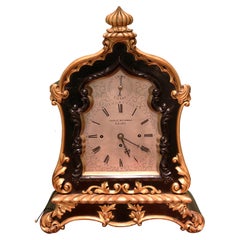
A mid 19th century striking bracket clock by Charles, Nephew & Co Calcutta

A mid 19th century striking bracket clock by Charles, Nephew & Co Calcutta

Located in London, GB

A rare mid 19th Century Bracket Clock of unusual large proportions, the silvered dial 8-day quarter repeat movement striking on bells and gong, by Charles. Nephew & Co, Calcutta. Th...

Category

Antique Mid-19th Century English Early Victorian Table Clocks and Desk C...

Materials

Ebony, Giltwood

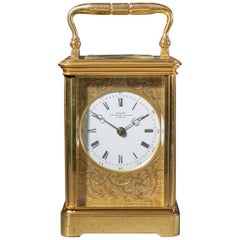
Single Fusee Carriage Timepiece By Thomas Cole and James Cole, Retailed By Hunt

Single Fusee Carriage Timepiece By Thomas Cole and James Cole, Retailed By Hunt

By Thomas Cole (Clockmaker)

Located in Amersham, GB

A miniature carriage clock timepiece by Thomas Cole and his brother James Fergusson Cole. The eight day single fusee movement with english lever escapement. The case is decorated with the ‘Rose and Trellis’ pattern as seen on another of Coles clocks retailed by Edward Dent with the same handle and case construction ( JB Hawkins, “The Hawkins Pictorial Survey of Cole Clocks...

Category

Antique 1840s English William IV Carriage Clocks and Travel Clocks
Materials

Brass, Steel, Ormolu

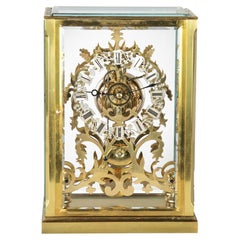
A very fine mid Victorian skeleton clock by Johnston of London

A very fine mid Victorian skeleton clock by Johnston of London

By John Johnston

Located in Lymington, Hampshire

A very fine mid Victorian skeleton clock by Johnston of London, of large rectangular form comprising two openwork arabesque panels parti A very fine mid Victorian skeleton clock by Johnston of London, of large rectangular form comprising two openwork arabesque panels partially shielding the fusée bell striking movement, the polished scroll frame raised on shaped turned pillars, the foliate scrolled silvered and engraved dial with Roman numerals joined with delicate thistle motifs, housed in its integrated glazed brass case applied with a silvered maker’s labels stating ‘Johnston, 2 Elm Street...

Category

Antique Mid-19th Century English Victorian Mantel Clocks

Materials

Brass