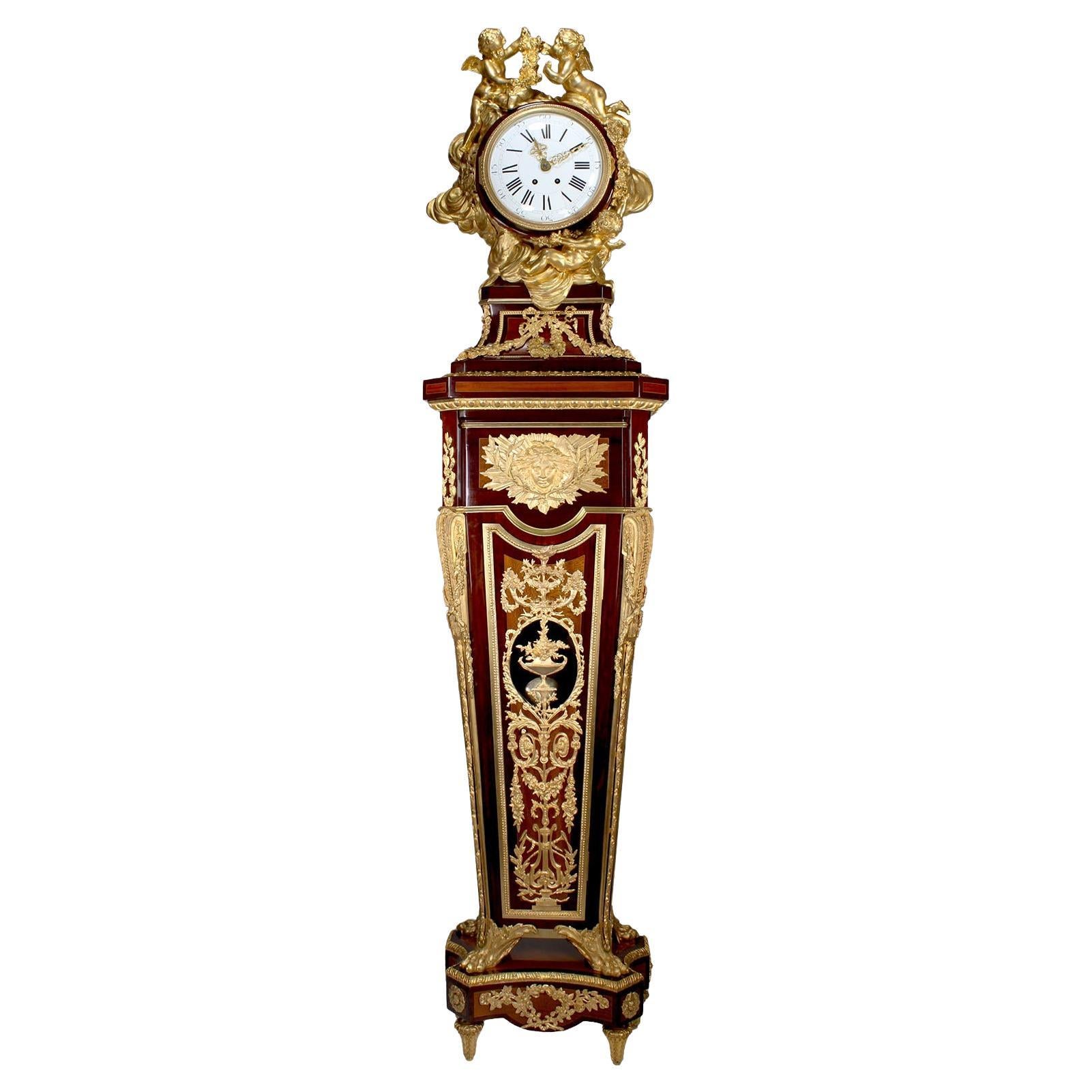
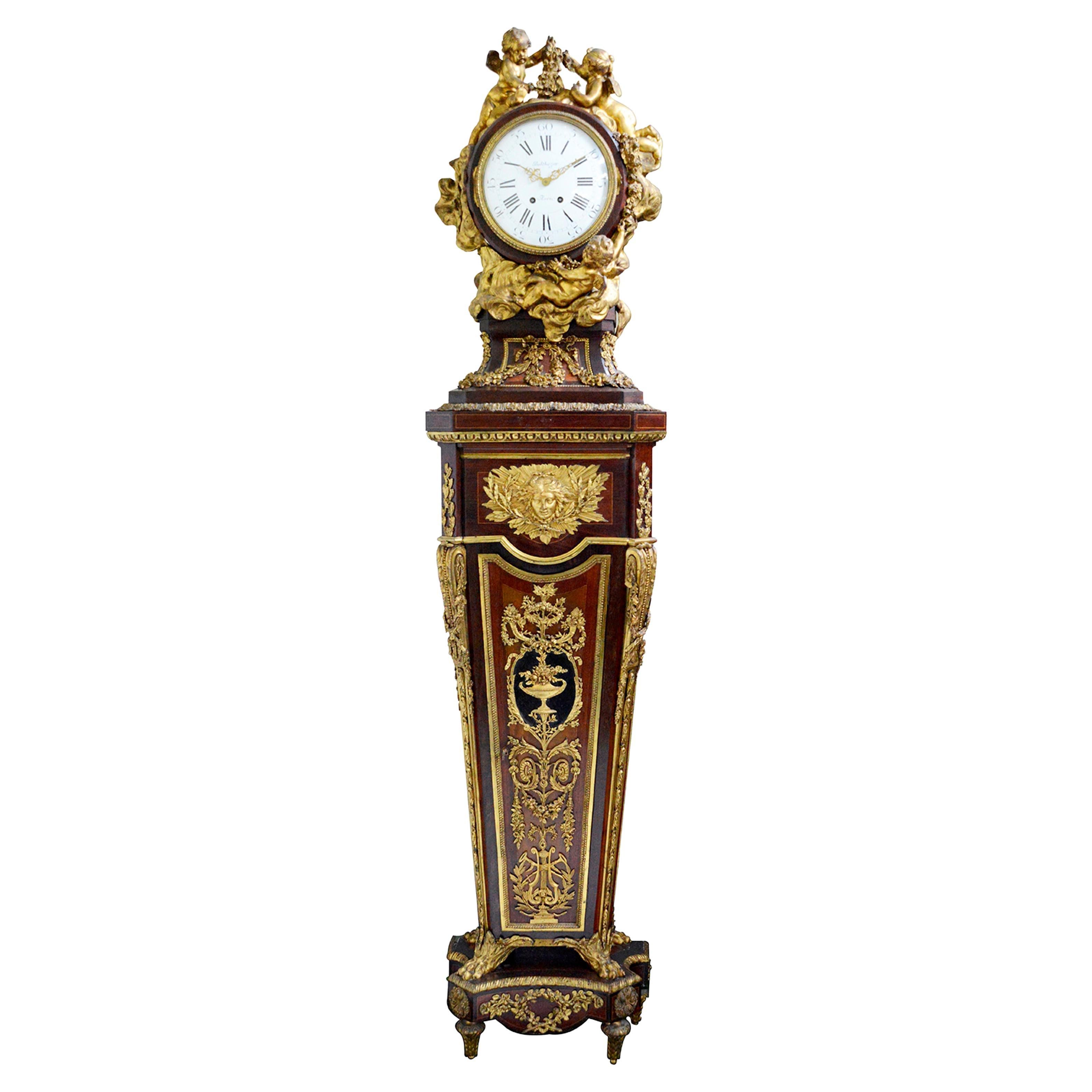
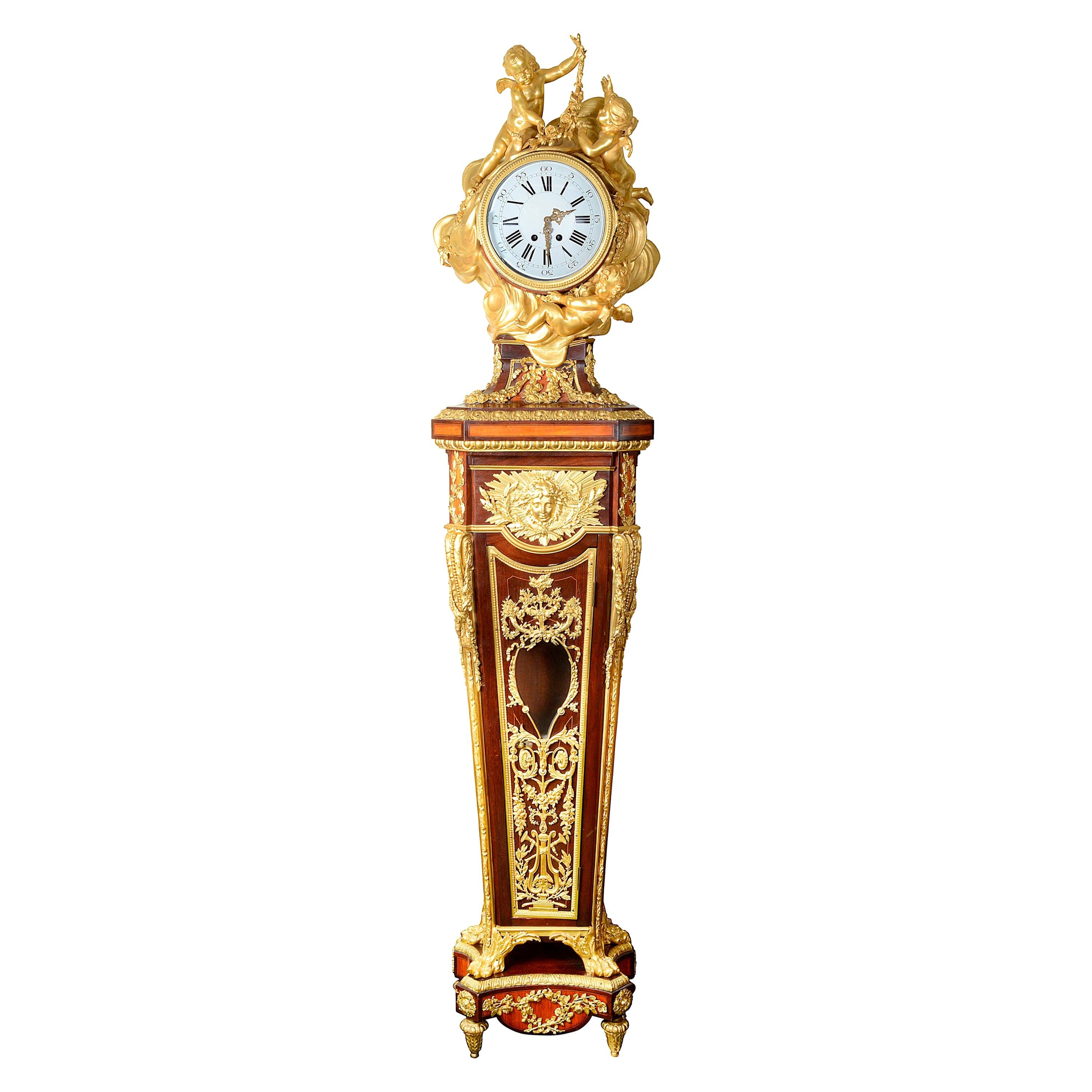
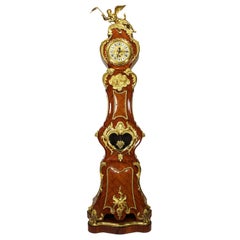
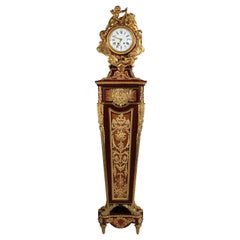
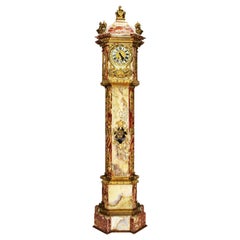
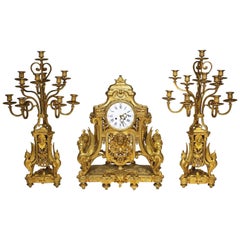
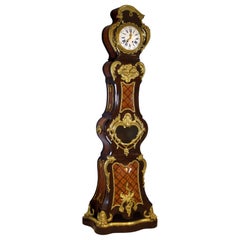
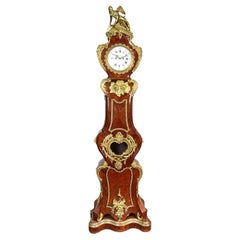
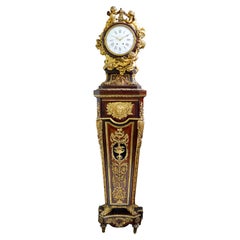
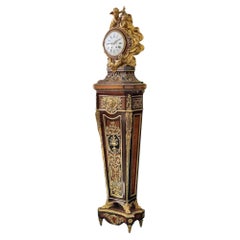
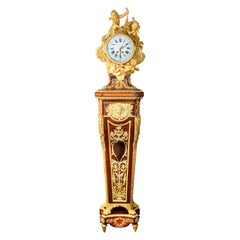
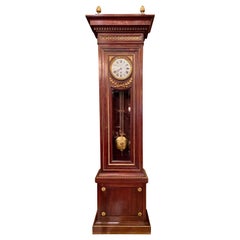
A very fine and palatial French 19th century Regence style figural ormolu-mounted kingwood and tulipwood floral marquetry long-case regulator, after a Model by Charles Cressent (French, 1685-1768). The circular porcelain clock face with Roman numerals and inscribed Henry Dasson, A Paris. An ormolu mount stamped "GP" After the bronzier Pierre Gouthière (1740-1806). The façade with musical trophy mount and shaped lenticle, with an Apollo-mask pendulum, winding key, key to case, circa Paris, 1880.
Measures: Height: 106 1/2 inches (270.5 cm).
Width: 27 3/4 inches (70.5 cm).
Depth: 15 3/4 inches (40 cm).
The original 18th century régulateur by Charles Cressent's, of which this clock case is a close 19th century copy, is currently part of the Royal Collection at Buckingham Palace (illustrated in A. Pradére, Les Ebénistes Français de Louis XIV à la Révolution, Paris, 1989, p. 135). Another similar example of this palatial clock surmounted with a figure of Chronos holding a scythe, also stamped 'GP' for the bronzier workshop, was sold at Sotheby's New York on 16 November 2011, lot 274 (sold $62,500 USD). The partial dial signature, 'Ma..', may refer to Martinot, whose name appears on the dial of a closely related model, see Christie's London, 24 September 2008, lot 96, sold £55,250 ($90,057 USD).
Charles Cressent (1685–1768) was a French furniture-maker, sculptor and fondeur-ciseleur of the régence style. As the second son of François Cressent, sculpteur du roi, and grandson of Charles Cressent, a furniture-maker of Amiens, who also became a sculptor, he inherited the tastes and aptitudes which were likely to make a finished designer and craftsman. Even more important perhaps was the fact that he was a pupil of André Charles Boulle. Trained in such surroundings, it is not surprising that he should have reached a degree of achievement which has to a great extent justified the claim that he was the best decorative artist of the 18th century. Cressent's distinction is closely connected with the Regency, but his earlier work had affinities with the school of Boulle, while his later pieces were full of originality.
He was likewise a sculptor, and among his plastic work is known to have been a bronze bust of Louis, the son of Philip II, Duke of Orléans, for whom Cressent had made one of the finest examples of French furniture of the 18th century the famous medaillier now in the Bibliothèque Nationale. Cressent's bronze mounts were executed with a sharpness of finish and a grace and vigour of outline which were hardly excelled by his great contemporary Jacques Caffieri. His female figures placed at the corners of tables are indeed among the most delicious achievements of the great days of the French metal worker.
The work of identification is rendered comparatively easy in his case by the fact that he published catalogues of three sales of his work. These catalogues are highly characteristic of the man, who shared in no small degree the personal bravura of Cellini, and could sometimes execute almost as well. He did not hesitate to describe himself as the author of a clock worthy to be placed in the very finest cabinets, the most distinguished bronzes, or pieces of the most elegant form adorned with bronzes of extra richness. He worked much in marquetery, both in tortoiseshell and in brilliant colored woods. He was indeed an artist to whom color appealed with especial force. The very type and exemplar of the feeling of the Regency.