
Want more images or videos?
Request additional images or videos from the seller
1 of 13

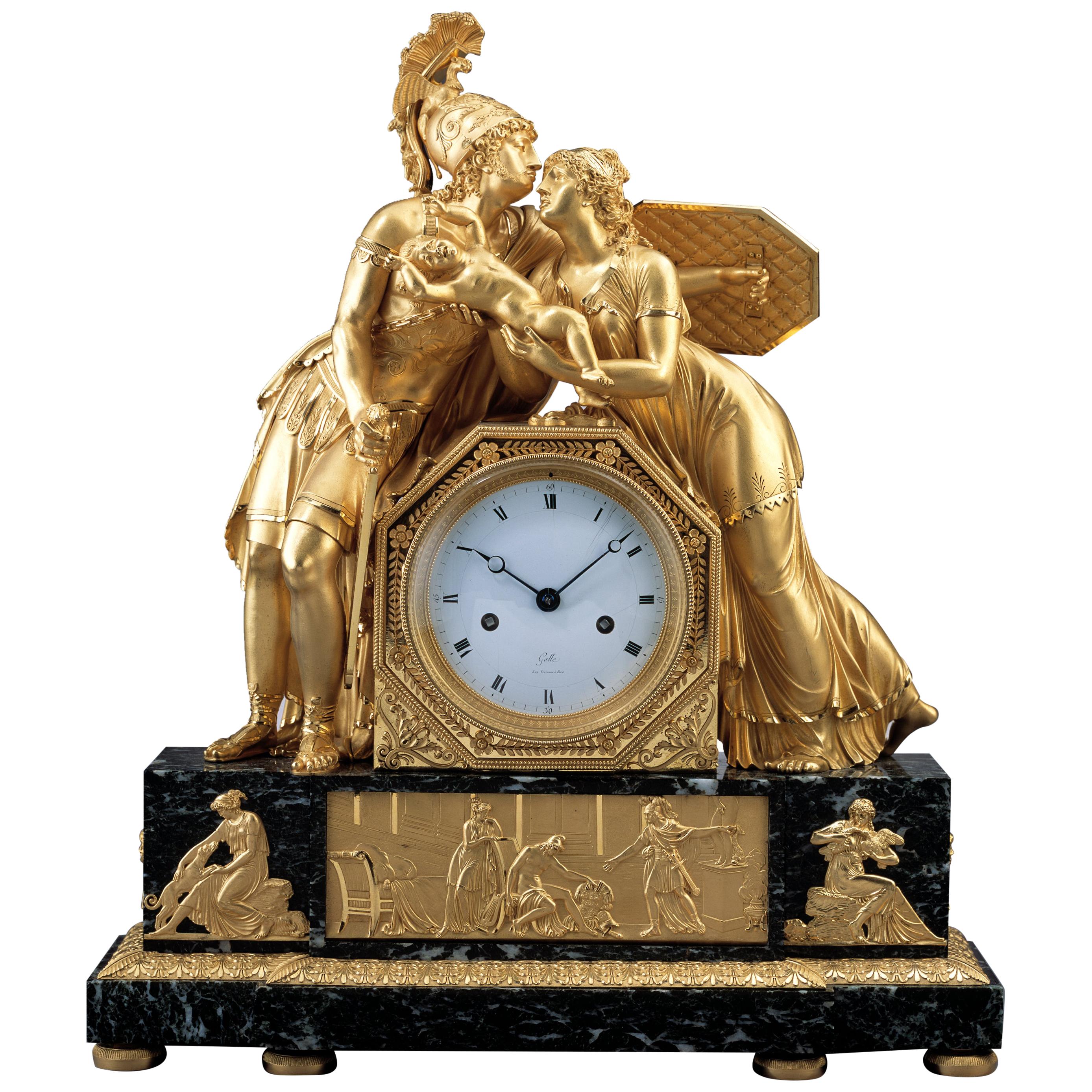
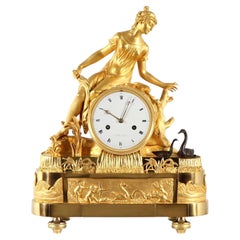
Early 19th Century Ormolu Mantel Clock, Atala freeing Chactas, Paris, circa 1810

$25,344.51
£18,785.53
€21,500VAT Included
CA$35,356.86
A$35,863.20
CHF 20,478.87
MX$434,315
NOK 241,086.40
SEK 240,286.27
DKK 163,928.32

About the Item

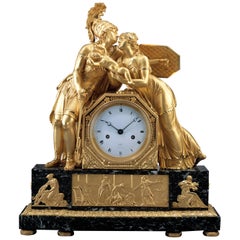
Mantel Clock "Atala and Chactas" Paris Bronze (fire-gilt and patinated), enamel Empire around 1810 Dimensions: H x W x D: 40 x 32 x 11 cm Description: Very rare and extremely high quality French mantel clock, so-called Pendule Au Bon Sauvage. Depicted are scenes from the love story "Atala or the love of two savages in the desert" written by Francois René Vicomte de Chateaubriand in 1801. At the beginning of the 19th century, this was probably the most famous love story in Europe, but today it has been forgotten. The story, set in present-day Louisiana (USA), is roughly rewritten about the forbidden love between Chactas, a young Indian, and Atala, the beautiful daughter of a Spaniard. Chactas is captured in a battle between two Indian tribes, chained to a palm tree and is to be sacrificed. Atala wants to save his life and convert him to Christianity. She unties him from the palm tree at night and they flee together into the wilderness of North America. Their love for each other grows stronger and stronger and they have prospects for a future together. The story takes a tragic turn when Atala, who must remain a virgin due to a vow made by her mother, can no longer withstand the conflict of her feelings and commits suicide. The main group of characters thus shows Chacta's liberation through Atala. Atala is leaning against a pile of logs. The animal fur thrown over the logs and the weapons leaning against the stack on the right give the impression of a night camp. The bronze is of rarely beautiful quality, finely chiselled and makes the scene appear very lively. The contrast of fire-gilded and patinated bronze adds tension to the composition. In the base we see the Entombment as the end of the tragic love story. This bronze work is also very detailed, the interplay of bright and matt gilding makes the flat relief appear much deeper than it is. The depiction of the mantel clock presented here shows that the exotic was only known from stories and that the bronzier had his own ideas about the appearance of this distant world. The Indian, for example, has very European facial features and his skin was not black in reality, of course. The palm tree was also certainly not found in the North American wilderness. The heart of the clock is a French pendulum movement, integrated into the wooden pile, with an eight-day power reserve and a lock plate striking a bell on the half and full hour. The pendulum is suspended on a thread, typical of the period. The classically shaped hands, so-called Breguet hands, are also typical of the time. The enamelled dial has black Roman hour numerals, Arabic quarter hours and bears the signature: Le Roy hr. de Madame A PARIS. Interesting facts: The period from 1795 to about 1815 saw the creation of probably the most spectacular group of bronzes: The "Au bon Sauvage" pendulums - depictions of the "Noble Savage". Today's viewers react to these objects with both fascination and irritation. Enthusiastic on the one hand about the obvious quality of the detailed bronzes and the allure of the exotic, on the other hand distanced and cautious because of the possible discrimination that is suspected behind them. The ambivalence of this feeling motivates the search for the conditions of origin of these pendulums. Europeans found their new ideal of the natural man primarily in fictional and realistic travelogues about the Indians of North America, the black Africans and the South Sea Islanders. Some of these works are still considered world literature today, think of Jonathan Swift's "Gulliver's Travels" (1726) or Daniel Defoe's "Robinson Crusoe" (1719). [Source: Elke Niehüser - The French Bronze Clock pp. 140-143] Condition: Beautiful and authentic and cleaned condition of the original fire gilding, so-called ormolu, with age-typical rubbing on the back of the clock. One of the feet is old-restored, was probably once broken off and has been reattached. The movement is completely cleaned, overhauled and runs perfectly. Recommended literature on this famous clock: Elke Niehüser - The French Bronze Clock p. 144 Heuer / Maurice - European Pendulum Clocks p. 79 Fig. 140.
  • Dimensions:
    Height: 15.75 in (40 cm)Width: 12.6 in (32 cm)Depth: 4.34 in (11 cm)
  • Style:
    Empire (Of the Period)
  • Materials and Techniques:
  • Place of Origin:
  • Period:
  • Date of Manufacture:
    1810
  • Condition:
    Repaired. Wear consistent with age and use. Authentic condition of the original fire gilding with age-typical rubbing on the back of the clock. One of the feet is restored, was probably once broken off and has been reattached. The movement is completely cleaned, overhauled and runs perfect.
  • Seller Location:
    Greven, DE
  • Reference Number:
    1stDibs: LU5419229715342

More From This Seller

View All
Early 19th Century Empire Ormolu Mantel Clock, La Lecture, Paris, c. 1813

Early 19th Century Empire Ormolu Mantel Clock, La Lecture, Paris, c. 1813

Located in Greven, DE

Pendule La Lieuse - The Reader Paris Bronze, marble, enamel Empire around 1813 Dimensions: H x W x D: 30 x 30 x 15 cm Description: The "La Lieuse" pendulum is probably the best-kn...

Category

Antique Early 19th Century French Empire Mantel Clocks

Materials

Enamel, Ormolu

Early 19th Century French Mantel Clock, signed Ferey au Havre, Ormolu

Early 19th Century French Mantel Clock, signed Ferey au Havre, Ormolu

Located in Greven, DE

Small mantel clock with bas-relief France Bronze, enamel early 19th century Dimensions: H x W x D: 33 x 19 x 9 cm Description: Antique, fire-gilt portal clock with figurative, Gre...

Category

Antique Early 19th Century French Empire Mantel Clocks

Materials

Bronze, Enamel, Ormolu

Early 19th Century French Mantel Clock - Allegory of Love, Paris circa 1815

Early 19th Century French Mantel Clock - Allegory of Love, Paris circa 1815

Located in Greven, DE

Antique French Mantel Clock - Allegory of Love Paris Ormolu circa 1815 Dimensions: H x W x D: 45 x 35 x 13 cm Description: Antique French mantel clock as an allegory of love. Set...

Category

Antique Early 19th Century French Empire Mantel Clocks

Materials

Enamel, Ormolu
Early 19th Century Ormolu Mantel Clock "Portefaix", Paris, circa 1810

Early 19th Century Ormolu Mantel Clock "Portefaix", Paris, circa 1810

Located in Greven, DE

Pendule Portefaix Paris Bronze, enamel Empire around 1810 Dimensions: H x W x D: 36 x 28 x 11 cm Description: Beautiful, fire-gilded and patinated bronze pendule from the early 19...

Category

Antique Early 19th Century French Empire Mantel Clocks

Materials

Ormolu

19th Century French Louis XVI Style "Astronomy" Mantel Clock, circa 1845

19th Century French Louis XVI Style "Astronomy" Mantel Clock, circa 1845

By Perrelet

Located in Greven, DE

French mantel clock "Astronomy" Paris Bronze, marble Mid 19th century Dimensions: H x W x D: 38 x 55 x 16 cm Description: A Louis XVI-style figural mantel clock mounted on a two-t...

Category

Antique 1840s French Louis XVI Mantel Clocks

Materials

Marble, Bronze

Empire Mantel Clock - La Bibliotheque, Ormolu, France, Paris, circa 1820

Empire Mantel Clock - La Bibliotheque, Ormolu, France, Paris, circa 1820

By Le Roi

Located in Greven, DE

Mantel Clock - La Bibliotheque - In the study room Paris fire-gilt bronze, enamel Empire around 1820 Dimensions: H x W x D: 38 x 28 x 19 cm Description: Scenery mounted on an oval...

Category

Antique Early 19th Century French Empire Mantel Clocks

Materials

Bronze

You May Also Like

Ormolu Mantel Clock, Belgium, circa 1810-1820

Ormolu Mantel Clock, Belgium, circa 1810-1820

Located in Belmont, MA

Empire ormolu mantel clock, Belgium, circa 1810, Signed "J.B. Romaet a Gand". Decorated with a shepherd scene. Strikes the hour and half hour on a bell. With enamel clock face and si...

Category

Antique 1810s Belgian Empire Mantel Clocks

Materials

Ormolu

French 19th Century Louis XVI St. Ormolu Mantel Clock

French 19th Century Louis XVI St. Ormolu Mantel Clock

Located in West Palm Beach, FL

A spectacular and unique French early 19th century Louis XVI st. ormolu mantel clock, signed by Chapsal a Paris. The clock is raised on finely chased swan supports below a rectangula...

Category

Antique 19th Century French Louis XVI Mantel Clocks

Materials

Ormolu

Empire Period Ormolu Mantel Clock by Le Roy et fils

Empire Period Ormolu Mantel Clock by Le Roy et fils

By Le Roy

Located in London, GB

Empire period ormolu mantel clock by Le Roy et fils French, c. 1810 Height 36cm, width 37cm, depth 14cm This refined mantel clock was created during the Empire period by the esteem...

Category

Antique Early 19th Century French Empire Mantel Clocks

Materials

Ormolu, Enamel

French 19th Century Louis XVI St. Belle Époque Period Ormolu Clock

French 19th Century Louis XVI St. Belle Époque Period Ormolu Clock

Located in West Palm Beach, FL

An exquisite French 19th century Louis XVI st. Belle Époque period ormolu clock. The clock is raised by elegant block feet with fine fluted and les oves designs. Impressive mirrored ...

Category

Antique 19th Century French Belle Époque Mantel Clocks

Materials

Ormolu

Fine 19th century French ormolu mantel clock (pendule) by Leroy a Paris, c. 1825

Fine 19th century French ormolu mantel clock (pendule) by Leroy a Paris, c. 1825

By LeRoy

Located in Oxfordshire, United Kingdom

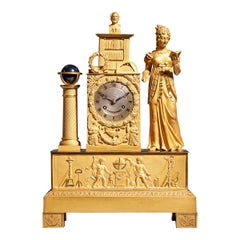
A most beautiful French ornolu mantel clock by Leroy à Paris A lovely French late Empire/early Charles X mantel clock with an ormolu case, c. 1825. The ormolu brass case depicts a celebration of Science and Learning. It is dominated by a rectangular superstructure containing the movement, flanked by an engine-turned column with a celestial globe on top on the left and an elegant lady reading a book on the right. The superstructure is surmounted by a bookcase and a bust of Socrates...

Category

Antique Early 19th Century French Empire Mantel Clocks

Materials

Brass, Ormolu

French Early 19th Century Empire Gilt Bronze Mantel Clock by Claude Galle

French Early 19th Century Empire Gilt Bronze Mantel Clock by Claude Galle

By Claude Galle

Located in Worpswede / Bremen, DE

Claude Galle, (1759–1815, master in 1786) is one of the most renowned bronziers active during the Napoleonic period, such as Pierre-Philippe Thomire, André-Antoine Ravrio and Louis-S...

Category

Antique Early 1800s French Empire Mantel Clocks

Materials

Marble, Bronze