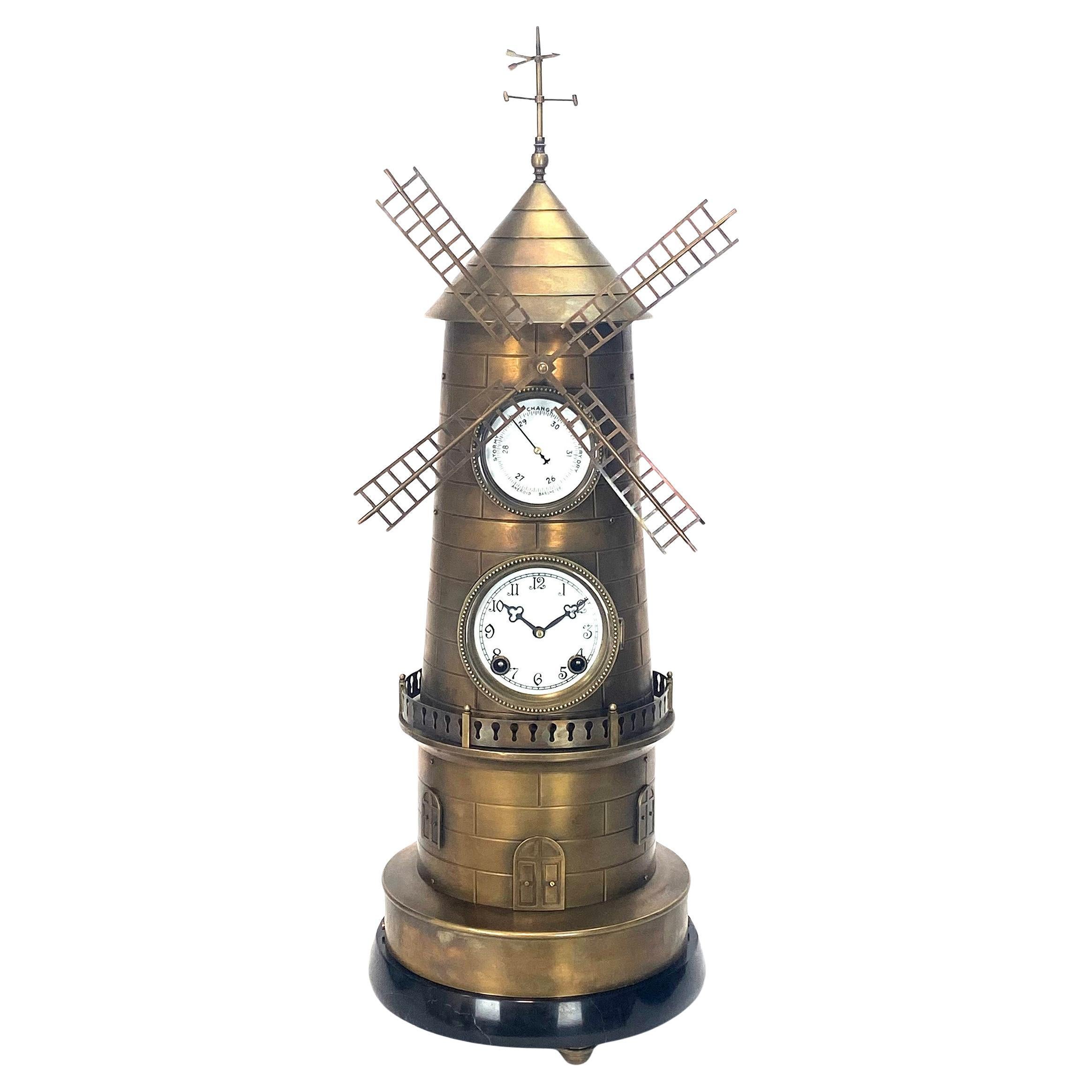
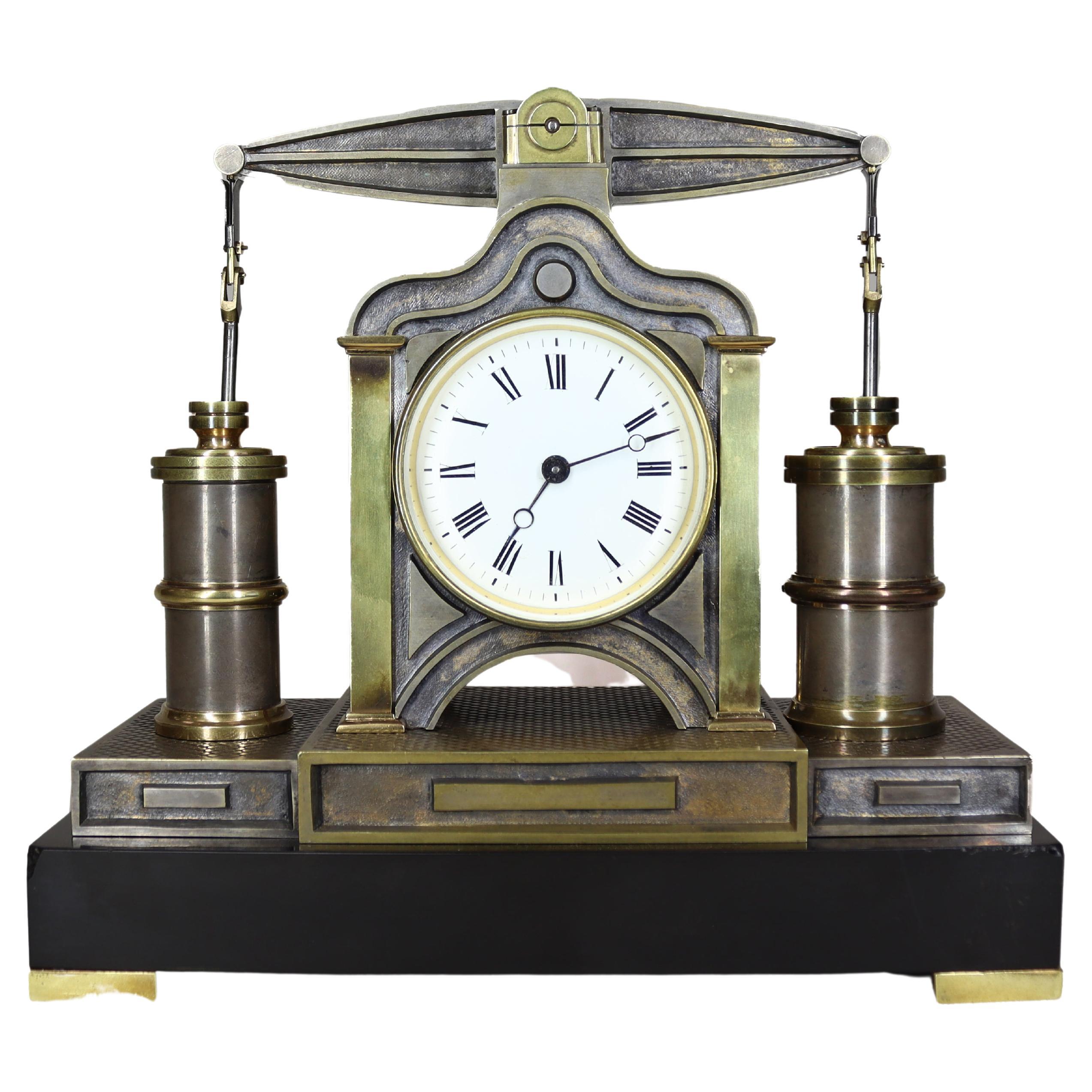
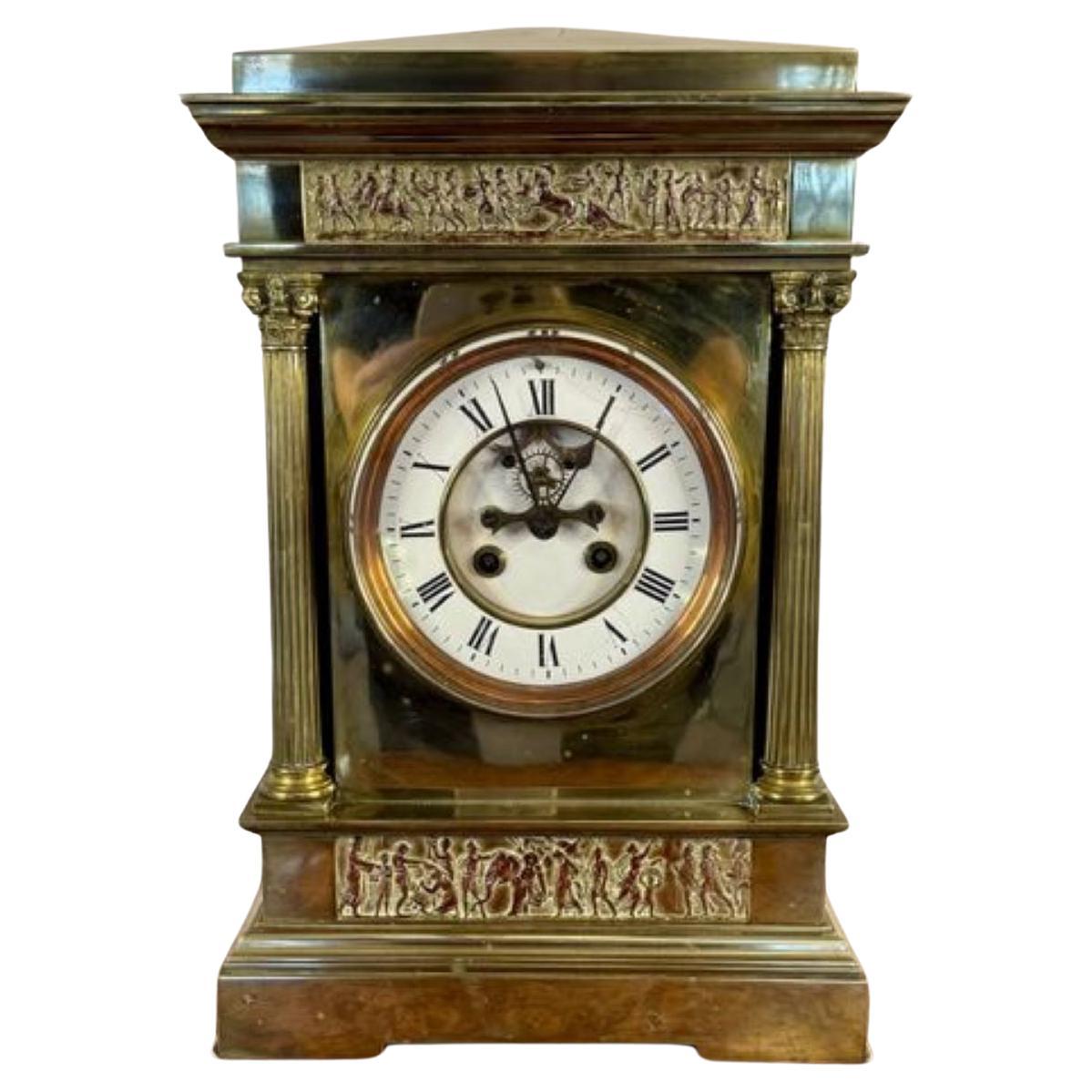
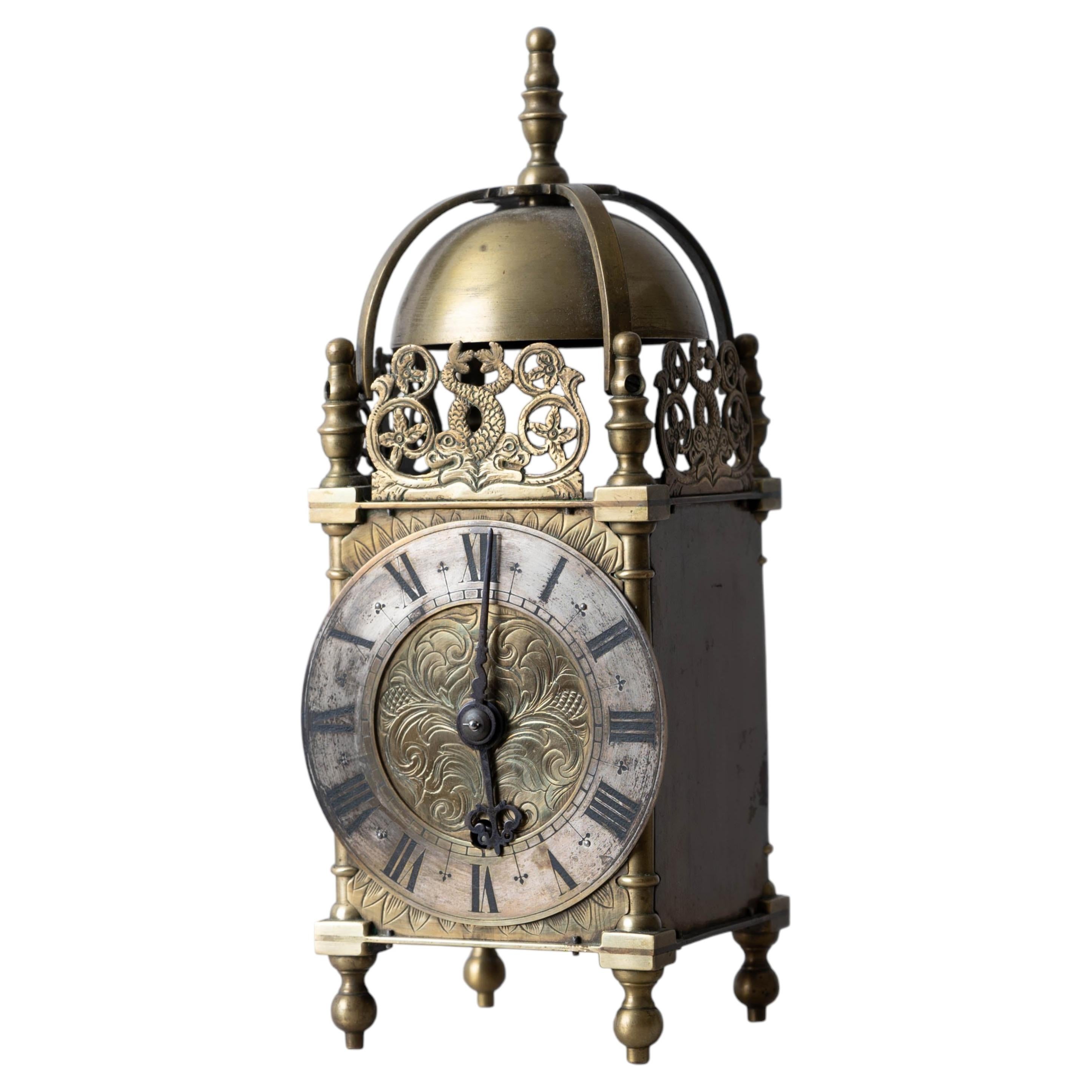
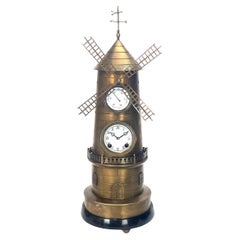
A superb and highly decorative French automaton lighthouse clock and weather compendium by André Romain Guilmet of Paris, circa 1880, from his celebrated series of Industrial novelty clocks.
Modelled as a late 19th-century lighthouse, the substantial case is constructed principally in gilt and silvered metal, the tapering tower finely engraved with simulated masonry and applied window and doorway details. Above is the cylindrical lantern room, surrounded by an elaborate pierced and fretted gallery and surmounted by a domed roof with decorative ribs and a charming arrow-form weather vane.
The lantern room incorporates four instruments. To the front is an eight-day clock, with silvered Roman numeral chapter ring, gilt centre and blued steel hands. Directly opposite is an aneroid barometer, its silvered dial calibrated from 27 to 31 inches and marked with the traditional indications Stormy, Much Rain, Rain, Change, Fair, Set Fair and Very Dry. Between these are two thermometers, calibrated respectively in Fahrenheit and Centigrade/Réaumur.
The great mechanical feature of the piece is the automaton revolving lantern room. Driven by a separate clockwork mechanism concealed within the base of the lighthouse, the entire upper section slowly rotates through 360 degrees, successively bringing the clock, thermometers and barometer into view and wonderfully recreating the revolving action of a lighthouse lantern.
André Romain Guilmet was one of the most inventive French clockmakers of the second half of the 19th century and is particularly celebrated for his ingenious novelty, mystery and Industrial Series clocks. Produced principally during the final quarter of the 19th century, these imaginative designs celebrated the technological and engineering achievements of the Industrial Age, with models taking the forms of locomotives, steam engines, ships, lighthouses and other machinery.
The lighthouse is among the most recognisable and desirable of Guilmet's Industrial designs, combining horology, meteorological instruments and automaton movement within an exceptionally architectural case.
French, circa 1880.
Literature: Comparable Guilmet Industrial clocks and lighthouse automata are illustrated and discussed in Derek Roberts, Mystery, Novelty & Fantasy Clocks, in the section devoted to Guilmet's Industrial Series.