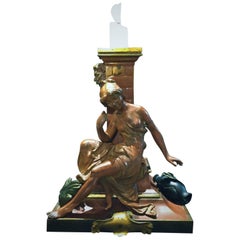
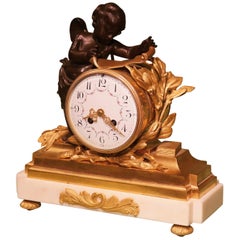
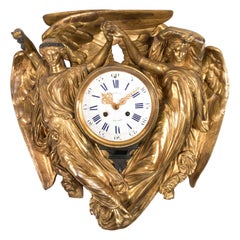
"L'amour Non Partagé" or "Unrequited Love", an allegorical timepiece by Max Blondat. The base of the clock is stamped with the artist name "Max Blondat", and carries a Valsuani foundry stamp with “CIRE at the top "PERDUE" at bottom (Cire Perdue is French for lost wax casting), as well as copyright symbol and date "02.1914".
It is rare to find a stunning work of art of museum quality and craftsmanship, such as this beautiful and important bronze sculptural timepiece. Like all Max Blondat's sculptural compositions, this one also features the originality and allegory of a specific theme. In this particular case, it is unrequited love. The body of the clock is in the form of a luscious three-dimensional heart embroidered with flowers. In the center of the front part a clockwork with porcelain face and enameled hour hands are mounted. There are several feathers of arrows piercing the bronze frame dial by the upper part of the perimeter, indicating the repeated unsuccessful attempts of the stubborn lover to succeed in this field with his impregnable vis-à-vis, who does not at all want to respond to loving appeals with reciprocity. In the foreground, a charming chubby Cupid bent down in thought and apparent helplessness. Having lost all hope and lowering his bow, he holds in his hand a broken arrow, the second fragment of which is lying under his feet. And, while he is frozen in thought, time passes and the clock is ticking! Naturally, the observer has a question: "And how, in fact, does this sad unrequited love story end? Will Cupid achieve desired reciprocity over time and, showing constant perseverance, break inaccessibility?" Looking at the cover in the form of several crossed arrows, defending the clockwork at the back of the clock very reliably, the answer to this question arises by itself - and, this answer is "No!”
Maximilian Blondat (1872-1926), or Max Blondat was a French sculptor of Art Nouveau and Art Deco styles. One of his most famous sculptures is the Fountain of Youth, representing three children watching three frogs. Copies are at the Place Darcy in Fontainebleau; Düsseldorf, Germany; Buenos Aires, Argentina; Ukraine, Odessa; Zurich, Switzerland, and the United States in Denver. He was the son of a copper worker and was apprenticed to an ornamentalist sculptor in 1886. Blondat continued over the sculpture work in many areas and different materials. He arrived in Paris and began his studies in 1889 at the Ecole Germain Pilon. In 1890, he exhibited at the Salon of French artists for the first time and presented a plaster medallion, then perfected in the workshop of Mathurin Moreau . In 1892 , he entered the École des Beaux-Arts in Paris. During that period, Max Blondat signed his first achievements using the maternal family name Henry . His works can be found in wood, stone, clay, glass, bronze, and he excelled in the decorative arts with the reduction of his sculptures and the creation of small utilitarian objects: car radiator caps, knockers, clocks, pockets, ashtrays etc. He also produced ceramics with Edmond Lachenal AT the Sèvres manufactory, and worked extensively with wrought iron with Edgar Brandt . His bronzes had been cast by the Siot-Decauville and Valsuani foundries . Blondat also created jewelry for Chambon and Hermes . In 1906, he became a founding member of the Society of French Decorative Arts . Part of his work is on display at the Museum of the 1930's in Boulogne-Billancourt . One of his most famous creations is the Fountain of Youth, representing three children observing three frogs. The exact copies of the fountain can be seen in Dijon Darcy, Fontainebleau, as well as in Dusseldorf , Germany; Buenos Aires, Argentina; Odessa, Ukraine; Zurich, Switzerland; Zurich, Switzerland; and Denver, United States. Engaged in the service of camouflage (the Chameleon) which he left in 1917 for becoming a head of the École des Beaux-Arts in Dijon, where he served until 1919. He then got carried away by creation of the WWI memorials. Maximilian Blondat was decorated with the Cross of War (WWI, 1914-1918) and made an officer of the Legion of Honour in 1925. He lived in the neighborhood of the Parc des Princes in Boulogne-Billancourt, a city which gave his name to one of its streets. A street in another small French town of Auxerre bears his name, as well.
Valsuani Foundry (1899 – circa 1977) was started by the Italian brothers Claude and Attilio Valsuani who learned the foundry trade while employed at the famous Hébrard art foundry. While working for Hébrard, Claude Valsuani showed great promise as a finisher and eventually worked his way up to become the Technical Director of the Hébrard foundry. In 1899 Claude Valsuani started his own foundry in Châtillon, casting mostly small works for various artists primarily using the lost wax technique of casting (cire perdue). In 1905 he moved his foundry to 74, rue des Plantes in Paris. Among the better known sculptors who had the Valsuani foundry cast their works were: Degas, Rodin, Renoir, Gauguin, Maillol, Picasso, Modigliani, Matisse, Giacometti, Brancusi. Ossip Zadkine also used this foundry for the casting of his sculptures. Thus, the Valsuani foundry quickly acquired a great reputation, particularly for its outstanding mastery of lost wax casting. Claude Valsuani was also celebrated for the beautiful patinas he created with a blowtorch, a technique imported from Italy which, as he said, did not leave any deposit of carbon and gave the sculptures a beautiful glossy aspect. One of the foundry’s most famous patinas until now is called the Noir de Valsuani (Valsuani black). Last but not least, Claude Valsuani was among the first casters to fight against counterfeiting and unauthorized editions by marking each sculpture with the total number of casts in a series, as part of his numerical notation (eg. 1/10). Claude Valsuani died in 1923 in his native Italy, but his son, Marcel took over the running of the foundry and continued to produce extremely fine detailed bronzes until the 1970s.