Want more images or videos?
Request additional images or videos from the seller
1 of 11

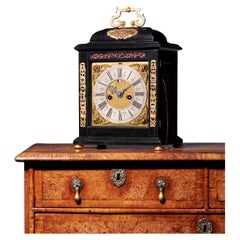
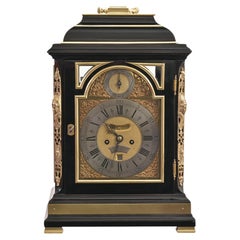
17th Century Hague Clock Signed by Pieter Visbagh, circa 1675

$82,349.38
£60,000
€71,375.58
CA$115,876.45
A$116,825.85
CHF 66,522.08
MX$1,420,067.28
NOK 785,261.04
SEK 783,006.72
DKK 533,524.09

About the Item

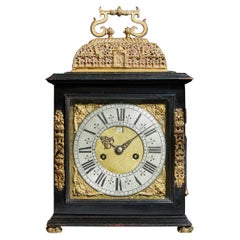
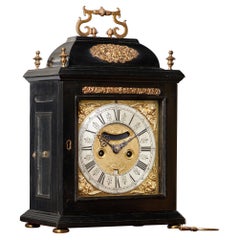
Unusually small Hague clock made c. 1675 by Pieter Visbagh, who was apprenticed by Salomon Coster. The latter made the first pendulum clock according to the instructions of Christiaan Huygens, the internationally renowned scientist who developed the idea of applying a pendulum to a clock movement. The delicate ebony-veneered case has a moulded broken arch pediment, whilst the door is flanked by plain half round Doric capital-capped columns on high bases. A traditional star adorns the internal face of the case surrounded by well-chosen cuts of olive in a parquetry fashion. This design of star was also popular in England around this time and was almost certainly introduce by the Huguenots. The two-day movement is driven by a compact single barrel. The going train has its original verge escapement with a silk suspended pendulum between cycloidal cheeks, also a design by Huygens to improve the trajectory of the pendulum bob. The sides of the backcock are richly pierced and engraved. The striking train is regulated by an external pierced countwheel with a blued steel backing on the backplate to create a lovely contrast; the last hour struck is indicated by Arabic numerals. The striking, which has elaborately pierced striking gates, sounds the hours on a bell inside the case, which has a sound fret in the bottom. The backplate is signed at the bottom by the maker: Pieter Visbagh Fecit Haghe. The velvet-covered brass dial is hinged on the left hand side, giving access to the movement, which has an almost bronze-like patina caused by age. It has a fine skeletonised gilt-brass Roman chaptering with half hour and Arabic minute divisions. The time is indicated by a fine pair of original gilt brass hands, the hour hand delicately pierced. Below is a shaped and chased signature cartouche, consisting of a crowned coat of arms held by two putti. It bears the maker’s name: P. Visbag Haghe. It is hinged at the top and upon lifting a rectangular hole is revealed through which the pendulum can be activated. Dimensions: height 35 cm; width: 24 cm; depth: 13 cm
  • Creator:
    A. Petersen & Co. (Clockmaker)
  • Dimensions:
    Height: 13.78 in (35 cm)Width: 9.45 in (24 cm)Depth: 5.12 in (13 cm)
  • Style:
    Baroque (Of the Period)
  • Materials and Techniques:
    Ebony,Olive,Parquetry,Veneer
  • Place of Origin:
  • Period:
  • Date of Manufacture:
    1675
  • Condition:
    Wear consistent with age and use.
  • Seller Location:
    Oxfordshire, GB
  • Reference Number:
    1stDibs: LU4936216414211

More From This Seller

View All
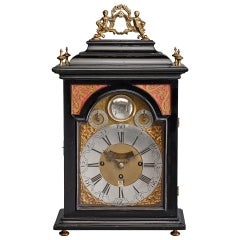
17th Century English eight-day spring-driven table clock, by John Wrench

17th Century English eight-day spring-driven table clock, by John Wrench

Located in Oxfordshire, United Kingdom

A Rare Late 17th Century English Basket-Top Spring Clock by John Wrench of Chester, Circa 1695-1700. England This exquisite late 17th-century English basket-top table clock, signed ...

Category

Antique 17th Century English William and Mary Table Clocks and Desk Clocks

Materials

Brass

A 17th Century William and Mary eight-day table clock by Johnathan Lowndes, 1695

A 17th Century William and Mary eight-day table clock by Johnathan Lowndes, 1695

Located in Oxfordshire, United Kingdom

A very attractive William and Mary eight-day spring-driven table clock, signed on the backplate Jonathan Lowndes, Pall Mall, À Londres, circa 1690–95. The well-proportioned ebony-ve...

Category

Antique 17th Century English William and Mary Table Clocks and Desk Clocks

Materials

Brass

A rare 17th century English eight-day spring-driven table clock by J Gerrard

A rare 17th century English eight-day spring-driven table clock by J Gerrard

Located in Oxfordshire, United Kingdom

A Rare Late 17th Century English Eight-Day Spring-Driven Table Clock, Circa 1700. England Signed J. Gerrard. This exceptional late 17th-century English eight-day table clock is a s...

Category

Antique 17th Century English William and Mary Table Clocks and Desk Clocks

Materials

Brass

18th Century George III Figured Mahogany Three Pad Stricking Bracket Clock

18th Century George III Figured Mahogany Three Pad Stricking Bracket Clock

Located in Oxfordshire, United Kingdom

18th century George III figured mahogany three pad bracket clock by John Wright Dorking, Circa 1780. England A most attractive English bracket clock, made around 1780, signed on ...

Category

Antique 18th Century English George III Table Clocks and Desk Clocks

Materials

Brass

A 17th Century William and Mary eight-day table clock by Isaac Lowndes, 1695

A 17th Century William and Mary eight-day table clock by Isaac Lowndes, 1695

Located in Oxfordshire, United Kingdom

A fine William and Mary eight-day spring-driven table clock signed on the backplate, Isaac Lowndes Pallmall Court, c.1695. The elegantly proportioned ebony-veneered oak domed top c...

Category

Antique 17th Century English William and Mary Table Clocks and Desk Clocks

Materials

Brass

You May Also Like

Austrian 18th Century Baroque Period Bracket Clock, Signed Andreas Hohenadl

Austrian 18th Century Baroque Period Bracket Clock, Signed Andreas Hohenadl

Located in Worpswede / Bremen, DE

An attractive Austrian mid-18th century Baroque period quarter-striking bracket clock by the maker Andreas Hohenadl (1714-1793), Vienna. The ebonised fruitwood case with figurative b...

Category

Antique Mid-18th Century Austrian Baroque Clocks

Materials

Brass

Rare 18th Century English Clock

Rare 18th Century English Clock

Located in Madrid, ES

Rare 18th century English clock Marquetry Weight: 9.20 kg England Sizes: H 62cm L 31cm very good condition.

Category

Antique 18th Century English British Colonial Table Clocks and Desk Clocks

Materials

Bronze

Bracket Clock John F.R.S. Ellicott, London early 18th Century

Bracket Clock John F.R.S. Ellicott, London early 18th Century

By John Ellicott II

Located in Münster, DE

Bracket Clock John F.R.S. Ellicott, London (1706–1791) Early 18th century, 8-day movement, striking on 2 bells, 4-note chime/repeater mechanism, date display, brass dial, origi...

Category

Antique Early 18th Century English Baroque Table Clocks and Desk Clocks

Materials

Bronze, Brass

Baroque Wall Clock in a Biedermeier Case, 18th/19th Century

Baroque Wall Clock in a Biedermeier Case, 18th/19th Century

Located in Greding, DE

A "marriage" combining a Baroque bronze wall clock with a Biedermeier case in the form of a temple. The case, crafted from birch, merges the ornate design of the Baroque period with ...

Category

Antique 19th Century European Biedermeier Wall Clocks

Materials

Bronze

18th Century Antique Mahogany Bracket Clock by Charles Blanchard of London

18th Century Antique Mahogany Bracket Clock by Charles Blanchard of London

Located in Devon, GB

A fine antique George II period mellowed mahogany striking bracket clock, the arched brass dial and verge movement both signed Charles Blanchard, London. The clock is standing on block feet, has glazed sides and an inverted bell top with a brass carrying handle. Literature: Charles Blanchard: 1688-1768 recorded in Baillie 'Watch and Clockmakers of the World, page 29.

Category

Antique 18th Century English George II Mantel Clocks

Materials

Brass