Provenance
Private collection, France.
Documents:
- Attached is thermoluminescence test.
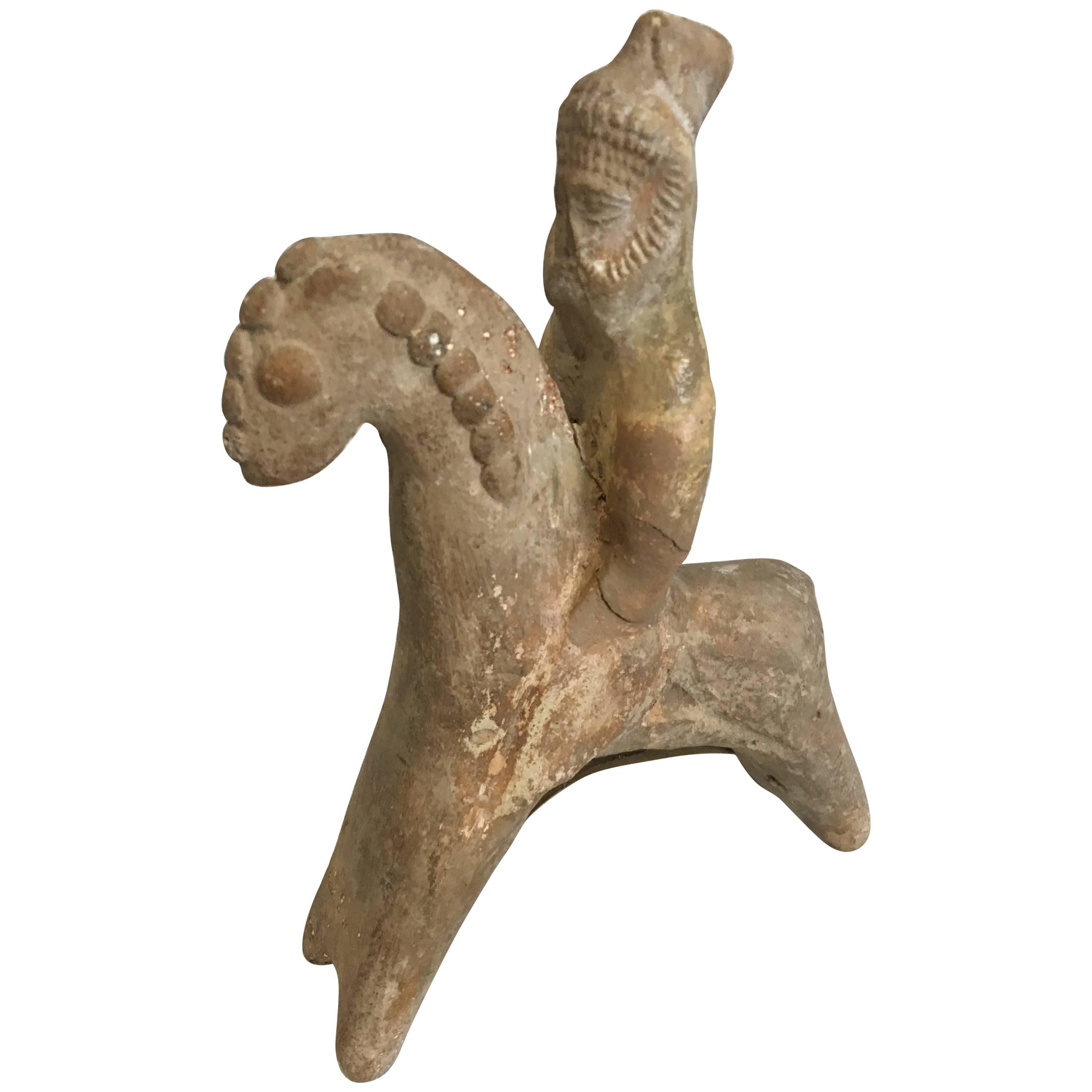
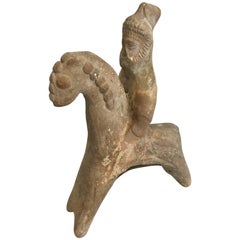
Figure representing Eros riding a goat. He has wings on his back. He is leaning slightly forward, with a flowing mane and his head facing forward. The animal also has its head tilted slightly downward with its left front leg flexed.
Eros was one of the primordial gods of ancient Greece. He was responsible for sexual attraction and love. He was venerated as a god of fertility. In some myths, he was the son of Aphrodite and Ares, but according to Plato's Symposium, he was conceived by Poros (abundance) and Penia (poverty) on Aphrodite's birthday. This explained the different aspects of love.
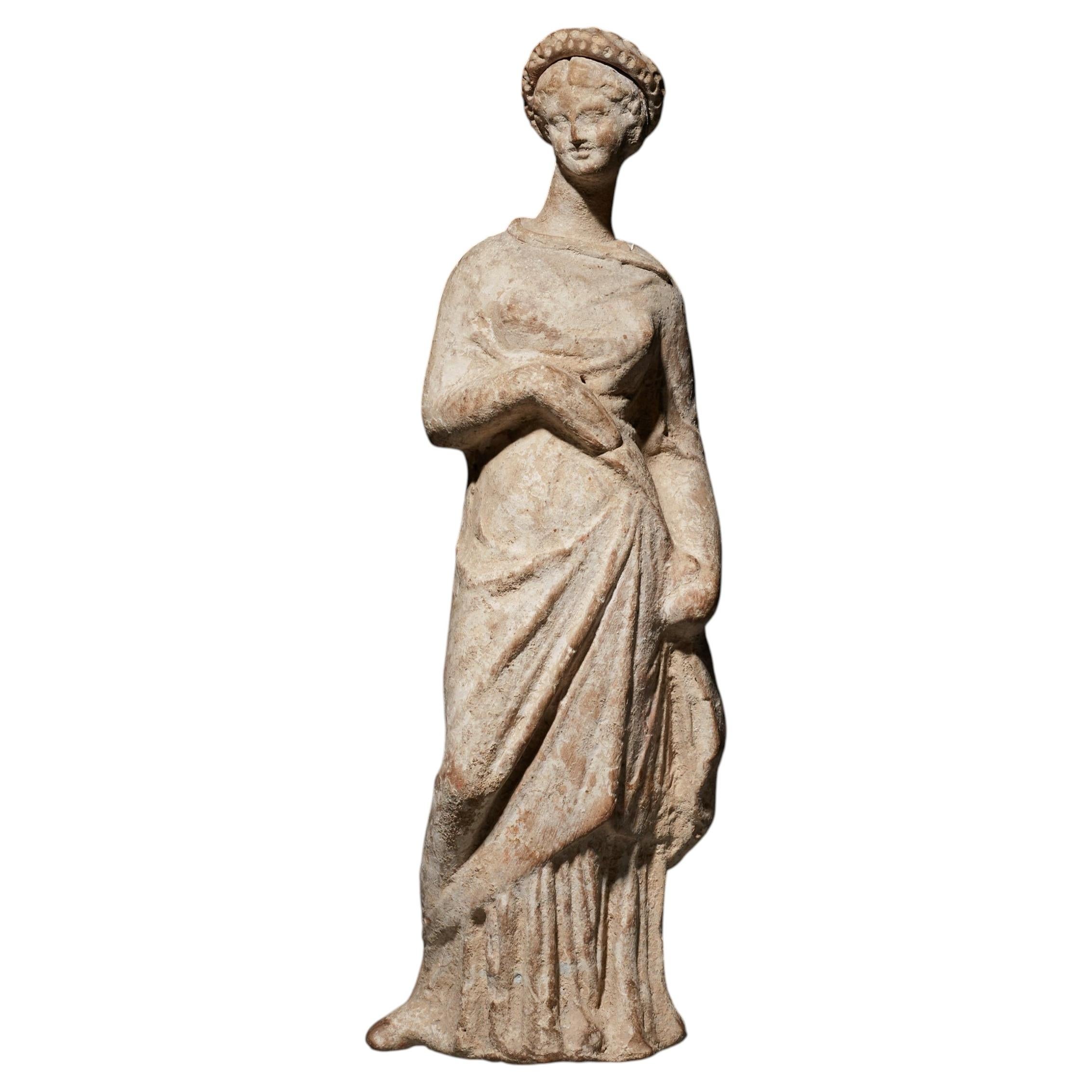
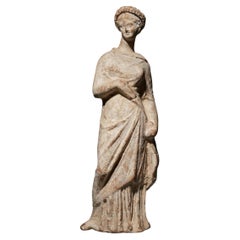
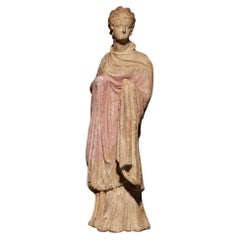
At the end of the 4th century BC, a style in the art of clay modeling developed called the "Tanagra style," named after the city of Tanagra, a center of terracotta production. This term refers to a female figure, usually standing, wearing a chiton with many folds and a long drape, over which a fine, flowing mantle is draped. These women also often wear shoes, carry fans, and wide-brimmed, pointed hats. They rarely carry other attributes and instead have their arms and hands wrapped in the cloak, which may also cover the head and even almost completely conceal the face.
In these figures, the classical composition of the body, in which a distinction was made between the supporting and free legs, disappears, and they are designed to be viewed from the front. One leg is positioned slightly to one side, either behind or in front. The body thus acquires a swaying motion, which is further visually accentuated by the tilt or elevation of the head, or by a turn to the left or right. The arms no longer hang rigidly at the sides of the body, as in the Archaic or Classical periods, but rest on the abdomen, chest, or back, or are supported at the hip.
The women's faces are marked by melancholy or introverted meditation, and a smile is rarely seen. The updo with a center part and a bun at the back, called the "melon hairstyle," is the most common style depicted on these terracotta figurines.
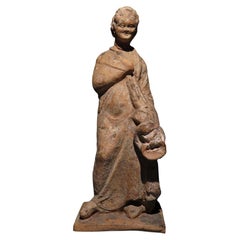
Along with the standing woman as the main motif of Tanagra coroplastic art, seated or crouching women, standing or seated children or youths, and entire groups of people are other frequently represented subjects. Often, there are figures carrying masks or musical instruments, grotesque characters, or actors. With the exception of Aphrodite and Eros, gods are rather infrequent.
While the Tanagra productions gained fame, this style spread throughout the Greek world, appearing in sites such as Corinth, Alexandria, Cyprus, Sicily, and in Middle and Upper Italy. The Tanagra workshops ceased production around 200 BC; others continued working in this style until the 1st century AD.