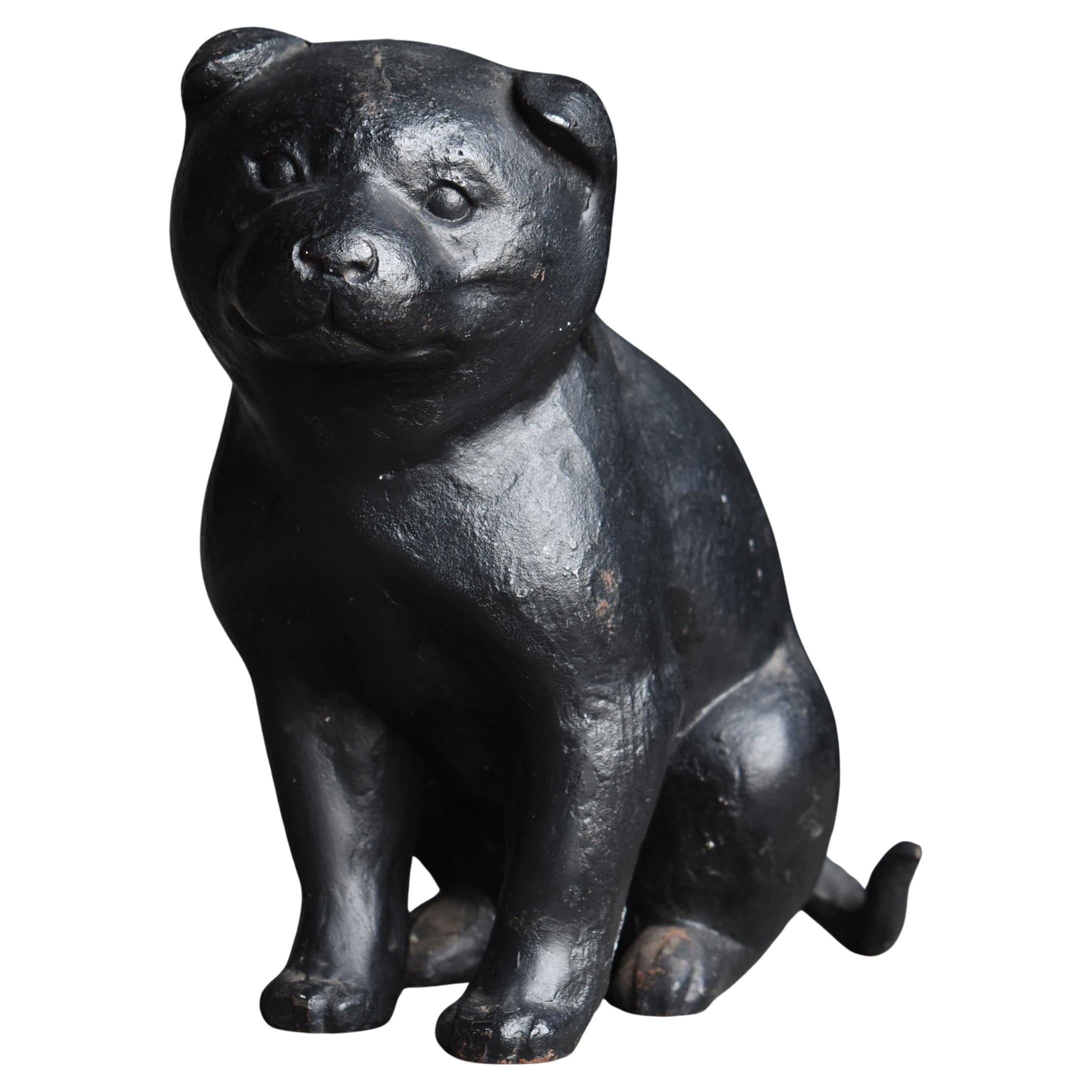
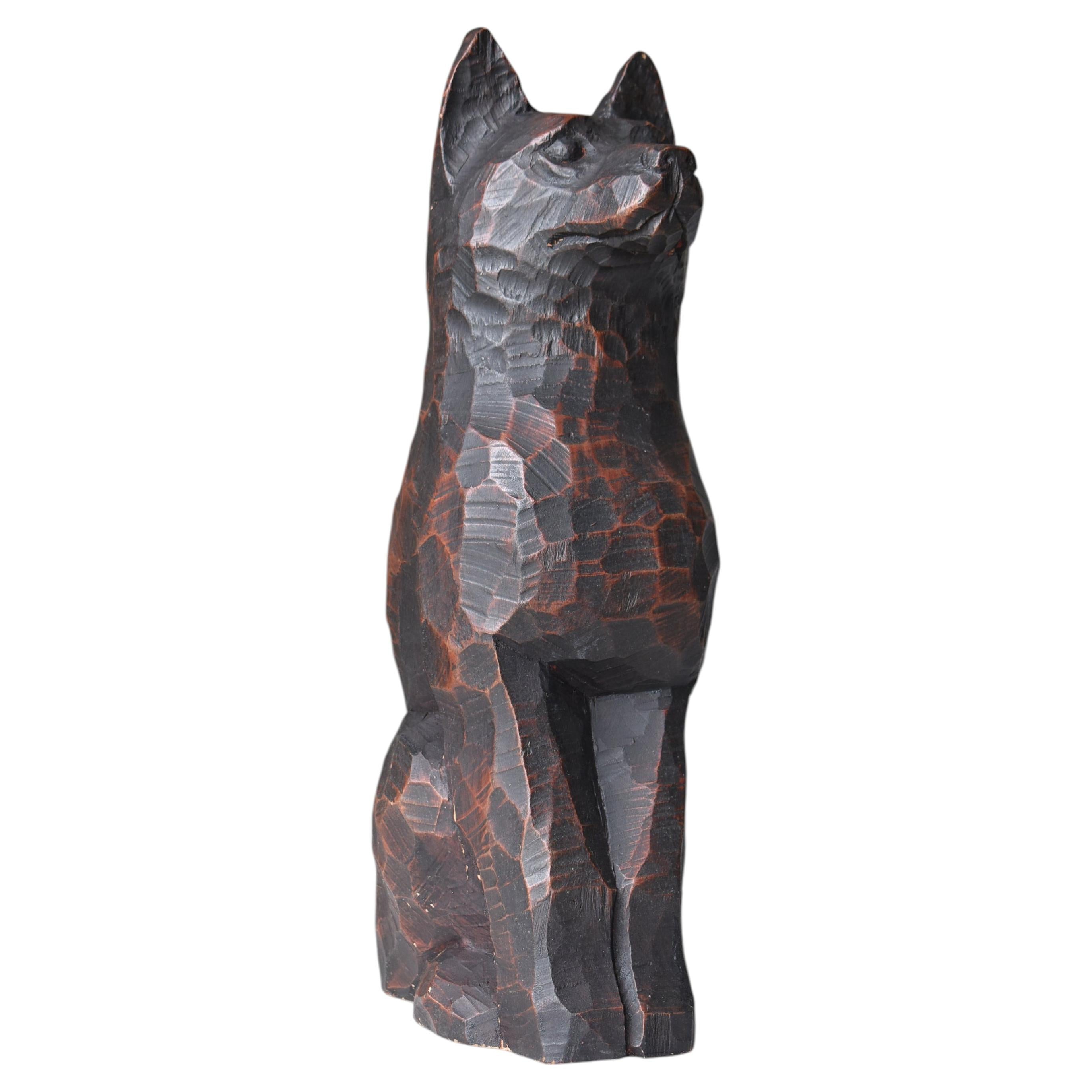
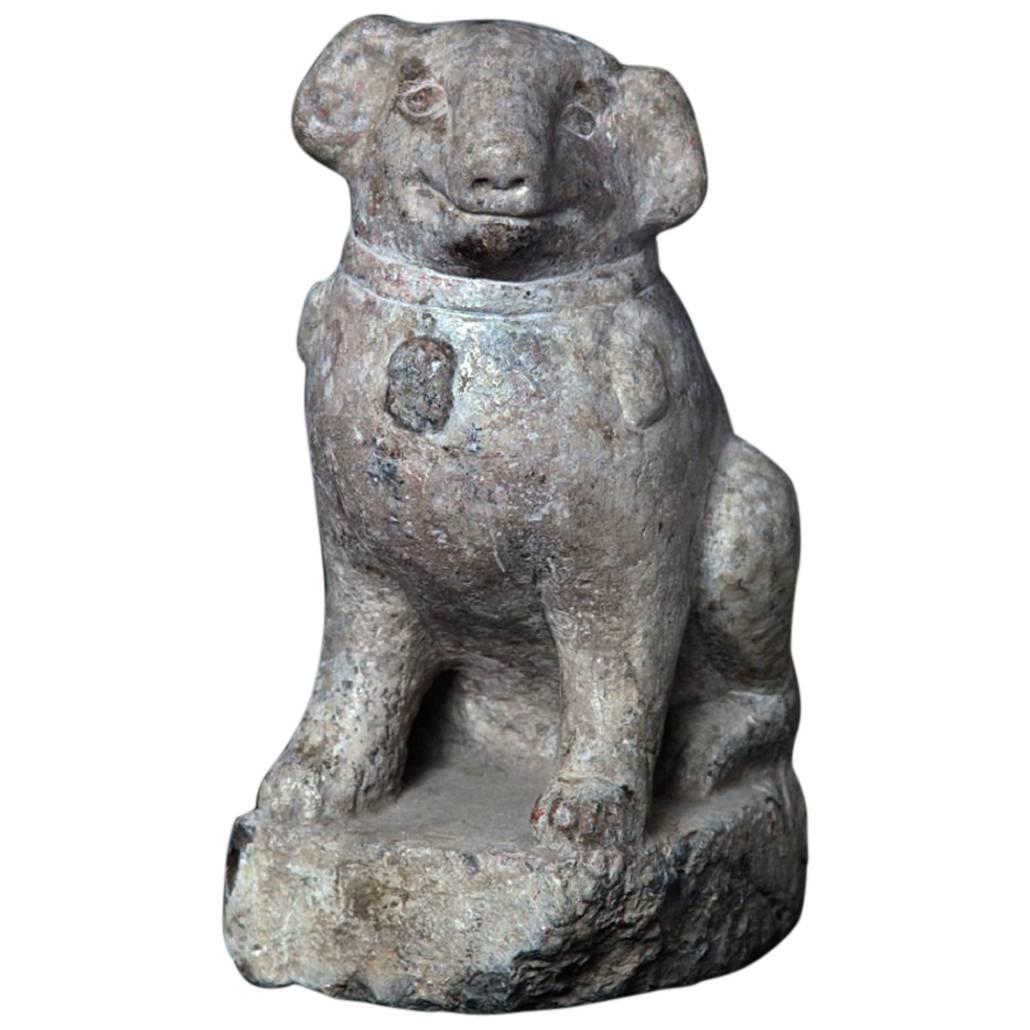
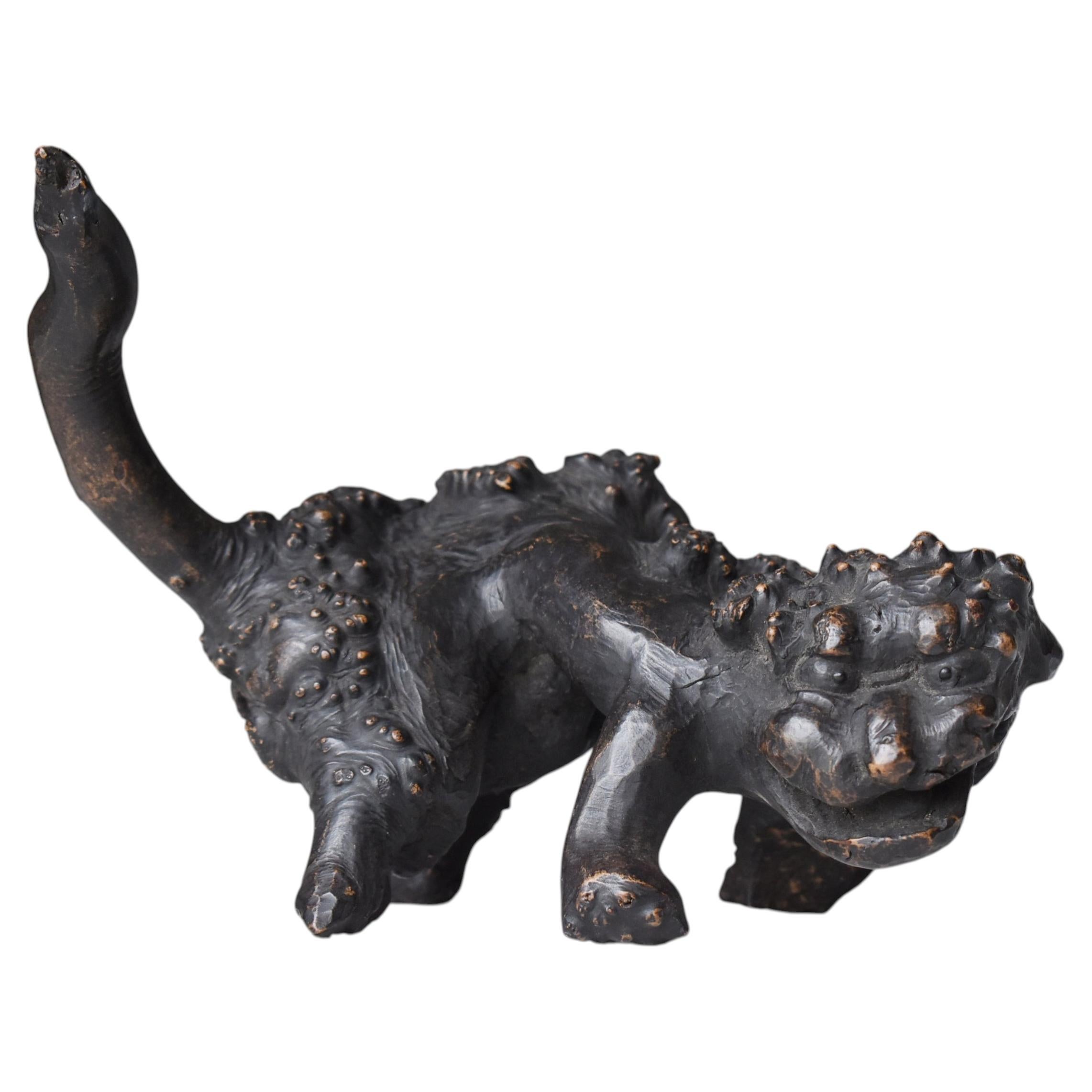
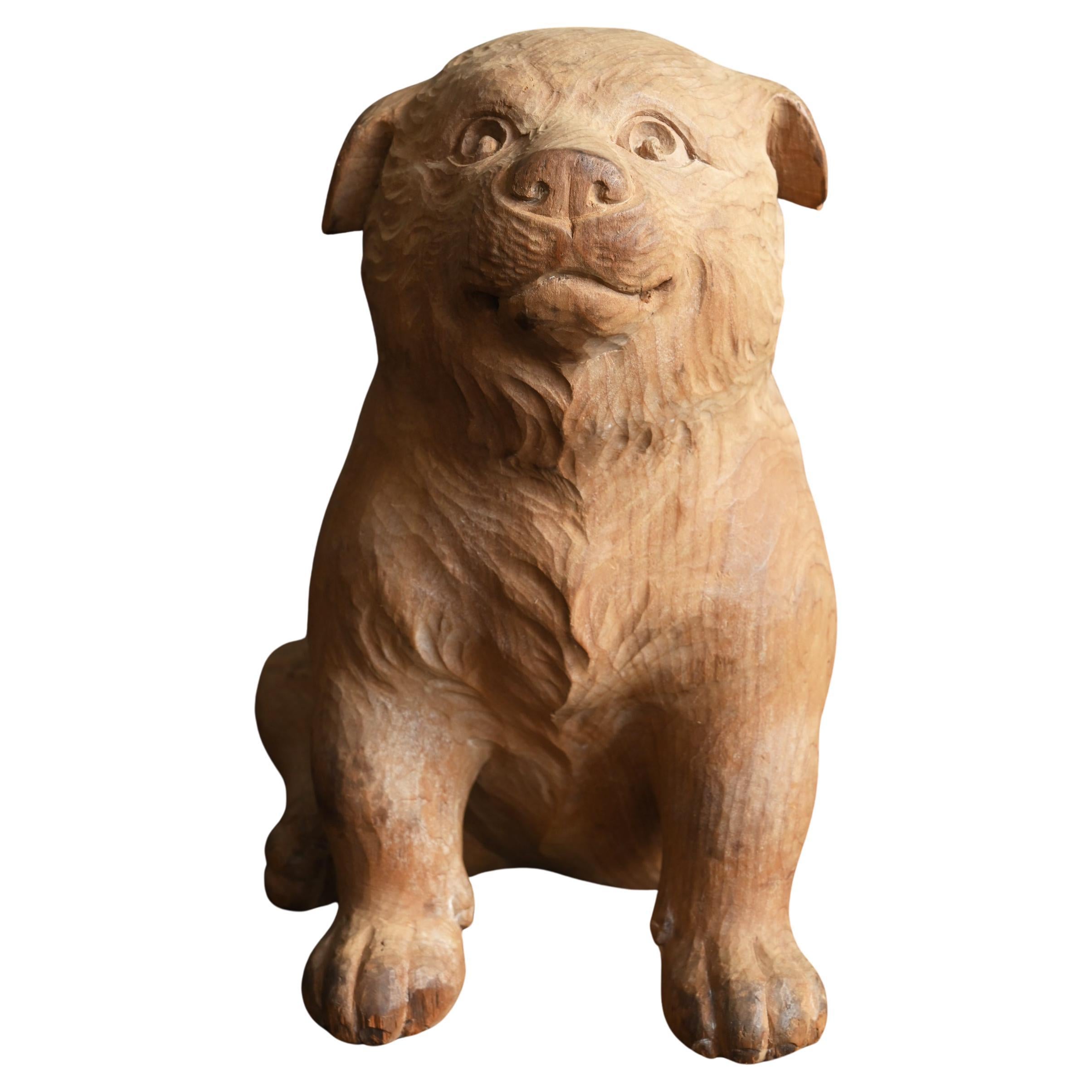
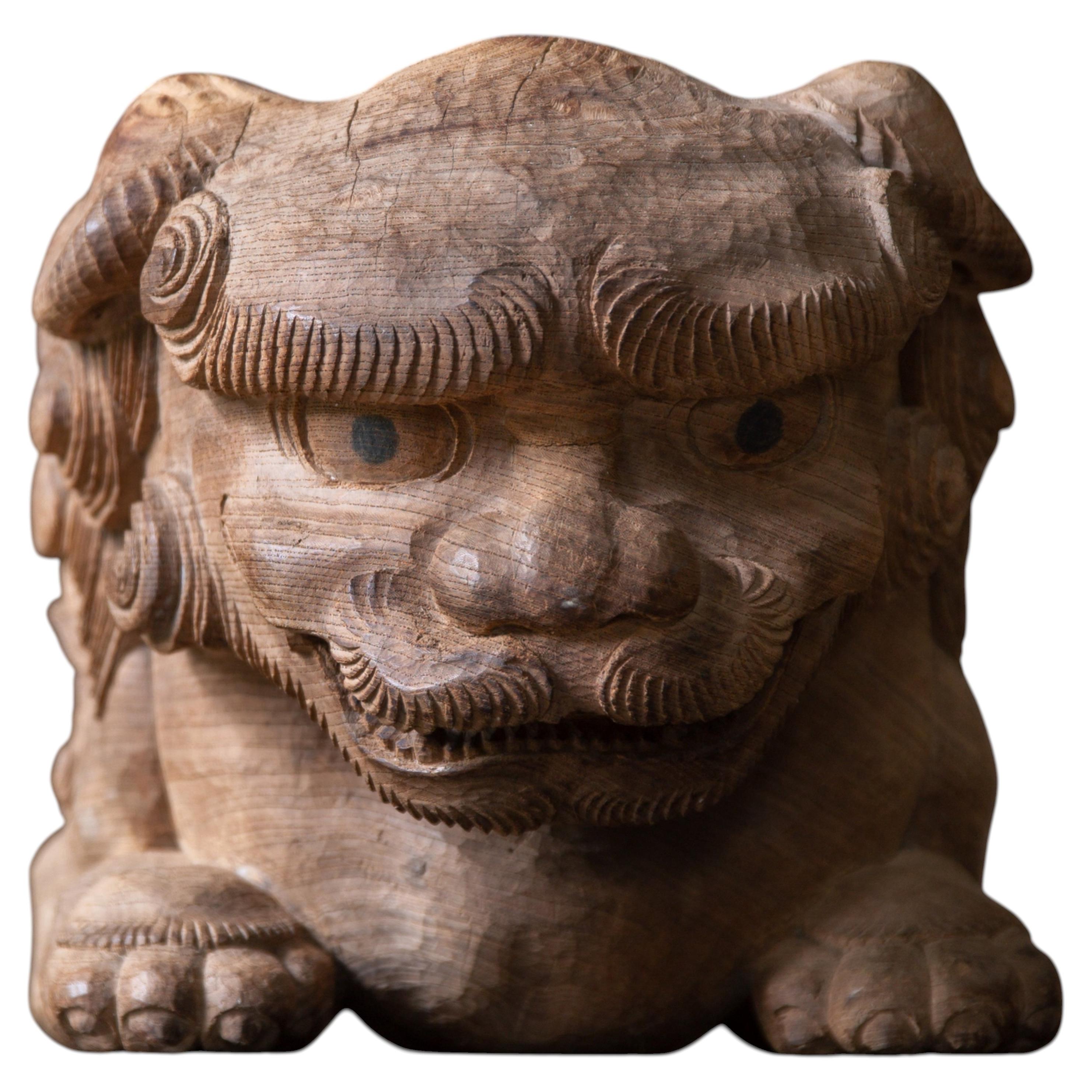
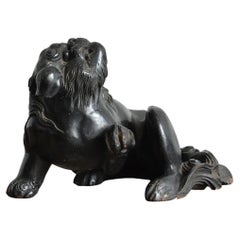
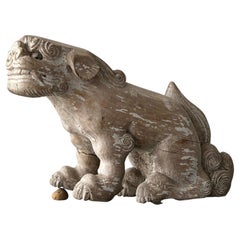
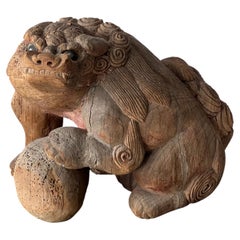
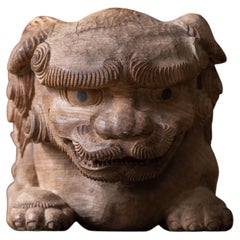
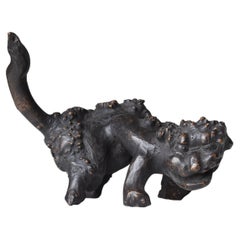
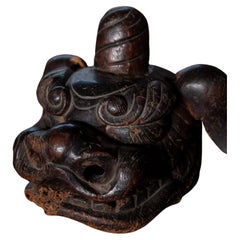
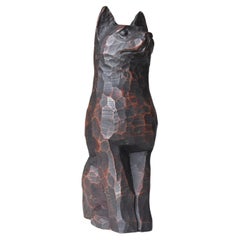
This is a Japanese "Komainu" (guardian lion-dog). Komainu are statues of guardian beasts placed in pairs at the entrances of Shinto shrines or in front of shrine buildings, protecting the sacred grounds from evil spirits. Their roots are said to lie in the lion statues of the ancient Orient and India; they were transmitted to Japan via China and the Korean Peninsula, where they developed into a uniquely Japanese form. As guardian deities of shrines, Komainu have stood alongside people's faith in Japan for more than a thousand years. While many are made of stone, wooden Komainu such as this one are thought to have been enshrined inside shrine buildings.
This piece was probably made from the late Edo period to the Meiji period, in the 19th century.
It is made of wood, most likely a hardwood such as keyaki (zelkova, one of Japan's representative hardwoods). Traces of a black lacquer-like coating can be seen on the surface, and where the black lacquer has peeled away in places, the red pigment of the undercoat is also visible. This surface, where black and red mingle as they flake away, has become a deep landscape that only long years can create.
Insect damage has progressed through many years of aging, resulting in its present appearance, but as a whole, the greater part of the figure remains firmly intact. Although the fine details of the face can no longer be made out, the carving conveyed by the limbs, tail, and the outline of the head is simple, and the figure has a somehow adorable, charming presence.
At first glance, the areas with insect damage throughout may look as if they would crumble away like a sponge if pressed with a finger. However, as this piece is made of quite hard wood, even those areas maintain a firm, solid hardness in their current state. You can therefore touch and move it with confidence, so please rest assured.
And it is precisely this weathered appearance that is the greatest charm of this piece. With the details lost, what remains is the essential form of the Komainu — the firmly planted limbs, the rising tail, the proud swell of the chest — giving it an abstract beauty like that of a modern sculpture. Though the facial expression has been lost, this instead stirs the imagination, and the result is a one-of-a-kind form sculpted by time itself. The Japanese have always found beauty precisely in such chips and decay — this is the aesthetic sense of "wabi-sabi." This piece can be said to embody wabi-sabi to the fullest.
Komainu are usually placed as a pair: the "A-gyo" with its mouth open and the "Un-gyo" with its mouth closed. Since there are traces suggesting that black lacquer was once applied deep inside the mouth of this piece, it may have been the open-mouthed "A-gyo" of such a pair.
Another charm of this piece is that it suits any style of display. It looks wonderful not only on an old wooden shelf or in a tokonoma alcove, but also in a space of exposed concrete or minimalist white walls, where its blackened, weathered wooden surface stands out quietly — a single figure with enough presence to bring the whole space together. It would be lovely placed at the entrance as a guardian, or in a study or living room as an art piece. As folk art born of Japanese popular faith, it is a work we can also recommend to lovers of primitive art around the world.
[Condition]
- There are traces of insect damage, but there are no insects now.
- However, fine wood dust may spill out from inside due to vibration during transport. Please be aware of this in advance.
Size: W28.9cm × D16cm × H34.2cm (with the top image viewed as the front)
Weight: 2.4kg
Item No.: SC170
【About us】
We mainly sell old Japanese items, but also items from around the world.
We have seen tens of thousands of items so far.
Using that experience, we list appealing items here.
This is something we can do because of our long experience.
If you are looking for something special, we encourage you to purchase it on our site.