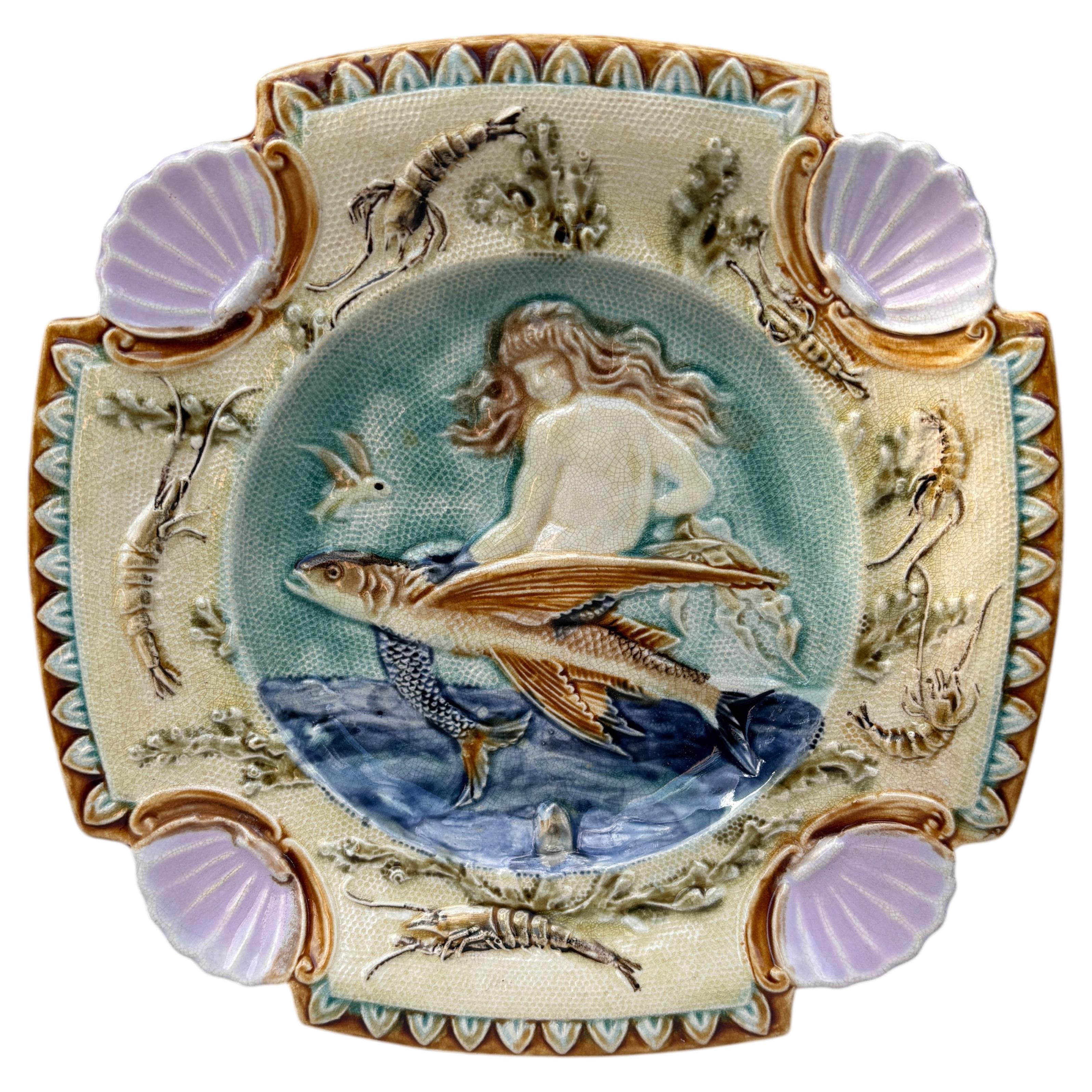
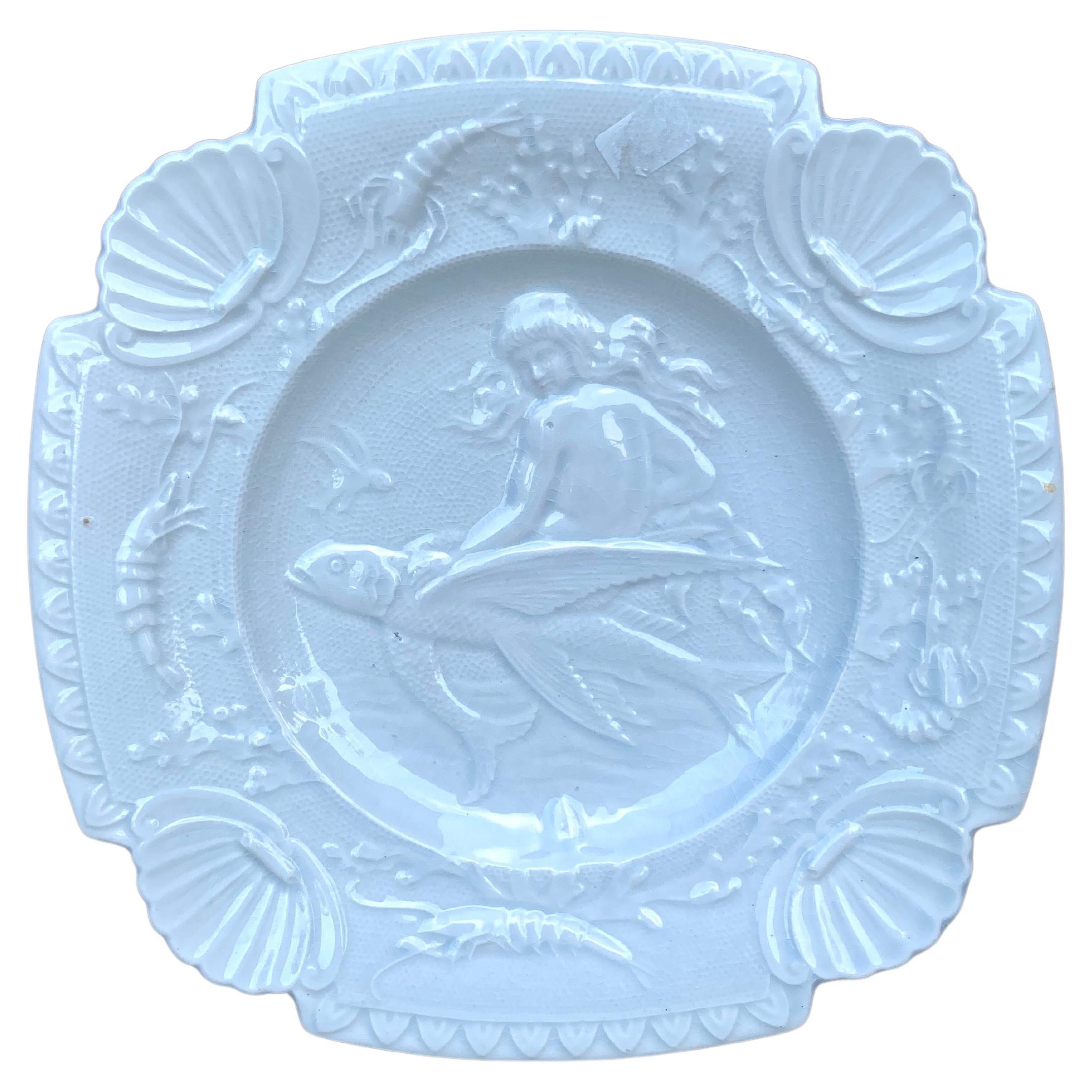
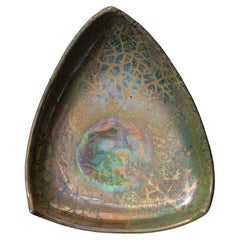
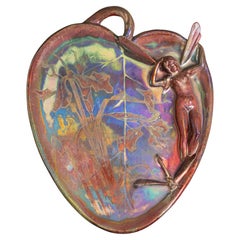
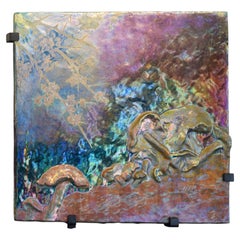
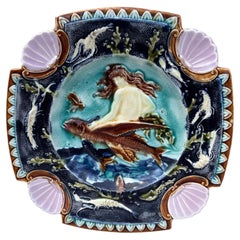
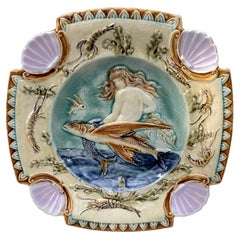
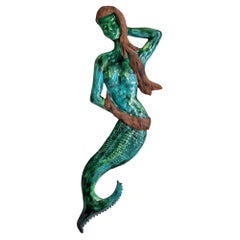
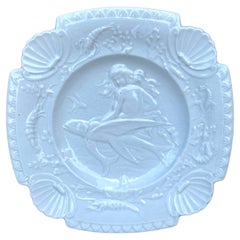
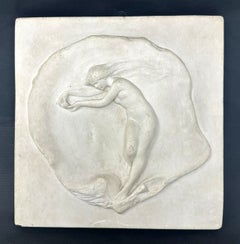
With artful and sensuous handling of material, Emile Jacob demonstrates his life-long love of learning with a technical mastery of porcelain and glazes as well as an awareness of current artistic trends such as Japonisme and l’Art Nouveau. From a bird’s-eye view perspective popularized by Japanese wood block prints circulating in Europe, Jacob immediately confronts the viewer with the sea. The variegated blues and greens take on every murky depth, every iridescence produced on a sun-filled water’s surface; while the suggestion of movement created by undulating patterns of water morphs into sand ridges caused by breaking waves as the viewer nears for a closer examination. The effect is remarkable. Upon closer scrutiny, the abstracted ridges create an affect of being even farther away from the sea, as if high in flight. The same captivating qualities are achieved by the opaque and crystalline glazes to suggest the interior of an oyster’s shell. The ultimate pearl, a female nude, is voluptuously modeled; fusing as one with her seascape, her hair spreads out in wavy tendrils and her graceful, long fingers wrap around the plaque’s edge.
Literature: Arthur, French Art Nouveau Ceramics: An Illustrated Dictionary, 2015, p. 213 for a similar example.
EMILE JACOB (1850-1919) The eldest of four, Emile Jacob was a self-taught artist and innovator in the ceramics industry. Along with his father and uncle, he opened tile manufacturing plants in Navilly, France in 1873 and in Chapot in 1882, doing business under the company name, Jacob Freres (et fils). In 1886 he extended his enterprise to include stoneware production by opening E. Jacob & Cie, Compagnie des Gres Francais de Pouilly-sur-Saone. In this endeavor, he joined forces with Maurice Delafon in 1889 to form the company, Jacob-Delafon et Cie, manufacturers of kitchen and bathroom ceramics. They were awarded a gold medal that same year at the Expositon Universelle for sanitary ceramics. Also exhibiting at the Paris Exposition under Jacob Freres (et fils), Emile Jacob submitted artistic ceramic ware produced at Navilly. A few years later in Paris in 1892, he exhibited artistic stoneware at the Exposition des Arts de la Femme. Soon after, he opened a ceramics store there located at 14 Quai de la Rapee which also housed ateliers for working wood, copper and pewter to complement his ceramic art. Never resting on his past accomplishments, Emile Jacob pushed for new research and new achievements. By the early-1890s, he added sang-de-boeuf glazes to his repertoire. Largely due to his firms’ commercial success, Jacob-Delafon expanded in 1898 by acquiring a factory in the Jura Department of France, a region known for marbre de Belvoye. The coarse limestone containing beige and pink-hued shells was rich in feldspar, a rock mineral necessary to make porcelain. Famous for what is known as their granit-porcelaine, the company once again took on a new name in 1899 to reflect the increasing breadth of its ceramic capability becoming Compagnie Ceramique de Pouilly-sur-Saone et Belvoye. Always in upward trajectory, Jacob received a gold medal at Paris’ Exposition Universelle in 1900, and in 1908, he was made a Chevalier in the French Legion of Honor. Among many private collections, examples of Emile Jacob’s ceramic art can be found at the Musee des Arts Decoratifs, Paris.