1 of 9

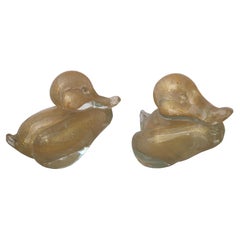
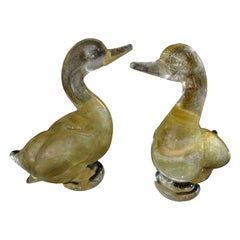
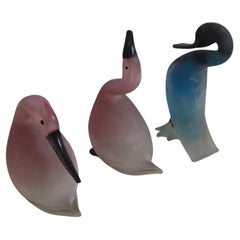
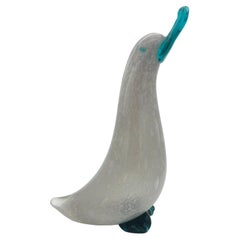
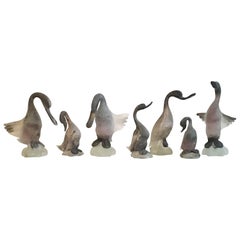
Collection of Murano Ducks; Seguso & Barovier

You May Also Like

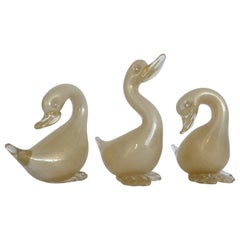
Set of 3 Murano Ducks

Set of 3 Murano Ducks

$750Sale Price / set|50% Off

H 7 in W 4.5 in D 2.5 in

Set of 3 Murano Ducks

Located in Los Angeles, CA

Set of 3 vintage hand blown Murano glass ducks infused with gold flecks, with Swarovski crystal eyes / Made in Italy, circa 1980s "Murano Glass" etc...

Category

Late 20th Century Italian Modern Animal Sculptures

Materials

Murano Glass

Ducks Murano, 1940, Italian, Attributed to Seguso, Barovier

Ducks Murano, 1940, Italian, Attributed to Seguso, Barovier

By Barovier Seguso & Ferro

Located in Ciudad Autónoma Buenos Aires, C

Logistics and International Shipping We provide a comprehensive export service so that your only concern is enjoying your acquisition. • Door-to-Door Service: Pieces located in our Argentina galleries are shipped directly to your address via air freight. • Simplified Customs Management: We handle the processing of export permits and the payment of customs duties. You will receive your purchase without additional paperwork or surprise costs. • High-Security Packaging: Following FedEx international standards, each piece is protected in custom-made wooden crates, designed to withstand 1-meter impacts and ensure the integrity of the object during transit. • Note for shipments to the USA: To comply with shipping company regulations and ensure delivery at the destination, a valid tax ID (EIN, SSN, or ITIN) is required. • Domestic US Shipping: For those pieces available in our United States storage, logistics are managed through 1stdibs. Murano with gold We have specialized in the sale of Art Deco and Art Nouveau and Vintage styles since 1982. If you have any questions we are at your disposal. Pushing the button that reads 'View All From Seller'. And you can see more objects to the style for sale. Attributed to Seguso - Barovier We have specialized in the sale of Art Deco and Art Nouveau and Vintage styles since 1982. If you have any questions we are at your disposal. The history of "Seguso Vetri D' Arte" is directly linked to the "Vetreria Artistica­ Barovier" company. When the Barovier workshop was forced to reduce production in 1929, due to a financial crisis in America, the original group of ten partners had to separate and Antonio Seguso in 1931, assisted by his sons Ernesto and Archimede opened a small workshop of his own. They were joined by Luigi Olimpio Ferro and Napoleone Barovier the following year. Together the craftsmen establish the "Artistica Soffieria e Vetreria Barovier Seguso & Ferro" company as equal partners. In 1934 Flavio Poli joins the firm as artistic director and within only a brief period of time a distinct style of designs emerged. The close collaboration between Flavio Poli, Archimede Seguso and Alfredo Barbini played an important part in the success of the company. New glass techniques are developed which include never before seen color applications. The companies innovative designs constantly received awards and during the 1935 World Fair in Brussels and the 1936 Milan Triennale they did attract the interest of a new group of clientele. One of them is the French wholesale company "Veronese" from Paris which would play a defining role in the history of the company. The demand for an increase in production requires additional investments and the partners felt that there is a need to multiply their investment tenfold. Luigi Olimpio Ferro subsequently decided to withdraw from the company and his shares are acquired by Flavio Poli, which makes him a full partner. As a result, the company name is changed to Seguso Vetri D’ Arte and it is officially recognized in 1937. A period of great success and prosperity ensues, lasting until the outbreak of World War II. The post ­war period is a time of great change in Europe and the rebuilding of the economical structure in Italy requires major investments which result in the introduction of new import duties and taxes. To safeguard the copyright of the Seguso Vetri D'Arte designs an application for a second entry into the commercial registers of Venice is made by the partners in 1945. Strict export regulations curb international business relations for many years after the war and the company decides to focus on the domestic market instead. In 1946 a large retail location is opened at the Piazza Diaz in Milan where in addition to the art glass, German porcelain and Italian pottery is offered. In 1950 Flavio Poli develops a new sommerso glass technique, which consists of an overlaying of transparent layers of glass. The overlapping creates new shades of color which prior to the introduction of this technique had not been seen. Flavio Poli's most iconic design is the "Valve", which resembles an upright, slightly opened clam shell. The design was introduced in 1951. Mario Pinzoni joins the company in 1953 as a personal assistant to Flavio Poli and his responsibilities as a draftsman included the compilation of archival and the existing production drawing s...

Category

Vintage 1940s Italian Art Deco Centerpieces

Materials

Gold

Pair of Murano Glass Ducks by Fratelli

Pair of Murano Glass Ducks by Fratelli

$995 / set

H 6 in W 7.13 in D 3.25 in

Pair of Murano Glass Ducks by Fratelli

By Barovier, Fratelli, Fratelli Toso, Salviati, Seguso

Located in Houston, TX

Pair of Murano glass ducks by Fratelli. Beautiful pair of gold murano glass ducks by Fratelli. This lovely pair of murano glass ducks are a gold gl...

Category

Vintage 1940s Italian Hollywood Regency Animal Sculptures

Materials

Blown Glass, Murano Glass

Murano glass birds by Cenedese mid-modern century italian sculptures 1970s

Murano glass birds by Cenedese mid-modern century italian sculptures 1970s

By Cenedese

Located in Nicolosi, IT

Murano glass birds by Cenedese mid-modern century italian sculptures 1970s This elegant trio of Murano glass birds, crafted by Cenedese in the 1970s, is a stunning example of mid-cen...

Category

Vintage 1970s Italian Mid-Century Modern Animal Sculptures

Materials

Murano Glass

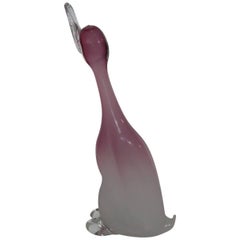
Mid-20th Century Murano Duck Figure attributed to Napoleone Martinuzzi

Mid-20th Century Murano Duck Figure attributed to Napoleone Martinuzzi

$800Sale Price|20% Off

H 13.78 in W 7.88 in D 5.12 in

Mid-20th Century Murano Duck Figure attributed to Napoleone Martinuzzi

By Napoleone Martinuzzi

Located in CABA, AR

This exceptional piece exemplifies Martinuzzi's mastery of glass manipulation, showcasing the distinctive Pulegoso and Bollicino techniques. This technique, pioneered by Martinuzzi,...

Category

Mid-20th Century Italian Mid-Century Modern Animal Sculptures

Materials

Blown Glass

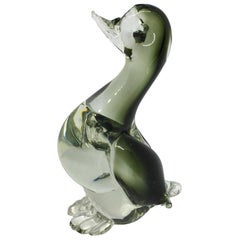
Duck Murano Glass Vetri di Murano Italy Vintage Art Glass, 1970s

Duck Murano Glass Vetri di Murano Italy Vintage Art Glass, 1970s

By Murano 5

Located in Nuernberg, DE

A Venetian sculptural duck figurine in hand blown glass, produced on the isle of Murano, circa 1970s. A nice piece of art for any room.

Category

Vintage 1970s Italian Modern Animal Sculptures

Materials

Art Glass

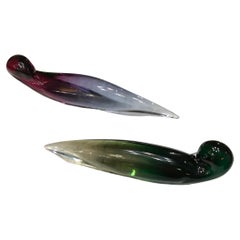
Ducks Murano, 1930, Italian, Sing Salviati & C

Ducks Murano, 1930, Italian, Sing Salviati & C

$3,500 / set

H 3.94 in W 13 in D 2.17 in

Ducks Murano, 1930, Italian, Sing Salviati & C

By Salviati

Located in Ciudad Autónoma Buenos Aires, C

Murano We have specialized in the sale of Art Deco and Art Nouveau and Vintage styles since 1982. If you have any questions we are at your disposal. Pushing the button that reads 'View All From Seller'. And you can see more objects to the style for sale. Salviati & C Measures: Violet : 33 long x 10 high x 5.5 depth Green: 30 long x 9 high x 5.5 depth The lawyer Antonio Salviati and his dream In 1859 in his premises at Number 731 of Dorsoduro, Venice the “Salviati Dott. Antonio fu Bartolomeo” company was established. This is when, Vicenza-born lawyer Antonio Salviati started the entrepreneurial career, moved by a passion for the precious mosaics of the Basilica of San Marco and fascinated by Murano glass art, he decided to start-up his own production of mosaics and objects in Murano glass. An ambitious and far-sighted goal pushed him along this path: to revive the fate of Murano glass production that has been fallen for decades. A challenge which finds the maximum support from two fundamental figures in the history of Murano glass: the mayor of the island, Antonio Colleoni, and the Abbot Vincenzo Zanetti, founder of the glass museum and of the first art school for glass masters. The first successes and international investments The launchpad was the “First Glassmakers’ Exhibition” in 1864 in which Salviati participated with a monumental mosaic that earns him a prize superior to the Gold Medal. The success achieved affirmed the credibility of the Company which thus started its glass production in Palazzo da Mula. The new corporate and productive reality needed investors and the lawyer started to internationalise the company by addressing the economic and financial market across the Channel. The UK immediately showed huge interest in Salviati’s mosaics – as testified by the mosaic that can be seen on the façade of the current Apple Store in Regent Street, London. It was also in London, on 21st December 1866, that the “Società Anonima per Azioni Salviati & C.” was established with the support of diplomat Sir Austen Henry Layard and historian William Drake. The new corporate set-up was further established with the purchase of a new headquarter, this time on the Riva dei Vetrai in Murano. The universal show of Paris in 1867 celebrated the relaunch project of Antonio Salviati “Venice owes a debt of gratitude to the knight Salviati in the resurgence for one of the most legitimately famous of its industries”. From Esposizione Illustrata di Parigi, 1867 pg. 275. “Venice and Italy have gain huge success in the Universal Exhibition. The resurgence of one of the city’s most famous industries is consecrated in this very occasion by the gold medal awarded by the jury to Mr Salviati […] the crowd […] is gathering around the display cases that hold those pieces of glass that are so transparent and so light as to appear like woven air, impregnated, when in their elegant forms that become rainbows of those iridescent reflections that cover them at the artist’s whim – the author of a real ray of sunshine from the beautiful and splendid Venice”. From Esposizione Illustrata di Parigi, 1867 pg. 311 The fundamental role of training in murano glass Training plays a fundamental role for the Company; attendance at the Art School was made compulsory for “[…] all the young workers of the Factory who don’t only tire themselves in manual work. This was established with the idea not only to lift their dignity and their initially limited aspirations, […] but also to improve their artistic education and thereby facilitate an improvement also in their economic situation”. Together with the art school, a free school was also set up to teach all employees to read and write. Diversification in production and made-to-measure projects In a short time, Salviati & C. diversified its production to include glasses, cups, amphoras, and vials which guaranteed the first prize in the universal exhibition for three consecutive years. Its mosaic production also flourished, being used in world-class projects: from the Houses of Parliament in London, to the Viceroy’s palace in Alessandria in Egypt, to the Opera House of Paris, including the private homes of wealthy New York personality. The entire 19th century for Salviati & C. was represented by development, success and fame in the national and international markets, and the Company became a symbol and reference point of Murano glass art throughout the world. The Salviati legacy at the turn of the century On the death of Antonio Salviati in 1890, first his three children followed one another at the helm of the company and then Maurizio Camerino, previously general manager. It was thanks to him that the decorative mosaic project of the Stanford Memorial Church in Palo Alto (California, USA) took place after 12 years of work. As well as the opening of a sales point in Via Montenapoleone in Milan and the institution of a museum collection of Murano glass from the 19th and 20th centuries. The post-war years, biennials and lighting After Maurizio Camerino’s death in 1931, his three children took over the helm of the company: its solid foundations allowed them to strive for new important goals in the art world, participating in the Biennials of 1932 and 1934. Not even the Second World War could tarnish the strength of the Salviati brand: in the post-war years Renzo Camerino renewed the ruined production headquarter and enthusiastically restored all his commercial contacts. Thanks to his grandson Renzo Tedeschi (newly graduated in Engineering at the Polytechnic of Turin and upon his return from an apprenticeship in the United States), Salviati launched its production in lighting appliances. The following years saw intense growth in the number of collaborations with renowned artists and designers. In 1959, the production site was moved to Fondamenta Radi 16, where it still stands today. The great lighting projects The larger production area allowed the company to further expand the international market in the field of architectural lighting. A number of projects were undertaken, such as the 9-tonne, 22-metres high chandelier in the Chamber of Commerce in Parma, the ceiling illumination in the premises of the World Intellectual Property Organisation in Geneva and the Kowloon Hotel in Hong Kong; not to mention the sound-absorbing windows of the Aula Nervi in the Vatican and the lighting system of the great honour hall of the Philippine Plaza Hotel in Manila in collaboration with architect John Marsteller. The reputation of Salviati & C. was further affirmed by the commission – after an international call for bids – for twelve 11-metre high chandeliers for the Tonhalle concert hall in Dusseldorf, made using an innovative system of modular glass elements – “LS- System” – one of the today company’s cornerstones. Salviati from the modern age to the present The story of Salviati continues in the modern era, keeping the focus on creating an innovative style that had distinguished it since its inception. Participation in international exhibitions increased, such as the Venice Biennials from 1958 to 1972 (the final year in which Murano glass was allowed) thanks to projects by designers of the calibre of Betha and Teff Sarasin, Claire Falkestein, and Luciano Gaspari. In 1962 Salviati was awarded with the highest recognition in the Design world, the “Compasso d’Oro” prize assigned by A.D.I. for the Marco vase designed by architect Sergio Asti. In 1965 the company changed its name to Salviati & C. s.p.a.; then it was purchased by the Gruppo Ferruzzi in 1987 which later on it was transferred to a French company. Since 2015 the company returned to be Venetian with the acquisition by the Umana group. Salviati and its designers Salviati’s designers: Luciano Gaspari, Sergio Asti (Compasso d’Oro 1962), Claire Falkenstein, Ward Bennet, Teff and Betha Sarasin, Ingo Maurer, Ross Lovegrove, Amanda Levete, Tom Dixon, Nigel Coates, Thomas Heatherwick, Luca Nichetto, Ben Gorham...

Category

Vintage 1930s Italian Art Deco Animal Sculptures
Materials

Murano Glass

Seguso Duck Murano Glass Alabaster 1960 Murano Glass

Seguso Duck Murano Glass Alabaster 1960 Murano Glass

$1,412Sale Price|20% Off

H 15.75 in W 9.85 in D 3.94 in

Seguso Duck Murano Glass Alabaster 1960 Murano Glass

By Archimede Seguso

Located in Palermo, Sicily

Duck Murano glass imitation alabaster Seguso, 1960.

Category

Vintage 1960s Italian Mid-Century Modern Animal Sculptures

Materials

Murano Glass

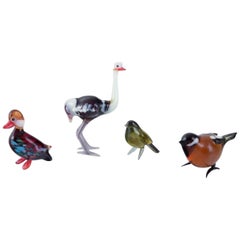
Murano, Italy. Collection of four miniature glass bird figurines.

Murano, Italy. Collection of four miniature glass bird figurines.

Located in København, Copenhagen

Murano, Italy. A collection of four miniature glass bird figurines in colored art glass. 1960s/1970s. The largest one measures: H 9.0 cm x W 6.0 cm. In perfect condition.

Category

Vintage 1960s Italian Animal Sculptures

Materials

Art Glass

Collection of Seven Cenedese Murano Glass Birds

Collection of Seven Cenedese Murano Glass Birds

$4,800Sale Price / set|20% Off

H 13 in W 7 in D 6 in

Collection of Seven Cenedese Murano Glass Birds

By Cenedese

Located in Palm Springs, CA

An assembled collection of seven birds (swans, ducks, geese, your call) by Antonio da Ros for Cenedese in the scavo technique. Four large birds, two small birds and one medium. The l...

Category

20th Century Italian Mid-Century Modern Glass

Materials

Murano Glass