Want more images or videos?
Request additional images or videos from the seller
1 of 18

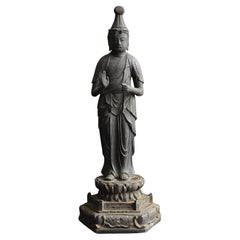
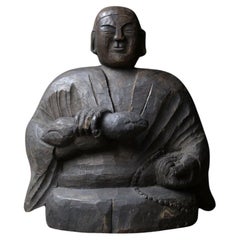
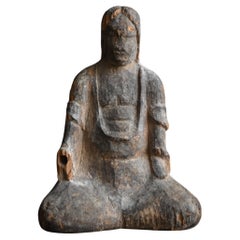
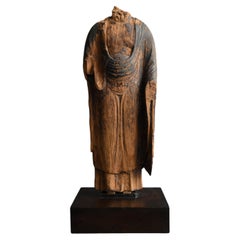
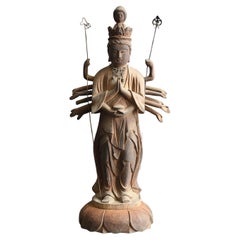
Japanese Small Antique Wooden Buddha / 1750-1868 / Late Edo Period/Wood Carved

Price:$700

You May Also Like

More From This Seller

View All
Japanese Edo Period Wooden Buddha Statue / Kannon Bodhisattva

Japanese Edo Period Wooden Buddha Statue / Kannon Bodhisattva

Located in Sammu-shi, Chiba

This is a wooden standing statue of Kannon Bosatsu (Avalokiteśvara) produced in Japan during the mid to late Edo period (18th to 19th century). With a height of 36.5 cm, it possesses...

Category

Antique Late 18th Century Japanese Edo Sculptures and Carvings

Materials

Wood, Cypress

Antique Wooden Sculpture "Kobo Daishi" / Buddha Statues / Edo-Meiji Period

Antique Wooden Sculpture "Kobo Daishi" / Buddha Statues / Edo-Meiji Period

Located in Sammu-shi, Chiba

This is an old Japanese "Kobo Daishi" wooden figure. "Kobo Daishi" means "Kukai". "Kukai" was a monk from the early Heian period. His posthumous name was "Kobo Daishi". He is the fou...

Category

Antique 19th Century Japanese Edo Sculptures and Carvings

Materials

Cypress

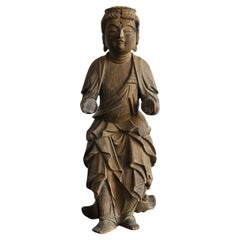
Rare Japanese antique wooden god statue /12th century/small wabi-sabi figurines

Rare Japanese antique wooden god statue /12th century/small wabi-sabi figurines

Located in Sammu-shi, Chiba

I was able to obtain a very rare item. This is a sculpture of the god ``Shinzo''. "Shin" = God "zo" = statue Since ancient times in Japan, it has been believed that gods reside in all things in the universe, and there have been many shrines. In the 6th century, Buddhism was introduced and gradually spread throughout Japan. Around the 8th century, the idea that gods follow the teachings of Buddha spread. Until the Edo period, God and Buddha became one and the idea of ``Shinto and Buddhism syncretism'' was established. This statue was created during such a history. Originally, the image of God was invisible and could not be understood as something tangible. However, with the introduction of Buddhism to Japan, idol worship was also introduced, and the idea that the gods follow the teachings of Buddha was also propagated at the same time in order to spread the teachings of Buddhism. Around that time, around the 9th century, the first statues of gods...

Category

Antique 15th Century and Earlier Japanese Other Figurative Sculptures
Materials

Cypress

Antique Japanese wooden Nyorai Buddha torso / Late Heian / Rare sculpture

Antique Japanese wooden Nyorai Buddha torso / Late Heian / Rare sculpture

Located in Sammu-shi, Chiba

This piece is thought to be a wooden Nyorai Buddha statue carved in the late Heian period. The moment we first saw it at the time of purchase, we were completely captivated by its pr...

Category

Antique 15th Century and Earlier Japanese Other Sculptures and Carvings

Materials

Softwood, Cypress

Edo period wooden carved Buddhist statue/11-faced Thousand-armed Kannon

Edo period wooden carved Buddhist statue/11-faced Thousand-armed Kannon

Located in Sammu-shi, Chiba

This is a wooden statue of **Jūichimen Senju Kannon Bosatsu (Eleven-Headed Thousand-Armed Kannon)**, created in Japan during the late Edo period. Senju Kannon (Thousand-Armed Kannon), formally known as *Senju Sengen Kanzeon Bosatsu*, is regarded as a symbol of compassion who saves all people through countless hands and eyes. Rather than literally carving one thousand arms, the expression of many arms symbolically represents “infinite salvation.” This work is further rendered in the **Eleven-Headed (Jūichimen)** form, bearing multiple faces above the main head. This signifies the ability to look in all directions and to never overlook the suffering of any being. The Eleven-Headed Thousand-Armed Kannon is both refined in design and highly significant in devotional practice. At **Sanjūsangendō (Rengeō-in)** in Kyoto, a similar Eleven-Headed Thousand-Armed Kannon statue is enshrined and is widely known as one of the representative masterpieces of Japanese Buddhist sculpture...

Category

Antique Early 19th Century Japanese Edo Sculptures and Carvings

Materials

Wood, Cypress