Provenance
- Private collection, France.
Documents
- Attach Thermoluminescence test.
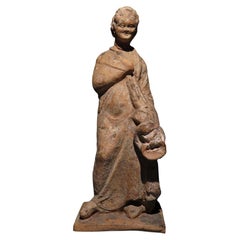
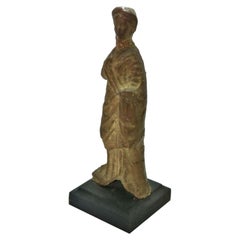
A terracotta figurine, molded in the round, depicting a woman with dwarfism, her legs noticeably short in proportion to the rest of her body. The clay is covered with a white slip, and some details, such as the eyes, eyebrows, lips, and part of the hair, remain after firing, having been painted cold. The woman is dressed in the archaic style, wearing a peplos, and stands facing the viewer, her arms held away from her body, the right arm extended and the left slightly raised. Dating from the late Classical and early Hellenistic periods, the sculptor has depicted the woman with a clear interest in naturalism, given her unusual proportions, but without attempting caricature. In fact, only the legs are shorter, not the arms, thus altering only the figure's height. Special attention is also paid to the beauty and expressiveness of the face, highlighted through polychromy. The statuette is thus characterized by an elegant combination of naturalism, expressiveness, and restrained idealization, characteristic of Hellenism.
This way of representing people with dwarfism, far removed from caricature and grotesque exaggeration, can be linked to contemporary Alexandrian statuary. While in Greece and Rome these individuals were preferentially depicted in banquet contexts, with a certain playful or humorous tone, in Egyptian society they were perfectly integrated and often represented associated with gods such as Bes or Patecos. In the Greco-Roman world, however, one of the main iconographic themes for representing people with achondroplasia is that of the "dancing dwarf," associated with public festivals and also private banquets, since it was common for banquet hosts to hire performers with dwarfism to dance and entertain their guests. However, in Greece and Rome, male representation predominated, often featuring a large phallus alluding to the supposed sexual potency of men with dwarfism, in images that were grotesque to varying degrees. Although associated with playful contexts, these figurines have frequently been found in funerary contexts, where they would have played an apotropaic role, offering protection against supernatural evil.
The position of the hands and fingers of this figurine, as well as the fact that the left hand is perforated lengthwise, indicates that the figure originally held an object, perhaps made of a material other than terracotta. Judging by the concentrated and almost ecstatic facial expression, the attire, and the posture, it can be deduced that it was a musical instrument, probably a plucked string instrument such as a lute, a lyre, or a barbiton. Numerous examples of Hellenistic terracotta figurines depicting men and women playing musical instruments are known today, originating from mainland Greece, the islands, Asia Minor, Magna Graecia, and Alexandria. Although often associated with everyday scenes, their appearance in tombs and sanctuaries highlights popular religious beliefs and, in some cases, illustrates mythological narratives. In Magna Graecia, specifically, figurines of female musicians can be linked to rites of the cult of Cybele and Dionysus when they appear playing the tympanum, the aulos, or crotales—instruments used in ecstatic rituals where music played an essential role.
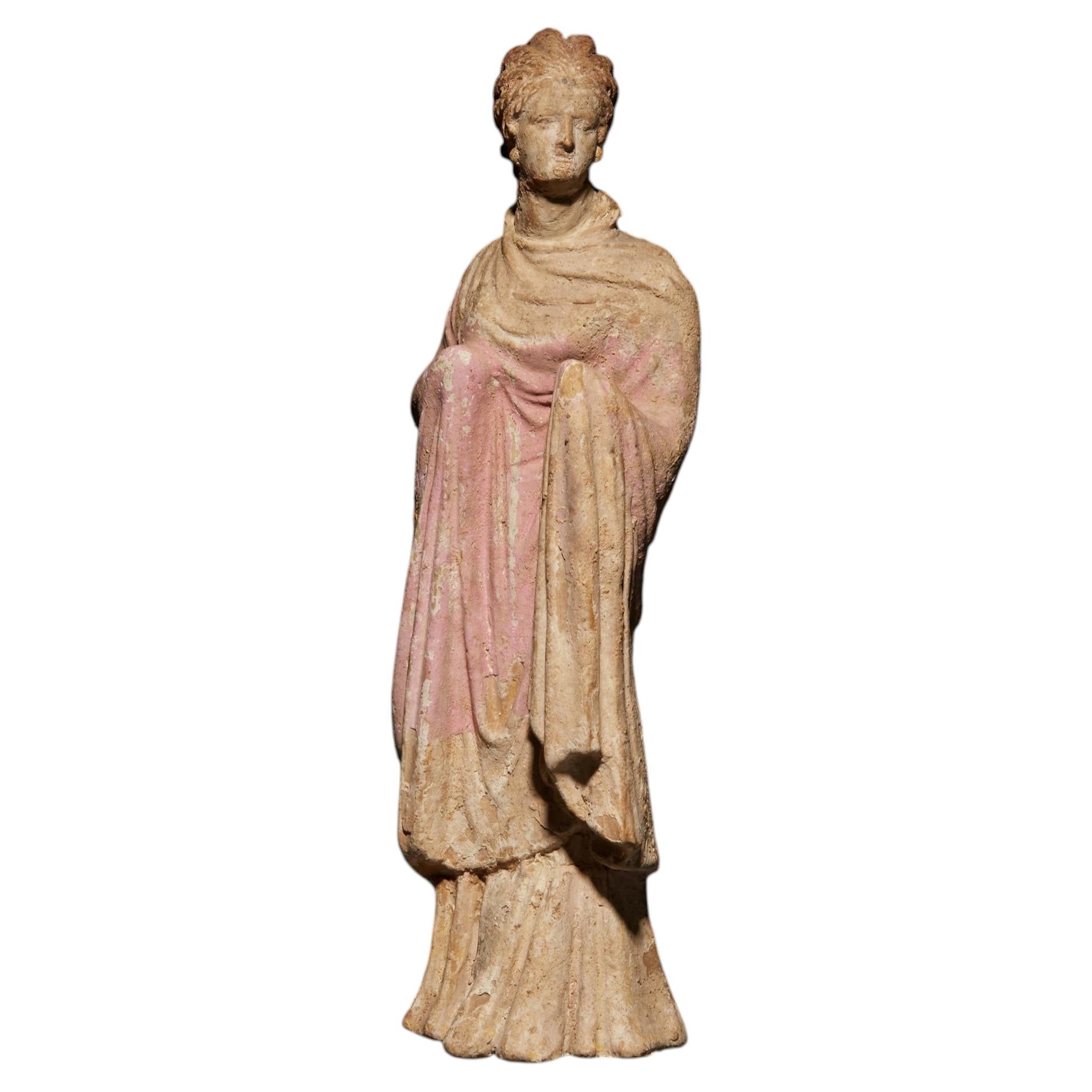
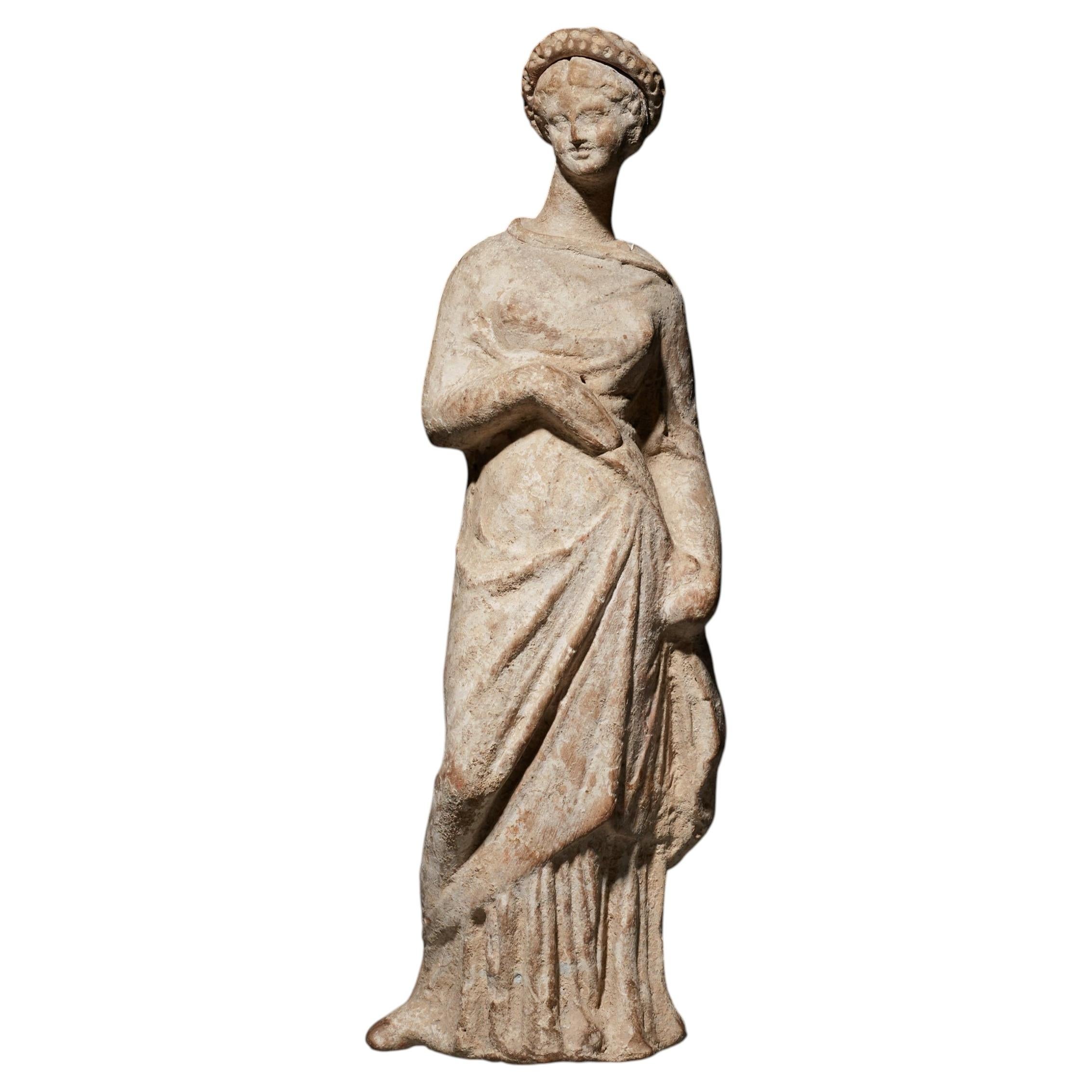
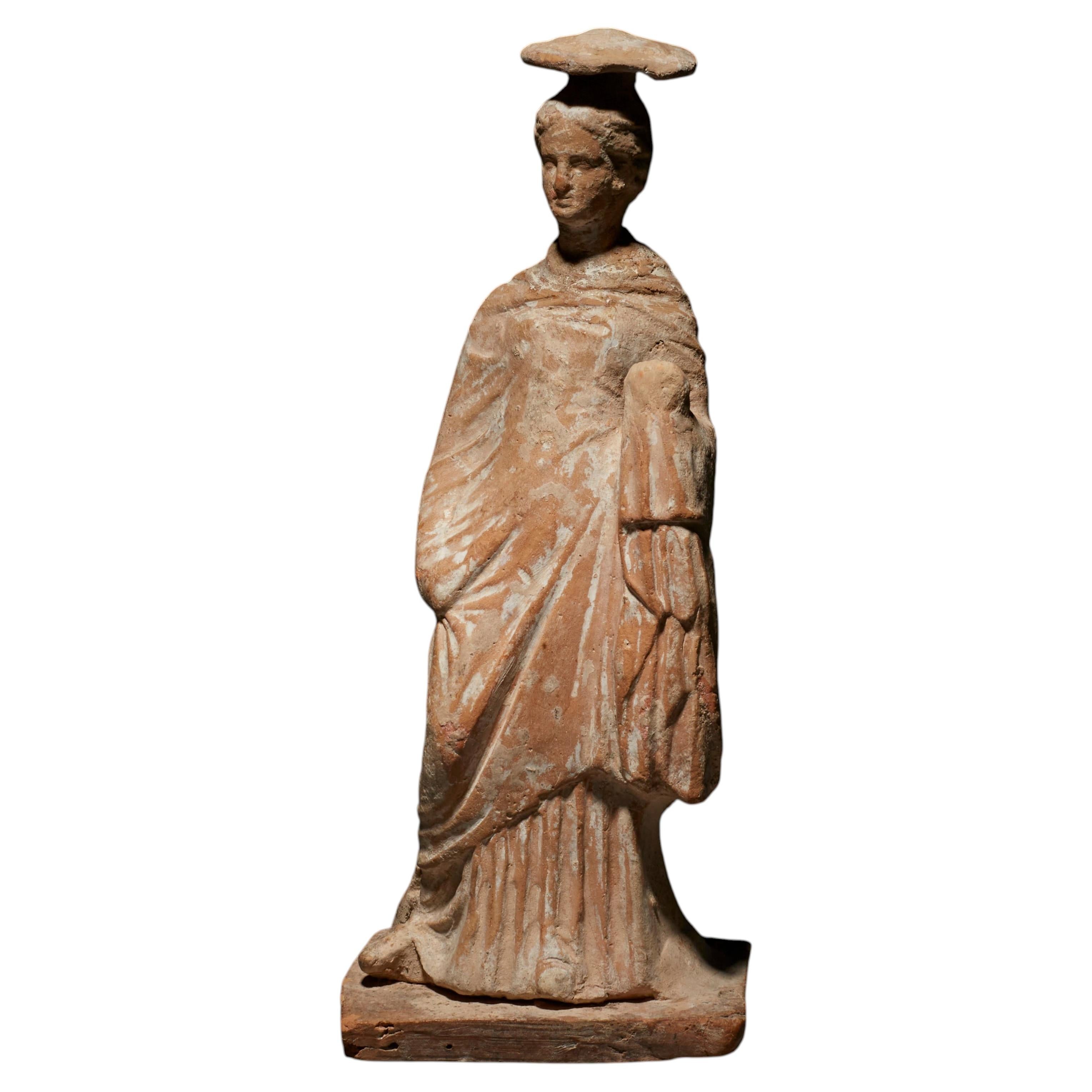
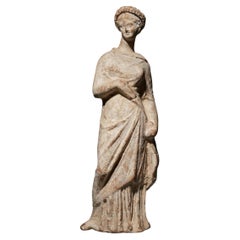
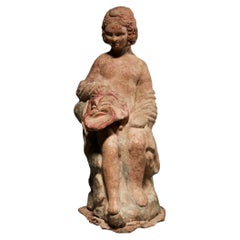
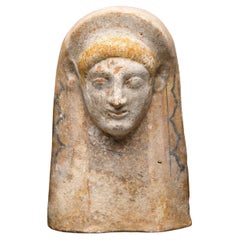
These mass-produced, polychrome terracotta figurines are among the most interesting and important manifestations of Hellenistic Greek art. In earlier periods, representations of idealized men and women were common; these votive pieces served as images of the donor. From the 4th century BC onwards, however, these figurines, with their ritualistic and hieratic poses, clearly votive, began to evolve in a more naturalistic style. Figures in everyday situations began to appear, no longer solely in offerings and rituals, and eventually, the votive function was almost entirely forgotten. Although these statuettes continued to be offered in temples and sanctuaries, their decorative function ultimately prevailed. The iconographic range then expanded enormously, incorporating all kinds of new themes, such as theatrical, grotesque, and caricatured subjects, as well as everyday figures not commonly seen in Greek art until then, such as old men and dwarfs. In this context, a new, specifically Hellenistic, production of statuettes emerged, known as Tanagra figurines because this Boeotian city was where they were found in the greatest numbers. Produced from the late 4th century BC onwards, these "Tanagra figurines" are figures between 10 and 20 cm tall, made in molds and covered with a slip before firing, often subsequently painted with rich polychromy. These pieces circulated throughout the Greek world and were produced not only in Tanagra and Attica, in mainland Greece, but also in Alexandria (Egypt), Myrina (Asia Minor), Tarentum and Centuripe (Magna Graecia). Tanagra-style figurines depict figures from daily life, generally women, in various everyday poses often linked to the family context, theater, or music. Although the Tanagra workshops ceased production around 200 BC, other centers continued the style even into the 1st century AD.