Want more images or videos?
Request additional images or videos from the seller
1 of 9

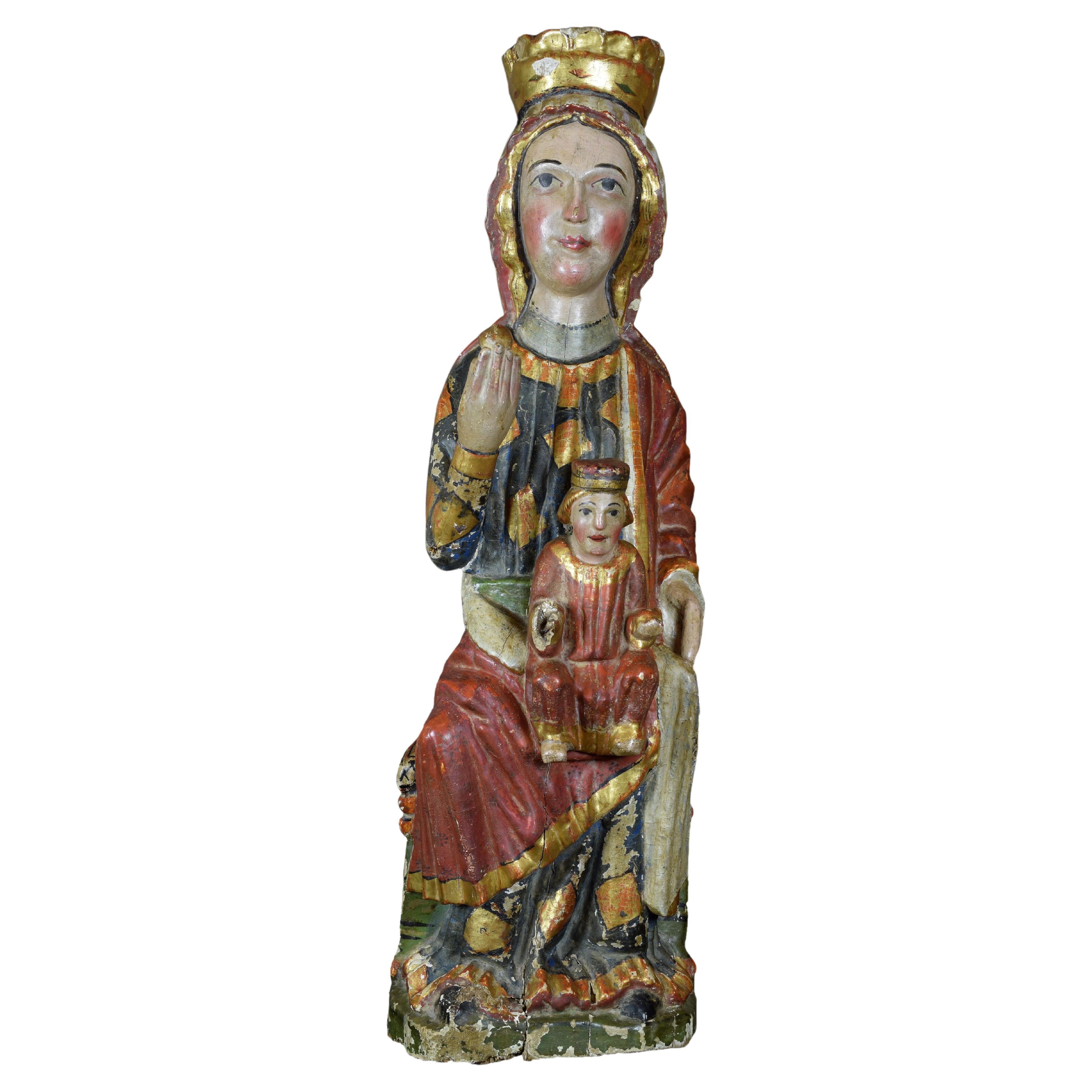
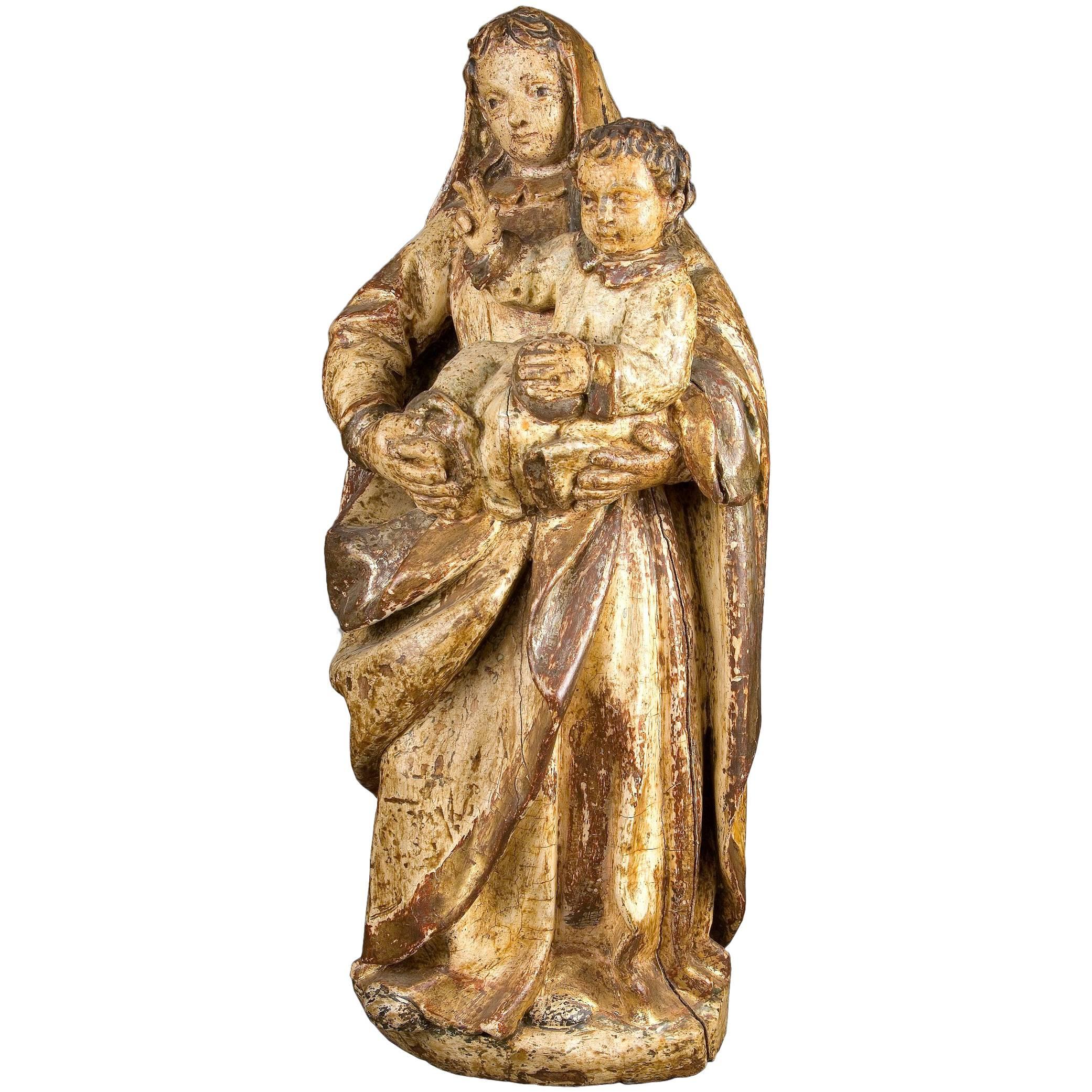
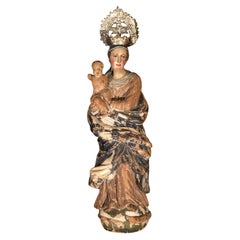
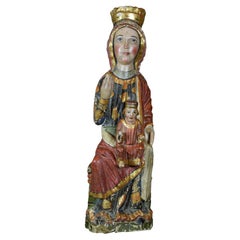
Seated Virgin and Child, both crowned, polychrome wood carving, Spanish school

$3,253.53
£2,411.54
€2,760VAT Included
CA$4,538.83
A$4,603.83
CHF 2,628.92
MX$55,753.93
NOK 30,948.77
SEK 30,846.05
DKK 21,043.82

About the Item

Rare Spanish devotional sculpture depicting the Virgin in Majesty enthroned with the crowned Christ Child, carved in wood with remnants of original polychromy and gilding. Attributed to the Spanish popular school, late 16th–early 17th century, the composition preserves strong Gothic and late medieval characteristics through its hieratic frontal pose, stylized drapery and deeply devotional character. Both figures retain their carved crowns, while the surface shows extensive authentic craquelure, age wear and traces of historic inactive worming consistent with centuries of religious use. The sculpture retains exceptional decorative presence and authenticity, making it a highly evocative example of early Spanish religious folk art. Measures: 32 x 12 x 9 cm.
  • Dimensions:
    Height: 13 in (33 cm)Diameter: 25.6 in (65 cm)
  • Style:
    Baroque (Of the Period)
  • Materials and Techniques:
  • Place of Origin:
  • Period:
  • Date of Manufacture:
    18th century
  • Condition:
    Wear consistent with age and use. good condition for the age.
  • Seller Location:
    Madrid, ES
  • Reference Number:
    1stDibs: LU5779248282882

More From This Seller

View All
Virgin and Child in Polychrome Wood, Spanish/Colonial 18th century

Virgin and Child in Polychrome Wood, Spanish/Colonial 18th century

Located in Madrid, ES

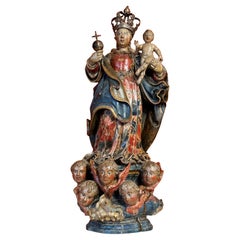
Virgin and Child in Polychrome Wood on a Cloud with Cherubs, Spanish/Colonial School, 18th Century This devotional sculpture in carved wood, 61 cm in total height, depicts the Virgi...

Category

Antique Early 18th Century Spanish Baroque Figurative Sculptures

Materials

Silver

Virgin and Child, polychrome wood carving, Hispanic school, 16th-17th century

Virgin and Child, polychrome wood carving, Hispanic school, 16th-17th century

Located in Madrid, ES

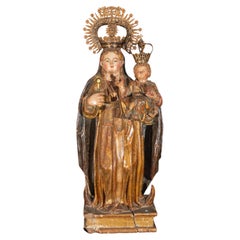
Virgin and Child, polychrome wood carving, Hispanic school, 16th-17th century This carved and polychrome wood sculpture depicts the Virgin Mary with the Child in her arms, crowned an...

Category

Antique 16th Century Spanish Baroque Figurative Sculptures

Materials

Silver

Virgin and Child, polychrome wood carving, Colonial school, 18th century

Virgin and Child, polychrome wood carving, Colonial school, 18th century

Located in Madrid, ES

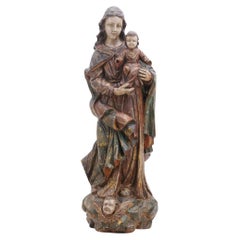
Virgin and Child, polychrome wood carving, colonial school, 18th century This sculpture of the Virgin and Child, carved and polychromed in wood, is attributed to an 18th-century colo...

Category

Antique Early 18th Century Spanish Baroque Figurative Sculptures

Materials

Silver

Renaissance Style Carved Wood Virgin and Child, Italian School, 16th-17th

Renaissance Style Carved Wood Virgin and Child, Italian School, 16th-17th

Located in Madrid, ES

A charming carved and polychromed wooden Virgin and Child, attributed to the Italian School and dating to the 16th century. The composition reflects Renaissance ideals, with a calm, ...

Category

Antique Early 17th Century Italian Renaissance Figurative Sculptures

Materials

Wood

Baroque Virgin and Child in Polychrome Wood with Silver Crown, Spain, 17th Centu

Baroque Virgin and Child in Polychrome Wood with Silver Crown, Spain, 17th Centu

By Spanish Manufactory

Located in Madrid, ES

Baroque Virgin and Child in Polychrome Wood with Silver Crown, Spain, 17th Century An important Spanish Baroque sculpture of the Virgin and Child, datable to the 17th century, made ...

Category

Antique 17th Century Spanish Baroque Figurative Sculptures

Materials

Silver

Early 16th Century Spanish Polychrome Virgin and Child Sculpture

Early 16th Century Spanish Polychrome Virgin and Child Sculpture

Located in Madrid, ES

A finely carved Spanish Virgin and Child sculpture dating to the early 16th century, executed in polychromed and gilded wood. The composition reflects the transition from the late G...

Category

Antique 16th Century Spanish Gothic Figurative Sculptures

Materials

Wood

You May Also Like

A Carved Polychrome Painted Figure of the Virgin and Christ, 18th Century

A Carved Polychrome Painted Figure of the Virgin and Christ, 18th Century

Located in ARMADALE, VIC

A Carved and Polychrome-Painted Group of the Virgin and Christ, 18th Century The modelled standing in robes holding the Christ child, on a rockwork base with a seraphim mask to the ...

Category

Antique 18th Century French Baroque Figurative Sculptures

Materials

Hardwood

Polychrome carved wood Virgin and Child from the 15th Century

Polychrome carved wood Virgin and Child from the 15th Century

Located in Saint-Ouen, FR

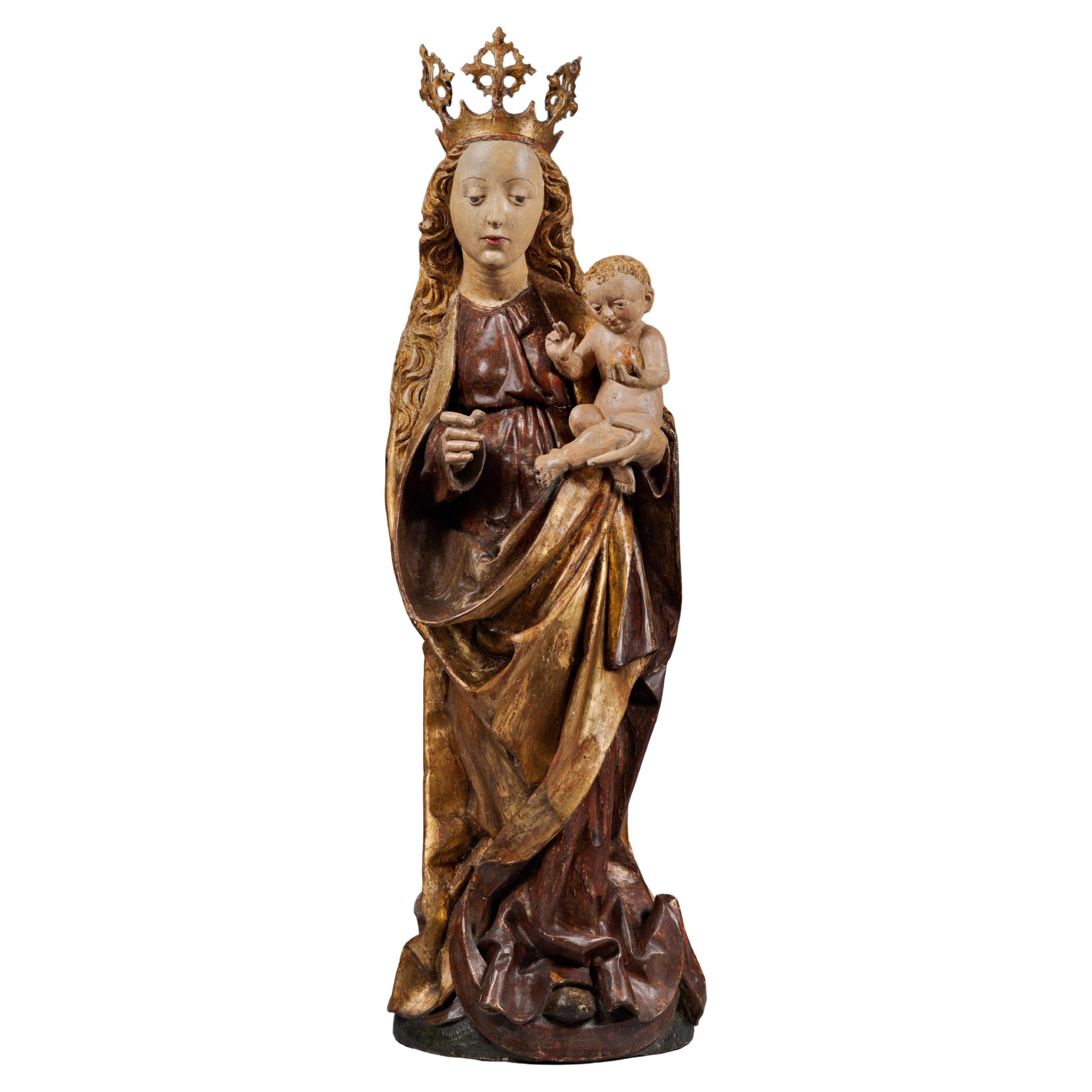
POLYCHROME CARVED WOOD VIRGIN AND CHILD FROM THE 15TH CENTURY   ORIGIN: SOUTH GERMANY, SWABIA, NUREMBERG REGION PERIOD: 15th CENTURY   Height: 94,6cm Width : 28 cm Depth : 18 cm   Lime wood Original Polychromy Good state of conservation     From 1430 onwards, sculpture underwent a profound stylistic renewal which continued until 1530, the so-called late Gothic period. In the Germanic countries, original sculptures flourished in an expressive and sensitive vein.
This renewal was inspired by the art of Nicholas of Leiden, who was active in Strasbourg in the 1460's. His style broke with the refined and delicate art of the international Gothic style in force throughout Europe around 1400. The figures became more authentic and realistic. The bodies became denser. Clothes are animated by deep, broken folds, the fabrics are heavy and have a great decorative value. In addition, the polychromy is intended to be illusionistic. The painting makes it possible to restore the texture of the materials, the richness of the textiles and the natural skin tone of the characters.   The dissemination of images through engraving and the great mobility of the artists led to the success of this style, which conquered the Upper Rhine, Swabian, Tyrolean and Franconian regions, contributing to the formation of a common stylistic identity in these regions. The economic boom in the flourishing German cities was conducive to the development of original production. Attracted by this prosperity, numerous workshops were set up in order to meet the orders of religious communities, the Church and the laity, including a clientele of middle-class rockers.      This precious Virgin and Child is depicted standing on a crescent moon, her head encircled by a crown of tall flowers. Her long wavy hair spreads over her shoulders, framing her beautiful oval face. Under fine eyebrows drawn with a brushstroke, her almond-shaped, slightly drooping eyes look at the Child with infinite softness. She is dressed in a long red dress with a rounded neckline, belted under the chest. The heavy fabric of her dress spreads out in broken folds at her feet. On her shoulders she wears a golden cloak. The drapery has deep folds. She holds out her right hand while she holds the Christ Child with her left.   Christ, with his well-defined hair, is naked. His cheeks are highlighted with red, he holds an apple in his left hand and with the other hand makes a sign of blessing towards the faithful.   Virgins with Child on a crescent moon were very popular in the second half of the 15th century, especially as the central subject of altarpieces in southern Germany and Austria. The crescent moon on which Mary is standing is reminiscent of the Woman of the Apocalypse. Often equated with the Virgin Mary.    This episode is taken from the Book of Revelation (12:1-6)   1 Then a great sign appeared in heaven: a woman clothed with the sun, with the moon under her feet and a crown of twelve stars on her head. ; 2 She was pregnant, and she cried out because she was in labor, in pain from giving birth. ; 3 Then another sign appeared in heaven: it was a great fiery red dragon, with seven heads and ten horns, and seven royal crowns on his heads. ; 4 His tail swept down a third of heaven's stars and threw them to the earth. The dragon stood in front of the woman who was about to give birth so that when she gave birth, he might devour her child. ; 5 She gave birth to a son, a male child who is to rule all the nations with an iron rod. Her child was snatched up to God and his throne. ; 6 Then the woman fled into the desert, where God has prepared a place for her. There she will be taken care of for one thousand two hundred sixty days.   Some theologians see in this woman a reference to the Virgin Mary and in the child, Jesus.    
This remarkable work is a very fine example of sculpture from Swabian workshops in the last decades of the 15th century. It presents all the characteristic stylistic elements: a highly girdled silhouette, an abundant drapery with angular folds, but also a great physical presence accentuated by the polychromy that restores the anatomical details. This group is made of a wooden log. The deep folds of the drapery highlight the movement of the Virgin holding the child.       Bibliography :   Sophie Guillot de Suduiraut, Dévotion et Séduction, Sculptures souabes des musées de France, vers 1460-1530, Paris musée du Louvre-Éditions somogy, 2015   “Revelation 12 -   Common English Bible...

Category

Antique 15th Century and Earlier German Gothic Figurative Sculptures
Materials

Wood

Virgin with Child. Carved and polychrome wood. Spanish school, 13th century.

Virgin with Child. Carved and polychrome wood. Spanish school, 13th century.

Located in Madrid, ES

Virgin with Child. Carved and polychrome wood. Spanish school, 13th century. It has faults. Polychrome wood carving that shows the Virgin sitting on a throne, with her right hand r...

Category

Antique 15th Century and Earlier Spanish Gothic Religious Items

Materials

Other

Important 15th Century Polychrome Wood Virgin and Child

Important 15th Century Polychrome Wood Virgin and Child

Located in Saint-Ouen, FR

Important 15th century polychrome wood virgin and child Origin: Southern Germany Period: Late 15th Century, Ca. 1480-1490 Height : 125 cm Polychrome limewood Good condition Provenance : Private collection, Alsace, France. As soon as 1430, sculpture starts a major and deep stylistic evolution than will unfold over a century, until around 1530. We call it the International Gothic. This production is particularly interested in a quest for realism. This important Virgin and Child wears a long red dress with a round gilded neckline. A delicate golden belt...

Category

Antique 15th Century and Earlier Figurative Sculptures
Materials

Wood

Virgin And Child In Polychrome Linden Wood, Germany, 18th Century.

Virgin And Child In Polychrome Linden Wood, Germany, 18th Century.

Located in Saint-Ouen, FR

Virgin and Child in polychrome linden wood, Germany, 18th century. Carved and polychrome wooden sculpture depicting the Virgin and Child, polychrome linden wood, Germany, 18th centu...

Category

Antique 18th Century German Renaissance Figurative Sculptures

Materials

Wood

18th C, Southern France, Madonna and Child, Carved and Polychrome Wood

18th C, Southern France, Madonna and Child, Carved and Polychrome Wood

Located in Leuven , BE

Although the 18th century, the period of the Enlightenment in France, spawned thinkers who criticised the privileges of the clergy and the truthfulness of certain dogmas, the Roman Catholic faith was very much present in everyday life. Since king Louis XIV had issued the Edict of Fontainebleau in 1685, Protestantism was banned. This Madonna with child illustrates the daily practice of faith. Like many 18th-century Madonna statues...

Category

Antique 18th Century French Figurative Sculptures

Materials

Wood