Want more images or videos?
Request additional images or videos from the seller
1 of 8

Virgin and Child in Majesty with a Bird

$52,957
£39,356.32
€45,000VAT Included
CA$74,517.48
A$75,128.03
CHF 42,778.82
MX$913,212.69
NOK 504,983.35
SEK 503,533.66
DKK 343,097.10

About the Item

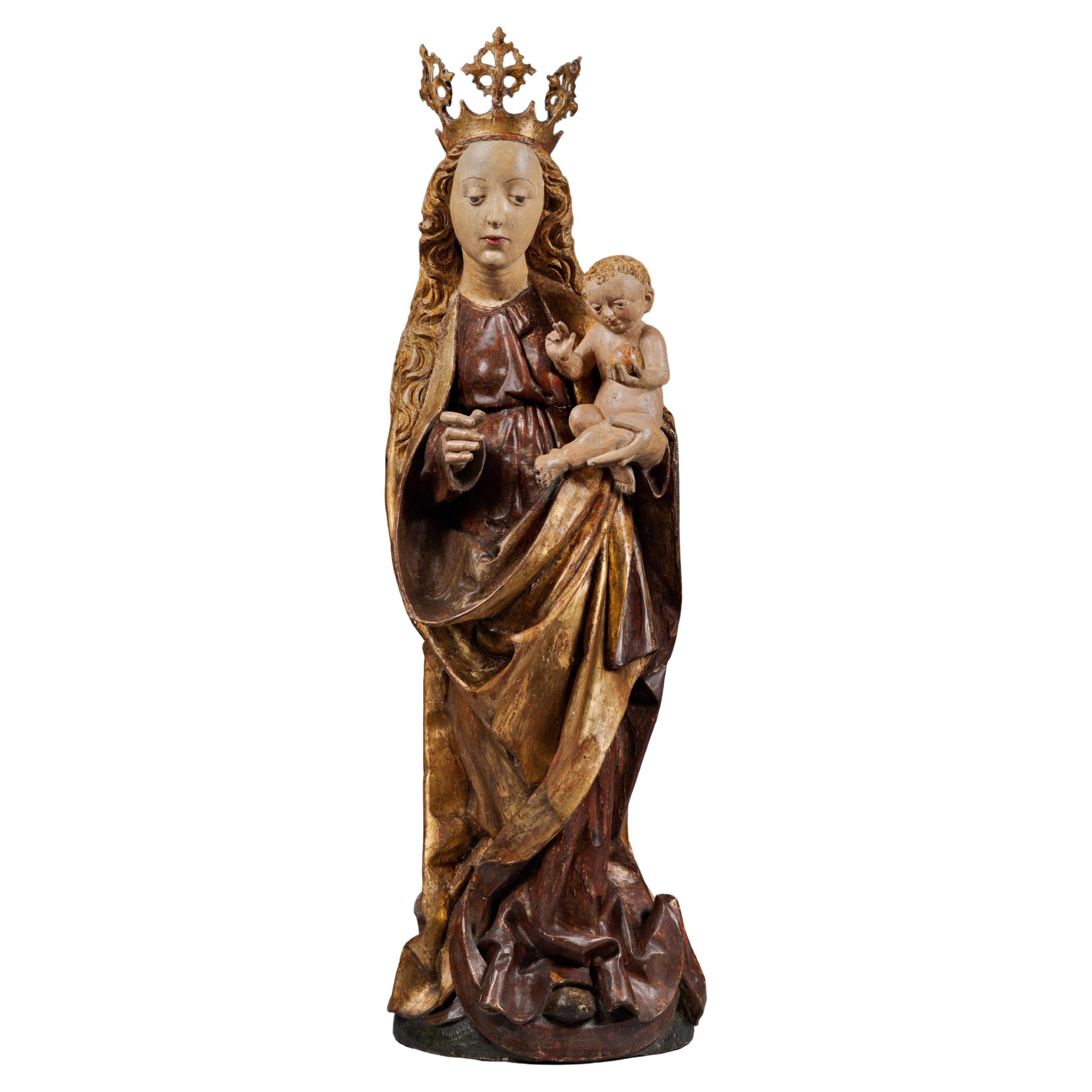
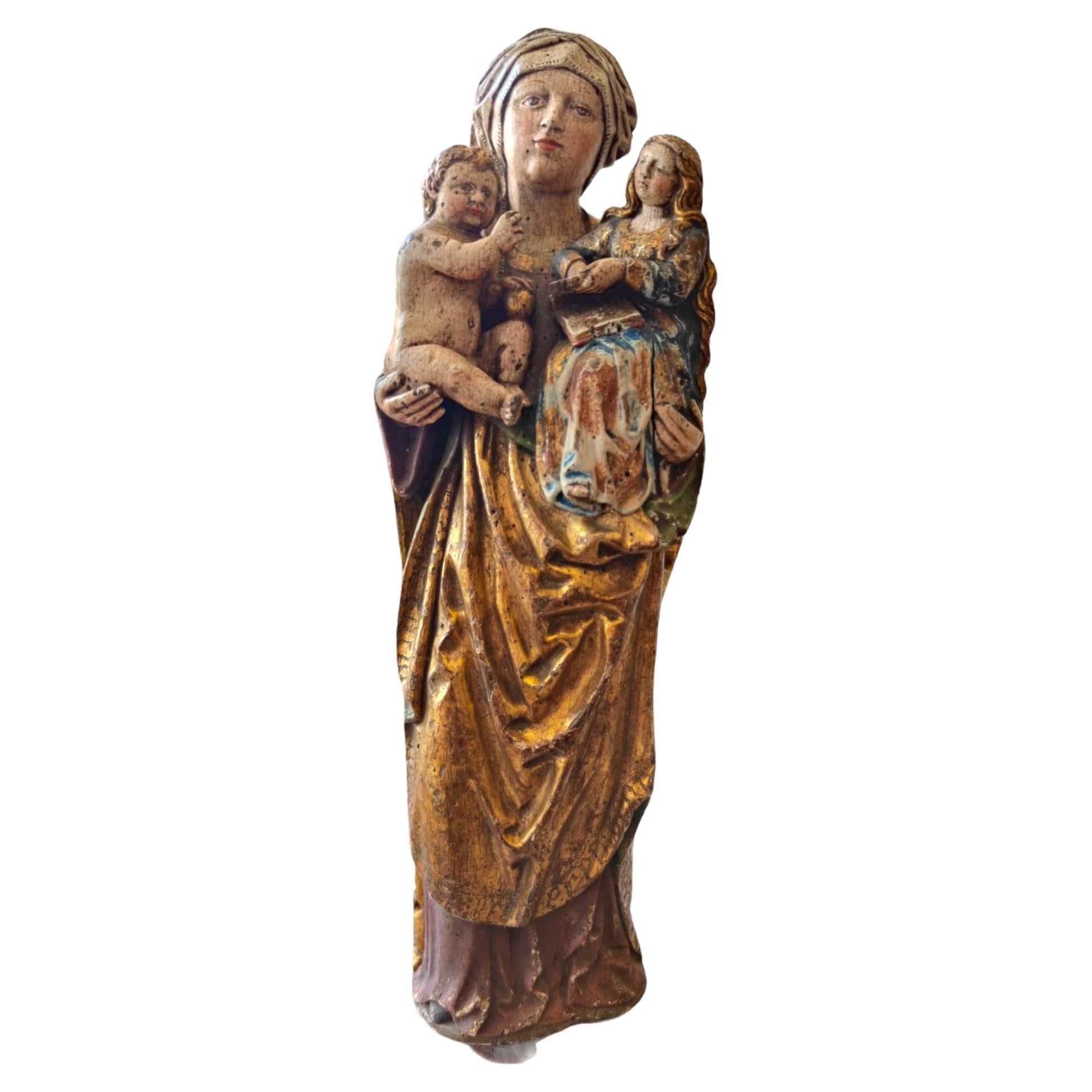
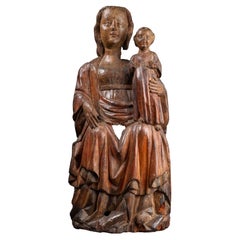
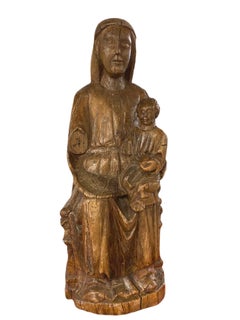
Virgin and child in majesty with a bird Origin: Southern Germany Or Austria Period: Late 13tth - Early 14th Century Height : 87.5 cm Length : 32 cm Depth : 19 cm Lime wood Mary is depicted on a throne bench of which we can only see the sides. She wears a tunic and a cloak covering her laps in the manner of an apron. The draperies are supple and follow the shape of the body. Her face presents fine features with a high forehead, straight and thin nose and is framed by strands of curly hair. She has delicate hands with elongated fingers. In her right hand she used to hold a flower of which only remains the stem. She holds the child Jesus on her left fore-arm. He wears a long tunic. His feet can be seen in the folds of the fabric. He holds a bird in his hands. This group of the Virgin and Child still retains a straight and hieratic posture, the gaze unwavering. However, the child is slightly moving to the left side and shows a slight smile full of humanity. Those few characteristics, the fluid fabric, the large eyes and straight nose support a datation to the the late 13th century or the early years of the following century. The presence of a bird as a symbolic element also stands in favour of such a datation. Indeed, it becomes a recurring attribute around the 13th century and can be interpreted in various manners. The dove can represent the Holy Spirit. In 325, during the first Council of Nicea the Holy Spirit is recognised as the third hypostasis (entity) of the Trinity. In artistic depictions, the Holy Spirit is then symbolised as a dove. It reminds us of the divine conception of Jesus and his true nature. However the dove appears very early in Paleochristian art where it stands for the freed soul saved by death. Sometimes identified as a goldfinch, the bird is in that case a symbol of Jesus’ upcoming sacrifice. It is then difficult to determine with certainty if the iconography of the bird is adopted by the sculptors as a way of evoking the true nature of Jesus or the divine sacrifice that will take place with the crucifixion.
  • Dimensions:
    Height: 34.45 in (87.5 cm)Width: 12.6 in (32 cm)Depth: 7.49 in (19 cm)
  • Materials and Techniques:
  • Period:
  • Date of Manufacture:
    Late 13th-Early 14th Century
  • Condition:
    Minor structural damages.
  • Seller Location:
    Saint-Ouen, FR
  • Reference Number:
    1stDibs: LU3115329586752

More From This Seller

View All
Virgin and Child in Majesty

Virgin and Child in Majesty

Located in Saint-Ouen, FR

Virgin and child in majesty Origine: castille Epoque: early 14th century Measures: Height: 72cm Length: 30cm Depth: 25cm Polychrome and gi...

Category

Antique 15th Century and Earlier Figurative Sculptures

Materials

Wood

Virgin and Child "Sedes Sapientiae", Seat of Holy Wisdom

Virgin and Child "Sedes Sapientiae", Seat of Holy Wisdom

Located in Saint-Ouen, FR

Virgin and child sedes sapientiae, seat of holy wisdom Origin : Northern Spain, castile, navarre or galicia. Period : early 13th century. Heigh...

Category

Antique 15th Century and Earlier Figurative Sculptures

Materials

Wood

Virgin and Child in Majesty, also known as "Sedes Sapientae"

Virgin and Child in Majesty, also known as "Sedes Sapientae"

Located in Saint-Ouen, FR

VIRGIN AND CHILD IN MAJESTY, ALSO KNOWN AS "SEDES SAPIENTIAE"   ORIGIN : SPAIN, CATALOGNE PERIOD: EARLY 13th CENTURY   Height :  95 cm Width : 32 cm Depth : 28 cm   Softwood No polychromy     In the middle of the 12th century, the Virgin took her place in churches, seated in Majesty, serving as a throne for her son Jesus. She is then called Sedes Sapientiae, meaning the Throne of Wisdom. At that time, she is not represented for herself and only exists because she has been designated as Theotokos, the mother of God, at the Council of Ephesus in 431, where the divine nature of Christ was proclaimed from his birth.   The upright and perfectly hieratic bust of this Virgin and Child in Majesty is seated on a throne-bench. She is dressed in a tunic with a rounded neckline and covered with a fine mantle placed on her narrow shoulders. The supple and natural drapery follows the lines of the body.   Large curls frame her face with delicate and regular features, a long straight nose, almond-shaped eyes, and small lips.   She supports the Infant Jesus with her left hand. Like his mother, he is dressed in a long tunic, and his little feet are visible in the folds. He holds a small sphere in his left hand, while with his right hand, he gestures in blessing. The face of Christ bears a strong resemblance to his mother’s one, and he gives a slight smile.   The position of the Child is no longer as hieratic, nor frontal or central as in the early 12th century, but his face still turns towards the faithful.   The 13th century indeed emerges as a period of transition in the artistic domain. The statuary, while retaining certain characteristics still belonging to the habits of the previous century, also develops new formal solutions.   As a result, Mary maintains a hieratic and frontal position, while her son shifts to place himself well to the left on her knee. Similarly, while the Virgin seems perfectly still, Jesus, on the other hand, appears much more animated, especially in the positioning of his hands. His left hand holds the orb, and judging by the raised right arm directed towards the faithful, one can easily imagine that he was making a gesture of blessing.   The influence of the Sedes Sapientiae from previous centuries still seems particularly prevalent in this work.   These few characteristics allow dating this Spanish Virgin...

Category

Antique 15th Century and Earlier Spanish Gothic Figurative Sculptures
Materials

Softwood

Gothic Virgin and Child from Flanders

Gothic Virgin and Child from Flanders

Located in Saint-Ouen, FR

Exhibition Museum Cantini, 1952, The art of the Middle Ages in the Marseille collections, n°101 Provenance Former collection Louis Bresset (before 1952) Former collection Profe...

Category

Antique 15th Century and Earlier Dutch Gothic Figurative Sculptures
Materials

Oak

You May Also Like

Virgin and the Child, Mosan Region, Second Half of 13th Century

Virgin and the Child, Mosan Region, Second Half of 13th Century

Located in Bruxelles, BE

A polychrome sculpture depicting the Virgin and the Child Mosan region, second half of 13th century Polychrome wood 73 x 29 X 12 cm Provenance : Former Belgian private collection from the beginning of the 20th century This remarkable early artwork portrays the Enthroned Virgin and Child, also known as Sedes Sapientiae, which translates to the 'Seat of Wisdom...

Category

Antique 15th Century and Earlier Belgian Medieval Figurative Sculptures

Materials

Wood

VIrgin and Child “Sedes Sapientiae" Seat of Holy Wisdom

VIrgin and Child “Sedes Sapientiae" Seat of Holy Wisdom

Located in PARIS, FR

Virgin and Child "Sedes Sapientiae" (Throne of Wisdom in Latin), carved in soft wood on the back. The Virgin Mary is depicted seated, holding the Infant Jesus on her lap: she thus s...

Category

Antique 15th Century and Earlier Italian Gothic Figurative Sculptures
Materials

Wood

Enthroned Madonna and Child.

Enthroned Madonna and Child.

Located in PARIS, FR

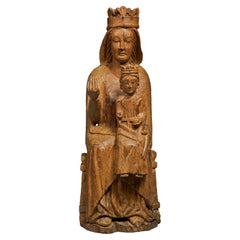
Large Virgin and Child in carved wood, carved back. Sitting on a throne bench, Mary carries Christ seated on her left knee. The Virgin has a face with stylized features with semicircular eyebrow arches, almond-shaped eyes with protruding eyeballs. Marie is wearing a belted dress with a simple neckline and a coat with a flap that goes back to the front. Tiny traces of polychromy. Romanesque influences are still present. With her protruding eyes, she can also be compared to the statuary of Lake Constance. Our Virgin, rare for its size, nevertheless presents strong analogies with the Italian Sedes Sapientiae...

Category

15th Century and Earlier Medieval Figurative Sculptures
Materials

Wood

Madonna and Child Statue, 17th Century

Madonna and Child Statue, 17th Century

Located in New Orleans, LA

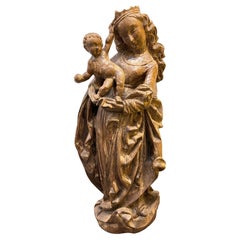
Carved from wood with lovely details. The pedestal dimensions are 21 W X 16 Deep and 11 H which makes the overall height about 60". All items offered are antique, vintage, or mid-ce...

Category

Antique 17th Century Italian Figurative Sculptures
Materials

Wood

Antique Statue of Virgin Mary and Child , 19th Century

Antique Statue of Virgin Mary and Child , 19th Century

Located in Basildon, GB

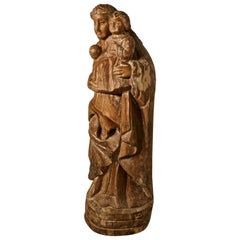
A Pine Carving of Virgin and Child signed E. Lechner. Carved in 15th Century style, a high relief with a hollowed back and depicting the crowned Virgin standing on contrapose with lo...

Category

Antique Mid-19th Century European Gothic Religious Items

Materials

Wood, Pine

18th Century French Carved Statue of Madonna and Child

18th Century French Carved Statue of Madonna and Child

Located in Godshill, Isle of Wight

18th century French carved statue of Madonna and Child. This charming piece has been rescued from a ecclesiastic clear out in the southern part of France The statue is carved fro...

Category

Antique Mid-18th Century Mission Figurative Sculptures